
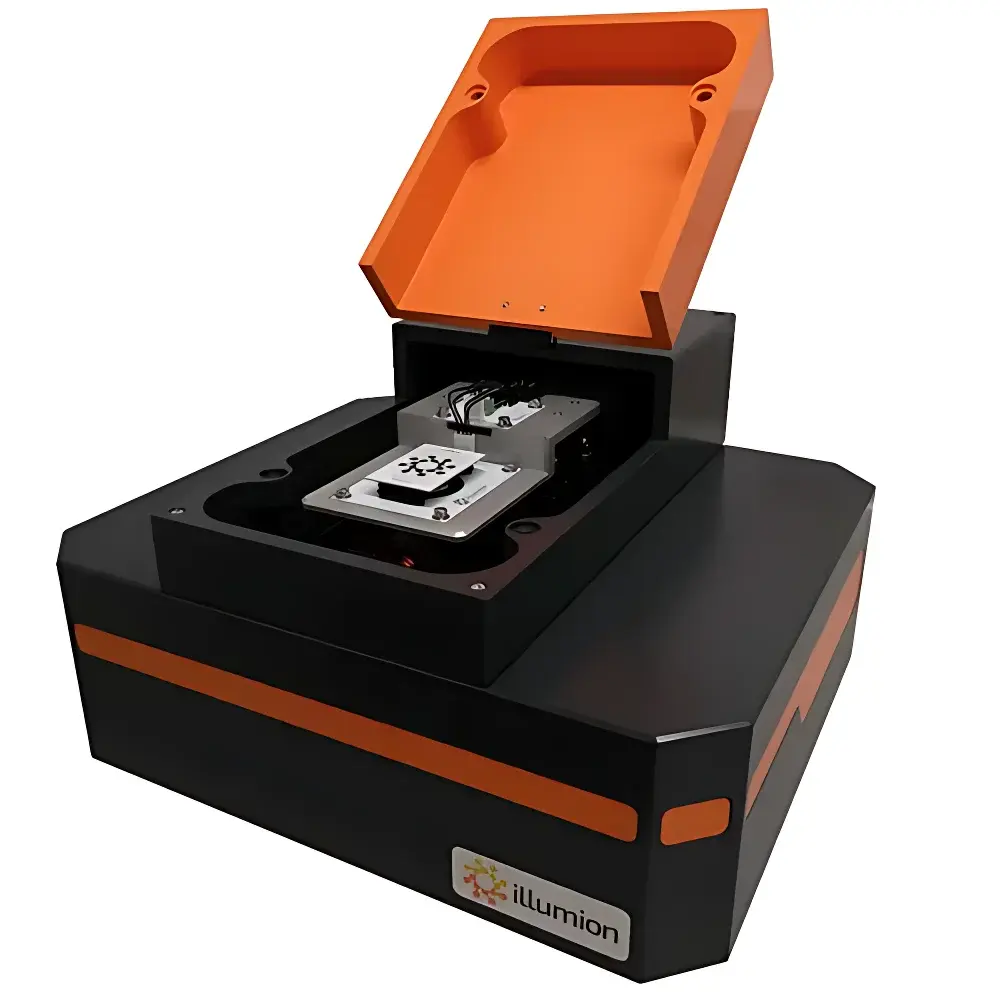
illumion illumionONE High-Resolution Operando Battery Charge Imaging System
| Brand | illumion |
|---|---|
| Origin | United Kingdom |
| Manufacturer Type | Authorized Distributor |
| Origin Category | Imported |
| Model | illumionONE |
| Pricing | Upon Request |
| Detection Principle | Charge Photometry |
| Compatible Cell Format | Button Cells |
| Minimum Resolvable Particle Size | >350 nm |
| Field of View | 112 × 70 µm |
| Magnification | 100× |
| Illumination Wavelength | 530 nm |
| Image Acquisition Frame Rate | <100 Hz |
| Dimensions (W × D × H) | 40 × 50 × 31.5 cm |
| Electrochemical Integration | Fully Synchronized Potentiostat/Galvanostat Control |
Overview
The illumion illumionONE High-Resolution Operando Battery Charge Imaging System is an advanced optical platform engineered for quantitative, single-particle-level interrogation of charge-state dynamics in battery electrode materials during electrochemical operation. Unlike conventional ex situ or bulk-averaged characterization techniques, the illumionONE implements charge photometry—a label-free, non-invasive operando microscopy method grounded in wavelength-specific scattering contrast modulation. As metal ions (e.g., Li⁺ or Na⁺) intercalate into or deintercalate from active particles, localized changes in electron density induce measurable shifts in scattered light intensity at 530 nm. By coupling high-numerical-aperture optics with synchronized potentiostatic control, the system captures spatially resolved, time-correlated optical signals directly linked to local stoichiometry and phase evolution—enabling direct mapping of lithiation/delithiation heterogeneity across individual particles within a working electrode.
Key Features
- Operando Microscopy Architecture: Real-time optical imaging concurrent with galvanostatic/potentiostatic cycling, supporting C/10 to 2C rates without signal degradation.
- Single-Particle Resolution: Capable of resolving structural and charge-state variations in individual active particles ≥350 nm in diameter under standard illumination conditions.
- Integrated Electrochemical Control: Fully embedded bidirectional communication with industry-standard potentiostats (e.g., BioLogic SP-300, Metrohm Autolab), enabling simultaneous acquisition of voltage, current, and optical contrast traces with sub-second temporal alignment.
- Modular Button-Cell Interface: Magnetic sample holder enables rapid, repeatable insertion and alignment of custom or commercial coin cells (CR2032, CR2025), minimizing mechanical drift and operator-induced variability.
- Compact Benchtop Design: Footprint of 40 × 50 × 31.5 cm allows seamless integration into standard glovebox environments or ambient lab workstations without dedicated infrastructure.
- Quantitative Contrast Calibration: Built-in reference standards and dark-field normalization protocols ensure reproducible intensity-to-charge-state mapping across experiments and users.
Sample Compatibility & Compliance
The illumionONE supports a broad range of electrode chemistries and cell configurations, including but not limited to lithium cobalt oxide (LCO), nickel-rich NMC (e.g., NMC811), lithium iron phosphate (LFP), silicon-based anodes, hard carbon, and layered sodium transition metal oxides (e.g., P2-Na₀.₆₇Mn₀.₆₇Ni₀.₃₃O₂). All measurements are performed in sealed, optically transparent coin cells fabricated with quartz or sapphire windows. The system complies with ISO/IEC 17025–2017 requirements for test method validation and supports audit-ready data logging aligned with GLP and GMP documentation practices. Raw image sequences and synchronized electrochemical logs are stored in HDF5 format with embedded metadata (timestamp, current density, SOC, temperature), facilitating traceability per FDA 21 CFR Part 11 guidelines when paired with validated LIMS integration.
Software & Data Management
The illumionONE is operated via illumion Studio v3.x—a Python-based application with a Qt5 GUI that provides real-time visualization, batch processing pipelines, and automated particle segmentation using adaptive thresholding and morphological filtering. Key analytical modules include: (i) pixel-wise intensity vs. voltage/current correlation mapping; (ii) kinetic profiling of individual particles across multiple cycles; (iii) heterogeneity quantification metrics (e.g., coefficient of variation in delithiation rate); and (iv) export to MATLAB, Python (NumPy/Pandas), or Origin-compatible formats. Audit trails record all parameter modifications, user logins, and processing steps, satisfying regulatory expectations for electronic records integrity. Software updates are delivered through secure HTTPS channels with SHA-256 signature verification.
Applications
This system is deployed in academic laboratories and industrial R&D centers focused on next-generation battery materials development. Typical use cases include: identifying rate-limiting interfacial processes in Ni-rich cathodes; evaluating mechanical fracture propagation in silicon anodes during lithiation; benchmarking solid-electrolyte interphase (SEI) formation kinetics on graphite surfaces; validating dopant effects on Li⁺ diffusion anisotropy in olivine structures; and screening novel binders for their impact on particle cohesion under dynamic stress. Published studies utilizing this platform appear in Nature (2021), Joule (2022), Nature Materials (2022), and Energy & Environmental Science (2025), demonstrating its utility in linking nanoscale charge redistribution to macroscopic performance decay mechanisms.
FAQ
Can the illumionONE be used with pouch or prismatic cells?
No—the current configuration is optimized for optically accessible button cells. Custom windowed pouch cell adapters are under development and available upon consultation.
Is temperature control integrated?
The base system operates at ambient temperature. Optional Peltier-based thermal stages (−20 °C to +60 °C) can be retrofitted with ±0.2 °C stability and synchronized thermal logging.
What level of expertise is required to operate the system?
Operators require foundational knowledge of electrochemistry and basic image analysis principles. Comprehensive training—including method development, calibration, and data interpretation—is provided during installation and annually thereafter.
Does illumionONE support multi-wavelength illumination?
The standard configuration uses a stabilized 530 nm LED source. Broadband or tunable laser options (488–640 nm) are available as configurable upgrades for spectral contrast optimization.
How is data security handled for proprietary research?
All data reside locally on customer-owned hardware. No telemetry or cloud upload occurs unless explicitly enabled via encrypted enterprise SFTP endpoints compliant with ISO 27001 policies.



