
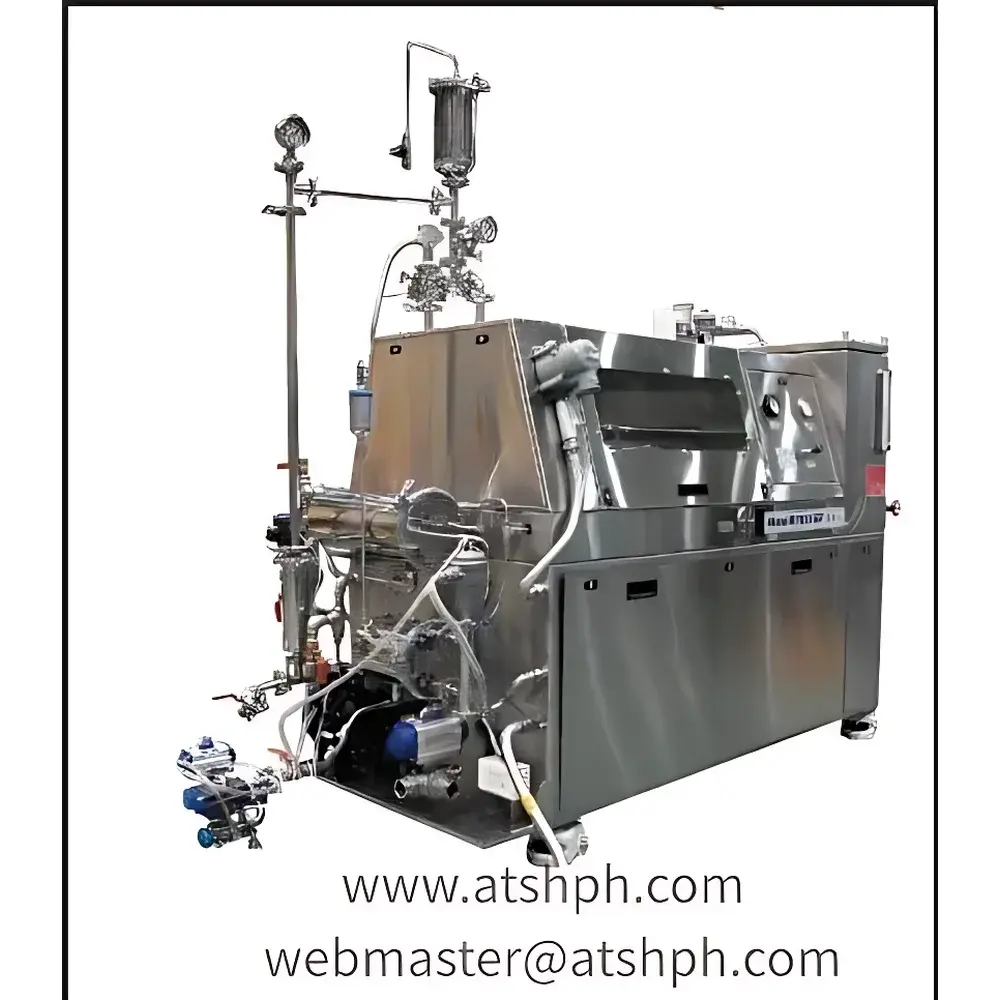
Ilshin Autoclave NANO DISPERSER NH2000 High-Pressure Microfluidic Homogenizer
| Brand | Ilshin Autoclave |
|---|---|
| Origin | South Korea |
| Model | NANO DISPERSER (NH2000) |
| Instrument Type | High-Pressure Microfluidic Homogenizer |
| Operating Pressure | Up to 1,500 bar (Max. 2,000 bar) |
| Flow Rate | 2,000 mL/min |
| Inlet Reservoir Capacity | 2,000 mL |
| Interaction Chamber Orifice Sizes | 100 / 200 / 400 µm |
| Dimensions (W×D×H) | 950 × 1900 × 1500 mm |
| Weight | Approx. 1,500 kg |
| Pump System | Hydraulic Unit (220/380 V, 3-phase, 20 hp) |
| Cooling Line | Integrated on High-Pressure Section |
| Back-Flushing System | Yes |
| Monitor & Alarm System | Yes |
| Solidification Prevention Tank | Yes |
Overview
The Ilshin Autoclave NANO DISPERSER NH2000 is a high-pressure microfluidic homogenizer engineered for reproducible, scalable nanoscale dispersion and cell disruption across demanding R&D and pilot-scale manufacturing environments. It operates on the principle of controlled microfluidization: pressurized fluid—typically aqueous suspensions, emulsions, or biological slurries—is forced through precisely engineered interaction chambers with fixed orifice geometries (100, 200, or 400 µm). Upon rapid pressure drop across the orifice, the fluid accelerates to supersonic velocities, generating intense shear gradients, turbulent eddies, and localized cavitation events. These combined hydrodynamic forces—impact, shear, and cavitation—act synergistically to fracture aggregates, disintegrate cells, and reduce particle or droplet size into the sub-100 nm range with narrow polydispersity. Unlike rotor-stator or ultrasonic systems, the NH2000 delivers consistent energy input per unit volume, independent of feed concentration or viscosity fluctuations within operational limits—making it particularly suitable for GMP-aligned process development in pharmaceuticals and biotechnology.
Key Features
- Triple-action microfluidization mechanism: simultaneous impact, turbulent shear, and transient cavitation for efficient nano-dispersion and lysis.
- Modular interaction chamber system supporting interchangeable orifices (100 µm, 200 µm, 400 µm) to optimize energy delivery for diverse sample rheologies and target particle sizes.
- Hydraulic-driven high-pressure pump unit rated for continuous operation up to 1,500 bar (peak 2,000 bar), delivering stable flow at 2,000 mL/min with minimal pulsation.
- Integrated cooling line on the high-pressure manifold to maintain thermal stability during extended runs—critical for heat-sensitive biologics and liposomal formulations.
- Dedicated inlet reservoir (2 L capacity) with anti-solidification design, enabling homogeneous feeding of viscous or temperature-sensitive suspensions without sedimentation or gelation.
- Real-time monitoring and configurable alarm system with HMI interface for pressure, temperature, flow rate, and system fault detection—supporting traceable operation logs.
- Automated back-flushing system for rapid, solvent-efficient cleaning between batches; reduces cross-contamination risk and downtime.
Sample Compatibility & Compliance
The NH2000 accommodates a broad spectrum of sample types—including aqueous colloids, lipid dispersions, protein solutions, bacterial and mammalian cell lysates, ceramic slurries, polymer emulsions, and pigment suspensions—without requiring pre-milling or sonication. Its all-stainless-steel wetted path (316L SS) ensures chemical compatibility with organic solvents, acidic/basic buffers, and sterilizing agents. The system meets mechanical safety standards per ISO 12100 and pressure equipment directives (PED 2014/68/EU). For regulated environments, its programmable operation log, alarm history, and manual intervention records support GLP/GMP documentation requirements. While not inherently 21 CFR Part 11 compliant, the system’s data export capability (CSV/TXT) enables integration with validated LIMS or ELN platforms for audit-trail generation.
Software & Data Management
The NH2000 operates via an embedded industrial PLC-based controller with a 7-inch touchscreen HMI. All critical parameters—including setpoint pressure, actual pressure, flow rate, cycle count, and thermal status—are continuously logged with timestamps. Operational data can be exported via USB or RS-485 to external PCs for post-processing in Excel or statistical analysis tools. No proprietary software license is required; raw log files are human-readable and compatible with standard QA/QC workflows. Optional analog/digital I/O ports allow integration with building management systems (BMS) or centralized process control networks for facility-wide monitoring.
Applications
- Pharmaceuticals: Production of sterile injectables, liposomal drug carriers, nanoemulsions for inhalation, and nanoparticle suspensions compliant with USP and ICH Q5A guidelines.
- Biotechnology: High-yield microbial and mammalian cell disruption for recombinant protein recovery; preparation of virus-like particles (VLPs) and mRNA-LNP formulations.
- Electronics: Dispersion of conductive metal oxides (e.g., ITO, ZnO) and ceramic precursors for MLCC dielectric layers and inkjet-printed electronics.
- Food & Nutraceuticals: Stabilization of omega-3 oil-in-water emulsions, nanoencapsulation of vitamins and plant sterols, and uniform dispersion of natural colorants.
- Materials Science: Exfoliation of 2D materials (graphene, MXenes), dispersion of carbon nanotubes in polymer matrices, and homogenization of ceramic green bodies.
FAQ
What is the maximum allowable viscosity for processing on the NH2000?
The system is optimized for viscosities ≤ 500 cP at 25°C. Higher-viscosity feeds may require pre-dilution or temperature-assisted pumping; consult the technical datasheet for shear-thinning behavior guidance.
Can the NH2000 be used for aseptic processing?
Yes—when coupled with sterile-filtered inlet lines, autoclavable interaction chambers, and SIP-compatible plumbing, the NH2000 supports aseptic nanomanufacturing under ISO Class 5 conditions.
Is validation support available for GMP installation?
Ilshin provides IQ/OQ protocol templates and factory acceptance test (FAT) documentation. Site-specific PQ must be performed by the end user per internal SOPs and regulatory expectations.
How often does the interaction chamber require replacement?
Under typical operation at ≤1,200 bar with aqueous buffers, service life exceeds 500 hours. Wear inspection is recommended every 100 hours when processing abrasive slurries (e.g., ceramics, pigments).
Does the system support CIP/SIP cycles?
The NH2000 supports CIP using compatible cleaning agents and elevated temperature water (≤80°C). SIP is feasible only with optional steam-rated components and third-party validation.



