
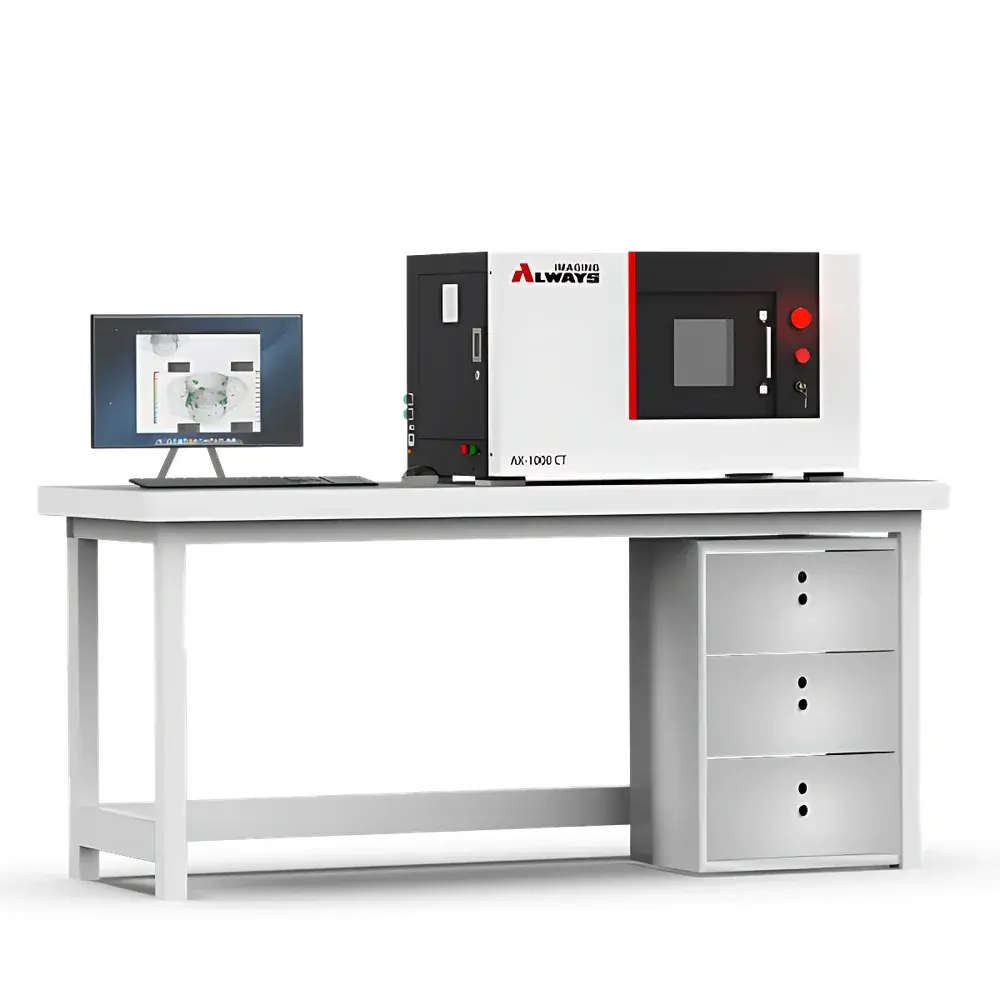
Always Imaging AX-1000CT Desktop Micro-CT System
| Brand | Always Imaging |
|---|---|
| Origin | Shanghai, China |
| Manufacturer Type | Original Equipment Manufacturer (OEM) |
| Country of Origin | China |
| Model | AX-1000CT |
| X-ray Source | Microfocus Closed-Tube (80 kV / 100 kV) |
| Detector Type | Flat-Panel Detector |
| Scan Geometry | Translation-Rotation (TR) |
| Spatial Resolution | 5 µm (high-res mode) / 40 µm (standard mode) |
| Field of View | Ø250 mm × H350 mm |
| Sample Weight Capacity | 5 kg / 10 kg (configurable) |
| System Dimensions (L×W×H) | 1100 mm × 660 mm × 600 mm |
| Radiation Leakage | <1 µSv/h at 100 mm from enclosure surface |
| Contrast Resolution | <1% (per ASTM E2737-22) |
| Net Weight | 350 kg |
Overview
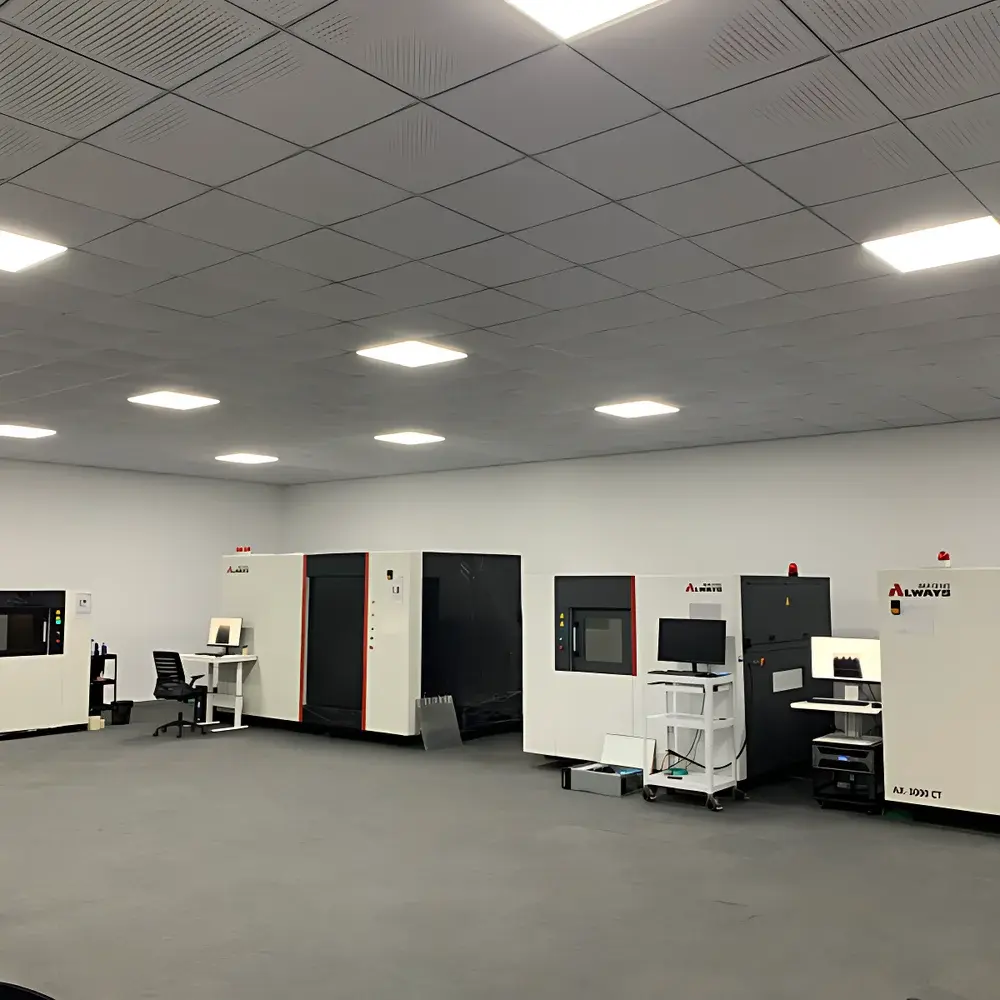
The Always Imaging AX-1000CT is a compact, high-performance desktop micro-computed tomography (micro-CT) system engineered for non-destructive 3D internal inspection and quantitative volumetric analysis in industrial R&D, quality control, and academic laboratories. Utilizing a microfocus closed-tube X-ray source operating at dual nominal energies (80 kV and 100 kV), the AX-1000CT generates high-contrast projections with minimal beam hardening artifacts. Its translation-rotation (TR) scanning geometry ensures geometric fidelity and reproducible sample positioning across repeated acquisitions. The system integrates a high-dynamic-range flat-panel detector with low-noise readout electronics, enabling robust signal-to-noise ratio (SNR) even at sub-micron effective pixel sizes. Designed for benchtop deployment, the AX-1000CT delivers laboratory-grade spatial resolution—down to 5 µm in high-resolution acquisition mode—without requiring dedicated shielded rooms, as its fully enclosed cabinet meets international radiation safety standards (IEC 61000-6-4, IEC 62463 Class II).
Key Features
- Compact footprint (1100 × 660 × 600 mm) optimized for space-constrained labs and cleanroom integration
- Dual-energy microfocus X-ray source (80 kV / 100 kV) with stable focal spot size ≤ 5 µm (FWHM), supporting material discrimination and density quantification
- High-sensitivity flat-panel detector with ≥ 16-bit dynamic range and programmable binning for SNR/throughput trade-off optimization
- Precision TR scanning stage with motorized X/Y translation and high-accuracy rotary axis (±0.01° repeatability)
- Integrated radiation shielding meeting IEC 61331-1 requirements; measured leakage dose <1 µSv/h at 100 mm from cabinet surface
- Configurable sample handling: standard 5 kg capacity stage or optional 10 kg heavy-duty rotation platform
- Modular software architecture supporting third-party reconstruction kernels (e.g., FDK, SART, iterative MBIR)
Sample Compatibility & Compliance
The AX-1000CT accommodates samples up to Ø250 mm in diameter and 350 mm in height, making it suitable for a broad spectrum of industrial and scientific specimens—including microelectronics packages, sintered metal components, geological core segments, polymer composites, additively manufactured lattice structures, biomedical implants, and fossilized biological tissues. All mechanical and electrical subsystems comply with CE marking directives (2014/30/EU EMC, 2014/35/EU LVD) and ISO 13485–aligned manufacturing controls. Radiation safety design conforms to IEC 62463:2016 (Medical Electrical Equipment – Requirements for the Safety of X-ray Equipment for Industrial Use) and national regulations (GBZ 130–2020). Data integrity and audit readiness are supported through optional GLP/GMP-compliant operation logs and user-access controls aligned with FDA 21 CFR Part 11 principles.
Software & Data Management
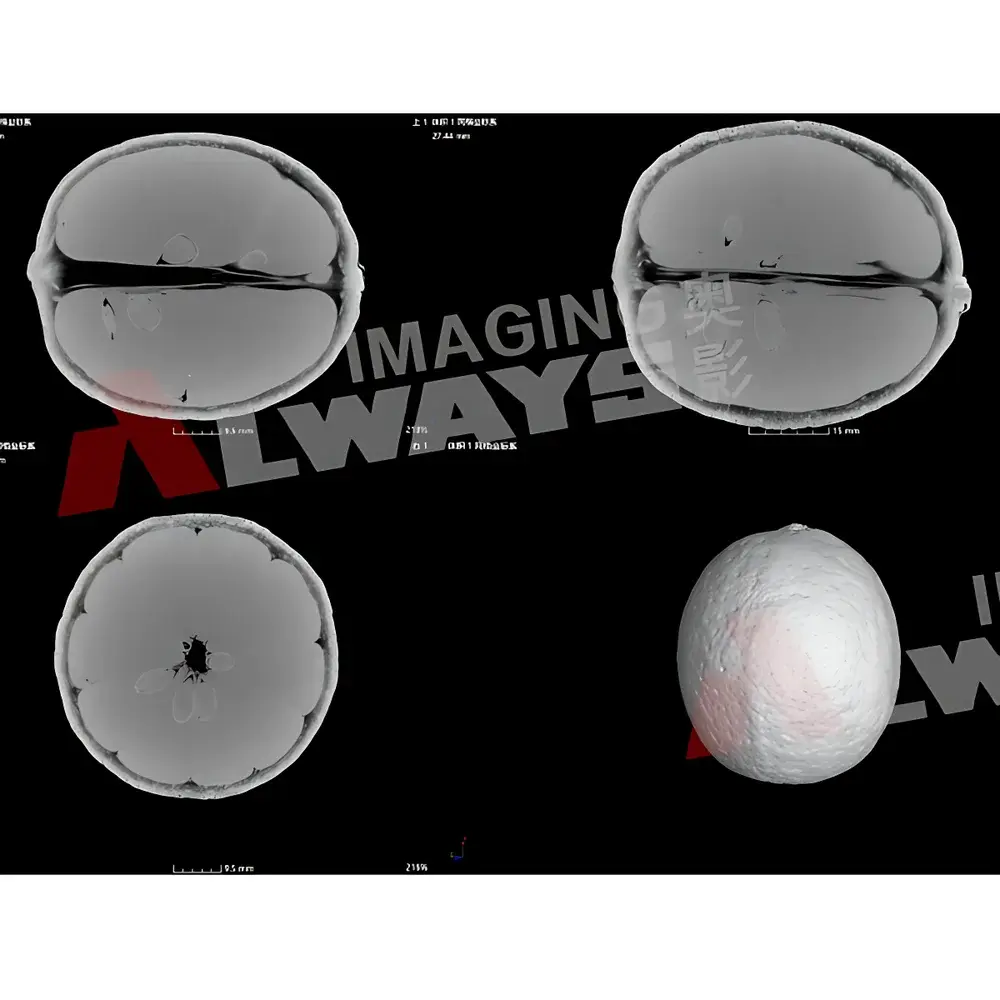
The AX-1000CT ships with proprietary acquisition software featuring real-time projection preview, automatic exposure optimization, and TR trajectory calibration tools. Reconstruction is performed using GPU-accelerated filtered backprojection (FBP) or iterative algorithms, generating isotropic voxel datasets in DICOM, TIFF stack, or HDF5 formats. Native integration with VGStudio MAX (v3.4+) enables advanced segmentation, porosity analysis, wall thickness mapping, fiber orientation tensor calculation, and GD&T-compliant dimensional metrology per ASME Y14.41–2019. Optional ADR (Automated Defect Recognition) modules support AI-assisted void, crack, and inclusion classification trained on domain-specific CT datasets. All raw projections and reconstructed volumes are stored with embedded metadata (scan parameters, timestamp, operator ID, calibration references), ensuring full traceability for QA/QC documentation and regulatory submissions.
Applications
- Failure analysis of solder joints, wire bonds, and encapsulated IC packages
- Porosity and inclusion quantification in investment-cast aerospace components
- Microstructural characterization of battery electrode coatings and separator layers
- Non-destructive validation of internal geometry in metal and polymer AM parts
- 3D morphometric analysis of rock pore networks for reservoir simulation input
- Dimensional verification of medical device assemblies (e.g., stents, catheter hubs)
- Longitudinal structural monitoring of biodegradable scaffolds under physiological conditions
FAQ
What is the minimum achievable voxel size under standard operating conditions?
The system achieves an effective isotropic voxel size of 5 µm in high-resolution mode, dependent on sample size, magnification, and detector binning configuration.
Does the AX-1000CT support automated batch scanning?
Yes—via programmable acquisition scripts and optional robotic sample loader interface (ISO 9283 compliant gripper mounting points available).
Can the system be validated for ISO/IEC 17025 accredited testing laboratories?
Yes—the AX-1000CT supports IQ/OQ/PQ documentation packages, traceable calibration protocols (NIST-traceable step wedges and resolution test patterns), and full audit trail export for accreditation bodies.
Is remote operation and monitoring supported?
Standard Ethernet (1 GbE) and optional TLS-secured web-based interface enable remote acquisition control, live projection streaming, and real-time dose monitoring from authorized client stations.
What maintenance intervals are recommended for the X-ray tube and detector?
The sealed microfocus tube has a rated lifetime of ≥ 10,000 hours; annual preventive maintenance includes detector gain/offset recalibration, mechanical stage backlash verification, and radiation leakage retest per IEC 62463 Annex D.



