
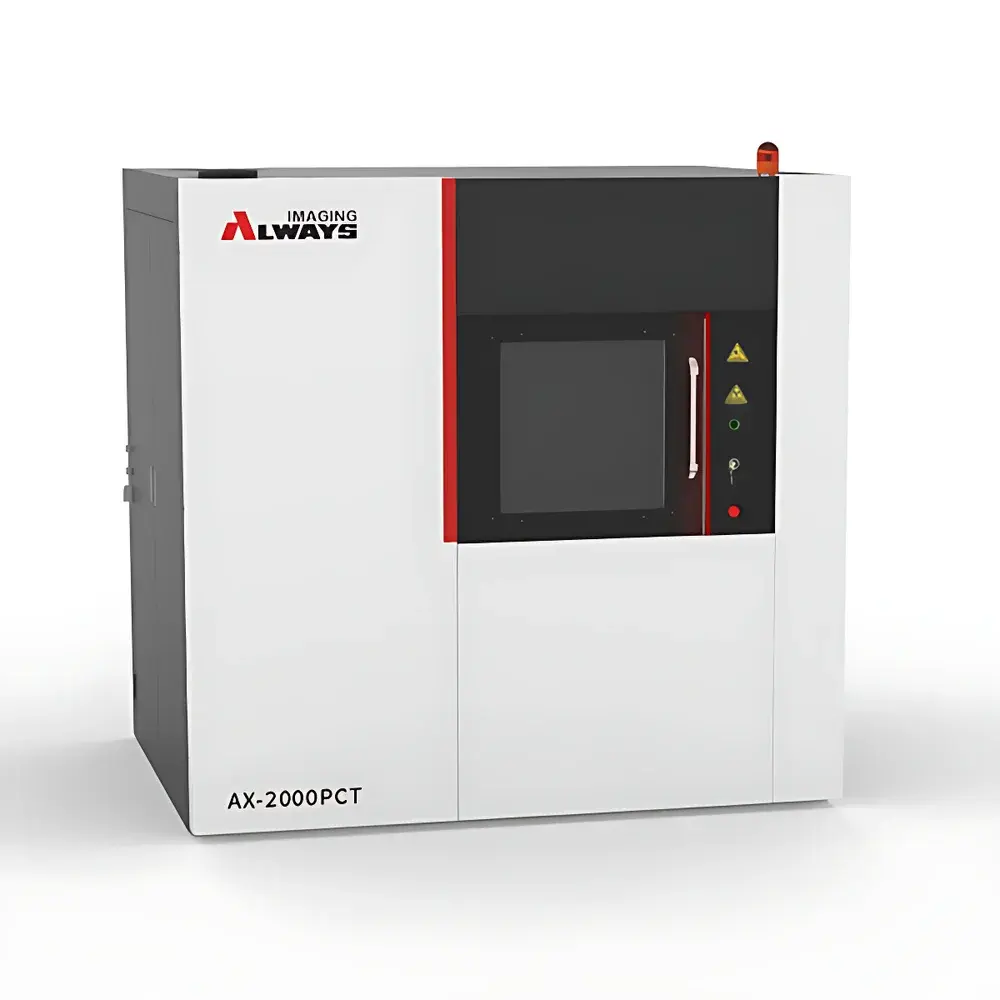
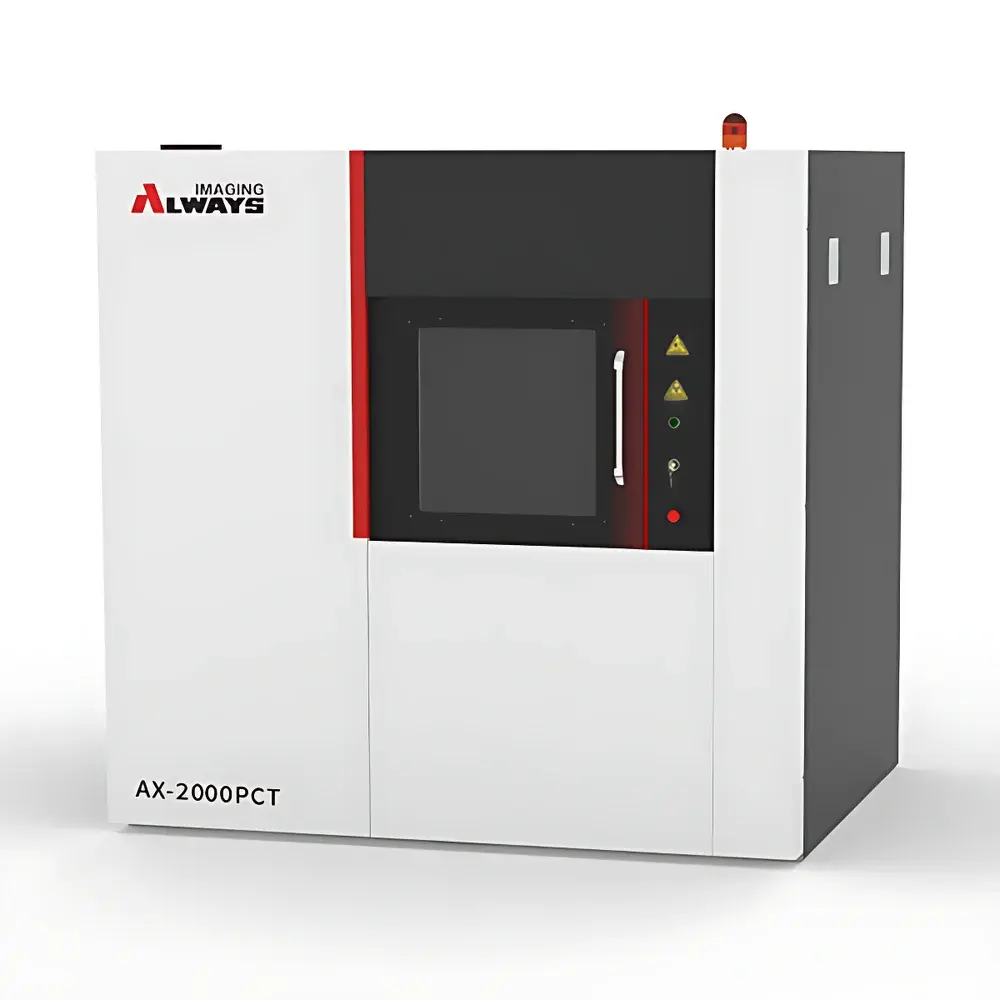
Always Imaging AX-2000PCT Industrial Flat-Panel Micro-CT System
| Brand | Always Imaging |
|---|---|
| Origin | Zhejiang, China |
| Manufacturer Type | Direct Manufacturer |
| Country of Origin | China |
| Model | AX-2000PCT |
| Detector Type | Flat-Panel Detector |
| Scanning Mode | Translation-Rotation (TR) |
| Spatial Resolution | Micron-level (10–40 µm) |
| X-ray Energy | 160 kV / 180 kV |
| Maximum Sample Dimensions (L×W×H) | 400 mm × 400 mm × 50 mm |
| Maximum Sample Weight | 5 kg |
| System Dimensions (W×D×H) | 1950 mm × 1050 mm × 1650 mm |
| Focal Spot Size | ≤1.5 µm |
| Pixel Pitch | 85 µm / 100 µm |
| Detector Active Area | 130 mm × 130 mm / 200 mm × 200 mm |
| Detector Pixel Matrix | 1536 × 1536 / 2048 × 2048 |
| Max Tube Current | 0.5 mA |
| Contrast Sensitivity | <1% |
| System Net Weight | 1500–2000 kg |
Overview
The Always Imaging AX-2000PCT is an industrial flat-panel micro-computed tomography (micro-CT) system engineered for high-fidelity, non-destructive 3D internal inspection of medium-sized components across R&D, quality control, and failure analysis workflows. Unlike conventional cone-beam CT systems relying on continuous rotational gantry motion, the AX-2000PCT employs a fixed flat-panel detector in conjunction with precise translation-rotation (TR) scanning geometry. This architecture eliminates mechanical instability associated with rotating detectors, enabling superior geometric reproducibility, reduced motion artifacts, and enhanced signal-to-noise ratio per projection. The system utilizes a high-brightness microfocus X-ray source with selectable operating voltages (160 kV or 180 kV) and sub-2 µm focal spot size to support high-resolution volumetric reconstruction of low-to-medium-Z materials—including polymers, composites, light metals, ceramics, and electronic assemblies. With a maximum field of view of 400 × 400 × 50 mm and 5 kg payload capacity, the AX-2000PCT bridges the gap between benchtop micro-CT and large-format industrial CT systems—delivering micron-level spatial resolution (10–40 µm) without compromising throughput or structural integrity.
Key Features
- Fixed flat-panel detector architecture minimizing mechanical drift and radiation exposure time during acquisition
- Translation-rotation (TR) scanning protocol ensuring consistent projection geometry and high volumetric fidelity
- Dual-resolution detector options: 1536 × 1536 (85 µm pitch) and 2048 × 2048 (100 µm pitch), both with active areas up to 200 mm × 200 mm
- Microfocus X-ray source with ≤1.5 µm focal spot size, enabling high-contrast imaging of fine internal features
- Adjustable kV settings (160 kV / 180 kV) and 0.5 mA max tube current for optimized penetration and contrast across heterogeneous samples
- Robust mechanical stage with precision linear and rotary encoders supporting repeatable positioning within ±1 µm
- Integrated thermal management and vibration-damping chassis designed for stable operation in production lab environments
Sample Compatibility & Compliance
The AX-2000PCT accommodates a broad range of industrial specimens—including castings, additive-manufactured parts, battery cells, PCB assemblies, medical devices, and composite laminates—within its 400 × 400 × 50 mm scan volume and 5 kg weight limit. Its open-stage configuration allows for custom fixturing and in situ testing integration (e.g., thermal or mechanical loading). The system complies with IEC 61331-1:2014 (radiation protection), ISO 15739:2017 (imaging performance evaluation), and meets essential requirements for CE marking under the EU Medical Devices Regulation (MDR) Annex I for non-clinical research instrumentation. All hardware and software components are designed to support audit-ready documentation in accordance with GLP and GMP frameworks, including full traceability of acquisition parameters, reconstruction settings, and operator logs.
Software & Data Management
The AX-2000PCT ships with a modular software suite supporting end-to-end workflow automation—from acquisition and reconstruction to quantitative analysis and reporting. Core modules include proprietary TR-scanning control firmware, GPU-accelerated FDK and iterative reconstruction engines (SART, OS-SART), and native export to standard DICOM-CT and HDF5 formats. Optional licensed integrations include Volume Graphics VG Studio MAX 3.5+ for advanced defect characterization (porosity, inclusion, crack quantification), dimensional metrology (GD&T-compliant measurements), and wall-thickness analysis. ADR (Automated Defect Recognition) software provides configurable AI-assisted classification of anomalies based on user-defined thresholds and training datasets. All software modules enforce role-based access control, electronic signatures, and full 21 CFR Part 11–compliant audit trails—including timestamped records of parameter changes, reconstruction iterations, and report generation events.
Applications
- Porosity and inclusion analysis in aluminum die-castings and investment cast components per ASTM E155 and ISO 10285
- Internal geometry validation of additively manufactured metal parts, including support structure residue detection and lattice integrity assessment
- Non-destructive evaluation of lithium-ion battery electrode delamination, separator wrinkling, and anode/cathode thickness uniformity
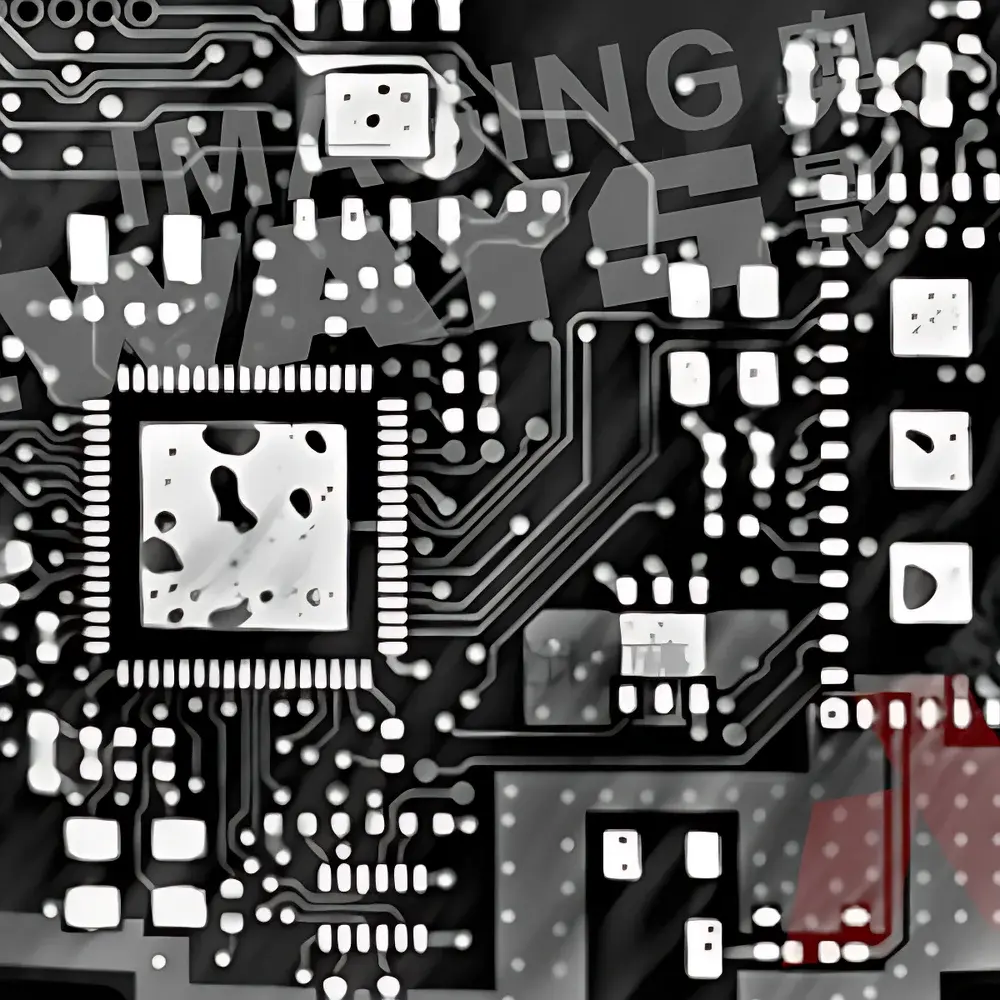
- Failure root-cause analysis of electronic packages—identifying voids in solder joints, wire bond lift-off, and encapsulant cracking
- Dimensional verification of polymer injection-molded parts against CAD models using voxel-based deviation mapping
- Archival and comparative analysis of heritage material degradation (e.g., corrosion progression in aerospace alloys)
FAQ
What scanning geometry does the AX-2000PCT use, and how does it differ from conventional CT?
The system implements a translation-rotation (TR) scanning method with a stationary flat-panel detector—eliminating detector motion and improving projection consistency versus rotating-gantry systems.
Is the AX-2000PCT suitable for metrology-grade measurements?
Yes; when operated with calibrated phantoms and validated reconstruction protocols, it achieves traceable dimensional accuracy compliant with VDI/VDE 2630-1.3 for industrial CT metrology.
Can the system be integrated into automated production lines?
It supports external PLC interfacing via Ethernet/IP and Modbus TCP, enabling synchronization with robotic loading/unloading stations and MES data exchange.
Does the software support batch processing of multiple samples?
Yes—the acquisition and reconstruction modules allow queue-based scheduling with automatic file naming, metadata tagging, and post-processing script execution.
What regulatory documentation is provided for validation purposes?
Always Imaging supplies IQ/OQ documentation templates, system configuration records, calibration certificates for X-ray output and stage encoders, and software validation summaries aligned with ISO 13485 and FDA guidance for QSR-compliant environments.



