
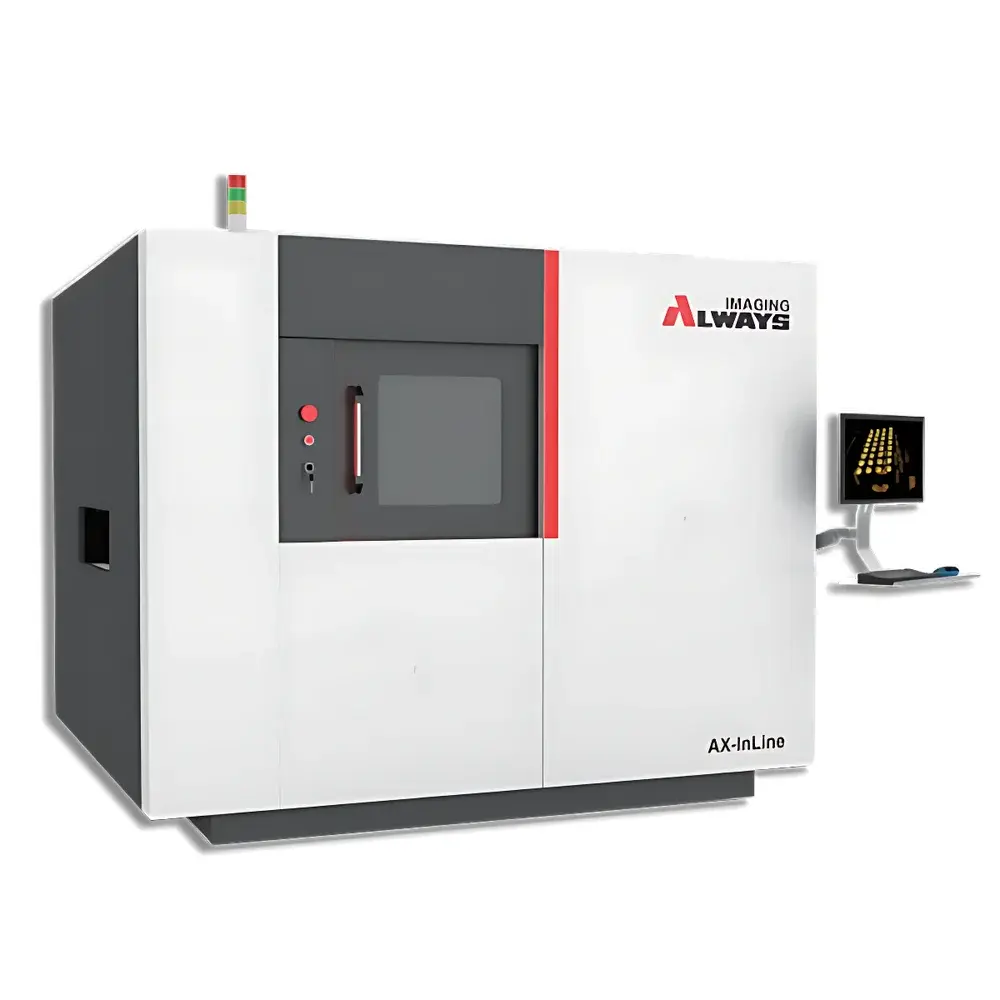


Always Imaging AX-InLine Industrial Micro-CT System
| Brand | Always Imaging |
|---|---|
| Origin | Zhejiang, China |
| Manufacturer Type | Direct Manufacturer |
| Detector Type | Flat-Panel Detector |
| Scan Mode | Translation-Rotation (TR) |
| Spatial Resolution | Micron-Level |
| X-ray Energy Options | 130 / 160 / 180 / 200 kV |
| Maximum Sample Footprint | 400 × 400 mm or 650 × 650 mm (customizable) |
| System Footprint | 2267 × 2062 mm |
Overview
The Always Imaging AX-InLine Industrial Micro-CT System is a fully integrated, inline-capable computed tomography platform engineered for high-throughput, non-destructive 3D inspection of industrial components in production environments. Based on cone-beam X-ray microtomography principles, the system reconstructs volumetric datasets with isotropic voxel resolution down to the micron scale—enabling quantitative analysis of internal geometry, porosity, assembly integrity, and material density variations without physical sectioning. Unlike laboratory-grade benchtop CT systems, the AX-InLine is architecturally optimized for integration into automated manufacturing lines, featuring rigid mechanical staging, real-time thermal stabilization, and synchronized I/O interfaces compatible with PLC-controlled conveyance systems. Its dual-energy X-ray source options (130–200 kV) support broad material penetration—from lightweight polymer housings and PCB assemblies to dense aluminum castings and sintered metal parts—while maintaining consistent contrast-to-noise performance across operational voltage ranges.
Key Features
- Inline-ready mechanical design with vibration-damped base frame and modular gantry architecture for seamless integration into factory-floor automation workflows.
- High-dynamic-range flat-panel detector with scintillator-coupled amorphous silicon (a-Si) sensor array, delivering >16-bit depth per projection and low electronic noise floor for enhanced low-contrast detectability.
- Translation-Rotation (TR) scanning geometry ensuring geometric fidelity and minimizing cone-beam artifacts—particularly critical for metrology-grade dimensional analysis per ISO 12179 and ASTM E1441 standards.
- Multi-kV X-ray source with selectable energy levels (130/160/180/200 kV) and focal spot sizes < 5 µm, enabling optimization of beam hardening correction and material-specific contrast enhancement.
- Real-time reconstruction engine supporting GPU-accelerated FDK and iterative SART algorithms; capable of generating full-volume 3D datasets (up to 2048³ voxels) within minutes post-scan.
- IP65-rated enclosure option available for deployment in humid, dusty, or temperature-fluctuating production zones.
Sample Compatibility & Compliance
The AX-InLine accommodates samples up to 650 × 650 mm in planar footprint and variable height (dependent on source-detector distance configuration), with maximum mass capacity of 50 kg under standard loading fixtures. It supports both static and dynamic scanning protocols—including time-resolved 4D CT for in situ process monitoring (e.g., thermal expansion, fluid ingress, or mechanical deformation). All system firmware and control software comply with IEC 62304 (medical device software lifecycle) and ISO 13849-1 (functional safety for machinery). Radiation shielding meets national regulatory requirements for Class II X-ray equipment (GBZ 138–2019) and is certified for CE marking under the EU Electromagnetic Compatibility (EMC) and Low Voltage Directives.
Software & Data Management
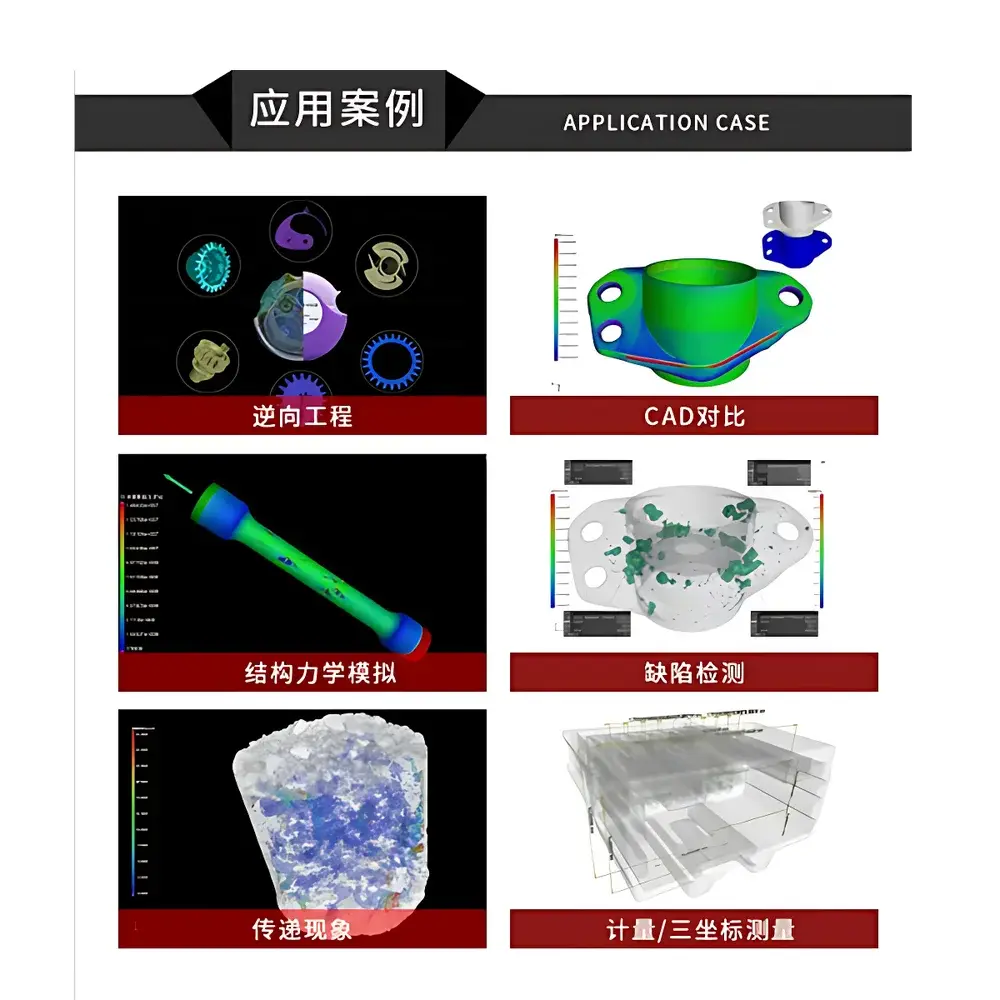
Control and reconstruction are managed via Always Imaging’s proprietary AX-Studio v4.2 software suite, which provides a role-based user interface compliant with FDA 21 CFR Part 11 requirements—including electronic signatures, audit trails, and secure data export in DICOM-CT, VGStudio MAX-compatible .vol, and standardized HDF5 formats. Batch processing pipelines support automated defect classification using pre-trained CNN models (transfer learning from ResNet-50 backbone), with configurable thresholds for void detection, crack segmentation, and wall-thickness deviation mapping. Raw projection data and reconstructed volumes are stored in encrypted local NAS or cloud-synced repositories with TLS 1.3 encryption and granular access permissions aligned with ISO/IEC 27001 information security frameworks.
Applications
- Automotive: Validation of casting porosity in engine blocks, verification of brazed heat exchanger joints, and dimensional conformity of EV battery module housings.
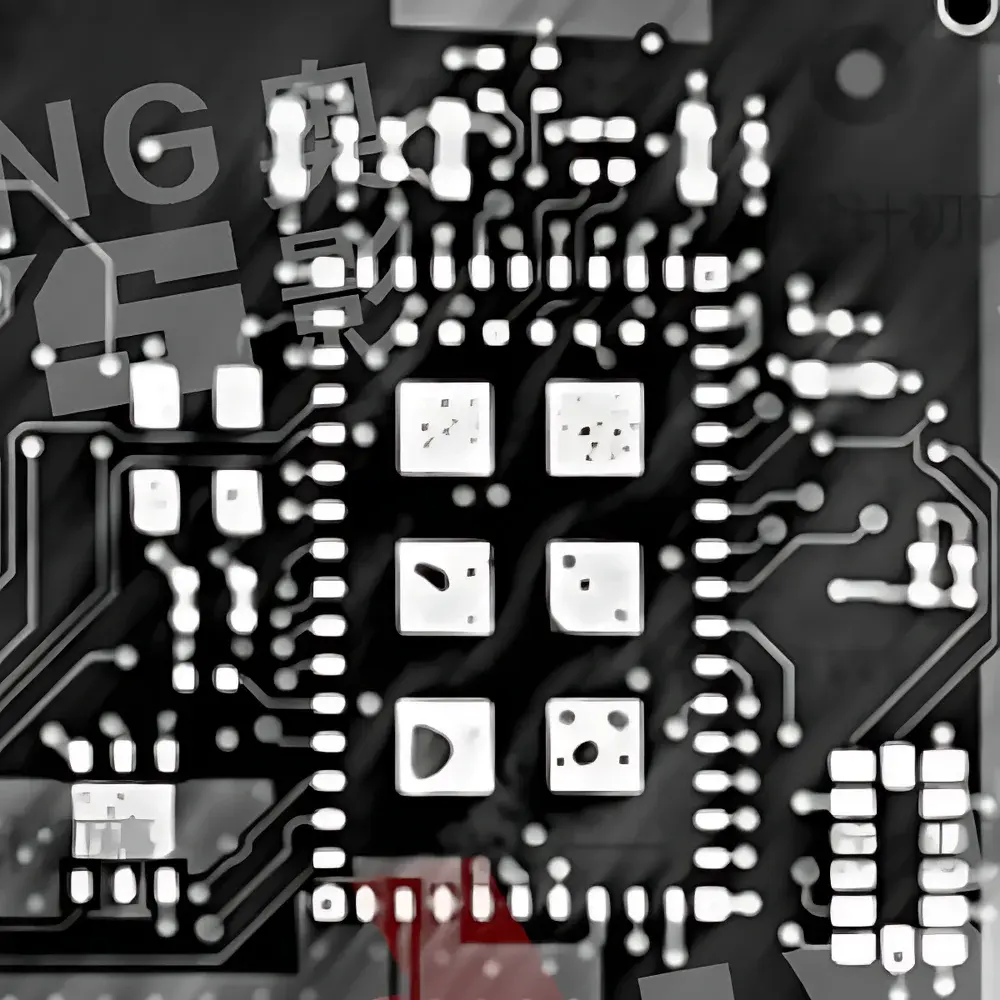
- Electronics: Detection of solder joint voids, wire bond lift-off, and delamination in multilayer PCBs and advanced packaging (e.g., SiP, Fan-Out WLP).
- Aerospace: Inspection of additive-manufactured turbine blades for internal channel continuity, powder residue entrapment, and microcrack propagation under fatigue load simulation.
- Medical Device Manufacturing: Metrological validation of polymer-based implant housings and stainless-steel surgical instrument assemblies against ASME Y14.5 GD&T specifications.
- Energy: Structural integrity assessment of ceramic insulators, composite wind turbine blade root sections, and lithium-ion cell electrode layer alignment.
FAQ
Is the AX-InLine suitable for GMP-regulated environments?
Yes—the system supports 21 CFR Part 11-compliant operation through AX-Studio’s audit trail logging, user authentication hierarchy, and electronic signature workflows. Full validation documentation (IQ/OQ/PQ templates) is provided upon request.
Can it be integrated with existing MES or SCADA platforms?
Yes—via OPC UA server interface and RESTful API endpoints for metadata exchange, scan trigger commands, and pass/fail status reporting. Native drivers are available for Siemens SIMATIC, Rockwell Automation FactoryTalk, and Schneider EcoStruxure platforms.
What is the typical spatial resolution achievable at 200 kV?
At 200 kV and optimal geometric magnification, the system achieves an effective isotropic voxel resolution of ≤ 5 µm in reconstructed volumes for samples ≤ 150 mm in diameter; resolution scales inversely with object size and required penetration depth.
Does Always Imaging provide application-specific calibration services?
Yes—certified metrology engineers perform on-site traceable calibration using NIST-traceable step gauges, sphere phantoms, and density reference standards, aligned with VDI/VDE 2630-1.3 guidelines for CT-based dimensional measurement.



