
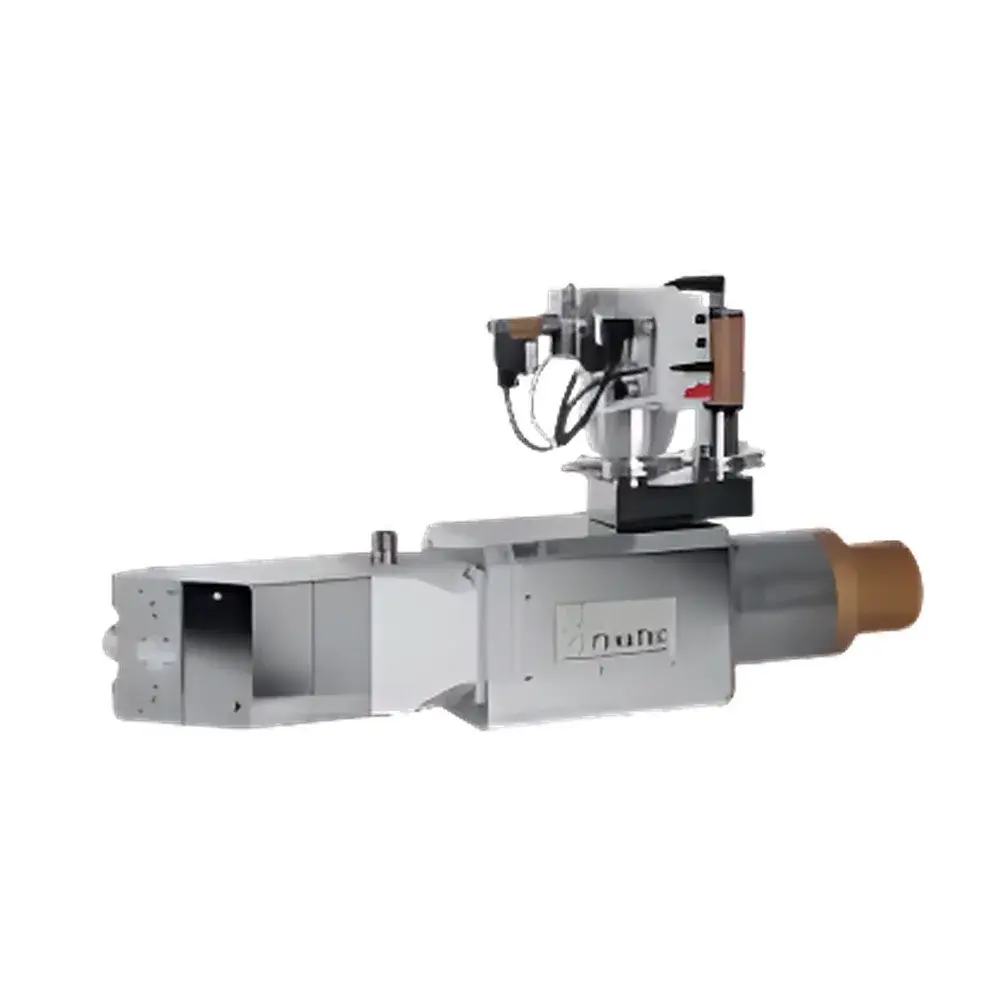
Always Imaging FineTec Microfocus X-ray Source Model TT-160 Integrated System
| Brand | Always Imaging |
|---|---|
| Origin | Zhejiang, China |
| Manufacturer Type | Manufacturer |
| Product Category | Domestic |
| Model | TT-160 Integrated |
| X-ray Energy | 160 kV / 180 kV / 200 kV / 225 kV / 240 kV / 300 kV |
| Max. Tube Voltage | 160 kV |
| Max. Tube Current | 0.5 mA |
| Max. Power (Water-cooled / Air-cooled) | 80 W / 25 W |
| Minimum Focal Spot Size (JIMA) | 1.5 µm |
| Minimum Detail Resolution | <1 µm |
| Anode Target Type | Transmission |
| X-ray Cone Angle | 170° |
| Window Material | 0.3 mm Carbon |
| Controller Form Factor | 19″ 2U Rack-mountable, Integrated High-Voltage Generator |
| Maintenance Requirement | Maintenance-free Operation |
Overview
The Always Imaging FineTec TT-160 Integrated Microfocus X-ray Source is a high-stability, all-metal, single-polarity transmission-target X-ray tube engineered for industrial micro-computed tomography (micro-CT), non-destructive testing (NDT), and high-resolution radiographic imaging. Operating on the principle of electron bombardment of a solid metal target within a high-vacuum environment, this source generates bremsstrahlung and characteristic X-rays with exceptional spatial coherence and minimal focal spot blur. Its sub-micrometer focal spot size—validated per JIMA standard—enables geometric magnification up to 1000× while maintaining optical resolution below 1 µm under optimized source-to-object distances. Unlike conventional X-ray tubes with thermionic cathodes and glass envelopes, the FineTec TT series employs a robust metal-ceramic hermetic structure, eliminating gas permeation risks and ensuring long-term stability in continuous-duty industrial environments. The integrated 19″ 2U controller houses a digitally regulated high-voltage generator and real-time emission control circuitry, supporting precise kV/mA stepping and closed-loop dose management.
Key Features
- All-metal, metal-ceramic vacuum envelope for enhanced thermal stability and extended operational lifetime
- Transmission-target anode architecture enabling short source-to-sample distances and high geometric magnification
- Integrated 19″ 2U rack-mount controller with embedded HV generator, eliminating external HV cables and EMI coupling paths
- Maintenance-free design with solid-state filament drive and auto-compensating emission regulation
- Adjustable X-ray cone angle (170° standard; optional 40° narrow-beam configuration for high-aspect-ratio samples)
- Customizable beryllium-free exit window options: 0.3 mm carbon (standard) or 0.5 mm aluminum for low-energy spectral tailoring
- Thermally decoupled anode assembly with dual-mode cooling support (water-cooled at 80 W; air-cooled at 25 W)
Sample Compatibility & Compliance
The TT-160 is designed for integration into industrial micro-CT systems, automated NDT stations, and inline quality assurance platforms. It accommodates samples ranging from miniature electronics (PCBs, solder joints, MEMS devices) to aerospace turbine blades and additive-manufactured metal components. With its 160 kV maximum accelerating voltage and 0.5 mA beam current, it delivers sufficient photon flux for penetrating aluminum alloys up to 45 mm thick and titanium up to 28 mm—while preserving contrast sensitivity for voids ≥0.5 µm in diameter. The system complies with IEC 61331-1:2014 (radiation protection), IEC 62495:2010 (X-ray equipment safety), and meets electromagnetic compatibility requirements per EN 61326-1:2013. When deployed in regulated manufacturing environments, the integrated controller supports audit-ready operation logs and configurable user access levels—facilitating alignment with ISO 17025 calibration traceability and FDA 21 CFR Part 11 electronic record integrity requirements.
Software & Data Management
The TT-160 communicates via Ethernet (TCP/IP) using a documented ASCII command protocol compatible with third-party CT reconstruction software (e.g., VGStudio MAX, Dragonfly, Octopus Reconstruction). Real-time telemetry includes tube voltage, current, anode temperature, vacuum status, and exposure time—all timestamped and exportable as CSV or HDF5. Firmware supports firmware-over-the-air (FOTA) updates and includes built-in self-diagnostics for filament resistance drift, vacuum degradation, and thermal derating events. For GLP/GMP workflows, the controller logs all parameter changes with operator ID, timestamp, and reason code—enabling full traceability across inspection batches. No proprietary acquisition software is required; integration is achieved through standard SCPI-like commands or OPC UA interface modules (optional).
Applications
- High-resolution failure analysis of semiconductor packages, wire bonds, and underfill voids
- Porosity and inclusion quantification in castings, sintered metals, and AM parts per ASTM E155 and ISO 10474
- In-process dimensional metrology of microfluidic channels, fuel injector nozzles, and medical device components
- Composite material inspection for fiber misalignment, delamination, and resin-rich zones
- Reverse engineering of legacy mechanical assemblies via micro-CT volume reconstruction
- Research-grade synchrotron-complementary imaging in university and national lab settings
FAQ
What is the minimum achievable focal spot size, and how is it verified?
The nominal focal spot size is 1.5 µm, measured per JIMA TR-15 standard using a knife-edge test method under defined loading conditions (100 kV, 0.2 mA, 30 s exposure). Actual performance depends on thermal equilibrium and voltage stability.
Can the TT-160 be retrofitted into existing micro-CT gantries?
Yes—the mechanical footprint (19″ 2U chassis + tube flange dimensions) and communication protocol are designed for drop-in replacement in systems conforming to DIN 6812 or ISO 15707 mounting standards.
Is radiation shielding included with the system?
No. Shielding must be engineered per local regulatory requirements (e.g., NRC 10 CFR 20 or EU Directive 2013/59/Euratom) based on installation geometry, workload, and occupancy factors.
Does the system support pulsed operation for motion artifact reduction?
Yes—external TTL triggering is supported with programmable pulse width (1–500 ms) and inter-pulse delay (≥100 ms), enabling synchronization with rotary stages or conveyor belts.
What warranty and service support is provided?
Standard coverage includes 24 months parts-and-labor warranty, remote diagnostics support, and access to firmware updates. Extended service plans include annual calibration verification and on-site preventive maintenance.



