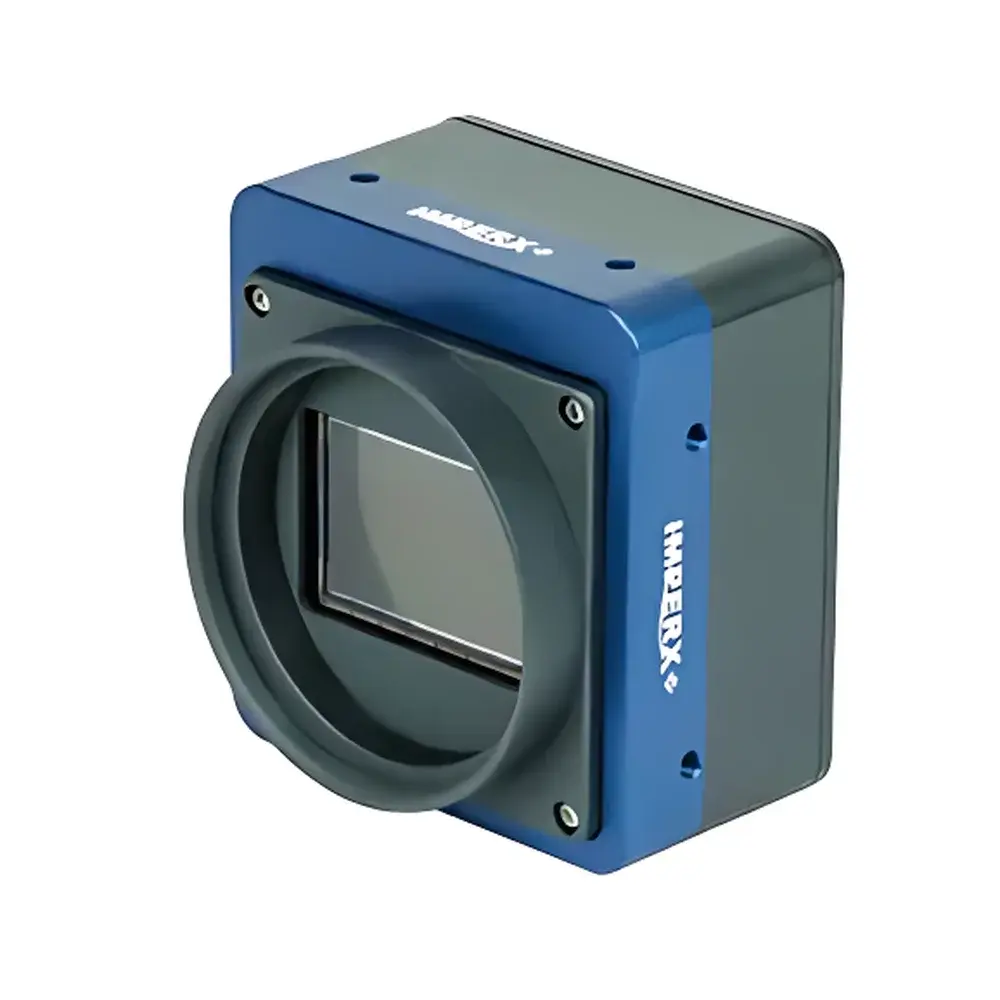
IMPERX Tiger T8810/T8820 High-Reliability 47 MP CCD Industrial Camera
| Brand | IMPERX |
|---|---|
| Origin | USA |
| Model | Tiger T8810 / T8820 |
| Sensor | ON Semiconductor KAI-47051 CCD |
| Resolution | 8856 × 5280 (47 MP) |
| Frame Rate | T8810 — 3.5 fps, T8820 — 7 fps |
| Bit Depth | 12-bit internal processing |
| Interface | Camera Link (Base/Medium/Full configuration support) |
| Operating Temperature | −40 °C to +85 °C |
| Compliance | MIL-STD-810F certified |
| Housing | Industrial-grade sealed aluminum chassis |
Overview
The IMPERX Tiger T8810 and T8820 represent the latest generation of high-reliability, large-format CCD industrial imaging systems engineered for mission-critical optical inspection and metrology applications. Built around the ON Semiconductor KAI-47051 interline-transfer CCD sensor—a 47 megapixel (8856 × 5280) monolithic device—the Tiger series delivers exceptional spatial fidelity, low-noise performance, and temporal stability under demanding environmental conditions. Unlike CMOS-based alternatives, the KAI-47051 employs true global shutter operation with precise charge transfer timing, eliminating motion artifacts and ensuring pixel-level synchronization essential for precision photogrammetry, aerial surveying, and flat-panel display (FPD) metrology. The camera’s architecture is grounded in a radiation-hardened, high-integration FPGA platform that performs real-time 12-bit image processing—including correlated double sampling (CDS), offset correction, and programmable gain control—without external frame grabber dependency beyond standard Camera Link protocol handshaking.
Key Features
- 47 MP resolution (8856 × 5280) full-frame output with <1.5 e⁻ RMS read noise at 12-bit digitization
- Dual-speed variants: T8810 supports 3.5 fps at full resolution; T8820 achieves 7 fps via optimized clock sequencing and parallel ADC architecture
- MIL-STD-810F qualified mechanical and thermal design—validated across shock (50 g), vibration (10–2000 Hz), and extended temperature cycling (−40 °C to +85 °C)
- Industrial Camera Link interface (Base/Medium/Full) compliant with ANSI/VITA 1.8-2001, supporting deterministic latency and GenICam-compliant register mapping
- Hermetically sealed, anodized aluminum housing with IP52-rated ingress protection and conformal-coated PCBs for long-term reliability in factory-floor or outdoor deployment
- Onboard non-volatile memory stores user-configurable LUTs, ROI presets, and calibration metadata for reproducible setup across multiple inspection stations
Sample Compatibility & Compliance
The Tiger series is designed for integration into automated optical inspection (AOI) platforms, coordinate measuring machines (CMMs), and remote sensing payloads where geometric accuracy, radiometric consistency, and operational longevity are non-negotiable. Its linear response curve, uniform quantum efficiency (>65% peak at 550 nm), and calibrated dark current drift (<0.3% per hour at 25 °C) meet ASTM E2720-20 requirements for digital imaging system characterization. The camera complies with CE marking directives (EMC 2014/30/EU, RoHS 2011/65/EU) and supports traceable calibration via NIST-traceable flat-field and photoresponse nonuniformity (PRNU) reference targets. For regulated environments—including ISO 13485 medical device manufacturing or IEC 62304 software lifecycle compliance—firmware revision logs and hardware serial traceability are maintained per GLP/GMP audit requirements.
Software & Data Management
IMPERX provides the Tiger SDK (v5.2+), a cross-platform C/C++ and Python API supporting Windows, Linux (x86_64, ARM64), and real-time OS extensions (VxWorks, QNX). The SDK includes GenTL-compliant transport layers, hardware-triggered acquisition sequences with sub-microsecond jitter, and metadata-embedded TIFF/RAW12 file export compatible with HALCON, OpenCV, and MATLAB Image Processing Toolbox workflows. All firmware updates undergo SHA-256 signature verification, and configuration changes generate immutable audit trails timestamped to UTC with embedded device serial and user-defined project ID. Optional IMPERX VisionStudio GUI enables live histogram analysis, dynamic range profiling, and automated MTF measurement using slanted-edge methodology per ISO 12233:2017 Annex A.
Applications
- High-accuracy flat-panel display (FPD) inspection—defect detection at sub-10 µm scale across OLED, LCD, and microLED substrates
- Aerial and satellite-based photogrammetric mapping requiring georeferenced, distortion-corrected imagery with <0.3-pixel RMS reprojection error
- Automated optical metrology in semiconductor packaging—leadframe alignment, die bond verification, and wire-bond height profiling
- Long-duration infrastructure monitoring—bridge deformation tracking, railway track geometry assessment, and wind turbine blade surface scanning
- Scientific imaging in synchrotron beamlines and astronomical test benches where low dark current and stable gain response over multi-hour acquisitions are mandatory
FAQ
Does the Tiger support triggering via TTL, RS-422, or optical input?
Yes—the camera features dual hardware trigger inputs (TTL-compatible and opto-isolated) with programmable polarity, debounce filtering, and exposure delay down to 100 ns resolution.
Can the T8810/T8820 be operated without a frame grabber?
No—Camera Link interface requires a compliant frame grabber; however, IMPERX validates compatibility with Teledyne DALSA, Euresys, and BitFlow models pre-certified for GenICam v2.3 interoperability.
Is radiometric calibration data provided with each unit?
Each shipped Tiger includes a factory-acquired calibration report covering PRNU, DSNU, linearity deviation (<±0.8%), and absolute responsivity (µV/e⁻) referenced to NIST SRM 2201.
What is the mean time between failures (MTBF) under continuous operation?
Based on accelerated life testing per Telcordia GR-468-CORE, MTBF exceeds 120,000 hours at 40 °C ambient with 70% duty cycle.
Are custom firmware modifications available for OEM integration?
Yes—IMPERX offers contracted firmware development services including custom register maps, proprietary trigger protocols, and deterministic packetization for embedded vision processors.