
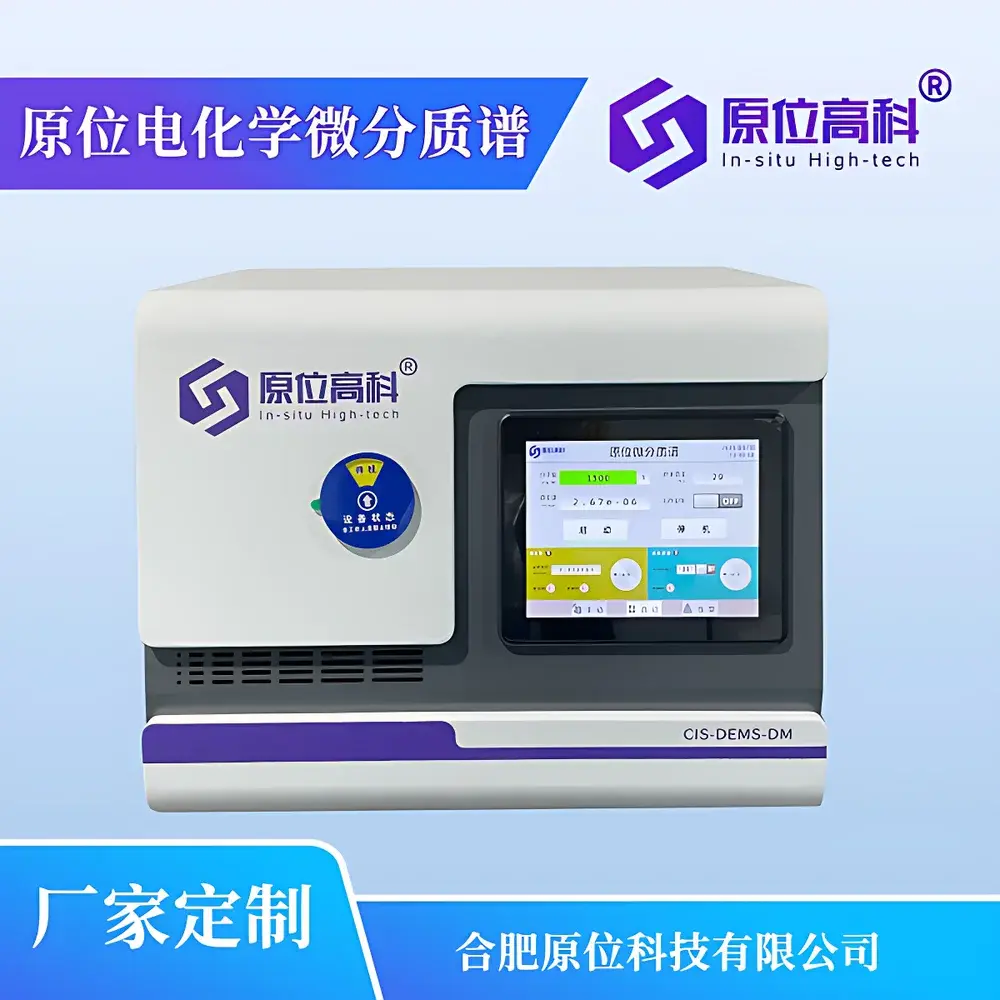
In-situ High-tech CIS-DEMS-DM Differential Electrochemical Mass Spectrometry System
| Brand | In-situ High-tech |
|---|---|
| Origin | Anhui, China |
| Manufacturer Type | OEM Manufacturer |
| Country of Origin | China |
| Model | CIS-DEMS-DM |
| Quotation | Upon Request |
| Mass Range | 1–100 / 200 / 300 amu |
| Inlet Pressure Range | 1×10⁻⁷ mbar to 10 bar (customizable) |
| Inlet Reduction Stages | 1/2/3-stage selectable |
| Inlet Flow Rate | 0.1–100 sccm |
| Max Inlet Pressure | ≤1.5 bar |
| Inlet Tubing Material | Stainless steel / Quartz / PEEK |
| Heated Inlet Temperature | 120 / 200 / 300 °C |
| Quadrupole Rods | Stainless steel, Ø6 mm × 125 mm |
| Detector | C-SEM / Faraday cup |
| LOD (C-SEM) | <100 ppb |
| Peak Width | 0.5–2.5 amu |
| Ion Source Bake-out Temp | Up to 150 °C |
| Scan Speed | 1 ms–16 s per amu (programmable, min. 1 ms/amu) |
| Vacuum System | Pfeiffer HiPace 80 molecular pump (90,000 rpm) + ACP 20 dry scroll pump |
| I/O Interface | Digital & analog outputs |
| Compliance | Fully compatible with ASTM E1947, ISO/IEC 17025 workflows, and supports GLP/GMP audit trails via optional software modules |
Overview
The In-situ High-tech CIS-DEMS-DM Differential Electrochemical Mass Spectrometry (DEMS) System is a purpose-engineered platform for real-time, quantitative monitoring of gaseous and volatile reaction products generated during electrochemical processes. It operates on the fundamental principle of quadrupole mass filtering—ionizing analytes in a controlled vacuum environment, separating them according to their mass-to-charge ratio (m/z), and detecting ion currents with high fidelity using either a continuous-dynode electron multiplier (C-SEM) or Faraday cup. Unlike conventional offline MS analysis, the CIS-DEMS-DM integrates seamlessly with electrochemical cells via heated, differentially pumped capillary inlets, enabling sub-second temporal resolution of transient intermediates and stable end-products. This architecture supports rigorous mechanistic studies in energy storage (e.g., Li-ion, solid-state, and CO₂ electrolysis), catalysis, corrosion science, and battery degradation analysis—where dynamic gas evolution kinetics directly inform reaction pathway validation.
Key Features
- Ultra-fast scanning capability: Programmable scan speed down to 1 ms per amu, optimized for capturing short-lived electrochemical intermediates such as CO, C₂H₄, O₂, H₂, and CH₄ during cyclic voltammetry or chronoamperometric experiments.
- Dual-path differential inlet system: Supports simultaneous or switchable sampling from micro-electrochemical cells and miniature thermal reactors, with configurable pressure reduction stages (1–3 stage differential pumping) to maintain ion source integrity under variable process pressures (1×10⁻⁷ mbar to 10 bar).
- German-sourced ultra-high-vacuum architecture: Equipped exclusively with Pfeiffer HiPace 80 turbomolecular pumps (90,000 rpm) and ACP 20 dry scroll backing pumps—ensuring oil-free operation, low base pressure (<5×10⁻⁹ mbar), and minimal background interference critical for trace-level detection.
- Integrated heated inlet manifold: Stainless steel, quartz, or PEEK tubing options with precise temperature control (120–300 °C), preventing condensation of polar volatiles and ensuring quantitative transfer of labile species like formaldehyde or methanol.
- Modular cell compatibility: Designed for direct coupling with standardized electrochemical DEMS cells (PMMA/PEEK body, FKM seals), Raman-MS flow cells (37 mm quartz window), IR-MS transmission cells, pouch-cell DEMS fixtures (max. 70×56 mm), and coin-cell DEMS holders (φ34.6×13.5 mm).
- Networked control infrastructure: Gigabit Ethernet interface supporting IP-based remote operation, synchronized timestamping, and integration into centralized laboratory data management systems compliant with IEEE 1588 and NTP protocols.
Sample Compatibility & Compliance
The CIS-DEMS-DM accommodates a broad range of sample introduction configurations without compromising vacuum integrity or analytical reproducibility. Its inlet design tolerates liquid electrolyte circulation, gas-phase feed streams, and solid-gas interfaces typical in electrocatalytic CO₂ reduction, water splitting, and lithium metal anode side-reaction studies. All cell variants—including pouch, coin, flow-through, and membrane-separated dual-chamber configurations—adhere to standard electrochemical cell geometries defined in ASTM D1193 and ISO 12107. The system’s vacuum architecture meets ISO 27432 requirements for cleanroom-compatible instrumentation, while its digital I/O interface enables direct acquisition of auxiliary sensor data (temperature, pressure, current, potential) for multi-parameter correlation. Optional software modules support 21 CFR Part 11-compliant electronic signatures, audit trail logging, and raw data encryption for regulated environments.
Software & Data Management
The proprietary DEMS Control Suite provides synchronized control of mass spectral acquisition, potentiostat triggering, and auxiliary sensor logging within a single time-stamped dataset. Real-time m/z-resolved ion chromatograms are generated with user-defined dwell times, peak deconvolution, and isotopic pattern fitting (e.g., ¹²CO vs. ¹³CO). Batch processing supports automated calibration against NIST-traceable gas standards (e.g., certified CO/N₂ mixtures), background subtraction, and quantification using internal standard normalization. Export formats include .csv, .mzML (PSI standard), and HDF5 for downstream integration with Python-based chemometrics pipelines (e.g., scikit-learn, PyMassSpec). All raw spectra and metadata are stored in a relational SQLite database with built-in versioning and rollback functionality—essential for method validation and regulatory submissions.
Applications
- Electrocatalysis mechanism elucidation: Quantitative tracking of Faradaic efficiency for CO₂-to-fuel conversion pathways (e.g., CO, CH₄, C₂H₄, ethanol) across applied potentials.
- Battery gas evolution profiling: In situ identification and quantification of SEI decomposition gases (C₂H₄, C₂H₆, H₂, CO) during formation cycling and overcharge conditions.
- Corrosion product analysis: Detection of volatile chloride hydrolysis byproducts (Cl₂, HCl) and hydrogen embrittlement indicators (H₂) in aqueous and non-aqueous media.
- Heterogeneous catalysis under operando conditions: Coupling with TGA or fixed-bed reactors to correlate mass loss profiles with evolved species (H₂O, NH₃, NOₓ).
- Photoelectrochemical gas detection: Integration with solar simulator systems to monitor photocurrent-correlated O₂ evolution kinetics in photoanodes.
FAQ
What mass ranges are supported, and can they be reconfigured post-purchase?
The CIS-DEMS-DM offers factory-configurable mass ranges of 1–100, 1–200, or 1–300 amu. Hardware-based upper limit is determined by quadrupole rod geometry and RF/DC voltage supply; reconfiguration requires recalibration but no physical component replacement.
Is the system compatible with third-party potentiostats?
Yes—via TTL-triggered start/stop signals and analog voltage inputs for real-time potential/current synchronization. Supported brands include BioLogic, Metrohm Autolab, Gamry, and Pine Research.
Can the vacuum system be maintained in-house?
All Pfeiffer components (HiPace 80, ACP 20) are serviced globally through authorized Pfeiffer service centers. In-situ High-tech provides full technical documentation, spare parts kits, and remote diagnostics support.
Does the system meet GLP or GMP requirements for pharmaceutical electrochemistry studies?
With optional compliance software add-ons (audit trail, user access control, electronic signature), the system satisfies core elements of FDA 21 CFR Part 11 and EU Annex 11 for computerized system validation in regulated labs.
What is the minimum detectable concentration for CO in N₂ matrix?
Under standard operating conditions (100 sccm flow, 1 ms/amu scan, C-SEM detection), the limit of detection is <100 ppb (v/v) at 95% confidence level, verified per ISO 11843-1 protocol.




