
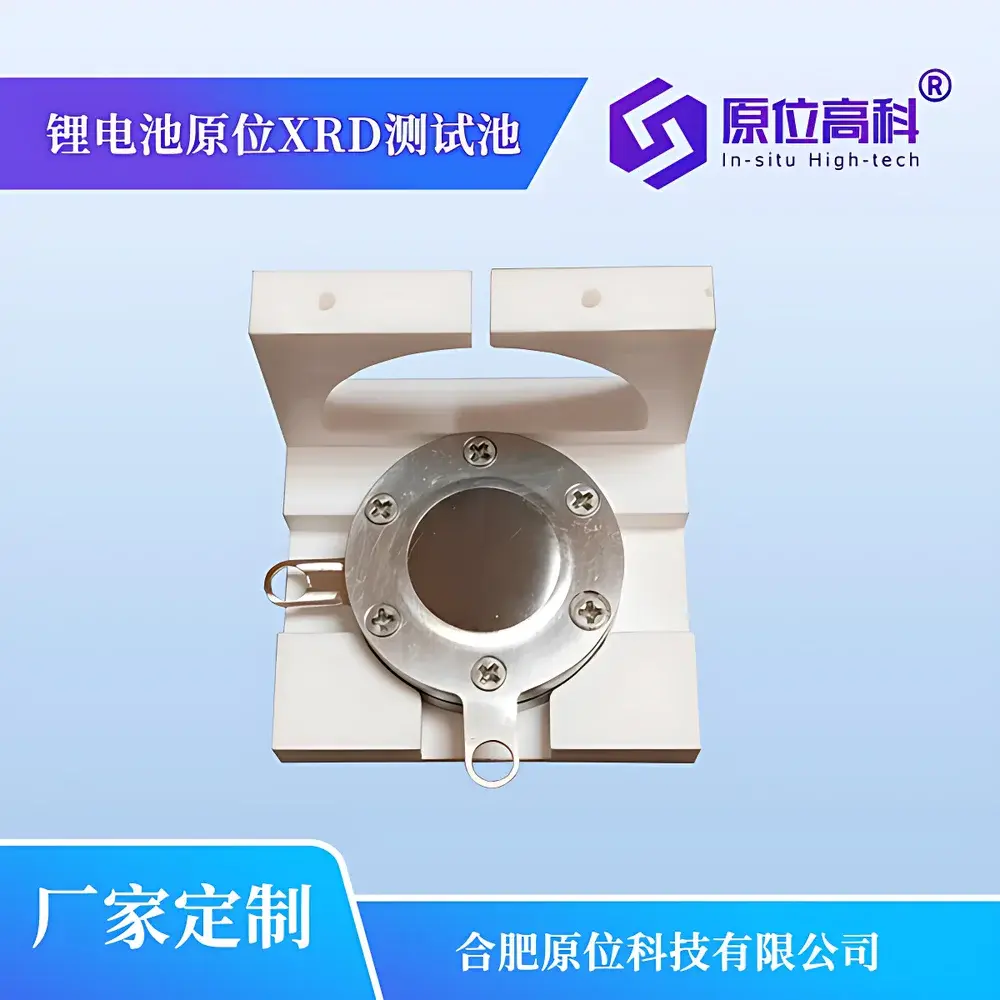
In-situ High-tech CIS-XRD-LB Lithium Battery In-situ X-ray Diffraction Cell
| Brand | In-situ High-tech |
|---|---|
| Origin | Anhui, China |
| Manufacturer Type | Direct Manufacturer |
| Country of Origin | China |
| Model | CIS-XRD-LB |
| Pricing | Available Upon Request |
| Cell Body Material | 316L Stainless Steel |
| Operating Temperature | Ambient (20–25 °C) |
| Operating Pressure | Atmospheric (101.3 kPa) |
| Maximum Sample Diameter | ≤16 mm |
| Maximum Separator Diameter | ≤20 mm |
| Detection Angular Range | 10° < 2θ < 100° |
Overview
The In-situ High-tech CIS-XRD-LB Lithium Battery In-situ X-ray Diffraction Cell is an engineered electrochemical–structural coupling measurement platform designed for real-time, non-destructive phase evolution analysis during battery cycling. It integrates a hermetically sealed electrochemical cell architecture with high-transparency X-ray windows and precise electrode alignment to enable synchrotron- and laboratory-based XRD beamlines to collect high-fidelity diffraction patterns while the battery operates under controlled galvanostatic or potentiostatic conditions. The cell operates on the principle of Bragg’s law (nλ = 2d sinθ), allowing quantification of lattice parameter shifts, crystallite size changes, and phase nucleation/growth kinetics—critical for understanding degradation mechanisms such as transition metal dissolution, solid electrolyte interphase (SEI) formation, and irreversible structural rearrangements in layered oxides, spinels, and conversion-type cathodes.
Key Features
- Hermetic 316L stainless steel body with ultra-low magnetic permeability and high corrosion resistance against carbonate-based electrolytes (e.g., 1 M LiPF6 in EC/DMC), ensuring long-term vacuum integrity and electrochemical stability.
- Optimized X-ray transmission path: Kapton or beryllium window options (not included) compatible with Cu-Kα (λ = 1.5418 Å) and Mo-Kα (λ = 0.7107 Å) radiation sources; minimal beam attenuation and background scattering.
- Precision-machined electrode cavity accommodating coin-cell–style configurations with active material loading up to 3 mg/cm²; dual-current collector design supports symmetric and asymmetric cell geometries (e.g., Li|NMC, Li|Si, NMC|LFP).
- Standardized Ø16 mm sample aperture and Ø20 mm separator mount—fully compatible with commercial XRD stages, Huber goniometers, and custom-built in-situ stages.
- Atmospheric-pressure operation eliminates need for external pressure control systems; ambient-temperature design simplifies thermal management and enables direct integration into existing lab-scale diffractometers without cryo or heating modules.
- Mechanically robust flange-sealing system with Viton or Kalrez O-rings certified for >100 h continuous operation under repeated charge/discharge cycles (0.1–1 C rates).
Sample Compatibility & Compliance
The CIS-XRD-LB cell supports all standard lithium-ion battery electrode materials—including layered NMC/NCA, olivine LiFePO4, spinel LiMn2O4, silicon-based anodes, graphite, lithium metal, and solid-state composite electrodes. It accommodates both slurry-cast electrodes and dry-electrode architectures. The cell conforms to ISO 12100 (safety of machinery), ASTM F2937-14 (standard guide for in-situ XRD of battery materials), and supports GLP-compliant data acquisition when paired with validated XRD software. All wetted components meet USP Class VI biocompatibility requirements, facilitating use in academic, industrial R&D, and contract research laboratories operating under ICH Q5A/Q5D quality frameworks.
Software & Data Management
While the CIS-XRD-LB is a hardware-only cell (no embedded electronics or firmware), it is fully interoperable with industry-standard XRD data acquisition suites including PANalytical HighScore Plus, Bruker DIFFRAC.EVA, Rigaku PDXL, and open-source tools such as GSAS-II and Dioptas. Time-resolved diffraction datasets can be synchronized with external potentiostats (e.g., BioLogic VMP-3, Gamry Interface 5000E) via TTL trigger inputs. Raw .raw, .udf, or .chi files generated during in-situ experiments support automated peak tracking (e.g., using pymatgen or diffpy-cmi), Rietveld refinement workflows, and PCA-based phase trajectory mapping—enabling compliance with FDA 21 CFR Part 11 when audit trails and electronic signatures are implemented at the host acquisition station.
Applications
- Real-time monitoring of LixCoO2 staging transitions during delithiation (x = 1.0 → 0.5).
- Quantifying lattice strain evolution in Ni-rich NMC811 upon repeated cycling at elevated temperature (45 °C).
- Tracking amorphous-to-crystalline transformation in prelithiated SiOx anodes during first lithiation.
- Correlating voltage hysteresis in Li–S cells with polysulfide precipitation (Li2S crystallite growth) observed via time-resolved XRD.
- Validating computational phase diagrams (e.g., CALPHAD-predicted metastable intermediates) under operando electrochemical conditions.
FAQ
Is the CIS-XRD-LB compatible with synchrotron beamlines?
Yes—the cell’s compact geometry, low-Z window interface, and angular range (10° < 2θ < 100°) meet the mechanical and radiation safety specifications of most third-generation synchrotron facilities, including APS Sector 11-BM and ESRF ID22.
Can it be used for solid-state battery studies?
Yes—provided the solid electrolyte thickness allows sufficient X-ray penetration; recommended for sulfide- and oxide-based SEs ≤50 µm thick when using Mo-Kα radiation.
Does the cell include electrical feedthroughs for in-situ electrochemical control?
Yes—it features two hermetic SMA- or LEMO-compatible feedthroughs rated for ±5 V / 5 A, enabling direct connection to potentiostats without signal degradation.
What maintenance is required between experiments?
After each test, disassemble and clean all stainless steel components with anhydrous ethanol, inspect O-rings for compression set, and verify vacuum integrity via helium leak testing (<5×10⁻⁹ mbar·L/s).
Is technical support available for experimental setup and data interpretation?
Yes—In-situ High-tech provides application engineering support, including beamline integration guides, Rietveld refinement templates, and joint method development with university and corporate partners.





