
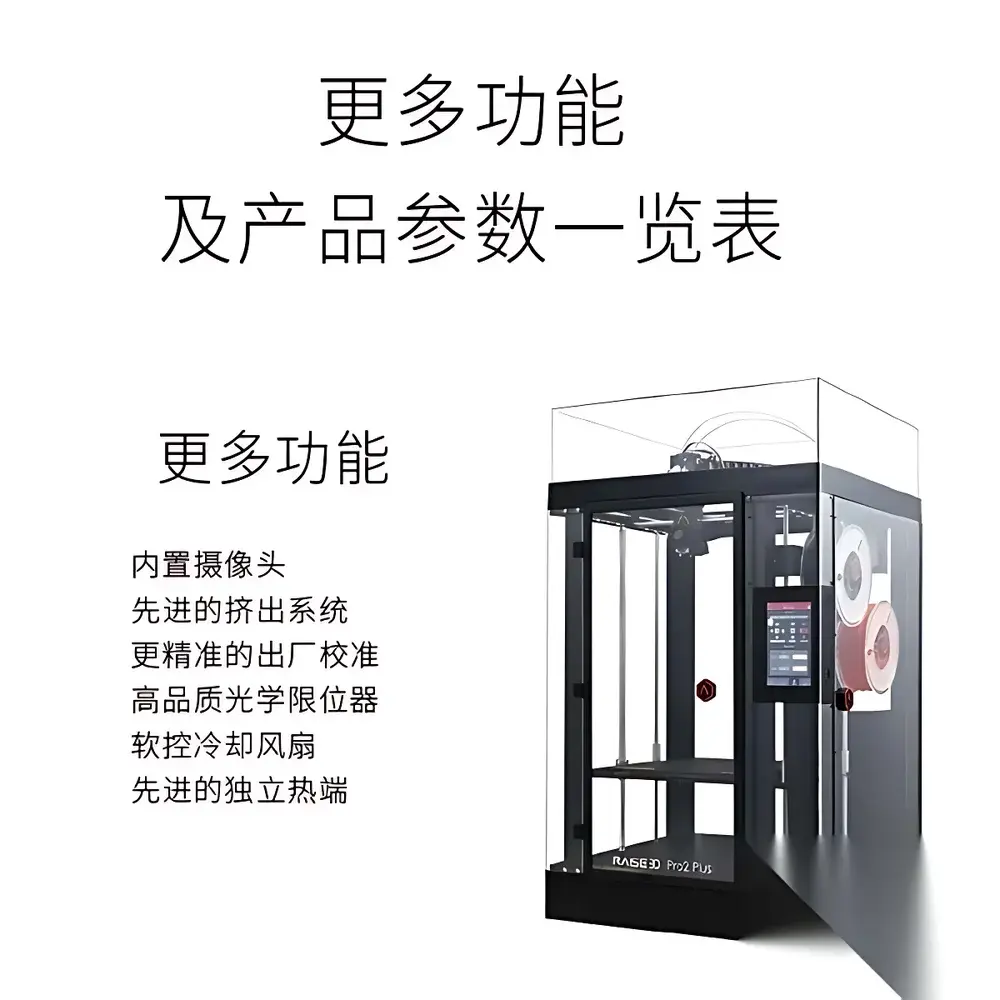
Industrial-Grade Smart Dual-Extruder 3D Printer
| Brand | Other Brands |
|---|---|
| Origin | Not Specified |
| Supplier Type | General Distributor |
| Import Status | Imported |
| Pricing | Available Upon Request |
Overview
The Industrial-Grade Smart Dual-Extruder 3D Printer is a precision-engineered additive manufacturing system designed for repeatable, high-fidelity prototyping and low-volume functional part production in laboratory, R&D, and pilot-scale manufacturing environments. Built upon fused filament fabrication (FFF) architecture, it employs dual independent hotends with synchronized motion control to enable true multi-material and multi-color printing—supporting simultaneous deposition of dissimilar thermoplastics (e.g., ABS/PLA, TPU/PC, or support-soluble PVA) without cross-contamination. Its rigid frame, closed-loop stepper motor drivers, and real-time thermal regulation across heated build chamber and dual-zone heated beds ensure dimensional stability and interlayer adhesion consistency across extended print durations (>100 h). The system is engineered for integration into ISO/IEC 17025-compliant lab workflows and supports traceable calibration protocols aligned with ASTM F2792 and ISO/ASTM 52900 standards for additive manufacturing terminology and process classification.
Key Features
- Dual independent extrusion system with auto-leveling hotends, each equipped with precision 0.4 mm nozzles (interchangeable up to 0.8 mm), capable of ±0.02 mm positional repeatability
- Heated build chamber (up to 60 °C) and dual-zone heated bed (max 110 °C) for warpage mitigation in engineering-grade polymers including polypropylene, nylon, and high-temp resins
- Integrated optical filament sensor and real-time nozzle clog detection via torque monitoring and pressure advance compensation
- Onboard 7-inch capacitive touchscreen with offline SD card operation and network-enabled firmware update capability (Ethernet + Wi-Fi 5)
- Modular toolhead design supporting future upgrades—including direct-drive Bowden configurations and optional IR-based layer thickness verification module
Sample Compatibility & Compliance
The printer accommodates standard 1.75 mm filament formats compliant with ISO 527-2 and ASTM D638 specifications. Compatible materials include PLA, PETG, ABS, TPU (Shore A 85–95), PC, PEEK (with optional high-temp upgrade kit), and water-soluble support filaments (PVA, HIPS). All firmware and mechanical configurations adhere to CE marking requirements under the Machinery Directive 2006/42/EC and EMC Directive 2014/30/EU. Electrical safety conforms to IEC 61000-6-2 and IEC 61000-6-4. For regulated environments, the system supports audit-ready log export (CSV/JSON) of print parameters, temperature profiles, and error events—enabling alignment with GLP documentation practices and internal SOPs governing equipment qualification (IQ/OQ/PQ).
Software & Data Management
The printer operates natively with open-source slicer compatibility (Cura, PrusaSlicer, Simplify3D) and includes proprietary firmware with G-code pre-processing validation and checksum-verified job queuing. Cloud-connected management is optional via secure TLS 1.2 API endpoints for remote queue monitoring, firmware version tracking, and centralized device health reporting. All print logs—including layer timestamping, thermal history, and extrusion rate deviation metrics—are stored locally on encrypted microSD and can be exported with ISO 8601-compliant timestamps. For laboratories operating under FDA 21 CFR Part 11 requirements, third-party validation packages are available to configure electronic signature workflows and audit trail retention policies (minimum 12-month log retention).
Applications
This platform serves as a versatile tool across academic research labs, materials science departments, and quality control units requiring rapid iteration of test fixtures, anatomical models, microfluidic housings, and custom jigs. It is routinely deployed for: functional validation of polymer formulations; fabrication of calibrated reference geometries for metrology studies; production of sterilizable surgical guides per ASTM F3122; and generation of conformal enclosures for embedded sensor assemblies. Its dual-extrusion capability enables co-printing of conductive traces (using carbon-filled filament) alongside structural substrates—facilitating rapid development of printed electronics prototypes without cleanroom dependency.
FAQ
Is this printer compatible with third-party slicing software?
Yes—it accepts standard G-code output from Cura, PrusaSlicer, and Simplify3D without proprietary lock-in.
Does the system support automated calibration routines?
It includes automatic bed leveling using inductive probe feedback and dynamic Z-offset compensation per extruder.
Can print logs be exported for regulatory documentation?
Yes—full parameter logs (temperature, speed, flow, errors) are exportable in CSV/JSON format with UTC timestamps.
What safety certifications does the unit carry?
The printer bears CE marking per Machinery and EMC Directives and complies with IEC 61000-6-2/6-4 immunity/emission standards.
Is remote monitoring supported out of the box?
Local network monitoring is native; cloud-based fleet management requires optional subscription-based gateway firmware.



