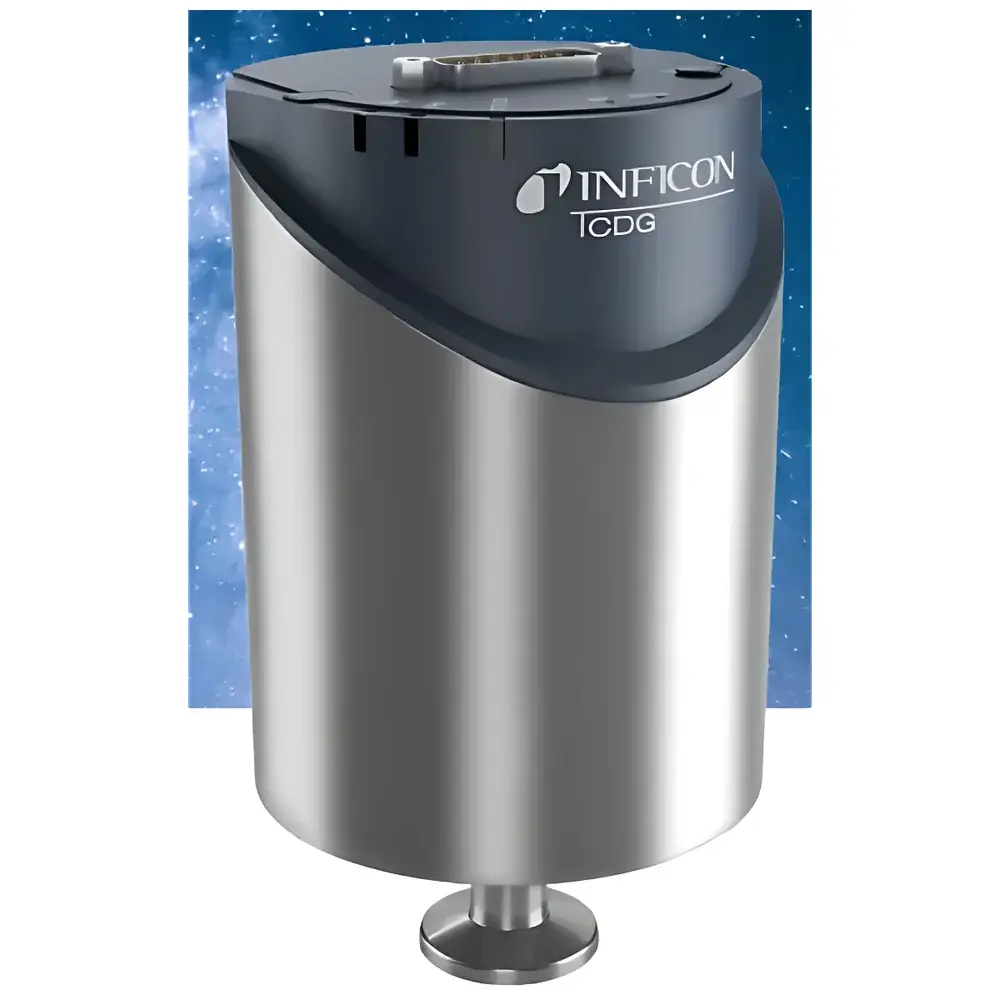
INFICON CDG045D Ceramic Capacitive Vacuum Gauge
| Brand | INFICON |
|---|---|
| Origin | Germany |
| Model | CDG045D (1 Torr and 100 Torr full-scale options) |
| Vacuum Flange | KF 16 |
| Measurement Principle | Ceramic Diaphragm Capacitance |
| Pressure Range | 5 × 10⁻² Torr to 1000 Torr (full-scale selectable: 1 Torr or 100 Torr) |
| Operating Temperature | 45 °C (thermally stabilized) |
| Output Signal | 0–10 V DC, gas-independent linear analog output |
| Compliance | CE, UL 61010-1, EN 61326-1, SEMI S2/S8, RoHS |
Overview
The INFICON CDG045D is a thermally stabilized ceramic capacitive vacuum gauge engineered for high-accuracy, gas-independent total pressure measurement in demanding industrial and research vacuum environments. Utilizing a hermetically sealed, ultra-pure alumina (Al₂O₃) ceramic diaphragm, the sensor operates on the principle of capacitance change induced by differential pressure across the diaphragm—measured with precision electronics and compensated for thermal drift via active temperature control at 45 °C. This architecture eliminates zero drift caused by ambient fluctuations and ensures long-term baseline stability without requiring frequent recalibration. Unlike metal-diaphragm gauges, the ceramic element resists corrosion from aggressive process gases (e.g., Cl₂, NF₃, CF₄, O₂ plasma effluents), making the CDG045D especially suitable for semiconductor etch, CVD, and PVD tools where chemical exposure and thermal cycling are routine. Its extended operational range—from 50 mTorr up to 1000 Torr—covers rough vacuum through medium vacuum regimes, bridging the gap between Pirani and Bourdon-based technologies while maintaining linearity and repeatability.
Key Features
- Thermally regulated sensing head at 45 °C for exceptional signal stability and reproducibility (±0.25% reading typical over 24 h)
- Ultra-pure 99.8% alumina ceramic diaphragm offering inherent resistance to halogenated, oxidizing, and acidic process chemistries
- Gas-independent 0–10 V analog output with ≤1% nonlinearity across full scale—no gas-specific correction factors required
- Fast thermal stabilization: <60 s warm-up time to operational accuracy—50% faster than conventional heated capacitance manometers
- Low power consumption (<2.5 W typical), enabling integration into space-constrained or energy-sensitive tool platforms
- Two factory-configurable setpoint relays for local alarm or interlock signaling; supports remote zero command via digital interface
- Diagnostic port for real-time offset monitoring and field service verification without disassembly
- KF 16 (ISO-KF) vacuum flange standard; optional CF, ISO-LF, and VCR configurations available per application requirement
Sample Compatibility & Compliance
The CDG045D is compatible with all common vacuum process gases—including reactive, corrosive, and condensable species—without performance degradation or calibration shift. Its ceramic sensor exhibits no hysteresis or creep under repeated exposure to plasma afterglow or high-vapor-pressure precursors. The device complies with international safety and electromagnetic compatibility standards: CE marking per EU Machinery and EMC Directives; UL 61010-1 certification for laboratory and industrial equipment; EN 61326-1 for measurement control equipment in industrial environments; SEMI S2 (safety) and S8 (ergonomics) for semiconductor manufacturing tools; and RoHS 2011/65/EU for hazardous substance restriction. It supports GLP/GMP-aligned operation when paired with INFICON’s optional audit-trail-enabled software, satisfying traceability requirements per ISO/IEC 17025 and ASTM E2655 for reference-grade pressure validation.
Software & Data Management
While the CDG045D operates as a standalone analog transmitter, it integrates seamlessly with INFICON’s Vacuum Control Suite (VCS) and third-party SCADA/PLC systems via optional digital modules (RS-485 Modbus RTU or EtherNet/IP). Firmware updates and configuration (e.g., zero offset adjustment, setpoint thresholds, output scaling) are performed remotely using INFICON’s certified engineering utility—logging all parameter changes with timestamp and user ID for 21 CFR Part 11-compliant audit trails. Calibration certificates (NIST-traceable) are supplied with each unit, and optional annual recalibration services include uncertainty budgets per ISO/IEC 17025 Annex A.3.
Applications
- Semiconductor fabrication: Endpoint detection and chamber pressure control in plasma etch (RIE, ICP), PVD sputtering, and ALD/CVD reactors
- Thin-film coating: Process monitoring in optical, architectural, and automotive glass coating lines
- R&D vacuum systems: Reference-grade pressure validation in university and national lab test stands
- Chemical vapor synthesis: Monitoring corrosive precursor delivery in fluoropolymer or silicon carbide deposition
- Leak detection support: Stable baseline reference for helium mass spectrometer systems during hold-time verification
- Medical device manufacturing: Controlled atmosphere packaging and sterilization chamber monitoring
FAQ
What pressure ranges does the CDG045D support, and how is full-scale selected?
The CDG045D is available in two factory-set full-scale configurations: 1 Torr and 100 Torr. Each variant covers a continuous operating range from 50 mTorr to 1000 Torr (1.33 Pa to 133 kPa), with optimal accuracy within 10–90% of full scale.
Is the output signal truly gas-independent?
Yes—the ceramic diaphragm’s mechanical response is unaffected by gas composition, and the electronics apply no gas-specific compensation algorithms. Linearity and span remain consistent across N₂, Ar, O₂, CF₄, Cl₂, and mixtures.
Can the CDG045D be used in oxygen-rich or plasma environments?
Absolutely. The alumina diaphragm is non-reactive with atomic oxygen and withstands sustained exposure to RF and microwave plasma afterglow without degradation or zero drift.
Does it require periodic recalibration?
Under normal operating conditions and stable thermal environment, recalibration is recommended every 12 months per ISO/IEC 17025 guidelines. The built-in diagnostic port enables in-situ verification of zero offset prior to scheduled maintenance.
What is included in the standard two-year warranty?
The warranty covers material and workmanship defects, including sensor failure, electronic module fault, and flange seal integrity—excluding damage from improper installation, overpressure events, or chemical exposure beyond specified compatibility limits.