
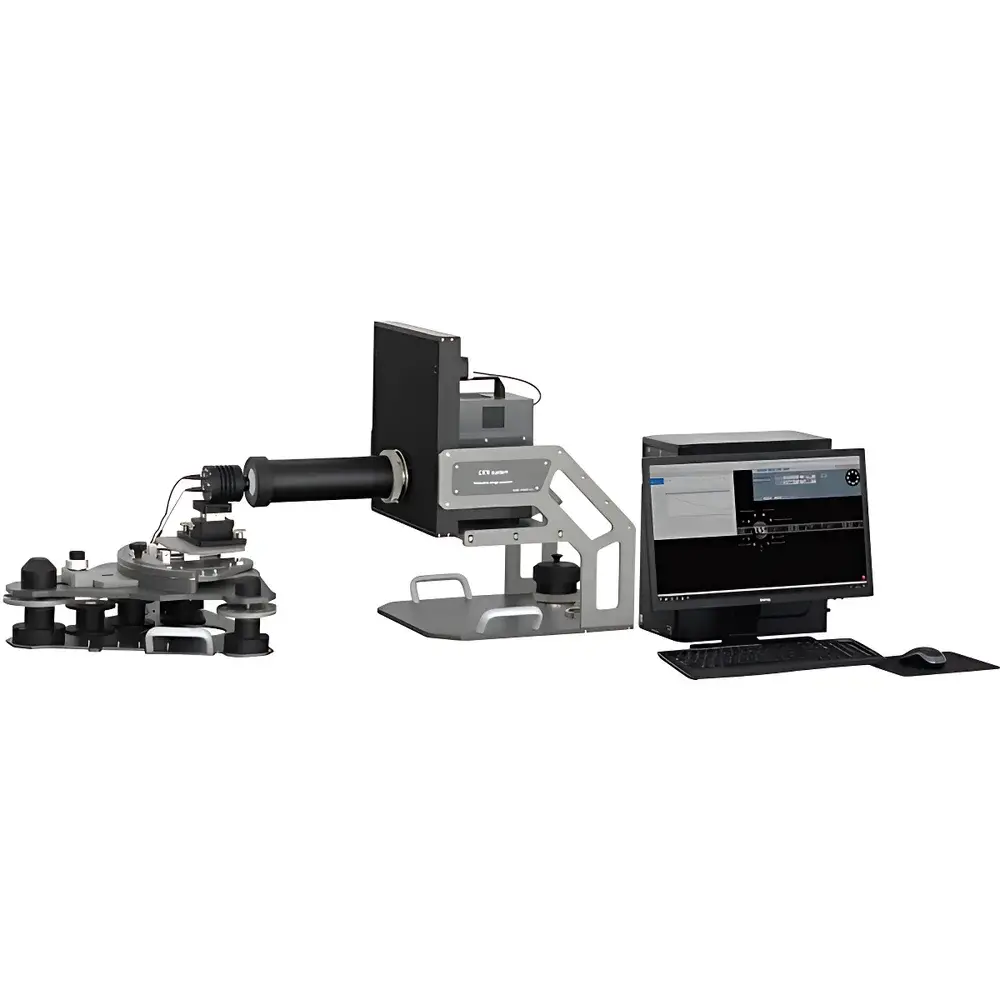
Inframet DTR Short-Focal Thermal Imaging Test System
| Brand | Inframet |
|---|---|
| Origin | Poland |
| Model | DTR |
| Spectral Range | LWIR 8–14 µm |
| Image Acquisition Options | Analog (PAL/NTSC), Camera Link (CL), GigE Vision, LVDS, HD-SDI, HDMI, SPI, UART |
| Measured Parameters | MRTD, MTF, SiTF, NETD, FPN, Non-Uniformity (NU), FOV, RCOL, SRF, ATF, SNR, MDTD, Auto-MRTD, PVF, 3D Dead Pixel Map, Response Function |
| Blackbody Temp. Range | 0 °C to ambient +20 °C (ΔT = –20 °C to +20 °C), Emissivity: 0.98 ± 0.005 (blackbody), 0.97 ± 0.01 (target wheel) |
| Temp. Uncertainty | 0.001 × |
| Target Wheel | Ø54 mm, configurable targets (slit, knife-edge, crosshair) |
| Optical Path | RCOL430L (Ø40 mm, >93% transmission, 8–14 µm) or RCOL210L/M (Ø20 mm, 8–14 µm or 3–5 µm) |
| Spatial Resolution | >3 lp/mrad (RCOL430L, >93% transmittance) |
| Control Interface | USB 2.0 |
| Software Support | TCB (Thermal Camera Bench), TAS (Thermal Analysis Suite), SUB-T module |
Overview
The Inframet DTR Short-Focal Thermal Imaging Test System is a turnkey metrology platform engineered for rigorous performance characterization of uncooled and cooled thermal imaging cameras operating in the long-wave infrared (LWIR) spectral band (8–14 µm). Designed in accordance with international standard test methodologies—including ISO 18564 (infrared imaging system performance evaluation), ASTM E1213 (minimum resolvable temperature difference), and MIL-STD-3009 (electro-optical imaging system testing)—the DTR integrates calibrated blackbody sources, precision motorized target wheels, high-transmission collimators, and synchronized digital acquisition to deliver traceable, repeatable measurements of critical electro-optical parameters. Its short-focal optical architecture enables compact benchtop deployment while maintaining full compliance with collimated far-field simulation requirements. The system operates on the principle of spatial-spectral radiometric calibration: modulated thermal targets are projected through an f/2.0 collimator onto the device under test (DUT), enabling measurement of modulation transfer function (MTF), noise-equivalent temperature difference (NETD), minimum resolvable temperature difference (MRTD), spatial frequency response (SRF), and non-uniformity (NU) under controlled thermal and geometric conditions.
Key Features
- Modular collimator suite: RCOL430L (Ø40 mm aperture, >93% transmission, 8–14 µm) and RCOL210L/M (Ø20 mm, dual-band support for 8–14 µm or 3–5 µm) ensure compatibility across microbolometer, QWIP, and Type-II superlattice detector formats.
- High-stability blackbody source: Temperature-controlled to ±0.01 °C absolute uncertainty (0 °C to ambient +20 °C), with emissivity certified at 0.98 ± 0.005 and 1 mK setpoint resolution.
- Programmable target wheel: Ø54 mm diameter, motorized indexing with user-configurable targets—including slit, knife-edge, crosshair, and bar patterns—each with certified emissivity of 0.97 ± 0.01.
- Multi-interface image acquisition: Native support for analog PAL/NTSC, plus optional digital interfaces including Camera Link (CL), GigE Vision, LVDS, HD-SDI, HDMI, SPI, and UART—enabling synchronization with third-party frame grabbers and embedded vision systems.
- Integrated control architecture: USB 2.0 host interface coordinates blackbody ramping, target positioning, shutter timing, and data logging via the TCB (Thermal Camera Bench) application layer.
- Comprehensive parameter extraction: Automated calculation of MRTD (including Auto-MRTD), MTF, SiTF (spatial impulse transfer function), NETD, fixed-pattern noise (FPN), non-uniformity (NU), field-of-view (FOV), RCOL, SRF, ATF (aperture transfer function), PVF (pixel value function), and 3D dead pixel mapping.
Sample Compatibility & Compliance
The DTR accommodates thermal imagers with focal lengths from 6 mm to 50 mm and detector formats up to 1280 × 1024 pixels. It supports both staring and scanning architectures, including VOx and a-Si microbolometers, HgCdTe (MCT), InSb, and quantum well infrared photodetectors (QWIPs). All measurement protocols align with ISO/IEC 17025-accredited laboratory practices. Calibration artifacts—including blackbody cavities and target patterns—are traceable to PTB (Physikalisch-Technische Bundesanstalt) and NIST standards. The system satisfies functional requirements for GLP-compliant validation workflows and supports audit-ready data export compliant with FDA 21 CFR Part 11 when deployed with validated TAS software configurations.
Software & Data Management
The DTR is operated via two tightly integrated software modules: TCB (Thermal Camera Bench) for real-time hardware orchestration and TAS (Thermal Analysis Suite) for post-acquisition analysis and reporting. TAS implements ISO 18564-compliant algorithms for MTF derivation (via slanted-edge and knife-edge methods), NETD computation (using temporal noise variance over uniform scenes), and MRTD determination (per human observer modeling per ASTM E1213). All raw image sequences, metadata (timestamp, blackbody setpoint, target ID, integration time), and derived metrics are stored in HDF5 format with embedded provenance tags. Export options include CSV, PDF reports with traceable uncertainty budgets, and XML-based configuration files for cross-laboratory method replication. Optional SUB-T module enables automated multi-target sequence execution with pass/fail logic against user-defined specification limits.
Applications
- Factory acceptance testing (FAT) of thermal camera cores prior to integration into defense EO/IR turrets, UAV payloads, and industrial condition-monitoring systems.
- R&D validation of new detector materials (e.g., vanadium oxide, amorphous silicon, quantum dots) and readout integrated circuit (ROIC) designs under varying scene dynamics and thermal drift conditions.
- Periodic performance verification in ISO 17025-certified calibration laboratories serving aerospace, medical thermography, and automotive ADAS development.
- Development and verification of AI-based thermal image enhancement algorithms, where ground-truth MTF and noise spectra are required for training dataset curation.
- Support for MIL-HDBK-344A environmental stress screening correlation studies, linking thermal parameter drift to thermal cycling exposure.
FAQ
Does the DTR support MWIR (3–5 µm) camera testing?
Yes—when configured with the RCOL210M collimator (Ø20 mm, 3–5 µm spectral range) and compatible blackbody source settings, the DTR fully supports MWIR imager characterization.
Can the system perform automated MRTD measurements without human observer input?
Yes—the Auto-MRTD mode uses contrast threshold modeling based on ISO 18564 Annex B to compute objective MRTD curves without subjective observer panels.
Is the TAS software qualified for regulated environments (e.g., FDA-regulated medical thermography devices)?
TAS can be deployed in 21 CFR Part 11-compliant configurations when installed on validated Windows OS platforms with electronic signature and audit trail enabled; IQ/OQ documentation packages are available upon request.
What is the maximum detector resolution supported for MTF analysis?
The system supports MTF evaluation for detectors up to 1280 × 1024 pixels using sub-pixel edge localization algorithms with <0.05 pixel uncertainty.
Are calibration certificates included with the system shipment?
Yes—each DTR ships with factory calibration certificates for blackbody emissivity, target wheel pattern dimensions, collimator focal length, and spectral transmittance, all traceable to national metrology institutes.





