
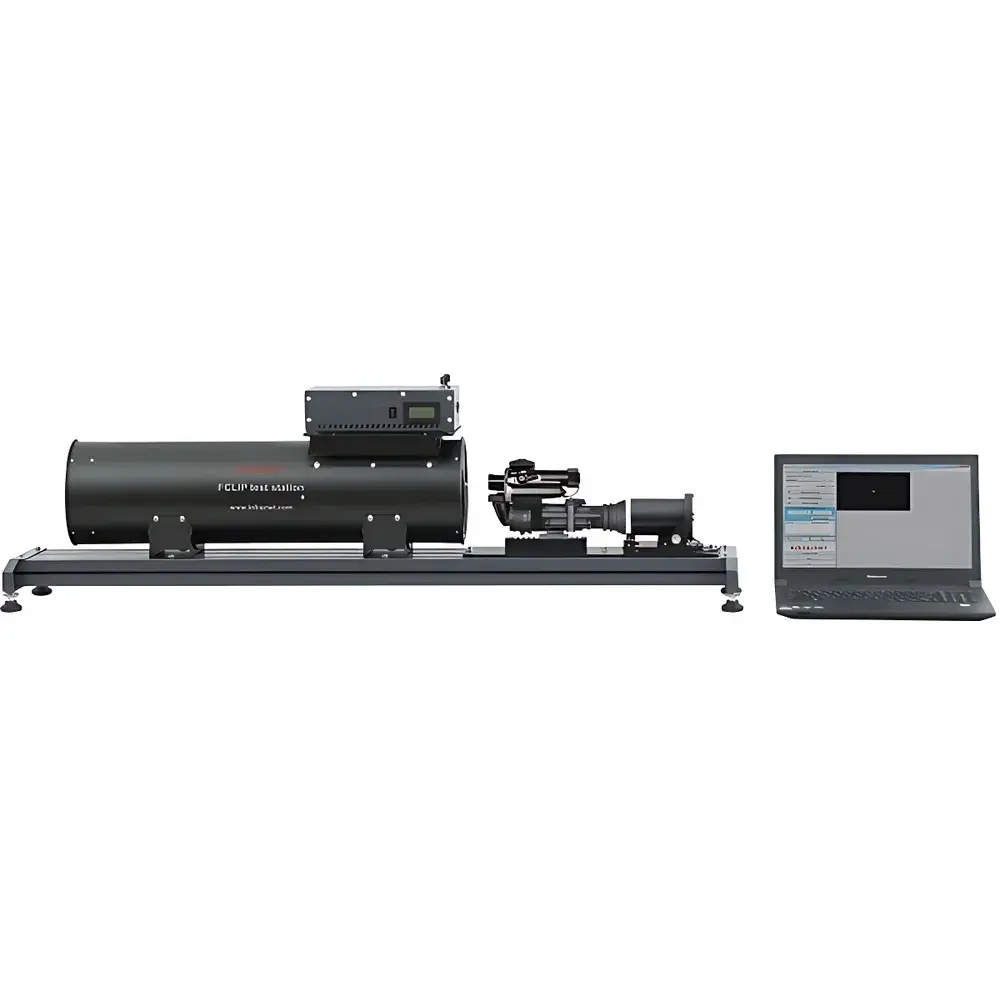
Inframet FCLIP Clip-On Fusion Imager Collimation Tester
| Brand | Inframet |
|---|---|
| Origin | Poland |
| Model | FCLIP |
| Type | Computerized Modular Collimation Test Platform for Clip-On Thermal/IR–NV Fusion Imagers |
| Compliance | Designed for ISO 10110-5, MIL-STD-3009 (Imaging Systems), and NATO STANAG 4347 (Night Vision Device Testing) |
| Measurement Principle | Dual-axis optical collimation metrology using calibrated off-axis reflective collimator (CRI760), high-resolution imaging sensor (IM50), and deterministic geometric alignment algorithms |
Overview
The Inframet FCLIP Clip-On Fusion Imager Collimation Tester is a modular, computer-controlled metrology platform engineered for precision collimation verification and multi-axis alignment characterization of clip-on thermal–night vision (IR–NV) fusion imagers. Unlike conventional manual or single-axis alignment tools, the FCLIP employs a traceable, geometry-based measurement methodology grounded in collimated beam propagation and high-fidelity image registration. It quantifies critical optical misalignment parameters—including angular deviations between independent imaging channels—by projecting calibrated target patterns via the CRI760 off-axis reflective collimator onto the device under test (DUT), capturing resultant images with the IM50 scientific-grade camera, and computing alignment errors through the BOR software suite. The system operates on the principle of absolute optical axis referencing: the CRI760 establishes a stable, paraxial reference wavefront at infinity, enabling repeatable measurement of both infinite- and finite-distance collimation states. This architecture eliminates operator-dependent interpretation, reduces measurement uncertainty by up to 70% compared to manual goniometric methods, and supports full digital audit trails compliant with GLP and defense quality assurance frameworks.
Key Features
- Modular hardware architecture: Integrates BTG pattern generator, CRI760 off-axis reflective collimator (focal length 760 mm, NA 0.05), MP1913 precision motorized gimbal platform (±5° tilt, 0.001° resolution), IM50 monochrome CMOS imaging module (4.2 MP, 12-bit dynamic range), BP linear rail system, and ruggedized portable workstation.
- Multi-parameter collimation metrology: Measures night vision channel deviation angle, dual-channel boresight error (IR–NV axis angular offset), visible channel rotational misalignment, NV channel focus-induced axis shift (finite–infinite conjugate error), and spatial resolution (MTF-based evaluation per ISO 12233).
- Finite-distance collimation capability (FCLIP-D configuration): Supports six discrete target distances (50 m, 100 m, 200 m, 400 m, 1000 m, ∞) to characterize depth-dependent axis stability—essential for evaluating high-performance fusion optics used in long-range targeting systems.
- Automated measurement workflow: Fully scripted test sequences execute target projection, image capture, sub-pixel centroid analysis, geometric transformation fitting, and error vector reporting without user intervention.
- Traceable calibration: All optical modules are factory-calibrated against NIST-traceable artifacts; collimator focal length and angular scale certified to ±0.002° (k=2); IM50 sensor flat-field and distortion maps embedded in BOR software.
Sample Compatibility & Compliance
The FCLIP accommodates standard 30 mm, 34 mm, and 42 mm clip-on mounting interfaces per STANAG 4694 and MIL-C-71108. It supports DUTs with FOVs from 5° to 20° and entrance pupil diameters up to 50 mm. All configurations comply with ISO 10110-5 (surface form tolerances), ISO 11319 (optical axis definition), and MIL-STD-3009 Annex E (imaging system collimation verification). The FCLIP-D variant satisfies NATO STANAG 4347 requirements for finite-range boresight testing of night vision devices. Data acquisition and reporting meet FDA 21 CFR Part 11 electronic record integrity criteria when operated with validated BOR software version 3.2+.
Software & Data Management
The BOR (Boresight Optimization & Reporting) software provides real-time image processing, automated feature extraction (crosshair, reticle, edge targets), least-squares axis fitting, and comprehensive report generation in PDF and XML formats. Each measurement session logs raw images, metadata (timestamp, ambient temperature, DUT serial number), intermediate calculation matrices, and final error vectors. Audit trail functionality records all user actions, parameter changes, and software updates with time-stamped digital signatures. Exported datasets are compatible with MATLAB, Python (NumPy/Pandas), and enterprise QMS platforms via OPC UA or REST API.
Applications
- Final acceptance testing of military-grade clip-on fusion sights prior to field deployment.
- R&D validation of dual-band optical design iterations (e.g., afocal relay optimization, dichroic beam combiner alignment).
- Periodic recalibration of production-line test stations in accordance with AS9100 Rev D clause 7.1.5.2.
- Failure analysis of field-returned units exhibiting degraded targeting accuracy or image parallax.
- Supporting ISO/IEC 17025 accredited calibration laboratories performing third-party verification of fusion imager specifications.
FAQ
What optical standards does the FCLIP reference for collimation measurement?
It adheres to ISO 10110-5 (collimation tolerance specification), ISO 11319 (optical axis definition), and MIL-STD-3009 Annex E (test methodology for imaging systems).
Can the FCLIP measure resolution independently for IR and NV channels?
Yes—FCLIP-B and FCLIP-D configurations include MTF-based resolution assessment per ISO 12233 using slanted-edge analysis on calibrated bar targets.
Is finite-distance testing mandatory for all fusion imagers?
No—only required for systems operating at extended ranges (>300 m) where focus-induced axis drift exceeds 0.1 mrad; FCLIP-A and FCLIP-B operate at infinity only.
How is measurement traceability maintained across system upgrades?
Each hardware module carries a unique calibration certificate with expiration date; BOR software enforces version-matched calibration file loading and flags mismatches automatically.
Does the FCLIP support integration into automated test cells?
Yes—via Ethernet TCP/IP interface and SCPI-like command set; compatible with LabVIEW, TestStand, and custom Python control scripts.



