
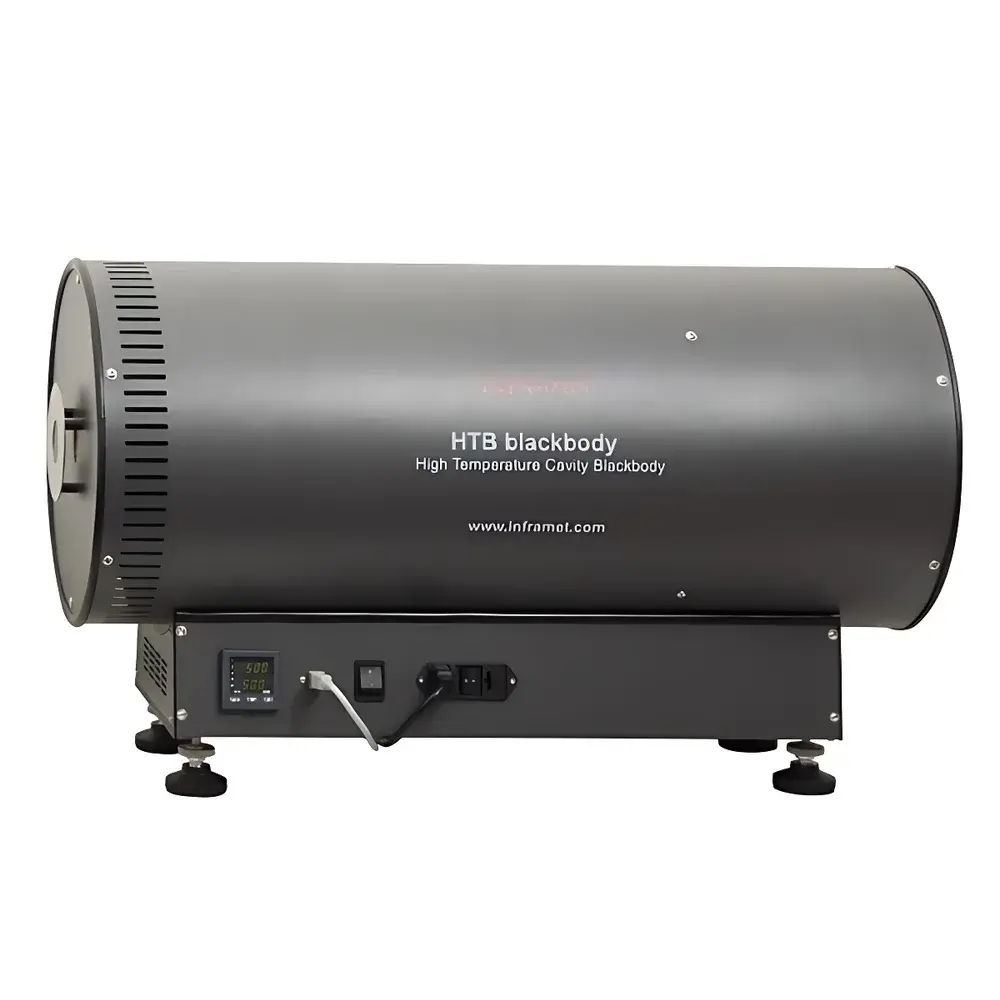
Inframet HTB-25D-1200 High-Temperature Cavity Blackbody
| Brand | Inframet |
|---|---|
| Origin | Poland |
| Model | HTB-25D-1200 |
| Aperture | 25 mm (35 mm optional) |
| Emissivity | >0.995 |
| Temperature Range | 100–1200 °C |
| Temperature Resolution | 0.1 °C ≤1000 °C |
| Temperature Uncertainty | ±0.25 °C or ±1 °C (whichever greater) |
| Short-term Stability | ±1 °C |
| Long-term Stability | ±1.5 °C |
| Uniformity at 800 °C | ±1.5 °C (25 mm aperture), ±2.5 °C (35 mm aperture) |
| Warm-up Time | <80 min |
| Power Supply | 230 V AC (110 V optional) |
| Dimensions | 403 × 712 × 292 mm |
| Weight | 23 kg |
Overview
The Inframet HTB-25D-1200 is a high-temperature, precision cavity blackbody source engineered for radiometric calibration and spectral responsivity characterization across the ultraviolet–visible–near-infrared–long-wave infrared (UV–VIS–NIR–LWIR) spectrum (0.4–30 µm). Its design follows fundamental principles of thermal radiation physics: a deeply recessed, temperature-controlled cylindrical cavity with high-emissivity internal walls and a precisely defined aperture establishes near-ideal blackbody behavior via multiple internal reflections and minimal escape factor. This geometry ensures spectral radiance closely approximates Planck’s law over its full operating range—from 100 °C up to 1200 °C—making it suitable for calibrating infrared cameras, spectroradiometers, thermopile detectors, and FTIR systems requiring traceable, stable, and spatially uniform radiation sources.
Key Features
- High emissivity (>0.995) validated per ASTM E1933-19 and ISO/IEC 17025-accredited procedures, supported by cavity geometry analysis and in-situ radiometric verification.
- Extended spectral coverage from 0.4 µm (visible) to 30 µm (long-wave IR), enabling cross-band calibration of multi-spectral imaging systems and broadband radiometers.
- Dual-aperture option (25 mm standard; 35 mm optional) with documented uniformity profiles at key reference temperatures (e.g., ±1.5 °C at 800 °C for 25 mm aperture).
- Temperature control system featuring PID regulation with dual-stage feedback, achieving short-term stability of ±1.0 °C and long-term drift <±1.5 °C over 8-hour operational cycles.
- Thermal uniformity mapping performed at 800 °C and 1000 °C per NIST-traceable protocols, with results documented in factory calibration reports supplied with each unit.
- USB-based digital interface compliant with USB 2.0 standards, supporting integration into automated calibration workflows via SCPI-compatible command sets.
- Robust mechanical architecture: stainless-steel vacuum-jacketed housing with ceramic insulation, rated for continuous operation at 1200 °C with no degradation in cavity integrity or emissivity performance.
Sample Compatibility & Compliance
The HTB-25D-1200 is designed for use with optical instruments requiring primary or secondary radiometric standards—including cooled and uncooled IR imagers, scanning monochromators, integrating sphere input systems, and filter-based radiometers. It meets functional requirements for compliance with ISO 18434-1 (condition monitoring — infrared thermography), ASTM E1256-22 (test methods for radiation thermometers), and supports validation under FDA 21 CFR Part 11 when used with compliant data acquisition software. All units ship with a manufacturer’s certificate of calibration, including traceability to PTB (Physikalisch-Technische Bundesanstalt) reference standards. Optional on-site recalibration services are available through Inframet’s EU-accredited metrology laboratory.
Software & Data Management
Inframet provides the HTB Control Suite—a Windows-based application supporting real-time temperature ramping, dwell control, profile logging, and export of time-stamped radiance data in CSV and HDF5 formats. The software implements audit-trail functionality compliant with GLP/GMP documentation requirements, recording operator ID, session timestamps, parameter changes, and calibration event history. Remote operation is enabled via TCP/IP wrapper (optional), facilitating integration into centralized lab management systems. Firmware updates preserve backward compatibility and include enhanced thermal model compensation algorithms for improved uncertainty estimation above 1000 °C.
Applications
- Primary calibration of infrared thermometers and thermal imaging systems per ISO/IEC 17025 accredited laboratories.
- Validation of spectral response functions for hyperspectral sensors operating in MWIR/LWIR bands.
- Characterization of detector linearity and saturation thresholds across wide dynamic ranges (e.g., 300–1200 K blackbody temperatures).
- Testing and verification of atmospheric transmission models using known Planckian sources.
- Research in high-temperature material emissivity measurement, where the HTB serves as a reference source in guarded-hot-plate or emissometer configurations.
- Supporting development and verification of radiative heat transfer simulations in aerospace and energy sectors.
FAQ
What is the maximum recommended continuous operating temperature?
The HTB-25D-1200 is rated for continuous operation at 1200 °C; however, extended exposure above 1100 °C may reduce long-term thermal stability and requires periodic revalidation of uniformity and emissivity.
Is the 35 mm aperture version calibrated separately?
Yes—each aperture configuration undergoes independent thermal mapping and emissivity verification; calibration certificates specify aperture size and corresponding uniformity data.
Can the HTB be integrated into an automated calibration line?
Yes—SCPI command set and USB/TCP/IP interfaces support seamless integration with LabVIEW, Python (PyVISA), and MATLAB-based automation platforms.
Does the unit comply with electromagnetic compatibility (EMC) directives for laboratory use?
It conforms to EN 61326-1:2013 for EMC and EN 61010-1:2010 for electrical safety, certified for CE marking in the European Economic Area.
How often should recalibration be performed?
Annual recalibration is recommended for routine metrological use; more frequent intervals (e.g., semi-annual) are advised in environments with >200 thermal cycles/year or critical regulatory applications.



