
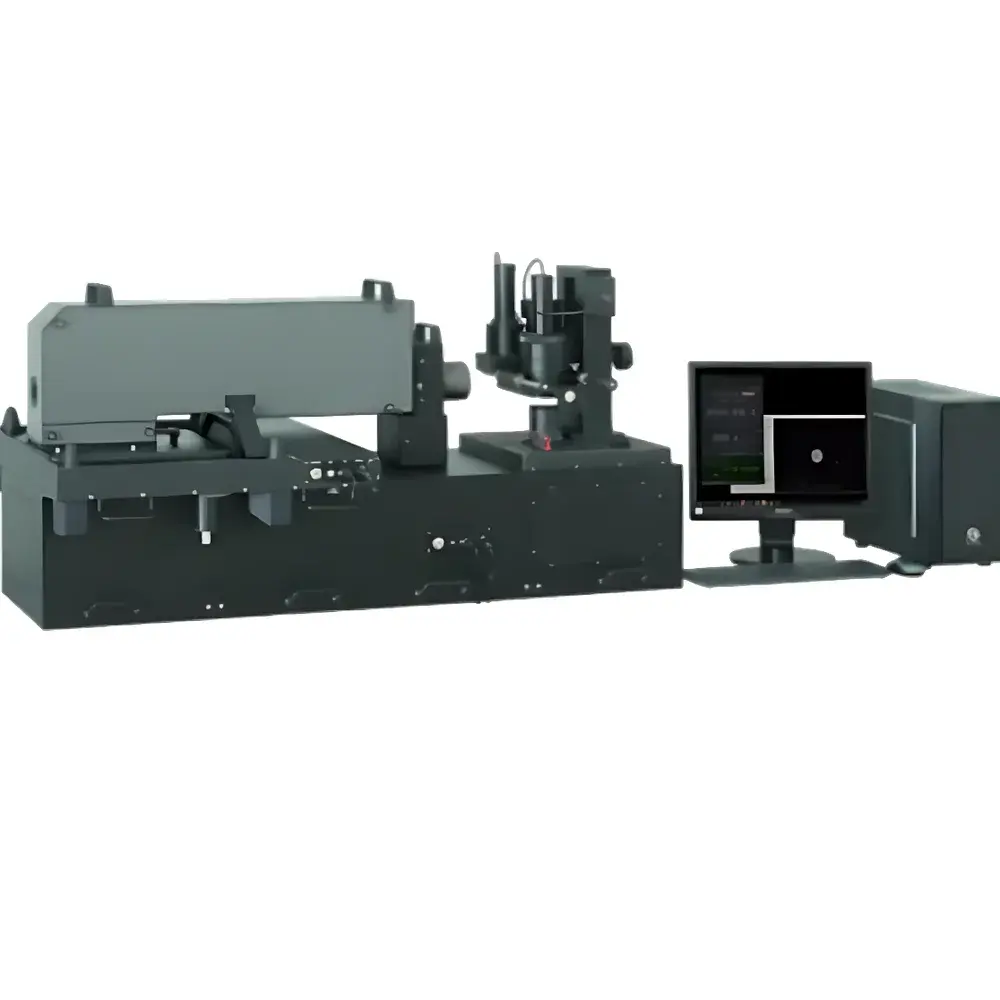
Inframet IBIG Advanced Image Intensifier Tube Test System
| Brand | Inframet |
|---|---|
| Origin | Poland |
| Model | IBIG |
| Spectral Range | 240–1600 nm |
| Max. Photocathode Diameter | 40 mm |
| Measurable Parameters | 18 |
| Resolution Capability | up to 80 lp/mm |
| Measurement Uncertainty | ≤7% (typ.) |
| Calibration Interval | 2 years |
| Light Source | LS-UVIR (Halogen + 9-band LED) |
| Imaging Optics | RC15137 Reflective Macro Objective |
Overview
The Inframet IBIG Advanced Image Intensifier Tube Test System is a purpose-built metrology platform engineered for the precise, traceable characterization of non-standard image intensifier tubes (IITs). Unlike conventional night-vision IIT test systems—optimized for small-diameter (≤25 mm), VIS–NIR-sensitive devices—the IBIG addresses critical measurement gaps in UV, UV–VIS, UV–SWIR, and large-aperture (25–40 mm) IITs used in specialized applications including solar-blind UV imaging, space-borne instrumentation, spectroscopic sensors, and low-light R&D imaging arrays. Its core architecture departs fundamentally from refractive projection designs (e.g., Inframet’s ITIP series) by implementing a broadband reflective macro-objective (RC15137), eliminating chromatic aberration across the full 240–1600 nm spectral band and enabling uniform illumination and high-fidelity image projection onto photocathodes up to 40 mm in diameter. The system operates under principles of photometric and radiometric traceability, with all optical, electronic, and software components aligned to support uncertainty budgets compliant with ISO/IEC 17025 requirements.
Key Features
- Photocathode diameter support up to 40 mm—enabling evaluation of large-format, scientific-grade IITs incompatible with standard night-vision testers
- Extended spectral coverage from 240 nm (deep UV) to 1600 nm (short-wave infrared), achieved via dual-mode LS-UVIR light source: calibrated 2856 K halogen lamp for broadband photometry (400–1600 nm) and nine discrete high-stability LEDs (265, 290, 400, 500, 595, 720, 810, 910, 1050 nm) for monochromatic responsivity mapping
- High-resolution performance validation: capable of measuring modulation transfer function (MTF) up to 50 lp/mm and spatial resolution up to 80.6 lp/mm with ≤6% relative uncertainty
- Optimized optical train featuring RC15137 reflective macro-objective—minimizing wavefront error and eliminating chromatic focus shift across the full UV–SWIR range
- Comprehensive parameter set: quantifies 18 critical IIT performance metrics—including SNR, EBI, brightness gain, MTF, resolution, halo geometry, photocathode sensitivity (radiometric and photometric), output luminance, and multi-mode noise—each with documented uncertainty budgets
- On-site recalibration capability using CALIN calibration kit; no return-to-factory requirement for routine 2-year recalibration cycles
Sample Compatibility & Compliance
The IBIG system accommodates both fiber-optic and proximity-focused IIT configurations with photocathode diameters from 18 mm to 40 mm and input window materials spanning fused silica (UV-transmissive), borosilicate (VIS), and SWIR-optimized substrates. It supports testing under controlled irradiance levels ranging from 10−20 W/cm² (ultra-low-light EBI characterization) to >10−2 W/cm² (high-flux gain and linearity assessment), enabled by precision mechanical attenuators with >12-decade dynamic range. All measurements adhere to foundational standards including ISO 14524 (optical transfer function), ISO 15739 (noise measurement in imaging systems), and IEC 61000-4-3 (EMC immunity for laboratory instrumentation). Test reports generated by the IBIG software include full uncertainty statements, environmental monitoring logs (temperature, humidity), operator identification, and instrument calibration status—meeting documentation rigor required for GLP, GMP, and ISO/IEC 17025 accredited laboratories.
Software & Data Management
The IBIG control and analysis suite runs on a dedicated Windows-based workstation and provides fully automated test sequencing, real-time image acquisition, and parametric computation per IEC 62676-5 and MIL-STD-3009 Annex D guidelines. Raw sensor data (16-bit TIFF or FITS format), processed MTF curves, SNR histograms, and resolution target overlays are stored with embedded metadata (wavelength, exposure time, attenuation setting, photocathode position). Audit trails record all user actions, parameter modifications, and calibration events in accordance with FDA 21 CFR Part 11 requirements. Export options include PDF reports with digital signatures, CSV datasets for statistical process control (SPC), and XML schemas compatible with LIMS integration. Optional SMT (Signal Measurement Toolkit) modules enable advanced spatial noise decomposition, halo profile fitting, and photocathode quantum efficiency modeling using NIST-traceable reference detectors.
Applications
- Characterization of solar-blind UV image intensifiers for corona detection, flame monitoring, and UV astronomy instrumentation
- Qualification of large-format IITs for space missions—where radiation-hardened photocathodes (e.g., GaAsP, CsTe) and SWIR response (>1000 nm) are essential for Earth observation payloads
- R&D validation of next-generation hybrid IITs integrating microchannel plates (MCPs) with CMOS readout, requiring precise halo geometry and inter-electrode distance metrology
- Production-line acceptance testing for OEMs supplying IITs to defense, medical endoscopy, and ultrafast laser diagnostics systems
- Independent third-party verification for ISO/IEC 17025-accredited calibration laboratories performing IIT type approval per NATO AEP-97 or STANAG 4347
FAQ
What distinguishes IBIG from Inframet’s ITIP series?
The ITIP systems are optimized for small-format (≤25 mm), VIS–NIR night-vision IITs using refractive projection optics. IBIG replaces that architecture with a reflective macro-objective and broadband UV–SWIR light engine—enabling accurate, low-aberration testing of large-diameter and spectrally extended IITs.
Can IBIG perform radiometric calibration of photocathode sensitivity?
Yes—using NIST-traceable reference detectors and calibrated LED/halogen sources, IBIG measures both photopic (μA/lm) and radiometric (mA/W) photocathode responsivity across 240–1600 nm with ≤8% relative uncertainty.
Is ISO/IEC 17025 compliance built into the reporting workflow?
Yes—every test report includes uncertainty budgets per parameter, calibration certificate references, environmental monitoring data, and digital signature fields meeting Clause 7.8.2 of ISO/IEC 17025:2017.
How is system recalibration performed?
Using the portable CALIN calibration kit, users perform on-site recalibration of photometric, radiometric, and spatial scales without shipping the system; full procedure documentation and traceability records are maintained within the software.
Does IBIG support custom target patterns or user-defined test sequences?
Yes—the FRW8 rotating target wheel accepts user-supplied targets (e.g., USAF 1951, sine-wave, slanted-edge), and the software API allows scripting of bespoke test protocols via Python or LabVIEW.




