
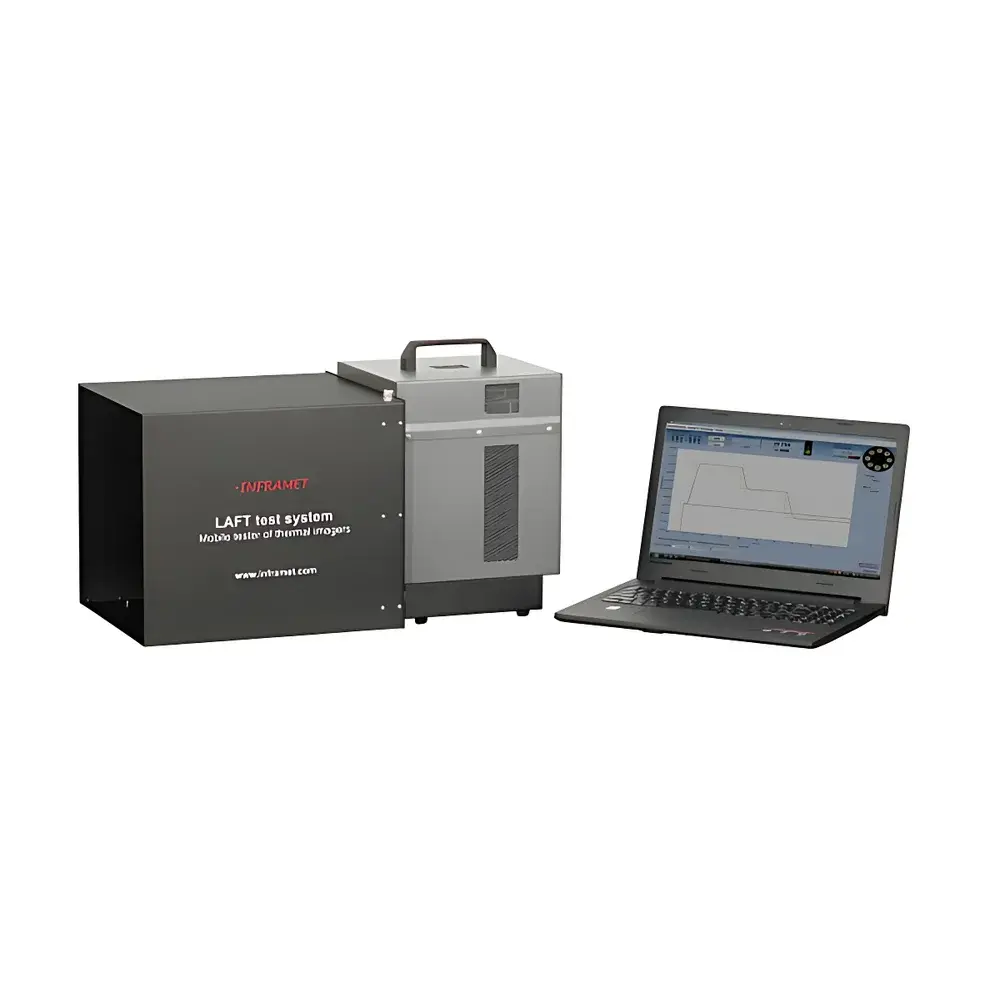
Inframet LAFT Mobile Thermal Imager Test System
| Brand | Inframet |
|---|---|
| Origin | Poland |
| Model | LAFT |
| Application | Field & Laboratory MRTD/MDTD/MTF/NETD/Non-Uniformity/SiTF/Distortion/FOV/Target Recognition Testing |
| Target Compatibility | Unrestricted Aperture |
| Operating Distance | > Minimum Focus Distance of DUT |
| Environmental Rating | -20 °C to +55 °C (non-condensing) |
| Blackbody Stability | ±0.003 °C (ΔT < 10 °C), Temp Resolution: 0.001 °C |
| Target Panel Size | 300 × 300 mm |
| System Weight | 20 kg (blackbody + target + TCB-6D enclosure) |
| Power Option | 12 V DC (optional converter) |
Overview
The Inframet LAFT Mobile Thermal Imager Test System is a portable, field-deployable calibration and performance verification platform engineered for quantitative evaluation of thermal imaging systems—primarily uncooled and cooled infrared cameras operating in MWIR and LWIR spectral bands. Unlike conventional collimator-based test benches, the LAFT employs a direct-projection architecture: high-contrast, temperature-controlled target patterns are projected onto the focal plane of the device under test (DUT) at distances exceeding its minimum focus distance. This eliminates optical alignment dependencies associated with collimated beam setups and enables rapid, geometry-agnostic assessment of spatial and thermal performance metrics. The system is designed to meet the functional equivalency of laboratory-grade DT-series testers under controlled ambient conditions—achieving comparable measurement repeatability for key parameters including Minimum Resolvable Temperature Difference (MRTD), Minimum Detectable Temperature Difference (MDTD), Modulation Transfer Function (MTF), Noise-Equivalent Temperature Difference (NETD), Fixed-Pattern Noise (FPN), non-uniformity, Spatial Invariant Transfer Function (SiTF), geometric distortion, field-of-view (FOV), and target recognition/detection thresholds per MIL-STD-3009 and ISO 18544.
Key Features
- True field-deployable architecture: fully self-contained in ruggedized transport cases; operational within minutes without facility integration.
- No aperture limitation: accommodates thermal imagers of any optical diameter—from handheld monoculars to large-aperture turret-mounted systems—without adapter optics or mechanical modification.
- Multi-unit concurrent testing: capable of projecting calibrated targets simultaneously onto two or more co-located thermal imagers for synchronized performance benchmarking.
- Non-intrusive in-situ validation: enables performance verification while the DUT remains mounted on platforms such as armored vehicles, UAV gimbals, or fixed surveillance towers—eliminating disassembly risks and downtime.
- Thermally stable blackbody source (LAFT-B variant): TCB-6D insulated enclosure with active temperature control, ±0.003 °C stability over ΔT < 10 °C, and 0.001 °C resolution across –20 °C to +55 °C ambient range.
- Modular target library: includes FOV-calibrated contour targets, SiTF slanted-edge arrays, MTF bar patterns, and MIL-STD-3009-compliant 3-bar resolution charts—all sized to 300 × 300 mm active area.
Sample Compatibility & Compliance
The LAFT system supports all common thermal imaging detector technologies—including VOx microbolometers, InSb, and HgCdTe—and interfaces seamlessly with analog and digital video outputs (PAL/NTSC, Camera Link, GigE Vision). It complies with metrological traceability requirements outlined in ISO/IEC 17025 for accredited calibration laboratories and satisfies data integrity provisions of FDA 21 CFR Part 11 when used with validated TCBSuite software (audit trail enabled, electronic signatures supported). All target pattern geometries conform to ISO 18544 (imaging performance of thermal cameras) and MIL-STD-3009 (infrared sensor performance testing). Environmental operation is certified per IEC 60529 IP54 for dust and water resistance during field deployment.
Software & Data Management
Control and analysis are executed via the TCBSuite application—a Windows-based platform supporting automated test sequencing, real-time thermal drift compensation, and standardized report generation in PDF/XML formats. Raw image acquisition utilizes a PCIe frame grabber with 12-bit digitization and hardware timestamping. Software modules include MRTD/MDTD curve fitting per ASTM E1543, NETD calculation per ISO 18544 Annex B, FPN quantification using temporal averaging, and distortion mapping via polynomial coefficient regression. All measurement sessions are logged with full metadata (ambient T, RH, DUT model/firmware, operator ID, GPS coordinates if enabled), ensuring GLP/GMP audit readiness.
Applications
- Field acceptance testing of thermal weapon sights and driver vision enhancers prior to military vehicle commissioning.
- Routine health monitoring of border surveillance IR cameras without service interruption.
- Verification of thermal imager performance following shock/vibration exposure or thermal cycling per MIL-STD-810.
- Comparative evaluation of multi-vendor IR systems in procurement qualification programs.
- Support for ISO 18544-compliant type approval testing in third-party certification labs.
- Research into human-in-the-loop target recognition thresholds using calibrated perceptual stimuli.
FAQ
Does the LAFT require collimation or optical alignment with the DUT?
No. The LAFT operates via direct projection at distances greater than the DUT’s minimum focus distance—eliminating collimator dependency and alignment sensitivity.
Can LAFT measure both cooled and uncooled thermal imagers?
Yes. Its target contrast and thermal dynamic range support performance characterization across all standard IR detector types and spectral bands (MWIR/LWIR).
Is the system compliant with FDA 21 CFR Part 11 for regulated environments?
When deployed with TCBSuite v4.2+ and configured with user authentication, audit logging, and electronic signature workflows, it meets core Part 11 requirements for electronic records and signatures.
What is the maximum operational distance between LAFT and the DUT?
There is no fixed upper limit; however, projection fidelity and signal-to-noise ratio must be verified per DUT pixel pitch and lens f-number—typical field use ranges from 1.5 m to 25 m.
How is thermal stability maintained during extended outdoor measurements?
The TCB-6D enclosure integrates dual-stage thermoelectric cooling/heating, vacuum insulation, and closed-loop PID control—ensuring blackbody surface stability within ±0.003 °C for durations exceeding 4 hours.





