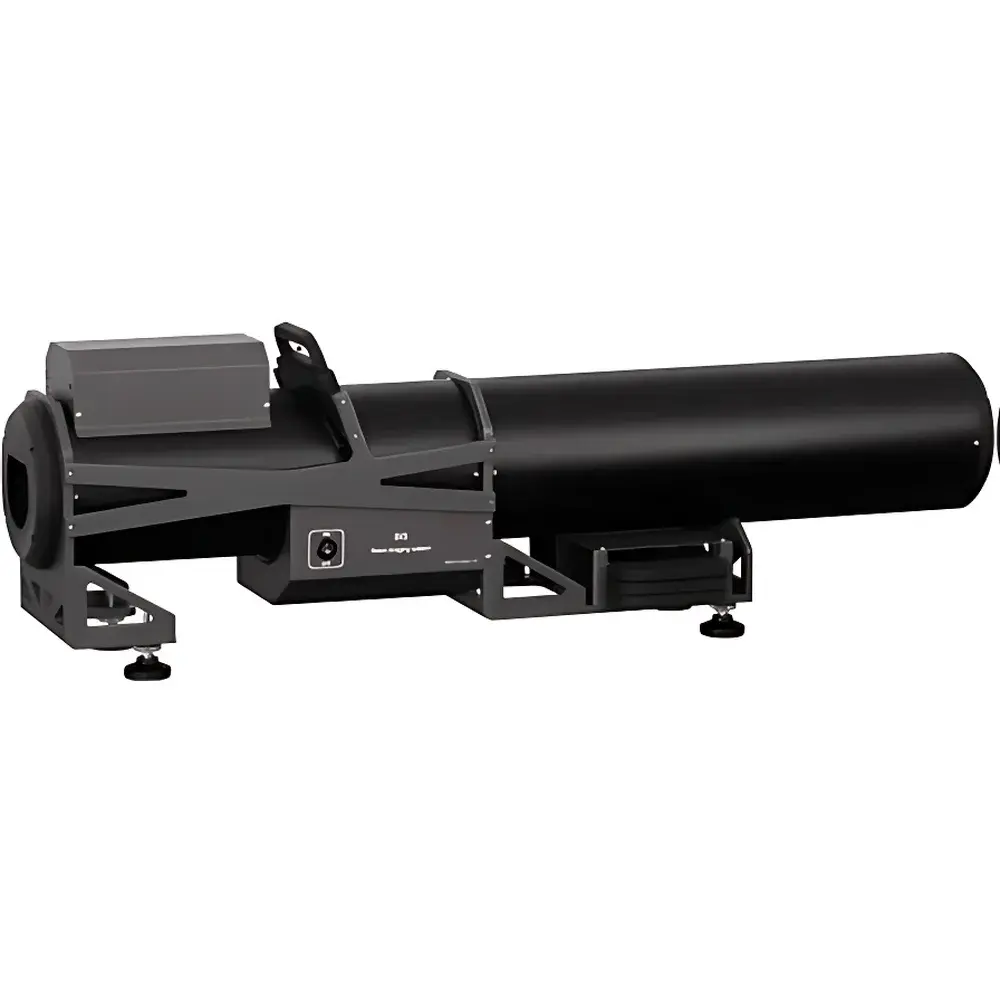
Inframet LIP Laser Indicator and Illuminator Testing System
| Brand | Inframet |
|---|---|
| Origin | Poland |
| Model | LIP |
| Beam Imaging System | LBIS |
| Power Meter | LCOP |
| Spectral Range (LBIS) | 400–1000 nm |
| Spectral Range (LCOP) | 400–1060 nm |
| LBIS Aperture | 46 mm |
| LCOP Effective Aperture | 24 mm |
| Power Measurement Range | 0.001 mW – 3 W |
| Power Resolution | 0.001 mW |
| Nonlinearity | <1% |
| LBIS Dynamic Range | >10⁶ |
| LBIS Divergence Range | 0.25 mrad – 200 mrad |
| LBIS Camera Resolution | 1280 × 1024 |
| LBIS Field of View (Narrow) | 24 mrad |
| LBIS Field of View (Wide) | 240 mrad |
| Operating Temperature | +10 °C to +35 °C |
| Storage Temperature | −5 °C to +50 °C |
| LBIS Dimensions | 1129 × 345 × 245 mm |
| LBIS Weight | ~23 kg |
| LCOP Electronics Dimensions | 226 × 76 × 169 mm |
Overview
The Inframet LIP Laser Indicator and Illuminator Testing System is a fully integrated, metrology-grade optical measurement platform engineered for the quantitative characterization of visible and near-infrared laser sources used in targeting, alignment, active illumination, and machine vision applications. Designed in accordance with fundamental radiometric and photometric principles, the LIP system combines two calibrated subsystems—LBIS (Laser Beam Imaging System) and LCOP (Laser Calibrated Optical Power meter)—to simultaneously quantify spatial beam parameters (e.g., divergence angle, intensity distribution uniformity, centroid position, beam diameter per ISO 11146-1) and absolute optical power (per ISO/IEC 17025-traceable calibration protocols). The system operates on the principle of direct imaging of the focused laser spot onto a high-dynamic-range CMOS sensor (LBIS), coupled with precision thermopile- and photodiode-based power detection (LCOP), enabling traceable, repeatable measurements across six orders of magnitude in irradiance without manual attenuation or range switching.
Key Features
- Modular dual-subsystem architecture: LBIS for spatial beam profiling and LCOP for absolute power measurement—both independently calibrated and co-aligned for correlated analysis.
- LBIS achieves >10⁶ dynamic range via hardware-level gain control and logarithmic pixel response mapping, eliminating saturation artifacts even when characterizing high-peak-power pulsed diodes alongside continuous-wave micro-watt emitters.
- LCOP employs a NIST-traceably calibrated, large-area (24 mm Ø) silicon photodiode with uniform angular responsivity (±1.5% over ±10° cone), minimizing cosine error during off-axis illumination testing.
- Automated divergence calculation per ISO 11146-1 Annex B: software computes full-angle divergence from second-moment (D4σ) beam widths measured at multiple axial positions along the propagation path.
- Beam uniformity assessment per ISO 13694: quantifies top-hat deviation using normalized intensity histograms, peak-to-valley ratio, and encircled energy metrics within user-defined apertures.
- Full compliance with EN 60825-1:2014 safety classification workflows—automatically generates required measurement reports for Class 1–Class 4 laser product certification.
Sample Compatibility & Compliance
The LIP system supports collimated and divergent laser sources emitting between 400 nm and 1060 nm, including single-mode and multimode diode lasers, VCSEL arrays, and fiber-coupled modules. It accommodates divergence angles from 0.25 mrad (telecentric long-range pointers) to 200 mrad (wide-field structured-light illuminators), and power levels spanning 1 µW to 3 W—covering Class 1 through Class 4 devices per IEC 60825-1. All optical components are certified to RoHS and REACH standards; calibration certificates include uncertainty budgets compliant with ILAC-G8:2009 and traceable to PTB (Physikalisch-Technische Bundesanstalt) reference standards. The system meets electromagnetic compatibility requirements per EN 61326-1:2013 and is suitable for GLP-compliant laboratories performing laser safety audits or OEM verification per FDA 21 CFR Part 1040.10.
Software & Data Management
The LIP Control Suite is a Windows-based application developed under IEC 62304 Class B software lifecycle requirements. It provides real-time beam visualization, automated measurement sequencing, and export of raw image data (16-bit TIFF), power logs (CSV), and compliance reports (PDF/X-3). Audit trail functionality records all user actions, parameter changes, and calibration events with timestamps and operator IDs—fully satisfying FDA 21 CFR Part 11 electronic record/electronic signature (ER/ES) requirements. Data files embed EXIF metadata including spectral bandpass, integration time, gain setting, and calibration certificate ID. Batch processing mode enables unattended testing of multi-unit production lots, with pass/fail thresholds configurable per parameter (e.g., divergence tolerance ±5%, uniformity >85%).
Applications
- Verification of military-grade laser aiming modules (LAMs) against MIL-STD-1472G beam quality requirements.
- R&D validation of automotive LiDAR illuminators, ensuring eye-safety compliance (IEC 60825-1 Class 1M) under worst-case optical coupling conditions.
- Production line testing of medical endoscopic laser illumination systems, where uniformity and thermal stability directly impact diagnostic image fidelity.
- Characterization of industrial machine vision illuminators for robotic guidance—measuring field flatness, edge sharpness, and temporal stability over 8-hour thermal soak cycles.
- Supporting ISO/IEC 17025 accredited calibration labs in delivering accredited power and divergence measurements for third-party laser device certification.
FAQ
Is the LBIS camera sensitive to pulsed laser operation?
Yes—the LBIS system supports both CW and pulsed lasers with repetition rates up to 10 kHz and pulse widths ≥10 ns, provided average power remains within the 0.1 mW–3 W operational envelope.
Can the LIP system measure beams with elliptical or asymmetric profiles?
Yes—software calculates independent D4σ diameters along orthogonal axes and reports astigmatism ratio, orientation angle, and M²-equivalent beam propagation parameters.
Does LCOP require recalibration after field use?
No—LCOP is factory-calibrated with drift compensation algorithms; however, annual recalibration is recommended to maintain ISO/IEC 17025 accreditation validity.
Is remote operation supported for integration into automated test benches?
Yes—LIP Control Suite exposes a documented COM interface and TCP/IP command set compatible with LabVIEW, Python (pywin32), and MATLAB instrumentation toolboxes.
What documentation is supplied with the system?
Each unit ships with a Certificate of Conformance, NIST-traceable calibration certificates for LBIS and LCOP, ISO 11146-compliant measurement procedure manuals, and a complete set of CE/UKCA technical files.