
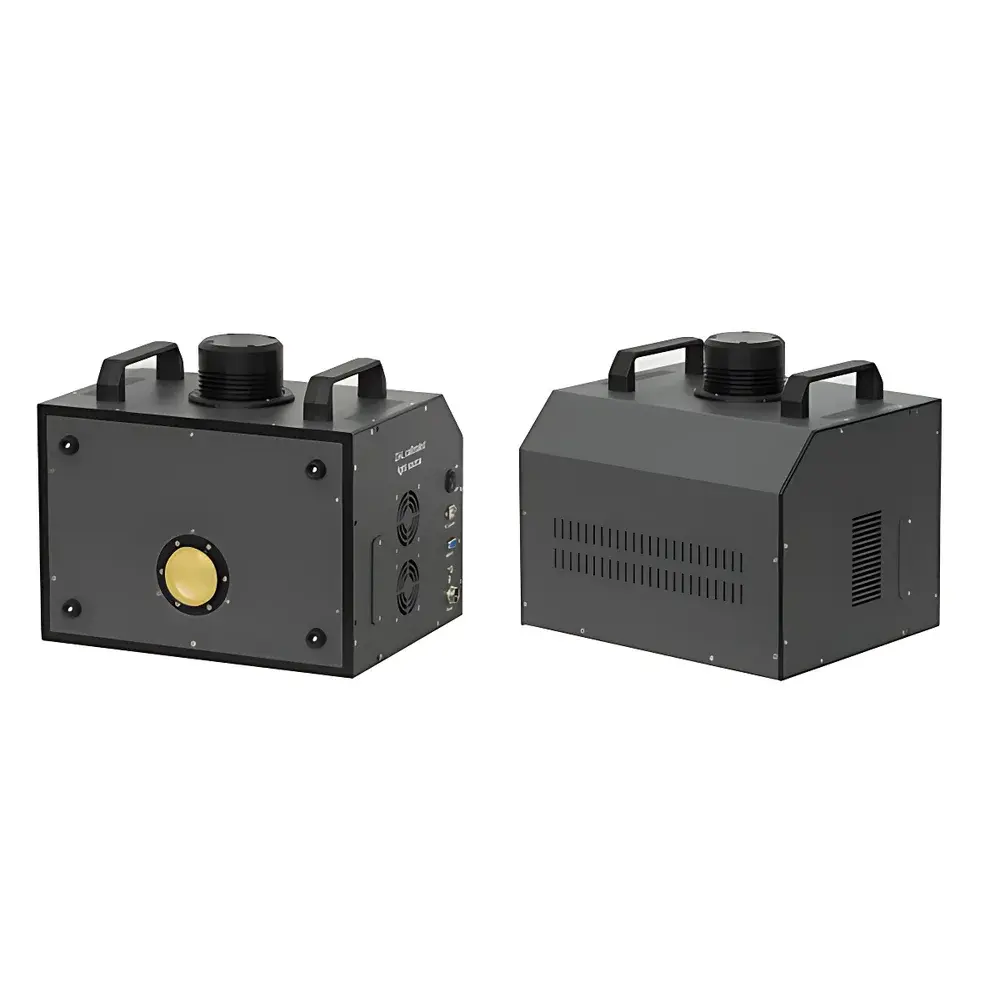
Inframet LS-DAL Multi-Channel Broadband Visible–NIR Calibration Source
| Brand | Inframet |
|---|---|
| Origin | Poland |
| Model | LS-DAL |
| Spectral Range | 400–1100 nm |
| Luminance Range (DN version) | 10 μcd/m² – 10 kcd/m² |
| Dynamic Range | 10⁹ |
| Output Angle | ≤15° (Lambertian) |
| Operating Temperature | +5°C to +35°C |
| Dimensions | 380 × 260 × 250 mm |
| Weight | 12 kg |
Overview
The Inframet LS-DAL Multi-Channel Broadband Visible–NIR Calibration Source is a precision-engineered radiometric reference instrument designed for laboratory-grade calibration, verification, and performance validation of electro-optical imaging systems. It operates across the full visible to short-wave infrared spectrum (400–1100 nm), supporting rigorous photometric and radiometric testing of CCD, CMOS, ICCD, EBCCD, and SWIR focal plane arrays used in defense, remote sensing, industrial inspection, and scientific imaging applications. The LS-DAL implements four distinct illumination modes—halogen, white LED, UV-A LED, and hybrid—each optimized for specific spectral fidelity, temporal stability, and dynamic range requirements. Its core architecture integrates calibrated thermal and solid-state emitters with high-precision mechanical and electronic attenuation, enabling continuous luminance control from sub-microlumen to kilocandela levels. Unlike single-spectrum sources, the LS-DAL maintains traceable spectral power distribution (SPD) across all modes, with halogen output approximating a gray-body radiator at 2856 K (±50 K) and white LED output exceeding 5000 K CCT—facilitating realistic simulation of daylight, twilight, and low-light operational environments.
Key Features
- Four independent, software-selectable illumination modes: Halogen (VIS–NIR, 400–1000 nm), White LED (VIS-dominant, 400–800 nm), UV-A LED (340–410 nm), and Hybrid (combined halogen + LED for extended dynamic coverage)
- Ultra-wide luminance range: 10 μcd/m² to 10 kcd/m² (DN configuration), delivering 10⁹ dynamic range—suitable for both starlight-level sensitivity validation and solar-lit target simulation
- Lambertian output profile with ≤15° half-angle, ensuring uniform irradiance over test targets and compatibility with collimated optical setups
- Continuous, high-resolution luminance adjustment: 10 μcd/m² resolution in low-brightness regime; <1% temporal stability over ≥30 min; <90 s thermal stabilization (halogen mode), <60 s (LED mode)
- Integrated dual-path attenuation: motorized neutral-density filters for coarse range selection and analog current/voltage control for fine-grained intensity modulation
- Factory-calibrated spectral radiance data provided per mode, traceable to national metrology institutes (e.g., PTB, NIST) via ISO/IEC 17025-accredited procedures
Sample Compatibility & Compliance
The LS-DAL is engineered for direct integration into automated test benches and optical alignment stations. Its 40 mm exit aperture accommodates standard lens mounts (C-mount, F-mount adapters optional) and supports spatially resolved MTF, SNR, and dynamic range characterization of imagers up to 1″ format. The source complies with key international standards governing optical measurement instrumentation, including ISO 14524 (electro-optical imaging system testing), ISO 15739 (noise measurement), and ASTM E284 (standard terminology for optics). For regulated environments—including defense qualification labs and medical imaging R&D—the LS-DAL’s firmware logs all calibration events, user interventions, and environmental parameters (temperature, humidity), satisfying audit requirements under ISO 9001, ISO/IEC 17025, and GLP frameworks. Optional external bandpass filters (VIS-only or NIR-only) enable spectral isolation for sensor QE mapping per ISO 15739 Annex D.
Software & Data Management
Control and configuration are executed via Inframet’s LS-Control Suite—a Windows-based application supporting local USB/Ethernet connectivity and remote API access (TCP/IP, SCPI-compliant commands). The software provides real-time luminance monitoring, multi-point non-uniformity correction tables, and scheduled sequence execution for repeatable test protocols. All measurement sessions generate timestamped .csv and .xml metadata files containing spectral irradiance values, shutter timing, filter positions, and environmental sensor readings. Audit trails are retained with immutable timestamps and operator ID tagging—enabling full compliance with FDA 21 CFR Part 11 for electronic records and signatures when deployed in regulated QA/QC workflows. Firmware updates and calibration certificate reissuance are managed through secure, authenticated cloud portal access.
Applications
- Calibration and linearity verification of VIS–SWIR cameras in aerospace EO/IR systems (e.g., UAV payload validation, satellite imager ground truthing)
- Dynamic range and blooming assessment of low-light intensified sensors (ICCD/EBCCD) under simulated night-sky background conditions
- UV-A resistance testing of optical coatings, filters, and detector window materials
- Development and validation of automatic exposure control (AEC) algorithms across extreme luminance gradients
- Inter-laboratory comparison studies requiring metrologically traceable broadband sources compliant with CIE S 023/E:2019
- Training and certification of optical test engineers using standardized scene luminance profiles per MIL-STD-810H optical test methods
FAQ
Is the LS-DAL suitable for absolute radiometric calibration?
Yes—when used with a NIST-traceable reference detector and configured per ISO/IEC 17025 procedures, the LS-DAL serves as a primary transfer standard for luminance and irradiance calibration.
Can the source be integrated into an automated production test line?
Yes—SCPI command support, TTL trigger I/O, and Ethernet-based remote control enable seamless integration with PLCs, vision controllers, and MES platforms.
What is the uncertainty budget for luminance output in halogen mode?
At 100 cd/m², expanded uncertainty (k=2) is ±2.3% (coverage includes spectral mismatch, angular response, and temperature drift compensation).
Does the LS-DAL require annual recalibration?
Inframet recommends recalibration every 12 months or after 2000 operating hours—whichever occurs first—to maintain traceability and ensure compliance with ISO/IEC 17025.
Are custom spectral filters supported?
Yes—third-party bandpass, notch, or edge filters with SM1-threaded mounts can be installed in the optional external filter wheel accessory (sold separately).




