
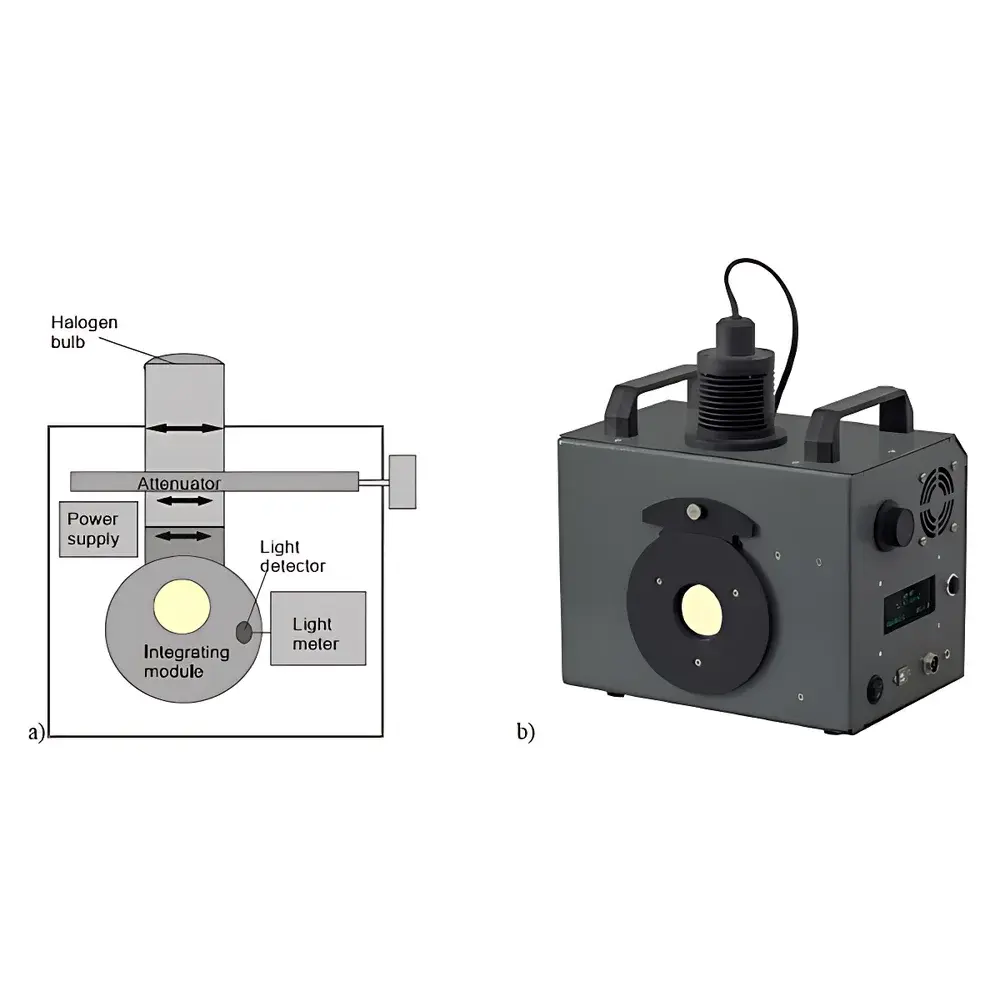
Inframet LS-LAM-40M Manual Halogen Standard Light Source
| Brand | Inframet |
|---|---|
| Origin | Poland |
| Model | LS-LAM-40M |
| Spectral Range | 350–2200 nm |
| Aperture | 40 mm (expandable to 100 mm with C100 collimator tube) |
| Color Temperature | 2856 K ± 100 K (measured over 400–1000 nm) |
| Luminance Range | 1 mcd/m² to 800 cd/m² |
| Luminance Resolution | 0.1 mcd/m² (low-range) |
| Stability | < 1% (over 30 min, ambient-controlled) |
| Filter Options | 3-position manual spectral filter wheel (VIS-only / NIR+SWIR / SWIR-only) |
| Dimensions | 370 × 490 × 290 mm |
| Weight | 12 kg |
Overview
The Inframet LS-LAM-40M is a manually operated, high-stability halogen-based standard light source engineered for radiometric and photometric calibration of VIS–SWIR imaging systems, focal plane arrays, and optical sensors. It implements a precision multi-filament tungsten-halogen lamp operating under controlled thermal equilibrium to reproduce the spectral power distribution of a blackbody radiator at approximately 2856 K—aligned with the CIE illuminant A reference standard. Its calibrated output spans 350 nm to 2200 nm, covering the full visible (VIS), near-infrared (NIR), and short-wave infrared (SWIR) spectral bands essential for multispectral and hyperspectral instrument validation. Designed for laboratory-grade traceability, the LS-LAM-40M delivers spectrally stable, spatially uniform irradiance across its 40 mm exit aperture—extendable to 100 mm via the optional C100 collimator tube—enabling compatibility with both compact sensor elements and larger-format imaging optics.
Key Features
- High-fidelity spectral match to CIE Illuminant A (2856 K ± 100 K, validated over 400–1000 nm)
- Manually adjustable luminance from 1 mcd/m² to 800 cd/m² using a precision mechanical neutral-density attenuator
- Sub-millilambert resolution (0.1 mcd/m²) in low-luminance regime, supporting low-light sensor characterization
- Three-position manual filter wheel for selective spectral band isolation: (1) VIS-only (350–780 nm), (2) NIR+SWIR (780–2200 nm), (3) SWIR-only (1000–2200 nm)
- Optical stability better than 1% over 30 minutes under stabilized ambient conditions (23 ± 1 °C, <50% RH)
- Robust mechanical architecture with vibration-damped base and thermally isolated lamp housing to minimize drift
- Compact footprint (370 × 490 × 290 mm) and modular design facilitating integration into optical benches and calibration stations
Sample Compatibility & Compliance
The LS-LAM-40M serves as a primary reference source for calibrating radiometric transfer standards, integrating spheres, lens-based test setups, and camera-based measurement systems compliant with ISO 15739 (electronic still-picture imaging — noise measurements), ISO 17321-1 (color rendering assessment), and ASTM E308 (computing CIE colors from spectrophotometric data). Its spectral coverage and luminance range support verification of linearity, dynamic range, dark signal non-uniformity (DSNU), photoresponse non-uniformity (PRNU), and spectral responsivity per MIL-STD-810G (optical system environmental testing). The device is supplied with NIST-traceable calibration certificates (optional upon request) and meets CE marking requirements for electromagnetic compatibility (EMC Directive 2014/30/EU) and low-voltage safety (LVD Directive 2014/35/EU). It is suitable for use in GLP-compliant laboratories where documented instrument qualification and periodic recalibration are required.
Software & Data Management
While the LS-LAM-40M operates exclusively in manual mode—ensuring deterministic, repeatable hardware-level control without software dependencies—it is fully compatible with third-party calibration management platforms including OptiCAL, Radiant Vision Systems TrueTest, and custom LabVIEW or Python-based automation suites via analog voltage input (0–10 V) for external luminance monitoring. All calibration reports include spectral irradiance data (W·sr⁻¹·m⁻²·nm⁻¹), relative spectral power distribution (SPD), and spatial uniformity maps measured per ISO 9037. Audit trails for user adjustments, filter selection timestamps, and lamp operating hours can be logged externally using standard industrial I/O modules conforming to IEEE 1588 PTP for time synchronization in metrology networks.
Applications
- Radiometric calibration of VIS–SWIR cameras used in remote sensing, agricultural monitoring, and semiconductor wafer inspection
- Characterization of quantum efficiency and spectral response functions of InGaAs, Si, and extended-InGaAs detectors
- Validation of optical attenuation standards and neutral density filter sets per ISO 9050
- Testing of spectral filter transmission curves in multispectral filter wheels and tunable Fabry–Pérot interferometers
- Reference source for inter-laboratory comparison exercises organized under EURAMET and BIPM frameworks
- Supporting development and verification of radiometric correction algorithms in airborne and spaceborne imaging spectrometers
FAQ
Is the LS-LAM-40M suitable for automated calibration systems?
Yes—while operation is manual, its analog monitoring interface and mechanical repeatability make it ideal for integration into semi-automated calibration workflows requiring deterministic, human-verified setpoints.
Can the C100 collimator tube be retrofitted to an existing LS-LAM-40M unit?
Yes—the C100 is a field-installable accessory; no internal modifications are required. Alignment and beam collimation are verified using integrated alignment targets and included collimation verification chart.
What is the recommended lamp replacement interval?
The halogen lamp is rated for ≥2000 hours of operation at nominal voltage. For metrological applications, lamp replacement is advised after 1500 hours or if color temperature deviation exceeds ±100 K during routine verification.
Does Inframet provide NIST-traceable calibration with delivery?
A factory calibration certificate (traceable to PTB or NPL standards) is included by default. NIST-traceable certification is available as a configurable option at order stage, with associated uncertainty budgets per ISO/IEC 17025.
How is thermal drift managed during extended measurements?
The lamp housing incorporates dual-stage thermal mass buffering and forced-air cooling regulated by internal thermistors. Ambient temperature must remain within 22–24 °C; deviations beyond ±1 °C require re-equilibration before critical measurements.





