
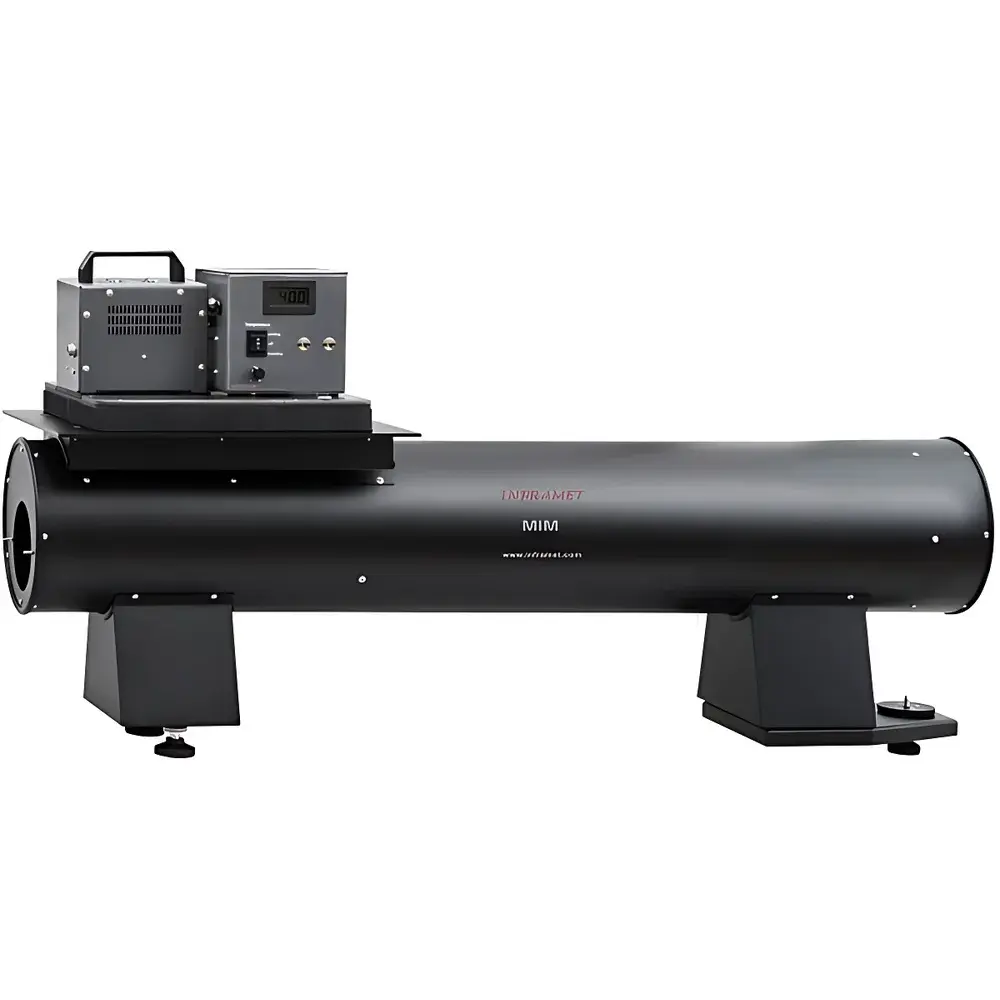
Inframet MIM Modular Multi-Sensor Test System
| Brand | Inframet |
|---|---|
| Origin | Poland |
| Model | MIM |
| Type | Non-computerized, manually operated modular optical test system for thermal/visible sensor alignment and performance verification |
| Optical Configuration | Off-axis reflective collimator (CDT series) + uncalibrated dual-color blackbody (DNCB) + manual target slider (TP2) + adjustable NIR/thermal contrast source |
| Spectral Range | 0.4–15 µm |
| Target Types | Metallic & glass USAF 1951 (1.00–57 lp/mm), coaxial alignment pinhole (0.5 mm standard) |
| Collimator Aperture | 110–300 mm |
| Focal Length | 300–1000 mm |
| Spatial Resolution | ≥100 lp/mrad |
| Mirror Surface Accuracy | λ/6 P-V @ 630 nm (HR grade) |
| Emissivity | ≥0.95 |
| Blackbody ΔT Range | ±10 °C vs ambient |
| Brightness Range | ≤500 cd/m² |
| Power Supply | 110/220 VAC, 50/60 Hz |
| Operating Temperature | +5 °C to +35 °C |
| Weight | 7–90 kg (system-dependent) |
Overview
The Inframet MIM Modular Multi-Sensor Test System is a purpose-engineered, non-computerized optical test platform designed for cost-effective verification of alignment, focus, resolution, and relative sensitivity in multi-sensor imaging systems—particularly those integrating thermal infrared (LWIR/MWIR) and visible-band cameras. Unlike fully automated metrology stations, the MIM leverages fundamental optical projection principles: it functions as an image projection apparatus in which a physical target—positioned at the focal plane of an off-axis reflective collimator—is illuminated by a dual-color blackbody (DNCB) source and projected as a collimated beam. This enables infinity-focused testing of both thermal and visible imagers under controlled thermal contrast and photometric conditions. The system operates on relative modulation rather than absolute radiometric calibration; its DNCB source provides adjustable thermal contrast (±ΔT up to 10 °C relative to ambient) and independent NIR brightness control via manual potentiometers—making it suitable for comparative pass/fail evaluation, production-line verification, and field maintenance where traceable NIST-calibrated output is not required.
Key Features
- Modular architecture with five core subsystems: CDT-series off-axis reflective collimator, DNCB uncalibrated dual-color blackbody with DCON controller, TP2 manual target stage, standardized USAF 1951 targets (metallic and glass variants), and optional MRW8 motorized target wheel for automated sequencing.
- Collimator options span CDT11100HR through CDT30200HR, supporting apertures from 110 mm to 300 mm and focal lengths from 300 mm to 1000 mm—enabling configuration-specific FOV, resolution, and angular sampling density.
- HR-grade optics with λ/6 surface accuracy (P-V @ 630 nm) and protected aluminum coatings ensure high wavefront fidelity across the full 0.4–15 µm spectral band.
- Dual-mode contrast generation: thermal contrast via blackbody temperature differential (−10 °C to +10 °C vs ambient) and visible/NIR intensity modulation (≤500 cd/m²), both manually adjustable with real-time visual feedback.
- Target set includes three metallic USAF 1951 patterns (1.00–14.30 lp/mm), one glass USAF 1951 pattern (1.00–57 lp/mm), and a precision coaxial alignment target with 0.5 mm aperture (custom sizes available).
- No embedded PC or proprietary software—designed for integration with user-supplied analysis tools or legacy lab infrastructure. Optional USB-connected data acquisition modules support basic thermal camera output logging.
Sample Compatibility & Compliance
The MIM system accommodates a broad range of electro-optical sensors, including uncooled microbolometer arrays (8–14 µm), cooled InSb/MCT detectors (3–5 µm), CMOS/CCD visible imagers (0.4–0.9 µm), and extended-range SWIR cameras (0.9–1.7 µm). Its collimated output meets standard requirements for infinity focus validation per MIL-STD-810G (optical test methods) and supports alignment verification per ISO 12233 Annex D (geometric distortion assessment). While the DNCB source is not NIST-traceably calibrated, its stable emissivity (≥0.95) and repeatable thermal modulation enable consistent inter-unit comparison during manufacturing QA or depot-level repair. The system complies with CE marking requirements for electromagnetic compatibility (EN 61326-1) and low-voltage safety (EN 61010-1). It is routinely deployed in environments subject to GLP-aligned quality procedures—though it does not provide FDA 21 CFR Part 11 audit trails or electronic signature capability due to its analog control architecture.
Software & Data Management
The base MIM configuration operates without embedded firmware or proprietary software. All controls—including blackbody temperature offset, NIR intensity, and target selection—are executed via front-panel knobs and mechanical positioning. Data acquisition is external: users connect thermal or visible cameras to their own analysis platforms (e.g., MATLAB, Python-based OpenCV pipelines, or commercial MTF/resolution software such as Imatest or OptiCAL). Optional USB-enabled signal interfaces allow digitization of analog video outputs or trigger synchronization for frame-accurate capture. Because no internal storage or network stack is present, the system imposes no cybersecurity overhead and requires no software validation under IEC 62304 or ISO 13485. This design ensures long-term operational stability and eliminates obsolescence risk associated with OS-dependent applications.
Applications
- Production-line verification of boresight alignment between fused thermal/visible camera channels in EO/IR gimbals and weapon sights.
- Relative resolution and MTF screening of uncooled thermal cores prior to integration into handheld or drone-mounted payloads.
- Focus calibration and depth-of-field mapping for multi-spectral surveillance lenses using collimated USAF target projection.
- Thermal contrast sensitivity threshold testing—e.g., evaluating minimum resolvable temperature difference (MRTD) trends across batches without absolute radiometric reference.
- Maintenance depot validation of optical train integrity following lens re-mounting or dewar re-sealing.
- Academic and defense R&D labs conducting comparative studies of sensor fusion algorithms where repeatable, low-cost stimulus generation is prioritized over metrological traceability.
FAQ
Is the DNCB blackbody NIST-calibrated?
No—the DNCB is intentionally uncalibrated. It delivers repeatable relative thermal contrast modulation but does not provide traceable temperature or radiance values. Users adjust current-driven heating and NIR LED drive levels via manual controls; output is interpreted comparatively, not absolutely.
Can the MIM measure absolute MTF or modulation transfer function?
Not natively. The system projects high-frequency USAF targets for qualitative or semi-quantitative resolution assessment. For quantitative MTF, users must pair the MIM with third-party analysis software and calibrated edge or sine-wave targets.
What collimator models are compatible with the MIM platform?
Standard configurations include CDT11100HR, CDT15150HR, CDT20200HR, CDT25250HR, and CDT30200HR. Economical SR-grade variants may be substituted where λ/4 surface accuracy suffices for non-critical applications.
Does the system support automated target sequencing?
Yes—via optional MRW8 motorized target wheel, which replaces the manual TP2 slider and enables programmable, repeatable target presentation under external TTL or USB command.
What power and environmental requirements apply?
The system operates on 110/220 VAC, 50/60 Hz. Ambient operating temperature must be maintained between +5 °C and +35 °C; humidity should remain below 80% non-condensing. No active cooling or vibration isolation is required for standard use.





