
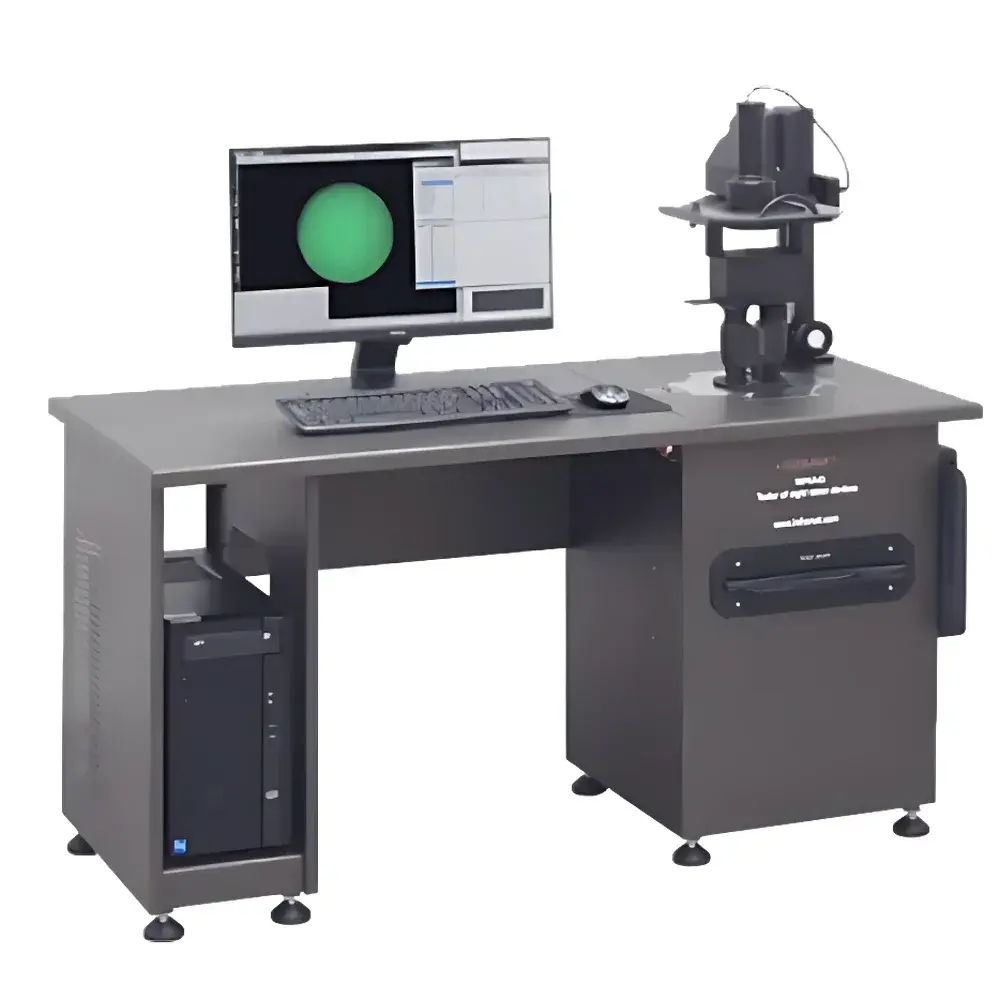
Inframet NMAG Automated Night Vision Device Testing System
| Brand | Inframet |
|---|---|
| Origin | Poland |
| Model | NMAG |
| Field of View (FOV) | up to 50° (monocular), up to 10° (binocular/scope) |
| Photometric Light Source | 2856 K halogen lamp |
| Monochromatic Light Source | 660 nm LED |
| Illuminance Range | 2×10⁻⁵ lx – 200 lx (LED mode) |
| Luminance Measurement Range (ILM3C) | 10 µcd/m² – 1000 cd/m² |
| Camera Resolution | NVC3: 1280×958 px |
| NDC3 | 2748×2748 px |
| MTF Measurement Range | 0–2.5 lp/mrad (scaled by magnification for scopes) |
| Center Resolution Range | 0.25–7.2 lp/mrad |
| Relative Uncertainty | 2%–15% depending on parameter |
| Calibration Interval | 2 years |
| On-site Re-calibration | CALNOK kit supported |
| Compliance | PN-EN ISO/IEC 17025 test report generation |
Overview
The Inframet NMAG Automated Night Vision Device (NVD) Testing System is a metrologically rigorous, fully integrated optical test platform engineered for objective, high-reproducibility characterization of image-intensifier-based night vision equipment. Unlike legacy manual or semi-automated systems—such as the NVT, NVS, or NICOM series—the NMAG implements a closed-loop, software-guided measurement architecture grounded in fundamental photometric and radiometric principles. It operates via projection-based target stimulus delivery: standardized test patterns (e.g., USAF 1951, Siemens star, contrast bars) are illuminated by dual-mode light sources and projected through a precision optical train onto the input window of the device under test (DUT). The DUT’s output image is then captured by calibrated imaging sensors (NVC3/NDC3 CMOS cameras) and photometric detectors (ILM3C luminance meter), enabling simultaneous acquisition of photometric, spatial, and noise-domain parameters without operator intervention in critical measurement phases. The system adheres to foundational U.S. military standards—including MIL-STD-3009 and MIL-L-21771—for NVD performance verification while extending beyond their procedural scope through algorithmic objectivity, traceable calibration pathways, and automated data governance.
Key Features
- Fully automated test sequences: Operator initiates measurement with a single software command after mechanical alignment; no manual target switching, focus adjustment, or illumination reconfiguration required.
- Dual-mode illumination architecture: A stabilized 2856 K halogen source enables traceable photometric measurements (e.g., brightness gain, EBI), while a 660 nm monochromatic LED source supports high-SNR imaging parameter evaluation (e.g., MTF, resolution, FPN).
- Extended field-of-view capability: Optical projection module supports monocular NVDs with FOVs up to 50°—exceeding the 40° limit of conventional systems—via an f/1.4, 55 mm aperture optical path with >50 lp/mrad intrinsic resolution.
- Objective resolution assessment: Replaces subjective observer-based methods with model-based prediction using modulation transfer function (MTF) and fixed-pattern noise (FPN) metrics, reducing inter-operator variability and improving repeatability.
- On-site recalibration support: CALNOK calibration kit enables full system verification and adjustment per ISO/IEC 17025 requirements without return-to-factory service.
- Integrated multi-sensor data fusion: Simultaneous acquisition from ILM3C luminance meter (±5% uncertainty in standard mode), NVC3 (4° × 3.1° FOV, 1280×958 px), and NDC3 (56° × 56° FOV, 2748×2748 px) ensures cross-validated parameter extraction across spatial and photometric domains.
- Compliant reporting engine: Auto-generates audit-ready test reports conforming to PN-EN ISO/IEC 17025 structure, including measurement uncertainty budgets, calibration traceability statements, environmental condition logs, and raw dataset references.
Sample Compatibility & Compliance
The NMAG accommodates all mainstream Gen II+, Gen III, and filmless image-intensifier NVD configurations, including monocular goggles (1× magnification, FOV ≤ 50°), binocular viewers, and magnified aiming devices (up to 4×, FOV ≤ 10°). Mechanical adaptability is achieved via interchangeable self-centering mounting fixtures (TAS-AN interface) and motorized target slide (TAR). All photometric measurements reference CIE 1931 V(λ) spectral luminosity function, ensuring compatibility with national metrology institutes that maintain primary standards for luminance and illuminance. The halogen light source is designed for direct comparison against accredited photometric laboratories operating under ISO/IEC 17025, while the LED channel meets ANSI PH2.10 and MIL-STD-3009 spectral fidelity requirements for monochromatic stimulus validation. System-level uncertainty budgets comply with GUM (JCGM 100:2008) methodology, and software audit trails satisfy FDA 21 CFR Part 11 electronic record integrity criteria.
Software & Data Management
The TAS-AN control suite provides real-time instrument orchestration, sensor synchronization, and adaptive exposure optimization. Its modular architecture separates acquisition, processing, and reporting layers—enabling independent validation of each computational step. Image processing employs non-proprietary, documented algorithms for MTF calculation (slanted-edge method per ISO 12233), SNR estimation (RMS-based per ISO 15739), and FPN quantification (temporal averaging over ≥100 frames). All raw sensor data (16-bit TIFF, linear gamma) and metadata (exposure time, lens aperture, ambient temperature, calibration coefficients) are stored in vendor-neutral HDF5 containers. The system supports export to CSV, XML, and PDF formats, with embedded digital signatures for report integrity. Audit logs record user actions, parameter changes, and calibration events with timestamps and operator IDs—fully supporting GLP/GMP documentation workflows.
Applications
- Production-line acceptance testing of Gen III image intensifier tubes and assembled NVDs.
- Periodic performance verification for military and law enforcement inventory maintenance programs.
- R&D characterization of next-generation microchannel plate (MCP) architectures and photocathode materials.
- Independent third-party certification per NATO AEP-97, STANAG 4591, and DEF STAN 00-139 requirements.
- Interlaboratory comparison studies under EURAMET calibration guidelines for low-light imaging metrology.
- Training and proficiency assessment for NVD test technicians via guided focus and alignment modules.
FAQ
Does the NMAG require periodic factory recalibration?
No. The system supports on-site recalibration using the CALNOK kit, eliminating downtime and shipping costs. Full verification against reference standards can be performed every two years in accordance with ISO/IEC 17025 interval recommendations.
Can the NMAG test both photometric and imaging parameters simultaneously?
Yes. Dual-source illumination and synchronized multi-sensor capture enable concurrent acquisition of brightness gain (via ILM3C + halogen source) and MTF/resolution (via NDC3 + LED source) within a single test cycle.
Is the software compliant with FDA 21 CFR Part 11?
Yes. The TAS-AN suite implements role-based access control, electronic signatures, immutable audit trails, and secure electronic record storage meeting Part 11 technical and procedural requirements.
What is the maximum measurable field of view for monocular NVDs?
50°, enabled by the NMAG-IP projection module’s optimized optical design—10° greater than industry-standard systems.
How does the NMAG improve measurement repeatability compared to observer-dependent methods?
By replacing human visual acuity thresholds with algorithmic detection limits (e.g., MTF50, SNR = 1 threshold), it removes inter-observer variability and ensures consistent pass/fail decisions across operators and facilities.





