
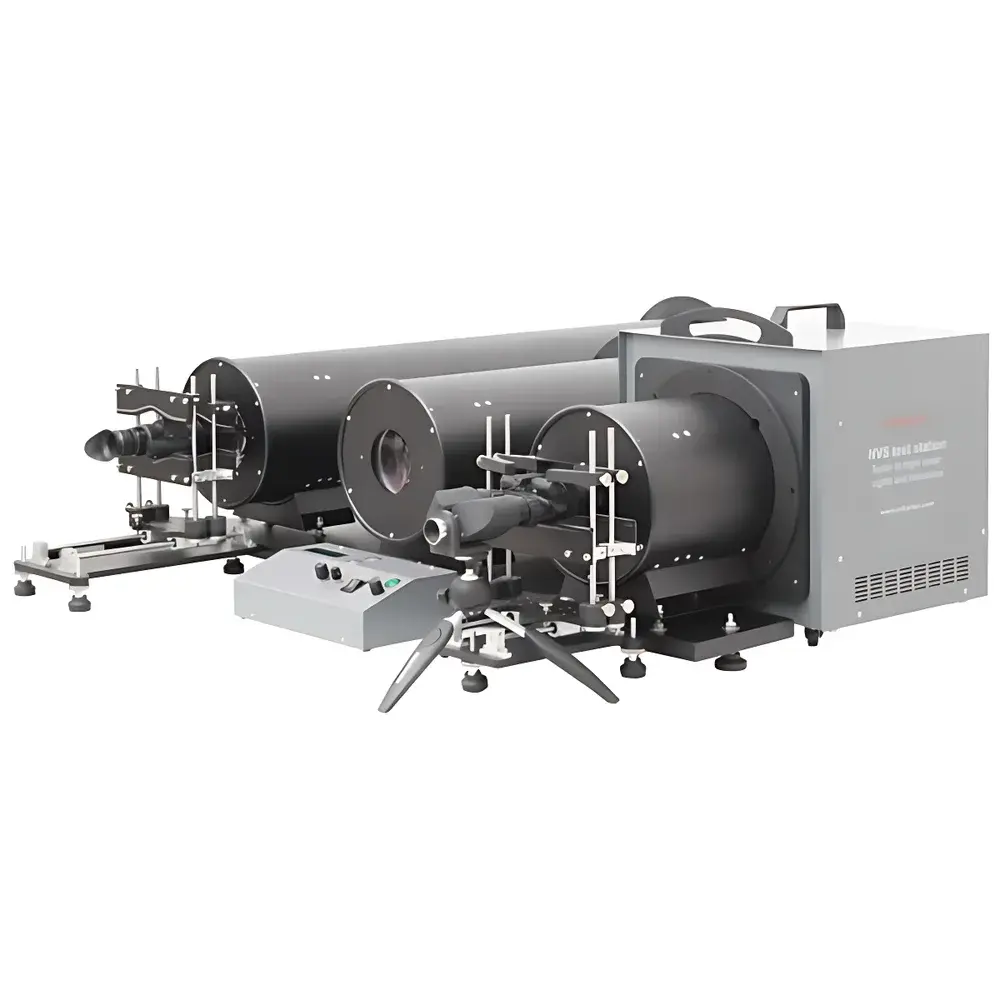
Inframet NVS Multifunctional Night Vision Device Test System
| Brand | Inframet |
|---|---|
| Origin | Poland |
| Model | NVS |
| Optical Aperture Capacity | Up to 120 mm (optional 150 mm) |
| Light Sources | Dual-source — 2850 K halogen lamp & 660 nm monochromatic LED |
| LED Illuminance Range | 0.1 mlx – 200 lx |
| Resolution | 0.01 mlx (low-light range) |
| Adjustment Type | Continuous mechanical manual control |
| Illuminance Stability | ±2% of set value |
| Collimator Options | CNV12100 (120 mm / 1000 mm), CNV950 (90 mm / 500 mm), CNV421 (35 mm / 210 mm), optional CNV15120 (150 mm / 1200 mm), CNV1260 (120 mm / 600 mm) |
| Collimator Resolution | ≥100 lp/mrad (CNV12100), ≥60 lp/mrad (CNV950), ≥30 lp/mrad (CNV421) |
| Target Set | USAF 1951 resolution chart (100% contrast), three FOV targets, distortion target, five dark-spot targets, three crosshair targets, five MRC targets with graded contrast levels |
| Luminance Meter Range | 0.01–1000 cd/m² |
| Display | Integrated digital screen |
| Power Supply | 230 VAC, 50/60 Hz |
| Operating Temperature | 5°C – 40°C |
| Lamp Lifetime | >10,000 hours |
| Dimensions (incl. collimator) | 1380 × 690 × 360 mm |
| Gross Weight | 47 kg |
Overview
The Inframet NVS Multifunctional Night Vision Device Test System is a precision-engineered optical metrology platform designed for comprehensive performance evaluation of image-intensified night vision devices (NVDs), including long-range night vision weapon sights, short-range monocular and binocular night vision goggles (NVGs), and compact tactical imaging systems. Built upon the foundational principles of collimated projection photometry and standardized visual assessment, the NVS system implements a traceable, repeatable methodology aligned with U.S. Department of Defense MIL-STD-3009, MIL-L-85762A, and related NATO STANAG 4521 test protocols. At its core, the system projects calibrated, collimated target imagery—generated by interchangeable light sources and high-resolution optical collimators—onto the input window of the device under test (DUT). The DUT’s intensified output is then evaluated either subjectively by trained observers or objectively using integrated luminance measurement and external imaging analysis tools. This architecture enables quantitative determination of critical electro-optical parameters including modulation transfer function (MTF)-inferred resolution, geometric distortion, relative center resolution, halo size, signal-to-noise ratio (SNR), and photopic/scotopic luminance response.
Key Features
- Modular collimator architecture supporting rapid reconfiguration for diverse NVD form factors—from compact helmet-mounted NVGs to large-aperture weapon sights—with optical apertures up to 150 mm.
- Dual-spectrum illumination: thermally stable 2850 K halogen source for broad-spectrum photometric calibration and narrowband 660 nm LED for spectral sensitivity verification per MIL-STD-3009 Annex A.
- High-fidelity target library compliant with ISO 12233 and MIL-STD-150A: includes USAF 1951 resolution charts (100% contrast), multi-FOV alignment targets, radial distortion grids, MRC (Minimum Resolvable Contrast) sets across five contrast levels, and precision crosshair/dark-spot arrays for gain uniformity assessment.
- Sub-millilux illuminance control with 0.01 mlx resolution in low-light regime and ±2% stability—enabling accurate simulation of starlight (0.001–0.01 lx) and quarter-moon (0.1–1 lx) conditions.
- Integrated luminance meter with 0.01–1000 cd/m² dynamic range and on-board digital display for real-time photometric feedback during setup and validation.
- Ruggedized benchtop design (47 kg, IP52-rated enclosure) optimized for laboratory, depot maintenance, and field-deployable calibration environments.
Sample Compatibility & Compliance
The NVS system accommodates all Gen II+, Gen III, and filmless Gen III+ image intensifier tubes, as well as digital night vision systems incorporating CMOS/CCD sensors with analog video outputs. Its modular collimator suite—including CNV12100 (120 mm aperture, 1000 mm focal length, ≥100 lp/mrad resolution), CNV950 (90 mm/500 mm), and CNV421 (35 mm/210 mm)—ensures diffraction-limited collimation across angular fields from 5° to 40°. All optical components are anti-reflection coated and calibrated against NIST-traceable standards. The system supports full compliance documentation packages required for ISO/IEC 17025-accredited testing laboratories and meets environmental operating specifications per MIL-STD-810G Method 501.5 (temperature) and Method 514.6 (vibration). It is routinely deployed in support of U.S. Army CECOM, NATO NDIA NVG certification programs, and EU defense procurement QA workflows.
Software & Data Management
While the base NVS configuration operates via manual mechanical adjustment and visual/photometric evaluation, it is fully compatible with Inframet’s optional NV-Analyzer software suite. This Windows-based application provides automated test sequencing, digital image capture via USB3.0 cameras, MTF calculation using slanted-edge algorithms per ISO 12233:2017, distortion mapping via polynomial fitting, and export of audit-ready reports in PDF and CSV formats. All measurement sessions include timestamped metadata, operator ID, collimator serial number, and calibration certificate references. When configured with optional 21 CFR Part 11-compliant modules, the system supports electronic signatures, role-based access control, and immutable audit trails—meeting GLP and GMP requirements for defense contractor qualification testing.
Applications
- Acceptance testing of newly manufactured NVDs prior to field deployment.
- Periodic performance verification and recalibration in military depot-level maintenance facilities.
- Comparative analysis of tube aging effects, including gain drift, halo expansion, and resolution degradation over service life.
- Development-stage characterization of novel photocathode materials and microchannel plate (MCP) architectures.
- Supporting technical data package (TDP) generation for DoD contract deliverables (e.g., DD Form 250).
- Training of NVG evaluation personnel using standardized pass/fail criteria per TM 11-5855-312-10.
FAQ
What standards does the NVS system comply with?
The NVS system is engineered to execute test procedures defined in MIL-STD-3009, MIL-L-85762A, STANAG 4521 Ed.4, and ISO 14490-2 for night vision device evaluation.
Can the NVS test digital night vision systems?
Yes—when equipped with appropriate video interface modules and target projection modes, the NVS supports evaluation of digital NVDs with analog composite or HD-SDI outputs.
Is the system suitable for field use?
The NVS is primarily designed for controlled laboratory or maintenance bay environments; however, its modular construction and shock-mounted optical rails allow transport and reassembly at forward operating bases with proper environmental conditioning.
How often does the system require recalibration?
Annual calibration is recommended for luminance meter and collimator alignment; light source intensity calibration should be performed before each test session using the included reference photodiode.
Does Inframet provide training and technical documentation?
Yes—comprehensive operator manuals, calibration certificates, traceability records, and on-site or virtual training courses are available under separate service agreements.




