
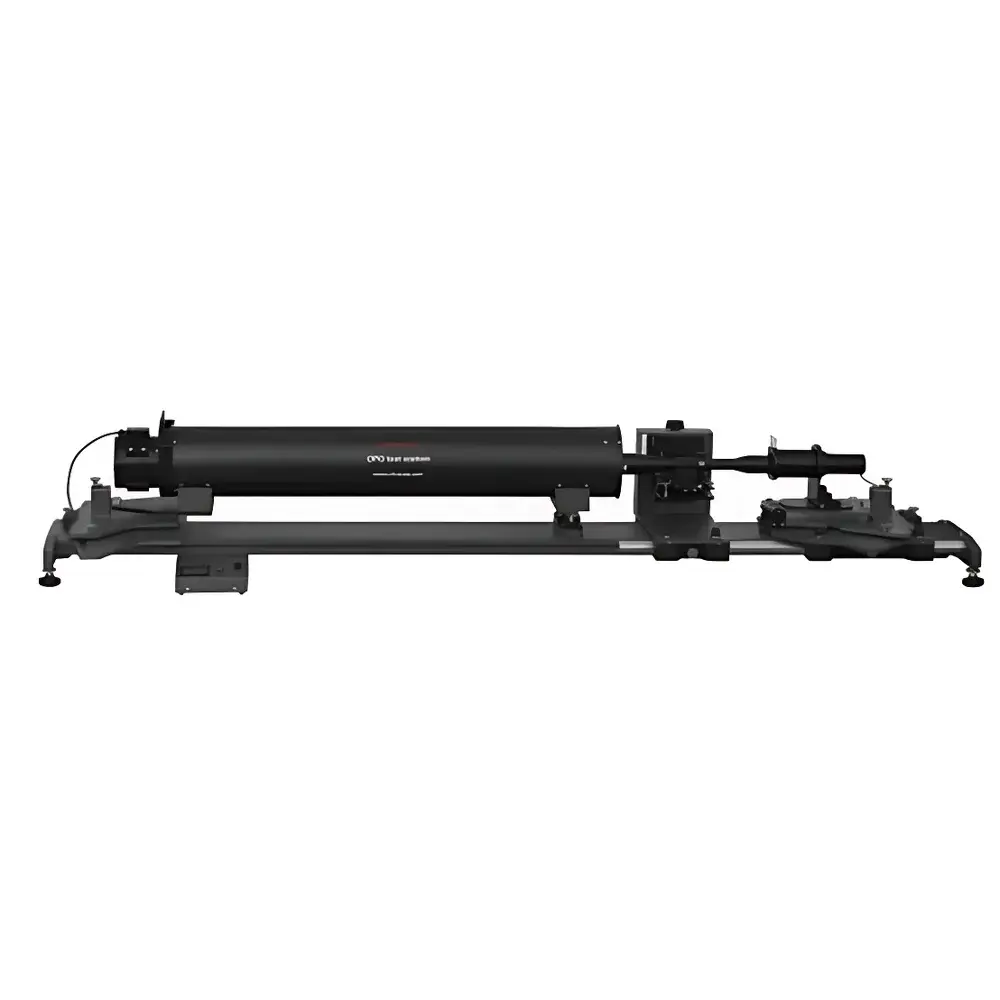
Inframet OPO Telescopic Sight Testing System
| Brand | Inframet |
|---|---|
| Origin | Poland |
| Model | OPO |
| Key Parameters | Resolution (0–2.5×M lp/mrad), MTF (on-axis & off-axis), Magnification, Distortion (<20%), FOV (up to 30°), Vignetting (relative uncertainty ≤3%), Exit Pupil Distance (0–10 mrad, ±0.1 mrad), Exit Pupil Diameter, Diopter Range (±X mrad), Parallax Measurement Capability |
| Compliance | Designed for ISO 10110-5, MIL-STD-1472G, and NATO AEP-97 optical test protocols |
| Software | TOPO v3.x with GLP-compliant audit trail, FDA 21 CFR Part 11–ready configuration options |
| Imaging | Dual-camera architecture (IM-PO & IM-TR) synchronized with TG-OP target generator and CPO-series collimators |
| Mechanical | MP-A/MP-B/MP-C precision motorized platforms with sub-arcminute repeatability |
Overview
The Inframet OPO Telescopic Sight Testing System is a computer-controlled, modular optical metrology platform engineered for comprehensive performance characterization of riflescope, spotting scope, and tactical aiming optics. Based on collimated target projection, high-resolution image capture, and quantitative spatial frequency analysis, the system implements standardized measurement principles aligned with ISO 10110-5 (surface imperfections and wavefront error), MIL-STD-1472G (human factors engineering for optical sighting devices), and NATO AEP-97 (optical test requirements for military electro-optical systems). Unlike empirical alignment benches or single-parameter testers, the OPO system delivers traceable, repeatable, and inter-laboratory comparable data across 14 critical optical parameters—including modulation transfer function (MTF), geometric distortion, vignetting uniformity, and parallax behavior—enabling full specification verification against design intent or procurement contracts.
Key Features
- Modular architecture supporting scalable test configurations: from basic resolution verification to full MIL-spec optical validation.
- Dual-sensor imaging subsystem: IM-PO (high-speed panchromatic camera for real-time alignment and dynamic tracking) and IM-TR (scientific-grade monochrome sensor with >12-bit dynamic range for MTF and contrast analysis).
- TG-OP programmable target generator with motorized aperture and spatial frequency masks, enabling automated MTF sweep from 0 to 2.5×M lp/mrad (where M is magnification factor).
- CPO10100 transmission collimator (f/10, 100 mm clear aperture) and matched CPO413/CPO25 telecentric lenses ensure diffraction-limited illumination and minimal wavefront error across full field-of-view.
- Motorized MP-A, MP-B, and MP-C precision stages with encoder feedback provide <10 arcsecond positional repeatability for multi-axis alignment, pupil scanning, and off-axis MTF mapping.
- TOPO software suite with integrated calibration workflow, NIST-traceable reference target library, and automated report generation compliant with ISO/IEC 17025 documentation requirements.
Sample Compatibility & Compliance
The OPO system accommodates telescopic sights with objective diameters up to 60 mm, eye relief ranging from 2 mm to 30 mm, and magnifications from 1× to 30×. It supports both daytime daylight optics and low-light intensified systems (e.g., Gen II+/III night vision scopes) via configurable spectral filters and IR-compatible targets. All measurements adhere to internationally recognized optical testing standards: distortion and FOV per ISO 9039; MTF and resolution per ISO 12233 Annex D; transmittance and vignetting per ISO 11318; and parallax evaluation per MIL-PRF-32127. The system’s mechanical and software architecture supports GLP/GMP environments, including electronic signatures, user access levels, and full audit trail logging required under FDA 21 CFR Part 11.
Software & Data Management
TOPO v3.x serves as the central control and analysis engine. It orchestrates hardware synchronization, executes pre-defined test sequences (e.g., “NATO STANAG 4347 Full Characterization”), and performs pixel-level image registration, edge spread function (ESF) derivation, and MTF computation using Fourier-based algorithms. Raw images, metadata, and intermediate calculation files are stored in vendor-agnostic HDF5 format with embedded calibration coefficients. Export options include PDF reports with embedded pass/fail flags, CSV datasets for statistical process control (SPC), and XML schemas compatible with enterprise LIMS integration. Optional validation packages include IQ/OQ documentation templates and third-party calibration certificates from accredited metrology labs.
Applications
- Production line final test for OEMs manufacturing military, law enforcement, and premium civilian optics.
- Incoming inspection at defense prime contractors verifying supplier-submitted test data against contractual optical specifications.
- R&D labs evaluating prototype designs for aberration balance, thermal drift, and mechanical stability under simulated environmental stress.
- Maintenance depots performing return-to-service verification after repair or refurbishment of legacy sighting systems.
- Standards laboratories conducting inter-laboratory comparison studies for optical test method harmonization.
FAQ
What optical parameters can be measured simultaneously during a single test sequence?
Resolution, MTF (on-axis and two off-axis points), magnification, field-of-view, distortion, and exit pupil distance are acquired concurrently. Additional parameters—vignetting, transmittance, diopter range, and parallax—are measured in dedicated sub-sequences requiring minor reconfiguration.
Is the system compatible with non-circular or anamorphic optical designs?
Yes. TOPO software supports custom field grids and asymmetric MTF sampling, enabling accurate characterization of prism-based or wide-angle rectilinear optics with non-uniform FOV coverage.
How is traceability maintained for MTF measurements?
Each TG-OP target includes NIST-traceable spatial frequency calibration marks. System-level MTF uncertainty (±0.01 for MTF >0.2) is validated annually using certified USAF 1951 and Siemens star targets from PTB-accredited suppliers.
Can the OPO system integrate with existing factory MES or ERP systems?
Yes. TOPO provides RESTful API endpoints and OPC UA server support for bidirectional data exchange with manufacturing execution systems, enabling automated pass/fail flagging and SPC dashboard population.
What maintenance is required for long-term measurement stability?
Annual recalibration of collimator wavefront error and camera sensor linearity is recommended. TG-OP LED intensity drift is automatically compensated via built-in photodiode feedback loop during every test run.





