
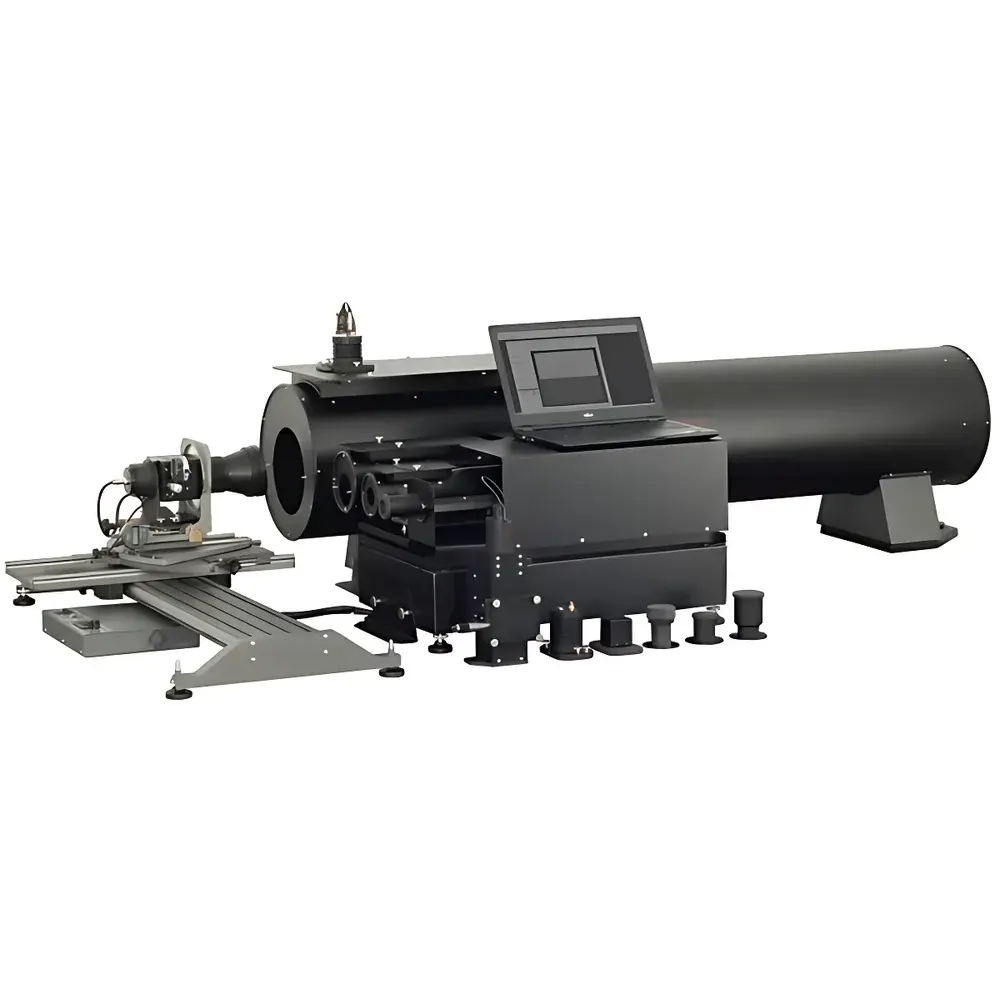
Inframet ORI Optical Lens Testing System
| Brand | Inframet |
|---|---|
| Origin | Poland |
| Model | ORI |
| Wavelength Coverage | VIS, NIR, SWIR, MWIR, LWIR |
| F/# Support | ≥0.7 |
| 焦距测量范围 | 7–1500 mm |
| Lens Diameter Range | 7–300 mm |
| MTF Spatial Frequency Range (VIS) | 0–400 lp/mm |
| MTF Uncertainty | ±0.02 (MTF > 0.2) |
| Compliance | ISO 10110-5, ISO 9039, ASTM E3087, MIL-STD-1472G |
Overview
The Inframet ORI Optical Lens Testing System is a high-precision, multi-spectral interferometric measurement platform engineered for comprehensive characterization of imaging optics across the full electromagnetic spectrum—from visible (VIS) and near-infrared (NIR) through short-wave (SWIR), mid-wave (MWIR), and long-wave infrared (LWIR). Unlike conventional collimator-based or Hartmann-Shack systems, the ORI employs an inverted optical path architecture—where the target generator is placed at the image plane of the lens under test (LUT), forming a reverse projection system. This design enables parallel illumination of the LUT’s entrance pupil with uniform, collimated light that propagates backward through the lens and is reimaged onto a calibrated focal-plane array (FPA) detector. The inversion eliminates mechanical constraints imposed by physical access to the LUT’s focal plane—especially critical for U-shaped, folded, or large-diameter optical assemblies—and ensures full utilization of source energy, eliminating the need for lock-in amplification in MWIR/LWIR bands.
Key Features
- Inverted optical path configuration enabling unrestricted access to the image plane and compatibility with non-standard lens geometries (e.g., periscopic, catadioptric, and off-axis designs)
- Multi-band spectral coverage: simultaneous support for VIS/NIR (350–1000 nm), SWIR (0.9–1.7 µm), MWIR (3–5 µm), and LWIR (8–12 µm) via interchangeable FPAs and broadband calibration sources
- Single-aperture dual-band IR optics: co-aligned MWIR/LWIR measurement path using one common cold shield and shared dewar interface—no manual detector swapping or realignment required
- F/# flexibility: validated performance down to F/0.7, significantly extending usability beyond standard diffraction-limited test benches (typically limited to F/1.2+)
- High-resolution spatial sampling: up to 456 lp/mm resolution target for VIS/NIR; 228 lp/mm for SWIR; optimized knife-edge and slit targets for rapid auto-focus and field-dependent MTF acquisition
- Traceable metrology: all measurements referenced to NIST-traceable standards; uncertainty budgets aligned with ISO/IEC 17025 requirements for accredited calibration laboratories
Sample Compatibility & Compliance
The ORI accommodates lenses with diameters from 7 mm to 300 mm, total lengths up to 450 mm, and focal lengths spanning 7–1500 mm. It supports both rotationally symmetric and asymmetric optical systems—including zoom lenses, multi-field-of-view (FOV) optics, and hybrid refractive-diffractive elements. System compliance includes ISO 10110-5 (surface irregularity and wavefront error), ISO 9039 (optical transfer function measurement), ASTM E3087 (infrared optical system performance testing), and MIL-STD-1472G (human-system integration for electro-optical devices). All software-generated reports include audit trails compliant with FDA 21 CFR Part 11 for regulated environments requiring electronic records integrity.
Software & Data Management
ORI Control Suite is a modular, Windows-based application supporting automated alignment, multi-field MTF mapping, distortion modeling (radial/tangential, polynomial and spline-based), and spectral transmittance analysis. Raw data is stored in HDF5 format with embedded metadata (wavelength, temperature, ambient pressure, detector gain settings). Export options include CSV, MATLAB .mat, and XML files compatible with Zemax OpticStudio, CODE V, and FRED for back-annotation and tolerance analysis. Version-controlled firmware updates and calibration certificate management are integrated into the software’s administrative module, ensuring GLP/GMP traceability across instrument lifecycle.
Applications
- Production-line verification of aerospace-grade IR objectives (e.g., missile seekers, EO/IR gimbals)
- R&D validation of multi-spectral fused optics (e.g., VIS-SWIR dual-band surveillance lenses)
- Quality assurance of medical endoscope objective assemblies requiring sub-micron wavefront fidelity
- Characterization of freeform and aspheric lenses used in AR/VR head-mounted displays
- Third-party certification testing per ISO 10110 and EN 13823 for defense contractors and OEM suppliers
- Academic research in computational imaging, where precise PSF/MTF ground truth is required for algorithm training
FAQ
Does the ORI require separate detectors for MWIR and LWIR testing?
No—the ORI uses a single co-aligned optical path and interchangeable cooled FPAs, allowing seamless switching between MWIR and LWIR bands without realignment or recalibration.
Can the system measure off-axis fields without mechanical scanning?
Yes—its inverted architecture enables full-field MTF acquisition at multiple field angles in a single setup, eliminating time-consuming point-by-point scanning.
What level of traceability does the ORI provide for MTF measurements?
All MTF results are traceable to NIST Standard Reference Materials (SRMs) 2034 and 2035, with documented uncertainty budgets meeting ISO/IEC 17025 Clause 6.5 requirements.
Is the ORI compatible with custom optical mounts or vacuum chambers?
Yes—standard kinematic mounting interfaces (ISO 30/40/60 flanges) and optional vacuum-compatible feedthroughs support integration into environmental test chambers and cleanroom setups.
How is calibration maintained over extended operation?
The system performs daily self-checks using internal reference targets and thermal-stabilized LED sources; full recalibration is recommended annually or after major hardware service events.





