
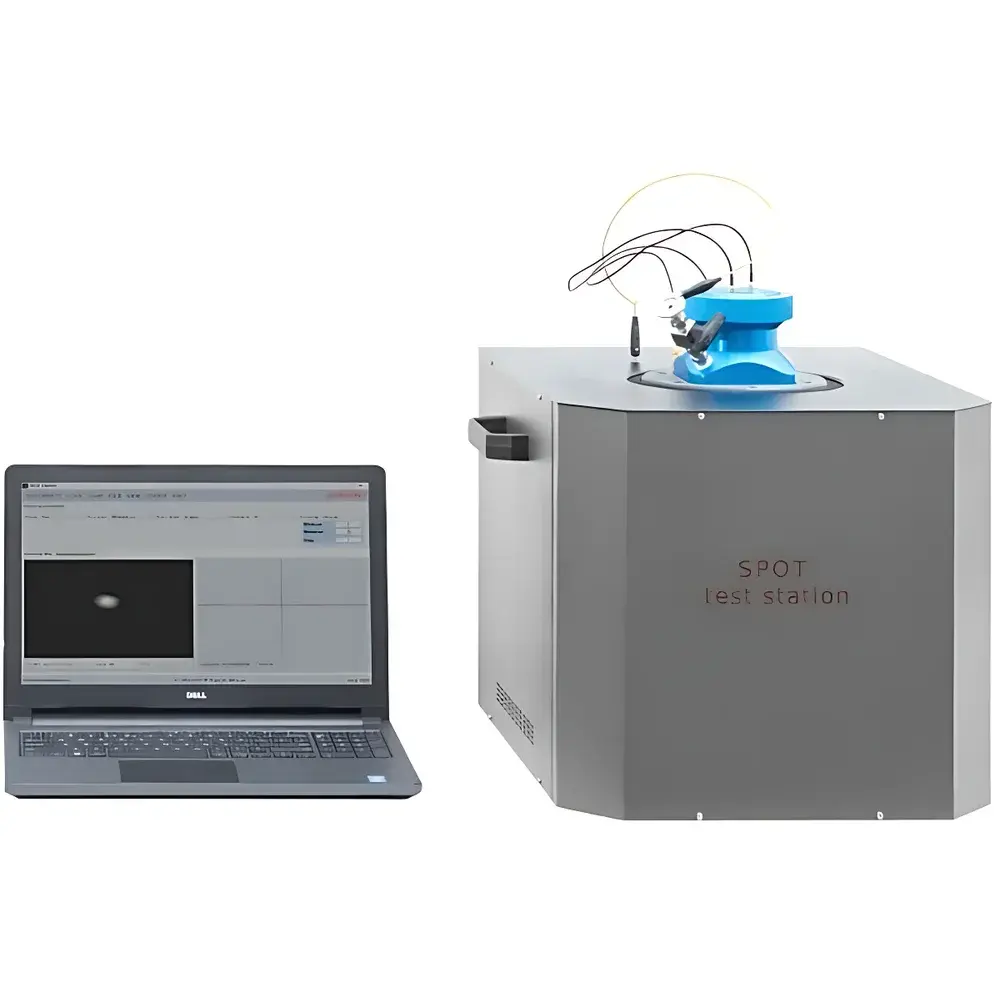
Inframet SPOT Mid-Wave Infrared Focal Plane Array Spatial Response Test System
| Brand | Inframet |
|---|---|
| Origin | Poland |
| Manufacturer Type | Authorized Distributor |
| Origin Category | Imported |
| Model | SPOT |
| Price Range | USD 68,000 – 109,000 (based on exchange rate and configuration) |
| Sensor Type | Cooled MWIR FPAs |
| Spectral Range | 1.0–5.5 µm |
| Spot Power | ≥4 mW |
| Spot Diameter (FWHM) | <6 µm |
| Pixel Size Compatibility | ≥8 µm (optional down to <8 µm) |
| FPA Format Support | SXGA (1280 × 1024) |
| Responsivity | >0.1 A/W |
| XY Scan Range | ≥10 × 10 mm |
| Coarse Scan Resolution | 2.5 µm |
| Fine Scan Resolution | 0.5 µm |
| Focus Travel | 18 mm |
| Focus Resolution | 0.5 µm |
| Environmental Operating Temp | +5 °C to +35 °C |
| Storage Temp | −5 °C to +55 °C |
| Max Operating Humidity | 85% RH (non-condensing) |
| Interface | USB 2.0/3.0, PC-controlled |
Overview
The Inframet SPOT Mid-Wave Infrared Focal Plane Array (MWIR FPA) Spatial Response Test System is a precision scanning spot projection platform engineered for quantitative characterization of infrared imaging sensor performance at the pixel level. It operates on the principle of controlled point-source illumination: a diffraction-limited, high-brightness optical spot—typically <6 µm in diameter at 70% energy containment—is raster-scanned across the active surface of a cooled MWIR FPA under test. Concurrently, the system records the analog or digital output signal from individual detector pixels (or pixel groups) with synchronized spatial registration. This enables direct acquisition of the spatial impulse response (SIR), from which the modulation transfer function (MTF), inter-pixel crosstalk, pixel-to-pixel responsivity uniformity, and effective pixel geometry are derived via deconvolution-based post-processing. Designed for laboratory-grade metrology in R&D, production screening, and sensor qualification environments, the SPOT system meets foundational requirements for traceable infrared detector characterization per ISO 12233 (adapted for IR), ASTM E1543, and MIL-STD-3009 Annex D.
Key Features
- Diffraction-limited spot generation using high-numerical-aperture reflective optics, achieving <6 µm full-width-at-half-maximum (FWHM) at 3–5 µm wavelength range
- Stable, adjustable spot power ≥4 mW—sufficient to overcome readout noise floor and reveal sub-threshold defects in photodiode junctions and passivation layers
- Motorized XY scanning stage with dual-resolution capability: coarse positioning at 2.5 µm steps and fine scanning at 0.5 µm resolution over ≥10 × 10 mm travel range
- Integrated motorized focus mechanism (18 mm travel, 0.5 µm step resolution) with real-time autofocus feedback loop enabled via software-guided image sharpness evaluation
- Modular electrical interface support for custom readout electronics—including high-dynamic-range (HDR) front-end amplification stages matched to specific FPA output impedance and bandwidth
- Fully automated measurement sequences with scriptable test protocols, synchronized data logging, and hardware-triggered frame capture
Sample Compatibility & Compliance
The SPOT system supports cooled MWIR FPAs operating across 1.0–5.5 µm spectral band, with standard compatibility for SXGA-format (1280 × 1024) arrays and pixel pitches ≥8 µm; optional configurations extend support to sub-8-µm pitch sensors. With appropriate adapter modules, it accommodates SWIR, VIS-NIR, and UV FPAs for cross-spectral validation. All measurements assume proper thermal stabilization of the DUT within its Dewar assembly—users must supply compatible cryogenic readout electronics and vacuum-compatible mounting fixtures. The system complies with CE marking directives (EMC 2014/30/EU, LVD 2014/35/EU) and meets mechanical safety requirements per ISO 12100. Data integrity workflows align with GLP principles, including audit-trail-enabled parameter logging and timestamped raw dataset archiving.
Software & Data Management
The SPOT Control Suite is a Windows-based application developed in C++ with Qt framework, providing intuitive GUI navigation and command-line scripting (Python API available). Core modules include: (1) Spot Calibration Wizard for beam profiling and power mapping; (2) Scan Configuration Manager for defining ROI, step size, dwell time, and averaging depth; (3) Real-Time Signal Monitor with FFT-based noise analysis and baseline drift correction; (4) Deconvolution Engine implementing Wiener filtering and constrained least-squares inversion to recover SIR and compute MTF up to Nyquist frequency; (5) Crosstalk Matrix Generator quantifying nearest-neighbor and diagonal coupling coefficients. All processed results export to HDF5 and CSV formats, with metadata compliant with FAIR (Findable, Accessible, Interoperable, Reusable) principles. Software validation documentation is provided per IEC 62304 Class B requirements.
Applications
- Pixel-level responsivity mapping and non-uniformity correction (NUC) coefficient derivation for MWIR camera calibration
- Detection and localization of micro-defects in HgCdTe or InSb detector arrays—including dead pixels, leakage paths, and edge discontinuities induced during hybridization
- Quantitative assessment of optical crosstalk mechanisms in staring-array architectures, distinguishing diffraction-limited spread from charge diffusion effects
- Validation of microlens array performance and alignment accuracy in multi-layer stacked FPAs
- MTF benchmarking against theoretical diffraction limits for optical design verification and lens–sensor co-optimization
- Supporting DOE and NIST traceable sensor characterization for defense, aerospace, and spaceborne infrared instrument programs
FAQ
Does the SPOT system require external cryogenic infrastructure?
Yes—the system interfaces with user-supplied Dewar assemblies and cold-finger-cooled FPAs; it does not include integrated cooling.
Can the SPOT measure dynamic MTF under modulated illumination?
No—it performs static spatial impulse response measurement; temporal MTF requires complementary lock-in or pulsed-laser setups.
Is FDA 21 CFR Part 11 compliance supported?
Electronic signatures and audit trails are implemented; full Part 11 validation packages are available upon request for regulated environments.
What file formats are supported for exporting raw scan data?
HDF5 (primary), CSV, TIFF (for 2D response maps), and MATLAB .mat—metadata embedded per NIEM/ISO 19115 schema.
How is spot position calibrated relative to pixel coordinates?
Via reference grid imaging using a calibrated reticle target, followed by affine transformation matrix registration with sub-pixel interpolation accuracy.





