
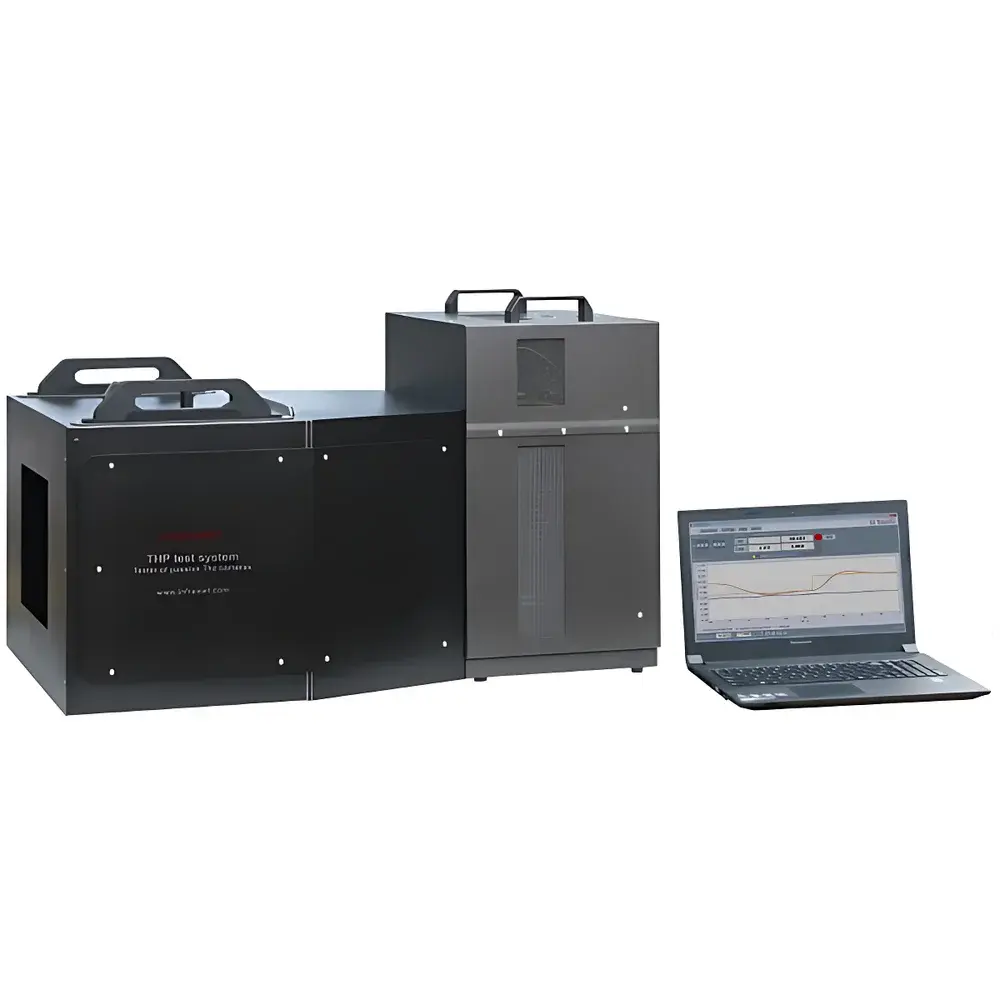
Inframet THP Terahertz Camera Test System
| Brand | Inframet |
|---|---|
| Origin | Poland |
| Model | THP |
| Blackbody Emission Area | 200 mm to 1000 × 1000 mm |
| Spectral Range | 0.03–30 THz (0.01–10 mm) |
| Blackbody Temperature Range | +5 °C to +95 °C |
| Target Plate Dimensions | 250 × 250 mm to 1200 × 1200 mm |
| Target Set | 8-bar MRTD targets, 1 knife-edge MTF target, 1 square uniformity/noise target |
| Bar Widths | 2–50 mm |
| Target Emissivity | >0.95 |
| Image Acquisition Interfaces | Analog Video / CameraLink / GigE |
| Control Interface | USB 2.0 |
| Power Supply | 115–230 VAC, 50/60 Hz |
| Operating Temperature | +5 °C to +45 °C (non-condensing) |
| Storage Temperature | −10 °C to +60 °C |
Overview
The Inframet THP Terahertz Camera Test System is a precision optical metrology platform engineered for the quantitative performance evaluation of uncooled and cooled passive terahertz imaging systems. It implements a standardized, distance-based projection methodology aligned with ISO 12233 (for MTF), ASTM E1543 (for NETD and MRTD), and IEC 62676-5 (for thermal imager characterization), adapted specifically for the 0.03–30 THz spectral band. Unlike conventional infrared test benches, the THP system employs a large-area, high-emissivity (>0.95) terahertz blackbody source coupled with mechanically interchangeable metal target plates—each featuring precisely machined apertures—to generate controlled thermal contrast patterns at defined spatial frequencies and temperature differentials. The system operates on the principle of far-field radiometric projection: the DUT (device under test) images the blackbody’s thermal emission through the target’s geometric features, enabling objective measurement of modulation transfer function (MTF), minimum resolvable temperature difference (MRTD), noise-equivalent temperature difference (NETD), fixed-pattern noise (FPN), spatial non-uniformity, and field-of-view (FOV) without physical contact or optical coupling.
Key Features
- Scalable blackbody integration: Compatible with Inframet’s MAB-series blackbodies, supporting emission areas from 200 mm diameter up to 1000 × 1000 mm² and spectral coverage spanning 0.03–30 THz (0.01–10 mm wavelength).
- Modular target assembly: Includes eight calibrated 4-bar MRTD targets (bar widths 2–50 mm, configurable per blackbody size), one knife-edge target for slanted-edge MTF analysis per ISO 12233, and one solid square target for spatial noise and non-uniformity assessment.
- Optimized thermal environment: Integrated thermal shielding enclosure minimizes air turbulence and suppresses ambient thermal reflections, ensuring background uniformity stability better than ±0.5% across the full field during extended measurements.
- Aperture-agnostic design: Independent of DUT entrance pupil diameter; accommodates both wide-FOV surveillance cameras and narrow-field scientific imagers via adjustable source-to-DUT distance—provided the distance exceeds the DUT’s minimum focus distance.
- Full-system traceability: All blackbody temperature setpoints are referenced to calibrated Pt100 sensors; thermal stability is maintained within ±0.1 °C over 30-minute intervals (per MAB specifications); emissivity is certified >0.95 across the operational THz band.
Sample Compatibility & Compliance
The THP system supports passive terahertz imagers operating in both direct-detection and heterodyne architectures, including microbolometer arrays, Schottky-diode focal plane arrays, and pyroelectric sensor-based systems. It complies with international standards governing thermal imager calibration: ASTM E1543 for NETD and MRTD determination, ISO 12233 Annex D for slanted-edge MTF, and IEC 62676-5 for multi-parameter performance reporting. All software-generated reports include metadata compliant with NIST SP 800-53 audit requirements and support GLP/GMP-aligned documentation workflows—including user-defined pass/fail thresholds, timestamped acquisition logs, and operator ID tagging. The system does not require cryogenic infrastructure or vacuum enclosures, making it suitable for routine lab-based QA/QC as well as third-party verification labs.
Software & Data Management
The THP platform is driven by two integrated applications: MAB Control (for blackbody temperature ramping, stabilization monitoring, and real-time thermal uniformity diagnostics) and TAS-TH (Terahertz Analysis Suite), which executes automated test sequences per preloaded standard protocols. TAS-TH supports batch processing of image stacks, exports MTF curves in CSV/SVG, generates MRTD threshold plots with confidence intervals (95%), computes NETD using temporal standard deviation over uniform regions, and quantifies FPN via pixel-wise offset maps normalized to scene temperature. All raw frames and processed results are stored with embedded EXIF-like metadata—including blackbody temperature, target ID, exposure time, ambient conditions, and software version—ensuring full traceability. Data export formats include HDF5 (for MATLAB/Python interoperability), TIFF (16-bit linear), and PDF reports with embedded digital signatures compatible with FDA 21 CFR Part 11 requirements when deployed on validated Windows environments.
Applications
- Factory acceptance testing (FAT) and incoming inspection of commercial THz security scanners (e.g., personnel screening systems per ECAC ACI guidelines).
- R&D validation of novel THz detector materials (e.g., graphene bolometers, metamaterial absorbers) against theoretical responsivity and spatial resolution limits.
- Calibration reference for national metrology institutes developing THz radiometric standards in the 0.1–10 THz range.
- Performance benchmarking of dual-band (MWIR/THz) fused imaging systems used in defense reconnaissance platforms.
- Long-term stability monitoring of THz camera modules under accelerated aging tests (e.g., thermal cycling between +10 °C and +60 °C).
FAQ
What is the minimum required distance between the THP blackbody and the DUT?
The source-to-camera distance must exceed the DUT’s specified minimum focus distance—typically ≥1.5× the focal length for most telecentric THz optics. A working distance of 1.5–5 m is recommended for optimal MTF sampling.
Can the THP system characterize active (illuminated) THz cameras?
No—the THP is designed exclusively for passive radiometric imaging systems. Active systems requiring THz illumination sources (e.g., photoconductive antennas, QCLs) require separate stimulus-generation hardware not included in this configuration.
Is the blackbody temperature uniformity validated across the full emission surface?
Yes—each MAB blackbody undergoes factory calibration using a 16-point thermocouple grid; uniformity data (±0.3 °C max deviation at 50 °C) is supplied with the unit and referenced in TAS-TH during measurement normalization.
Does the system support automated compliance reporting for ISO/IEC 17025 accredited labs?
Yes—TAS-TH includes customizable report templates aligned with ILAC P15:2022 requirements, including uncertainty budgets derived from blackbody temperature accuracy, target geometry tolerances, and image acquisition noise statistics.
Are firmware updates and software patches provided post-purchase?
Inframet offers 3 years of complimentary technical support and software maintenance, including critical bug fixes, new standard protocol integrations (e.g., upcoming ISO/IEC TR 20932 extensions), and compatibility updates for Windows OS revisions.






