
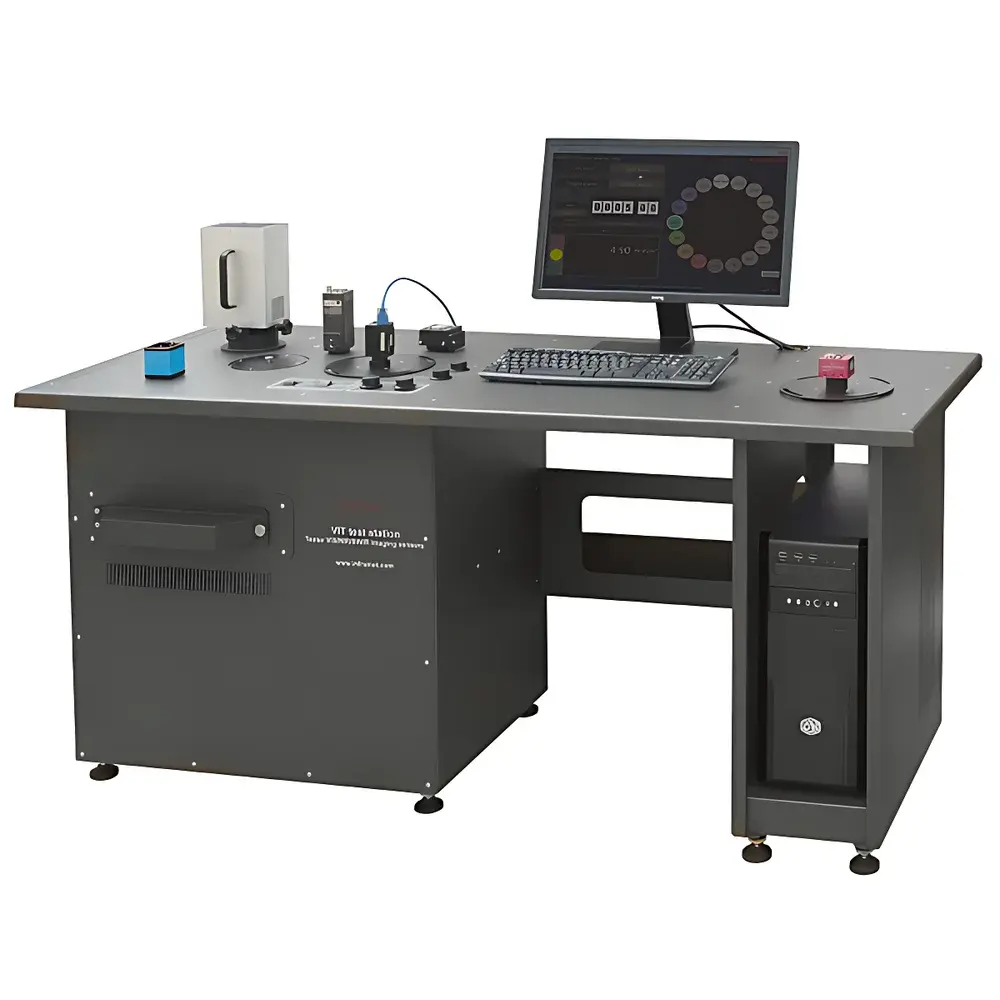
Inframet VIT VIS-SWIR Imaging Detector Test System
| Brand | Inframet |
|---|---|
| Origin | Poland |
| Model | VIT |
| Power Supply | 230/110 VAC, 50/60 Hz |
| Max Power Consumption | <800 W |
| Operating Temperature | 10–40 °C |
| Dimensions (L×W×H) | ~163 × 63 × 73 cm |
| Weight | ~91 kg (excluding PC) |
| Modular Architecture | Dual-channel projection (radiometric + imaging), frame grabber suite, thermal/environmental chamber (optional), proprietary test software, optional CON module for bare-die sensor evaluation |
| Supported Sensor Types | Silicon-based VIS-NIR imagers, Black Silicon detectors, InGaAs SWIR focal plane arrays (FPAs) |
| Standardized Testing | EMVA 1288:2014 compliant measurements |
| Radiometric Parameters | Spectral responsivity (16 wavelengths), D*, QE, sensitivity, dynamic range, linearity, NEI, FPN, non-uniformity, SNR, dead/hot pixel count, 3D noise |
| Imaging Metrics | MTF, spatial resolution, minimum resolvable contrast (MRC), crosstalk, blooming, FOV |
| Calibration Traceability | NIST-traceable radiometric sources integrated per channel |
Overview
The Inframet VIT VIS-SWIR Imaging Detector Test System is a modular, laboratory-grade platform engineered for comprehensive electro-optical characterization of solid-state imaging detectors operating across the visible (VIS) to short-wave infrared (SWIR) spectrum—specifically 400 nm to 1700 nm. It implements dual-path optical architecture grounded in calibrated radiometric projection and high-fidelity image acquisition, enabling traceable, repeatable measurement of both fundamental detector physics parameters and system-level imaging performance. The system adheres to internationally recognized metrological frameworks—including ISO 15529 (optical transfer function standards), IEC 62676-5 (imaging sensor testing), and critically, EMVA 1288:2014 for quantitative, standardized evaluation of camera and sensor performance. Its design supports full compliance with GLP and pre-GMP documentation requirements, including audit-ready test logs, user-access control, and timestamped calibration records—essential for R&D validation, supplier qualification, and production line verification in defense, aerospace, industrial inspection, and scientific imaging sectors.
Key Features
- Dual independent optical channels: A radiometric channel delivering spectrally tunable, NIST-traceable irradiance (16 discrete wavelengths from 400–1700 nm) and an imaging channel supporting MTF slanted-edge, Siemens star, and bar-target analysis under controlled illumination.
- Modular hardware architecture: Interchangeable sensor interface modules (A/B/C configurations per Table 1) allow seamless adaptation to packaged cameras, hybrid FPAs, or unpackaged die—enabling wafer-level and final-assembly testing within a single platform.
- EMVA 1288:2014 native implementation: Fully automated acquisition and calculation of all mandatory parameters—including quantum efficiency (QE), temporal dark noise, DSNU1288, PRNU1288, photoresponse nonlinearity (LE), saturation capacity, and absolute sensitivity threshold—without post-processing interpolation.
- Environmental integration readiness: Optional thermal chamber coupling enables temperature-dependent characterization (e.g., dark current vs. T, noise spectral density at −10°C to +60°C), critical for cryogenically cooled or thermally stabilized SWIR systems.
- Radiometric traceability: Integrated calibrated halogen and InGaAs-optimized LED sources, each referenced to primary standard detectors maintained by accredited calibration laboratories; full uncertainty budgets provided per measurement.
Sample Compatibility & Compliance
The VIT system accommodates silicon-based VIS-NIR imagers (e.g., CMOS/CCD up to 1000 nm), black silicon photodiodes, and InGaAs focal plane arrays (up to 1700 nm). It supports both monochrome and multispectral configurations with pixel pitches from 3.45 µm to 25 µm and array formats up to 1280 × 1024. All radiometric measurements conform to ASTM E1376 (standard practice for spectral responsivity calibration) and ISO 15739 (noise and dynamic range determination). Software-generated reports include metadata required for FDA 21 CFR Part 11 compliance when deployed in regulated environments—electronic signatures, change history, and immutable audit trails are natively supported.
Software & Data Management
The VIT Control Suite is a Windows-based application built on Qt and Python 3.x, featuring a role-based access interface (administrator, operator, reviewer). Raw frame data is stored in HDF5 format with embedded EXIF-like metadata (exposure time, gain, temperature, wavelength, calibration ID). Batch processing workflows support statistical aggregation across multiple devices under identical test conditions. Export options include CSV (for SPC analysis), PDF (formatted for QA review), and XML (compatible with LIMS integration). All calibration coefficients are digitally signed and version-controlled; software updates undergo regression testing against reference datasets prior to release.
Applications
- Quantitative validation of SWIR camera cores for autonomous vehicle perception systems requiring robustness against solar glare and atmospheric scattering.
- Production-line screening of InGaAs FPAs used in semiconductor wafer inspection tools, where pixel uniformity and blooming suppression directly impact defect detection yield.
- Research characterization of novel black silicon architectures—measuring wavelength-dependent QE enhancement and low-light SNR improvement relative to conventional Si.
- Supporting MIL-STD-810G environmental stress screening protocols by correlating MTF degradation with thermal cycling profiles.
- Independent verification of manufacturer datasheet claims for defense procurement—particularly D*, NEI, and MRC under low-contrast, low-flux conditions.
FAQ
Does the VIT system support real-time MTF calculation during acquisition?
Yes—slanted-edge MTF is computed on-the-fly using ISO 12233-compliant algorithms; results update dynamically as exposure or focus parameters change.
Can the system characterize sensors with non-standard output interfaces (e.g., JESD204B, Camera Link HS)?
Yes—the frame grabber suite includes configurable FPGA-based digitizers supporting custom timing, serialization protocols, and bit-depth mapping up to 16-bit linear RAW.
Is third-party calibration certification included with delivery?
Each system ships with a factory calibration certificate referencing NIST-traceable standards; optional UKAS-accredited calibration (ISO/IEC 17025) is available upon request.
How is dark current stability verified over extended integration times?
The software implements multi-frame dark sequence acquisition with statistical outlier rejection and Arrhenius-model fitting to extract activation energy and predict long-term drift.
What level of technical support is provided for EMVA 1288 report generation?
Inframet provides documented SOPs, validation templates, and remote assistance for method transfer—including cross-platform verification against certified reference cameras.



