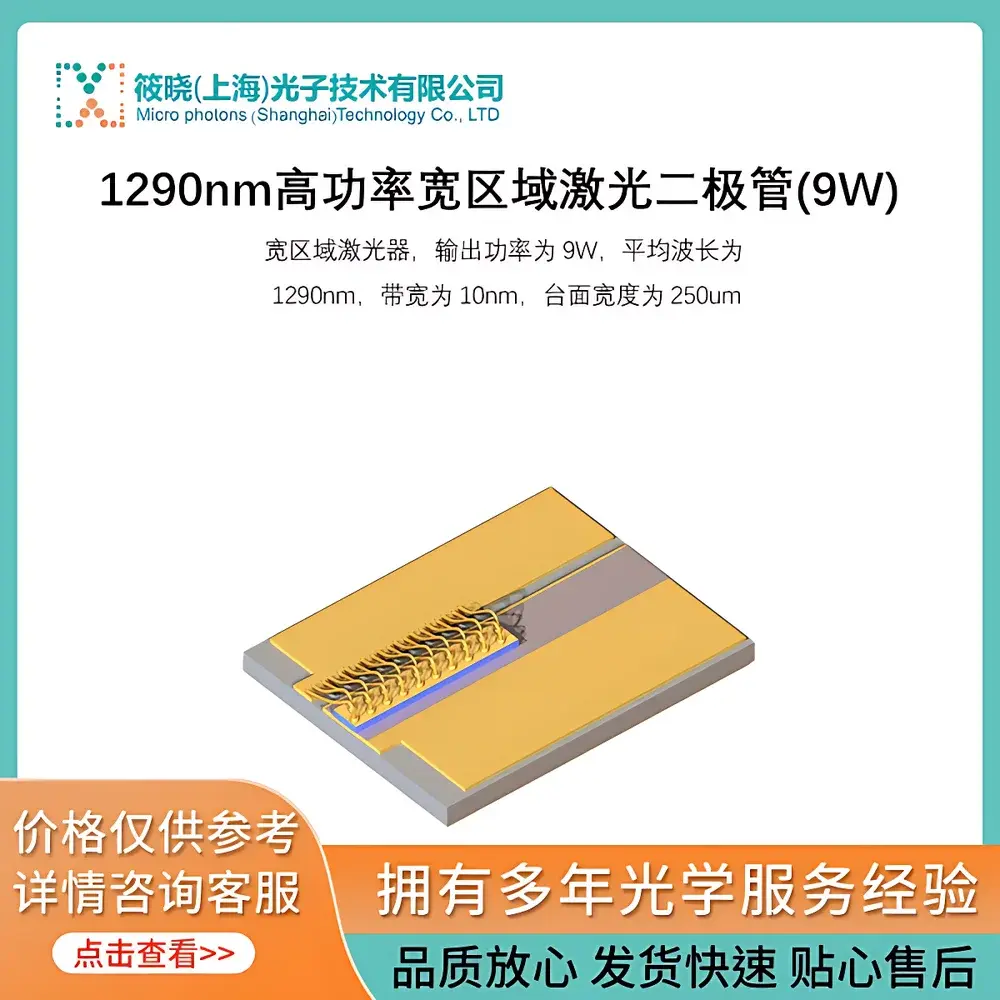
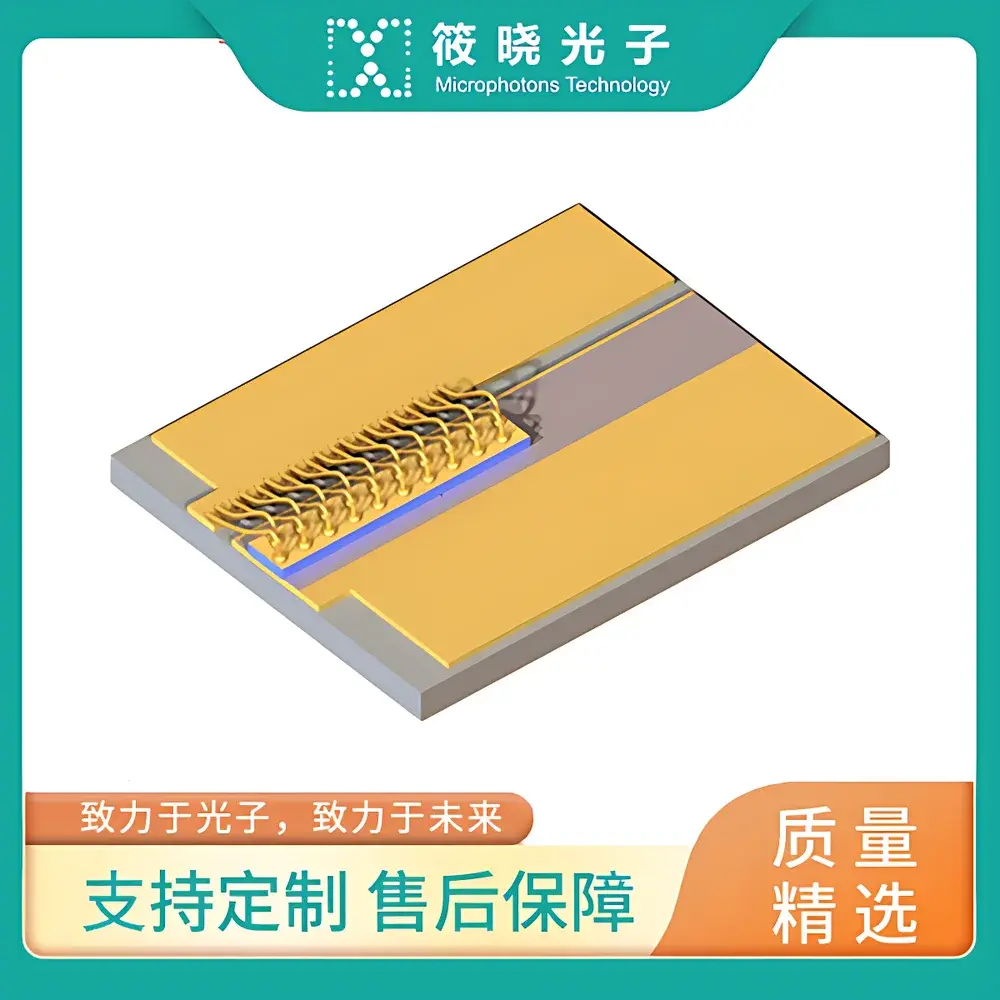
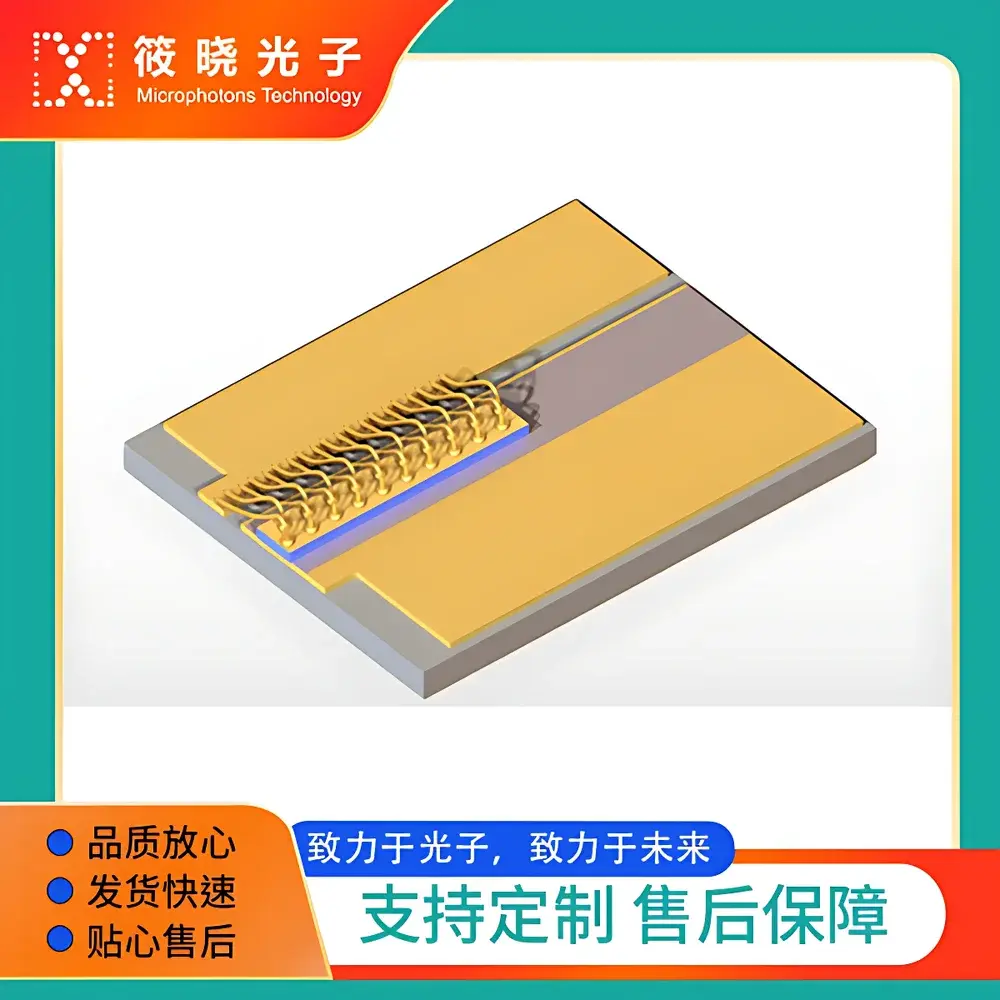
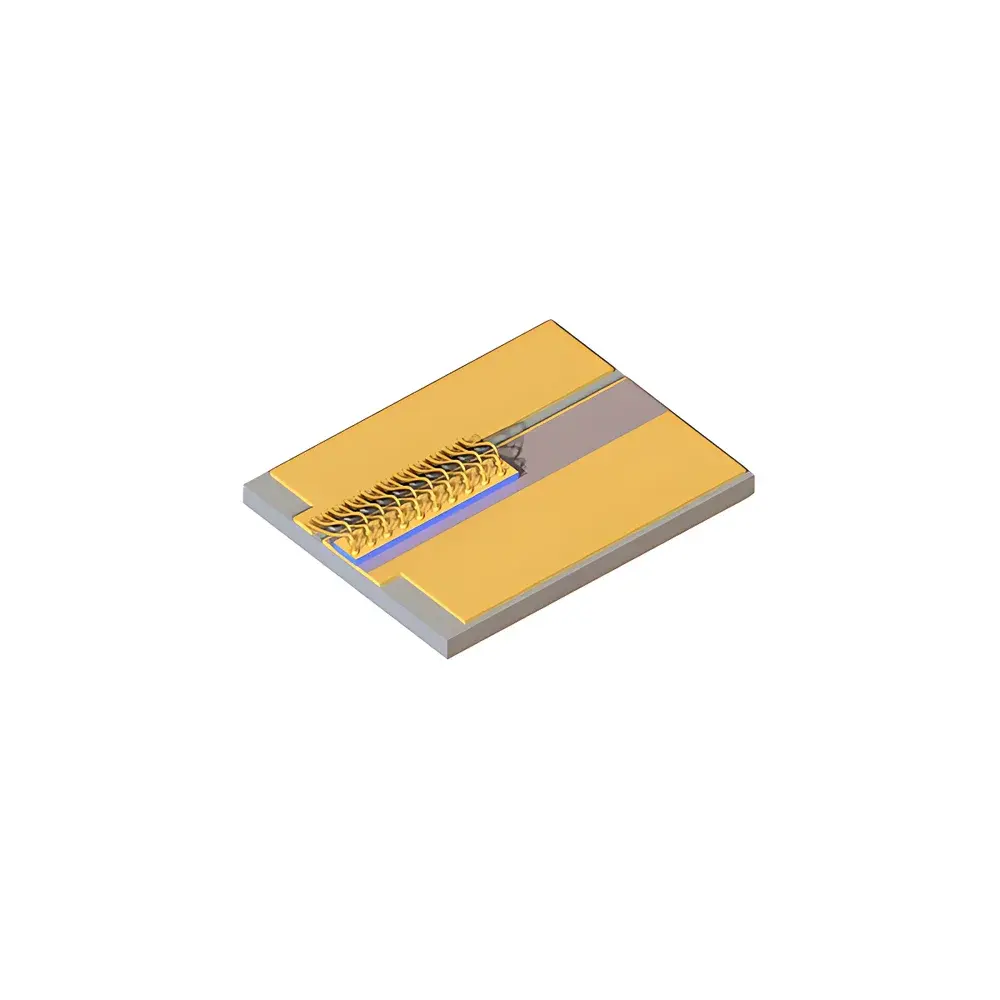
Innolume BAH1290010CC009WXXXX 1290 nm High-Power Broad-Area Laser Diode (9 W)
| Brand | Innolume |
|---|---|
| Origin | Germany |
| Model | BAH1290010CC009WXXXX |
| Output Power | 9 W (CW) |
| Central Wavelength | 1290 nm |
| Spectral Bandwidth (FWHM) | 10–15 nm |
| Emission Stripe Width | 250 µm |
| Polarization | TE |
| Slow-Axis Divergence (FWHM) | 5–15° |
| Fast-Axis Divergence (FWHM) | 31–36° |
| Threshold Current | 1.8–2.2 A |
| Operating Current @9 W | 21.5 A |
| Forward Voltage | 1.5–1.9 V |
| Wavelength Tuning Coefficient | 0.5 nm/°C |
| Max. Case Temperature | 60 °C |
| Storage Temperature Range | −40 to +85 °C |
| Reverse Voltage Rating | 2 V |
| Soldering Temperature (≤5 s) | 250 °C |
Overview
The Innolume BAH1290010CC009WXXXX is a high-brightness, continuous-wave (CW), broad-area laser diode engineered for demanding applications in scientific research, industrial pumping, and optical system integration. Operating at a central wavelength of 1290 nm—within the short-wavelength infrared (SWIR) band—it delivers up to 9 W of optical output power under thermally stabilized conditions (mounted on a temperature-controlled heatsink at 25 °C). Its broad emission stripe (250 µm) enables high-power operation while maintaining robust reliability and low spatial coherence—critical for applications where beam homogenization or fiber coupling precedes nonlinear frequency conversion. Unlike single-mode or tapered amplifiers, this device leverages a wide-aperture ridge structure with TE-polarized emission, optimized for efficient thermal management and scalable power extraction. It is not a complete module but a bare die-on-submount component intended for OEM integration into custom optical assemblies requiring precise thermal, electrical, and mechanical interface control.
Key Features
- High CW output power of 9 W at 1290 nm, validated under controlled heatsink conditions (25 °C case temperature)
- Narrow spectral bandwidth (FWHM: 10–15 nm) with excellent wavelength stability (0.5 nm/°C tunability via temperature)
- Broad-area architecture featuring a 250 µm emission stripe width, enabling high power density with reduced catastrophic optical damage (COD) risk
- Low threshold current (1.8–2.2 A) and high wall-plug efficiency, supported by forward voltage of only 1.5–1.9 V at operating current
- Controlled beam divergence: slow-axis FWHM 5–15° and fast-axis FWHM 31–36°, facilitating downstream collimation and shaping using standard anamorphic optics
- Robust packaging on copper-tungsten submount with gold-plated surface—designed for direct hard-soldering to high-conductivity heatsinks
- Compliant with JEDEC JESD22-A110 and JESD22-A108 reliability standards for temperature cycling and humidity exposure
Sample Compatibility & Compliance
This laser diode is supplied as a bare die on a conductive submount, requiring integration into a user-defined mechanical and thermal platform. It is compatible with industry-standard C-mount or CS-mount heat sinks when used with thermally conductive interfacial materials (e.g., gold-tin solder or indium foil). The device meets RoHS Directive 2011/65/EU and REACH Regulation (EC) No. 1907/2006 requirements. For safety-critical deployments—including medical laser systems or airborne LIDAR subsystems—users must implement Class 4 laser safety controls per IEC 60825-1:2014. Optical alignment and handling must follow ANSI Z136.1-2022 guidelines due to invisible 1290 nm radiation posing severe retinal hazard. ESD protection during assembly is mandatory; static discharge exceeding ±500 V may permanently degrade facet reflectivity or cause sudden failure.
Software & Data Management
As a discrete semiconductor component, the BAH1290010CC009WXXXX does not include embedded firmware or digital interfaces. However, it is fully compatible with third-party laser diode drivers supporting analog current modulation (0–22 A range), temperature feedback loops (via integrated NTC or RTD sensors), and real-time optical power monitoring (using calibrated photodiodes). When integrated into automated test systems—such as semiconductor curve tracers or wafer-level burn-in stations—it supports traceable parameter logging aligned with ISO/IEC 17025 quality management frameworks. For GLP/GMP environments, users may configure external DAQ systems to record timestamped current/voltage/temperature/power datasets compliant with FDA 21 CFR Part 11 audit trail requirements.
Applications
- Pumping of thulium-doped or holmium-doped fiber amplifiers for 1.9–2.1 µm mid-IR generation
- Seed source for master oscillator power amplifier (MOPA) architectures in industrial marking and cutting systems
- Optical coherence tomography (OCT) light sources requiring SWIR spectral coverage and high instantaneous power
- LIDAR transmitter arrays in autonomous vehicle perception systems, especially for eye-safe atmospheric penetration
- Photoacoustic spectroscopy excitation sources targeting molecular absorption bands near 1290 nm (e.g., C–H overtone transitions)
- Research-grade instrumentation for ultrafast pulse amplification via optical parametric chirped-pulse amplification (OPCPA)
FAQ
What is the recommended heatsink configuration for stable 9 W operation?
Mount the device on a copper or CuW heatsink maintained at ≤25 °C using active liquid cooling or high-performance thermoelectric coolers. Thermal interface material with ≥100 W/m·K conductivity (e.g., AuSn preform) is strongly advised.
Can this diode be operated in pulsed mode?
Yes—though rated for CW use, it supports quasi-CW (QCW) operation up to 10% duty cycle at 22 A peak current, provided pulse width remains <100 µs and average power stays within 9 W limits.
Is spectral narrowing possible via external cavity feedback?
Not recommended. The broad-area design lacks grating-integrated or distributed feedback (DFB) structures; external cavity stabilization would require complex external optics and introduce significant alignment sensitivity and power loss.
What precautions are required for ESD handling?
All assembly must occur in a Class 0 ESD-protected area (≤100 V withstand capability). Use grounded wrist straps, dissipative mats, and ionized air blowers. Never touch the laser facet or bond pads with ungloved fingers.
Does Innolume provide aging data or lifetime projections?
Yes—accelerated life testing (at 25 °C case temperature, 9 W output) indicates median time-to-failure >10,000 hours under proper thermal and current regulation. Full reliability reports are available under NDA upon request.