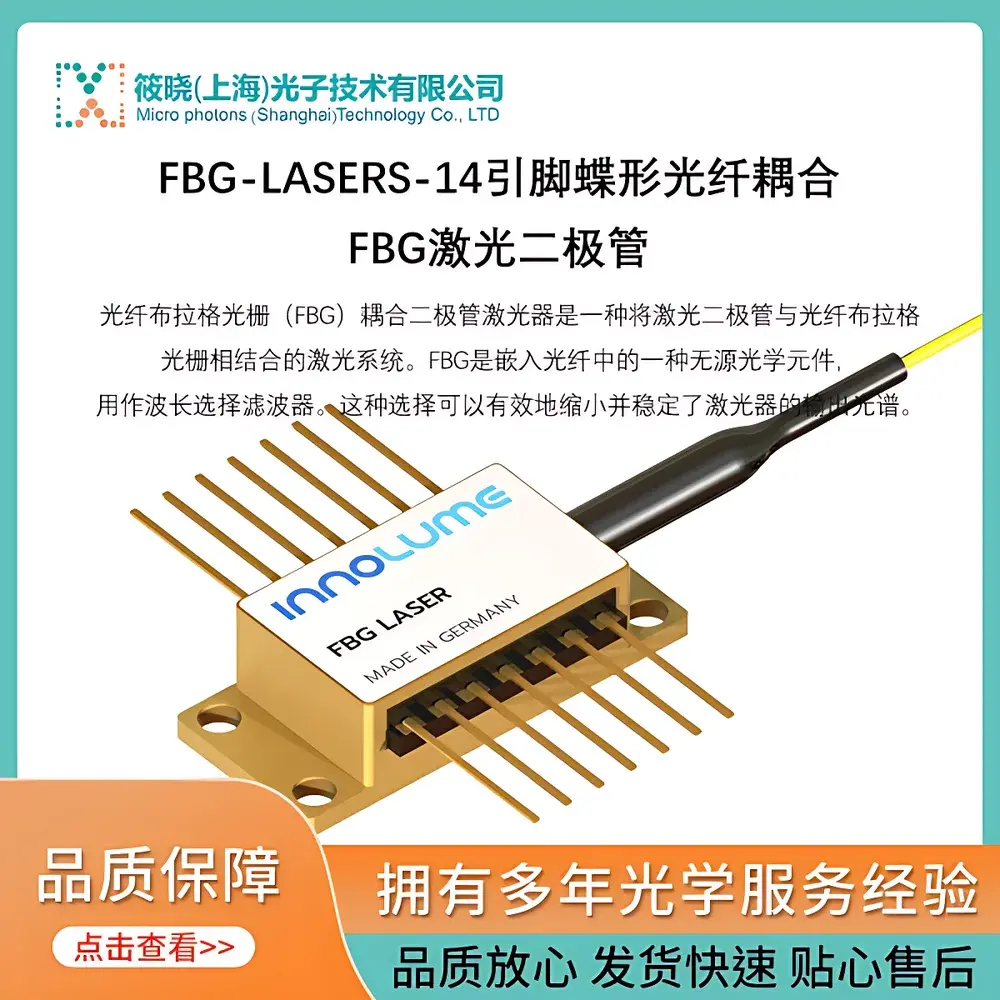
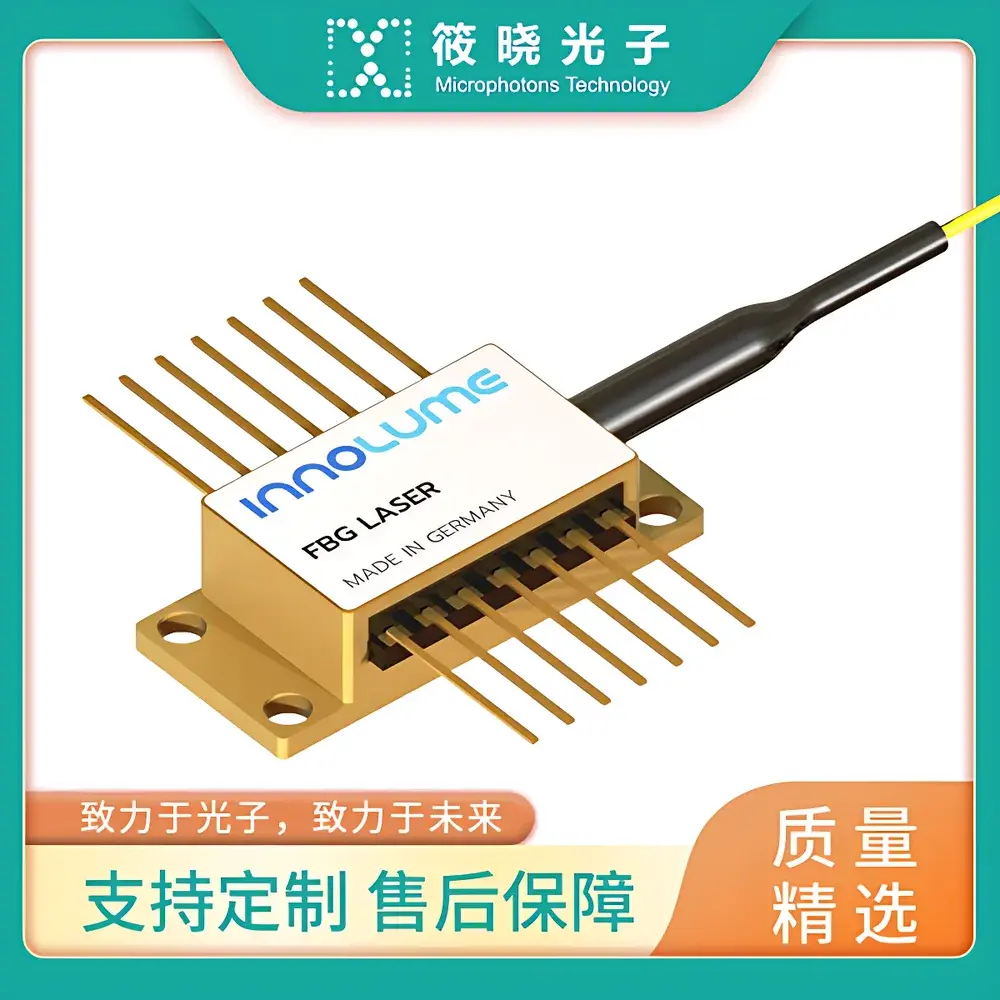
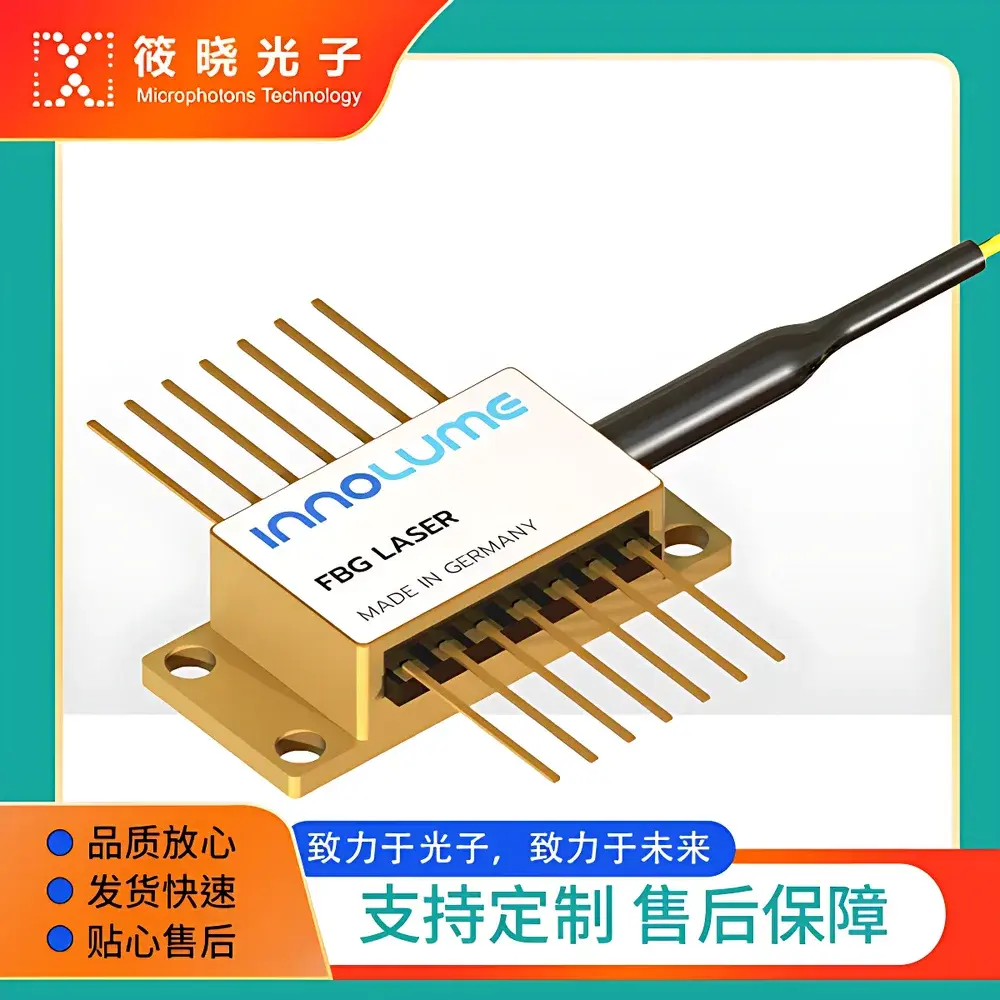
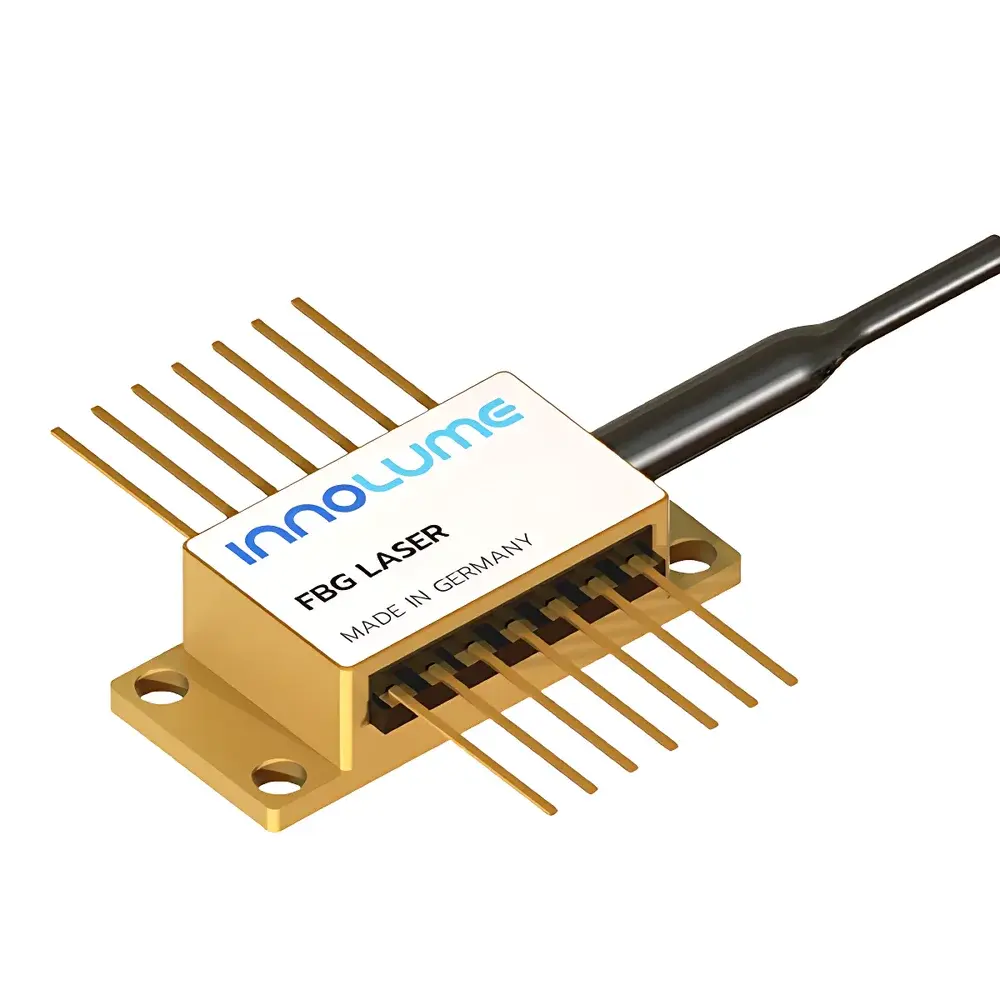
Innolume FBG-LASERS-14-Pin Butterfly-Packaged Fiber-Coupled Distributed Bragg Reflector (DBR) Laser Diode
| Brand | Innolume |
|---|---|
| Origin | Germany |
| Packaging | 14-pin butterfly housing with integrated FBG wavelength stabilization |
| Wavelength Range | 1020–1320 nm |
| Output Power | Up to 500 mW (CW, fiber-coupled) |
| Spectral Linewidth (FWHM) | 0.02–3.0 nm (configurable) |
| Wavelength Accuracy | ±0.15 nm |
| Temperature Tuning Coefficient | ~0.07–0.10 nm/°C (device-dependent) |
| Beam Divergence (Fast Axis) | 30–42° (FWHM) |
| Beam Divergence (Slow Axis) | 6–10° (FWHM) |
| Threshold Current | 0.3–2.0 A |
| Slope Efficiency | 0.39–0.93 W/A |
| Operating Current | up to 2.0 A |
| Thermal Interface Requirement | Indium foil or compliant thermal interface material (TIM), flatness < 0.05 mm |
| Mounting Torque | 0.075 Nm (initial), 0.15 Nm (final, X-pattern) |
| Fiber Options | SMF-28, PMF, 900 µm loose tube |
| Connector Options | FC/PC, SC/APC, SC/PC |
| Optional Integrations | Monitor photodiode (PD), external optical isolator, athermal FBG package |
Overview
The Innolume FBG-LASERS series comprises high-brightness, wavelength-stabilized laser diodes housed in industry-standard 14-pin butterfly packages and fiber-coupled via single-mode or polarization-maintaining fiber. Engineered for precision spectroscopy, optical sensing, gas detection, and pump applications in scientific and industrial systems, these devices utilize monolithically integrated distributed Bragg reflector (DBR) structures with external fiber Bragg grating (FBG) feedback—enabling narrow-linewidth, temperature-insensitive emission without active wavelength locking. Unlike conventional FP or DFB lasers, the FBG-LASERS architecture decouples gain and wavelength selection, permitting flexible spectral bandwidth tuning (0.02–3.0 nm FWHM) while maintaining high side-mode suppression ratio (>50 dB) and long-term wavelength stability (<±0.5 pm/h drift under constant current and temperature). The laser chip is mounted on a C-mount or submount platform compatible with standard thermoelectric cooler (TEC) assemblies, supporting operation from −10 °C to +50 °C case temperature.
Key Features
- High CW output power: up to 500 mW coupled into single-mode fiber (SMF-28 or PMF), scalable across 1020–1320 nm range
- Wavelength accuracy of ±0.15 nm (typ.) at 25 °C, traceable to NIST-calibrated reference spectrometers
- Configurable spectral bandwidth: factory-set FWHM from 0.02 nm (ultra-narrow for metrology) to 3.0 nm (broadband absorption spectroscopy)
- Athermal FBG packaging option minimizes wavelength drift over temperature (≤±2 pm/°C), eliminating need for dynamic TEC compensation in many OEM integrations
- Integrated monitor photodiode enables real-time power feedback for closed-loop current control in automated test equipment (ATE)
- Compliant mechanical design: 14-pin butterfly footprint conforms to IEC 61300-2-4 and Telcordia GR-468-CORE reliability standards
- Low fast-axis divergence (30–42°) and slow-axis divergence (6–10°) facilitate efficient fiber coupling and reduce alignment sensitivity during module integration
Sample Compatibility & Compliance
These lasers are designed for integration into Class 3B or Class 4 laser systems per IEC 60825-1:2014 and FDA 21 CFR Part 1040.10/1040.11. All units undergo burn-in testing at 1.2× rated current for 100 hours and pass hermeticity verification per MIL-STD-883 Method 1014. The butterfly housing meets RoHS Directive 2011/65/EU and REACH Regulation (EC) No. 1907/2006. For medical or regulated instrumentation use, the device supports GLP-compliant calibration documentation upon request. Optical interfaces comply with IEC 61753-1 (Category U for uncontrolled environments) when paired with specified isolators and thermal management. Back-reflection sensitivity is characterized per IEC TR 62672, recommending ≥30 dB optical isolation for stable operation under variable load conditions.
Software & Data Management
While the laser diode itself is analog-controlled (constant-current source with TEC driver), it is fully compatible with industry-standard instrumentation control frameworks including IVI-COM drivers, SCPI command sets (via optional digital monitor interface), and LabVIEW™, Python (PyVISA), and MATLAB® integration kits provided by Innolume’s application support team. Real-time monitoring of photodiode current, case temperature, and drive current enables automated aging analysis and predictive maintenance in production test systems. Traceable calibration data—including L-I-V curves, spectral maps, and thermal roll-off coefficients—is delivered in CSV and HDF5 formats, supporting ISO/IEC 17025-compliant data archiving requirements. Audit trails for parameter configuration and operational history can be logged in accordance with FDA 21 CFR Part 11 when deployed with validated host software.
Applications
- Gas sensing platforms targeting H2O, CH4, CO2, NH3, and hydrocarbons using tunable diode laser absorption spectroscopy (TDLAS) at near-IR wavelengths
- Pump sources for optical parametric oscillators (OPOs) and Raman fiber amplifiers requiring narrow linewidth and high brightness
- Fiber-optic gyroscopes (FOGs) and interferometric sensors demanding low phase noise and high coherence length (>10 m)
- Calibration references in wavelength-division multiplexing (WDM) test sets and optical component characterization benches
- Research-grade light sources for ultrafast pulse generation via external modulation or seeding of fiber amplifiers
- OEM modules for portable environmental monitors, process analyzers, and quantum technology infrastructure (e.g., atomic vapor cell excitation)
FAQ
What is the maximum permissible back-reflection level for stable operation?
Back-reflection exceeding −30 dB relative to output power may induce mode hopping or power instability; an external isolator with ≥35 dB isolation is recommended for all non-terminated configurations.
Can this laser be operated in pulsed mode?
Yes—pulse widths down to 10 ns are supported with appropriate current drivers; however, peak current must remain within absolute maximum ratings (see datasheet Section 5.2), and thermal management must account for duty-cycle–dependent average power dissipation.
Is the FBG permanently bonded to the fiber, or is it field-replaceable?
The FBG is permanently inscribed and athermally packaged within the butterfly housing; replacement requires full module requalification per IEC 61300-2-4.
What thermal interface material is validated for use with this package?
Indium foil (25–50 µm thickness) or phase-change TIMs meeting ASTM D5470 thermal impedance specifications are qualified; silicone-based greases are excluded due to outgassing and pump-out risk under thermal cycling.
Does Innolume provide wafer-level or chip-on-carrier options for custom integration?
Yes—bare-die and C-mount submount variants are available under NDA, including custom facet coatings and waveguide tapers optimized for specific fiber NA or numerical aperture matching.