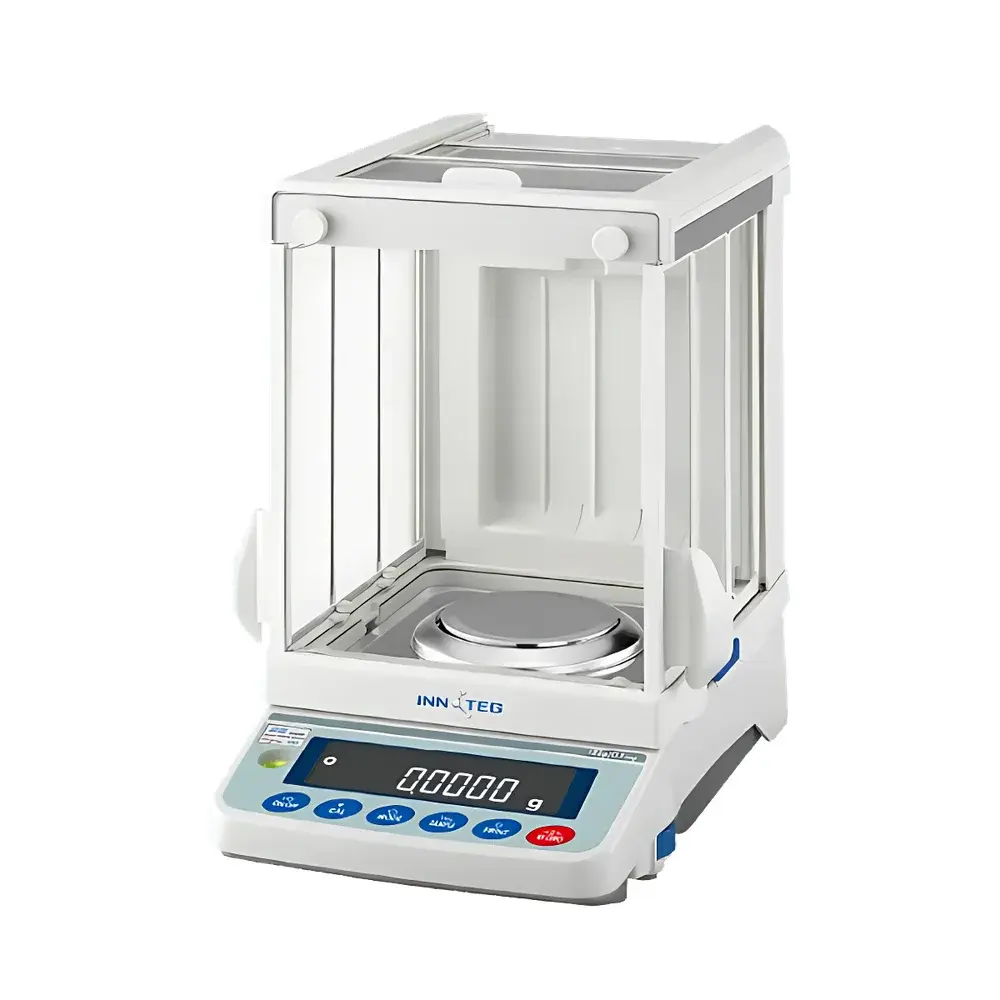
INNOTEG IB Series Analytical Balance (0.1 mg Readability)
| Brand | INNOTEG |
|---|---|
| Origin | Imported |
| Manufacturer Type | Direct Manufacturer |
| Model | IB / IBE |
| Instrument Type | Analytical Balance |
| Capacity | 122 g / 220 g / 320 g |
| Readability | 0.1 mg |
| Repeatability | 0.1 mg |
| Minimum Weight (USP) | 120 mg / 3.0 mg / 5.0 mg |
| Linearity Error | ±0.2 mg / ±0.2 mg / ±0.3 mg |
| Stabilization Time | ~1.5 s (IB), ~2.0 s (IBE) |
| Calibration | Internal Automatic Calibration (IB) / External Calibration (IBE) |
| Pan Diameter | Ø90 mm |
| Dimensions (W×D×H) | 258 × 357 × 331 mm |
| Interface | Dual RS-232C + USB |
| Compliance | GLP/GMP/GCP/ISO-compliant data output |
| Optional | Density kit, below-balance weighing hook, rechargeable battery, control I/O modules |
Overview
The INNOTEG IB Series Analytical Balance is a high-precision laboratory instrument engineered for demanding quantitative analysis in regulated and research-intensive environments. Operating on electromagnetic force compensation (EMFC) principle, it delivers consistent 0.1 mg readability across three standard capacities—122 g, 220 g, and 320 g—with repeatability rigorously verified at ≤0.1 mg under ISO 17025–aligned test conditions. Designed to meet the metrological requirements of pharmacopeial standards—including USP <41>, EP 2.1.6, and JP 2.03—the IB Series integrates ECL (Enhanced Calibration Logic) technology to dynamically assess repeatability and determine minimum weight (MinWt) in real time, ensuring compliance with risk-based weighing strategies. Its robust mechanical architecture includes shock-resistant load cell mounting and integrated anti-vibration damping, enabling stable operation in shared lab spaces or near HVAC systems where micro-vibrations may compromise measurement integrity.
Key Features
- ECL Technology: Automatically calculates standard deviation during repeated weighing cycles to validate repeatability and determine minimum weighable quantity per USP <41> guidelines.
- Impact Sensing & Detection (ISD): Monitors mechanical shocks exceeding 0.5 g acceleration threshold; triggers visual alert and logs event timestamp—critical for preventive maintenance in production QC labs.
- Automatic Performance Assessment (APA): Executes periodic self-diagnostic routines to verify linearity, eccentricity, and repeatability without user intervention.
- Flow Rate Display (FRD): Computes mass flow rate (g/s) for powders or liquids when paired with compatible dispensing or feeding peripherals—enabling real-time process monitoring in formulation workflows.
- Dual Communication Interface: Simultaneous RS-232C and USB ports support concurrent connection to PCs, printers, and peripheral controllers—enabling bidirectional command execution (e.g., tare-on-trigger, auto-print-on-stable).
- Auto Environmental Compensation (AEC): Detects ambient temperature drift >0.5°C and initiates internal recalibration—maintaining traceable accuracy across diurnal lab temperature fluctuations.
- High-Speed Electrostatic Neutralization (IB-J variant): Integrated ionizer achieves <1.0 s decay time for ±1 kV charges—twice the speed of conventional passive neutralizers—reducing static-induced error in low-mass powder handling.
- User Access Control: Supports up to 11 hierarchical user profiles with configurable permissions for calibration, method editing, data export, and audit trail access—fully aligned with FDA 21 CFR Part 11 requirements.
Sample Compatibility & Compliance
The IB Series accommodates diverse sample forms via standard Ø90 mm stainless steel pan and optional below-balance weighing hook (included). It supports animal weighing with dynamic averaging, density determination (with optional density kit), and percentage weighing against reference masses. All models comply with international regulatory frameworks: GLP-compliant audit trails with immutable timestamps, GMP-ready electronic records, and ISO/IEC 17025 traceable calibration certificates. Data export formats include CSV, TXT, and PDF with embedded metadata (operator ID, timestamp, balance ID, environmental log)—formatted to meet ALCOA+ principles (Attributable, Legible, Contemporaneous, Original, Accurate, Complete, Consistent, Enduring, Available).
Software & Data Management
Built-in memory stores up to 200 measurement records, 50 calibration logs, and 50 custom unit definitions. All entries are time-stamped and tagged with operator ID. The balance supports direct integration with LIMS and ELN platforms via ASCII protocol over RS-232 or USB CDC class. Optional PC software enables method scripting, statistical process control (SPC) charting, and automated report generation compliant with ISO 14130 and ASTM E2656. Audit trail functionality records all critical events—including calibration, parameter changes, and user login/logout—with read-only export to prevent tampering.
Applications
This analytical balance serves core functions in pharmaceutical quality control (API assay, blend uniformity testing), academic materials science (catalyst dosing, nanomaterial dispersion), food safety laboratories (nutrient fortification verification), and environmental testing (filter mass gain in PM2.5 analysis). Its rapid stabilization (~1.5 s), low minimum weight (as low as 3.0 mg for IB-220), and resistance to electrostatic interference make it suitable for high-throughput labs performing >200 daily weighings under cGMP conditions.
FAQ
What is the difference between IB and IBE models?
The IB series features internal automatic calibration using a built-in motorized weight; the IBE series requires external calibration weights and is preferred where internal mechanisms must be excluded from metrological audits.
Does the balance support ISO/IEC 17025-compliant calibration?
Yes—each unit ships with a factory-issued calibration certificate traceable to NIST or PTB standards, and supports user-initiated calibration with documented uncertainty budgets.
Can the balance operate on battery power?
An optional rechargeable Li-ion battery module is available, providing up to 8 hours of continuous operation—ideal for mobile QC stations or field applications.
Is density measurement capability built-in?
Density determination requires the optional density kit (including sinker, thermometer interface, and liquid bath support), which enables solid/liquid density calculation per ASTM D792 and ISO 1183.
How is data security ensured during transfer?
All USB and RS-232 communications use hardware-level handshaking and CRC-16 error checking; exported files include digital signatures when used with validated software packages.