
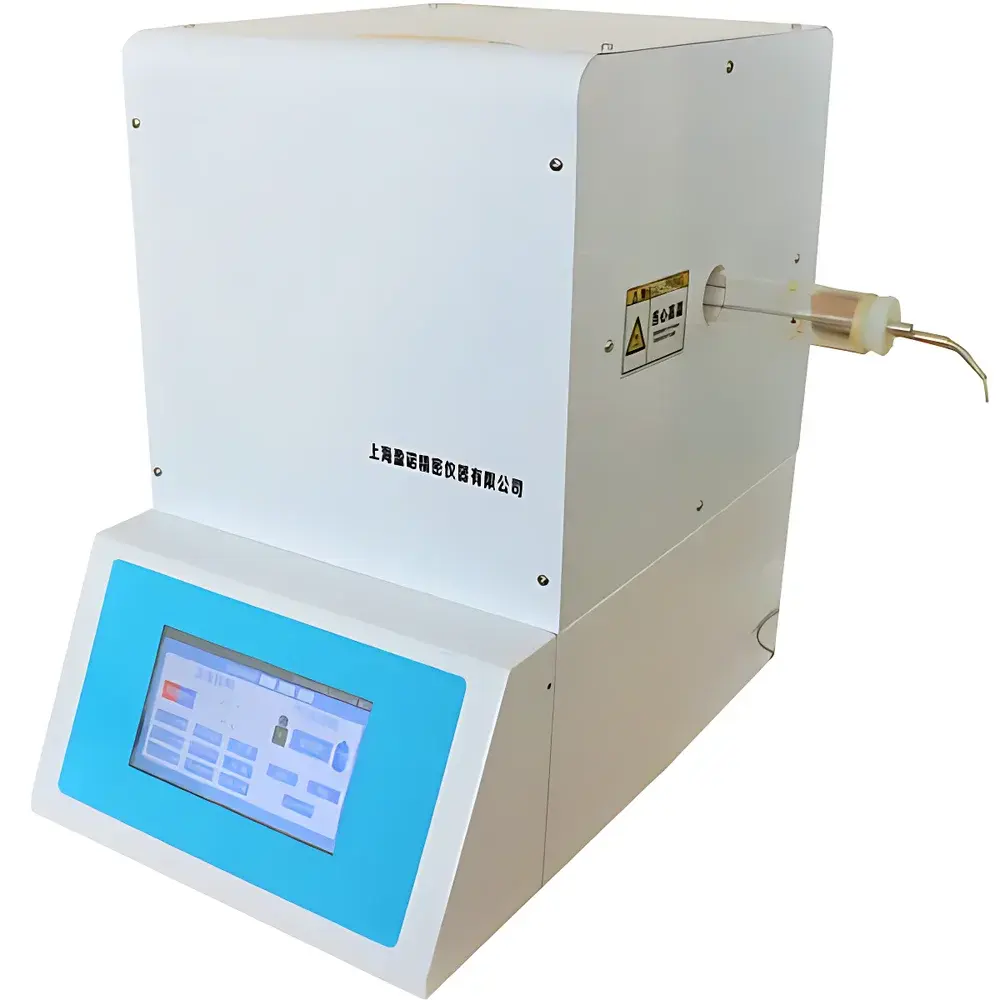
INNUO DH-G1001B Carbon Black Content Analyzer
| Brand | INNUO |
|---|---|
| Origin | Shanghai, China |
| Manufacturer Type | Authorized Distributor |
| Region of Manufacture | Domestic (China) |
| Model | DH-G1001B |
| Price Range | USD 9,800 – 13,900 |
| Temperature Range | Ambient to 999.9°C |
| Heating Zone Length | 300 mm |
| Combustion Tube Dimensions | Ø32 mm × 450 mm |
| Heating Element | Resistance Wire |
| Display | 7-inch Capacitive Touchscreen |
| Gas Flow Control | Dual-channel Float-type Flowmeter (Optional Mass Flow Controller) |
| Flow Ranges | 3 L/min (0.1 L/min resolution, for wire & cable) or 250 mL/min (12.5 mL/min resolution, for pipe & fitting) |
| Temperature Control | PID Programmable Controller with Auto-segment Memory |
| Crucible Options | (1) Wire/Cable: 93 mm total length (70 × 16 × 11 mm cavity) |
| (2) Pipe/Fitting | 72 mm total length (55 × 7 × 9 mm cavity) |
| Calculation Engine | Automatic black content, ash content, and filler content computation from user-input mass values |
| Data Output | Integrated thermal printer |
| Power Supply | AC 220 V, 50/60 Hz |
| Rated Power | 1.5 kW |
| Dimensions (W × D × H) | 30 × 49 × 50 cm |
| Thermal Insulation | Nano-fiber Blanket for Uniform Furnace Temperature Distribution |
| Compliance | GB/T 13021–2023 (ISO 6964), GB/T 2951.41–2008 (IEC 60811-4-1), JB/T 4278.17–2011, JTG E50–2006 (T1165) |
Overview
The INNUO DH-G1001B Carbon Black Content Analyzer is a precision-controlled, dual-atmosphere thermogravimetric instrument engineered for quantitative determination of carbon black loading in polyolefin-based polymers—primarily polyethylene (PE), polypropylene (PP), and polybutene (PB). It operates on the principle of controlled pyrolysis and combustion under sequential inert (N₂) and oxidative (O₂) atmospheres, enabling selective volatilization of organic polymer matrix while preserving carbon black and inorganic fillers. The residual mass after complete oxidation yields total inorganic residue; subtraction of ash content (determined separately or via standardized correction) provides gravimetric carbon black concentration. This method aligns with ASTM D1606–22 (withdrawn but historically referenced), ISO 6964:2023, and multiple national standards governing quality assurance in pipe manufacturing, wire & cable insulation, and geosynthetic materials.
Key Features
- 7-inch industrial-grade capacitive touchscreen interface displaying real-time furnace temperature, setpoint, gas status (N₂/O₂ active), pyrolysis phase indicator, soak duration, crucible pre-burn status, and elapsed operation time—all synchronized within a single visual field.
- Integrated furnace-controller architecture eliminates external cabling and simplifies laboratory footprint management; all thermal control logic resides within the main chassis.
- Pre-programmed thermal profiles—including pyrolysis ramp, inert soak, oxidation ramp, and post-combustion cooling—are stored in non-volatile memory; users initiate full sequences with one-touch execution, eliminating manual parameter re-entry across batches.
- Dual-gas manifold with solenoid-actuated automatic switching between high-purity nitrogen and oxygen; flow calibrated via dual-range float-type rotameters (3 L/min for wire/cable applications; 250 mL/min for pipe/fittings), with optional upgrade path to digital mass flow controllers (MFCs) for enhanced repeatability.
- Nano-fiber ceramic blanket insulation ensures radial and axial temperature uniformity across the 300 mm heating zone (±2.5°C at 600°C), critical for consistent decomposition kinetics and minimizing inter-sample variability.
- PID-based programmable temperature controller supports up to 8-stage ramp-soak cycles with auto-memory function—retaining last-used parameters even after power interruption.
Sample Compatibility & Compliance
The DH-G1001B accommodates two standardized crucible geometries optimized for industry-specific sample formats: a 93 mm-long boat (70 × 16 × 11 mm cavity) for stranded or extruded wire/cable specimens, and a compact 72 mm-long variant (55 × 7 × 9 mm cavity) for granular or pelletized pipe resin samples. Its operational methodology satisfies mandatory testing requirements under GB/T 13021–2023 (equivalent to ISO 6964:2023), GB/T 2951.41–2008 (IEC 60811-4-1), JB/T 4278.17–2011 (calibration verification protocol), and JTG E50–2006 (T1165) for highway geotextiles. While not certified for FDA 21 CFR Part 11 compliance out-of-the-box, its audit-ready data logs—timestamped mass entries, gas switch events, and thermal profile execution records—support GLP/GMP-aligned documentation workflows when paired with validated laboratory information management systems (LIMS).
Software & Data Management
The embedded firmware implements deterministic real-time control without reliance on external PCs. All user inputs—including initial sample mass, tare weight, and crucible ID—are entered directly via touchscreen and retained in volatile RAM during analysis. Upon completion, the system computes carbon black content (% w/w), ash content (% w/w), and filler contribution (% w/w) using standardized formulas per ISO 6964 Annex A. Results are output via built-in thermal printer with date/time stamp, operator ID field, and test sequence number. Raw thermal event timestamps and gas-switching triggers are logged internally and exportable via USB port (optional firmware module) for traceability audits. No proprietary software installation is required; data files conform to CSV format for direct import into Excel or statistical process control (SPC) platforms.
Applications
This analyzer serves as a primary QC tool in polyolefin compound production facilities, PE/PP pipe extrusion plants, and wire & cable manufacturers where carbon black dispersion and loading directly influence UV resistance, mechanical longevity, and regulatory conformance. It is routinely deployed for incoming raw material verification (e.g., masterbatch consistency), in-process batch release testing, and failure analysis of discolored or brittle extrudates. In civil engineering labs, it supports specification compliance for HDPE geomembranes used in landfill liners and canal linings per ASTM D5885–21 and EN 13438. Its robust thermal design also permits adaptation to modified protocols evaluating char yield in flame-retardant formulations containing synergistic mineral fillers.
FAQ
What standards does the DH-G1001B directly support?
It is configured to execute Method A (tube furnace) per GB/T 13021–2023 (ISO 6964), GB/T 2951.41–2008 (IEC 60811-4-1), and JTG E50–2006 T1165.
Can the instrument operate without a continuous gas supply?
No—both nitrogen and oxygen must be supplied from regulated cylinder sources or centralized lab gas lines; the system requires uninterrupted flow during pyrolysis and combustion phases.
Is calibration traceable to NIST or equivalent national metrology institutes?
Temperature calibration is performed using Class A platinum resistance thermometers (PRTs) traceable to CNAS-accredited laboratories; mass input relies on user-provided analytical balance readings.
Does the unit include validation documentation for IQ/OQ/PQ?
Factory-issued Installation Qualification (IQ) and Operational Qualification (OQ) protocols are provided; Performance Qualification (PQ) must be executed by the end user using reference materials per ISO Guide 34.
What maintenance intervals are recommended?
Quarterly inspection of gas seals and flowmeter calibration; annual replacement of furnace insulation blanket and thermocouple verification; biannual cleaning of combustion tube interior with alumina wool swabs.





