
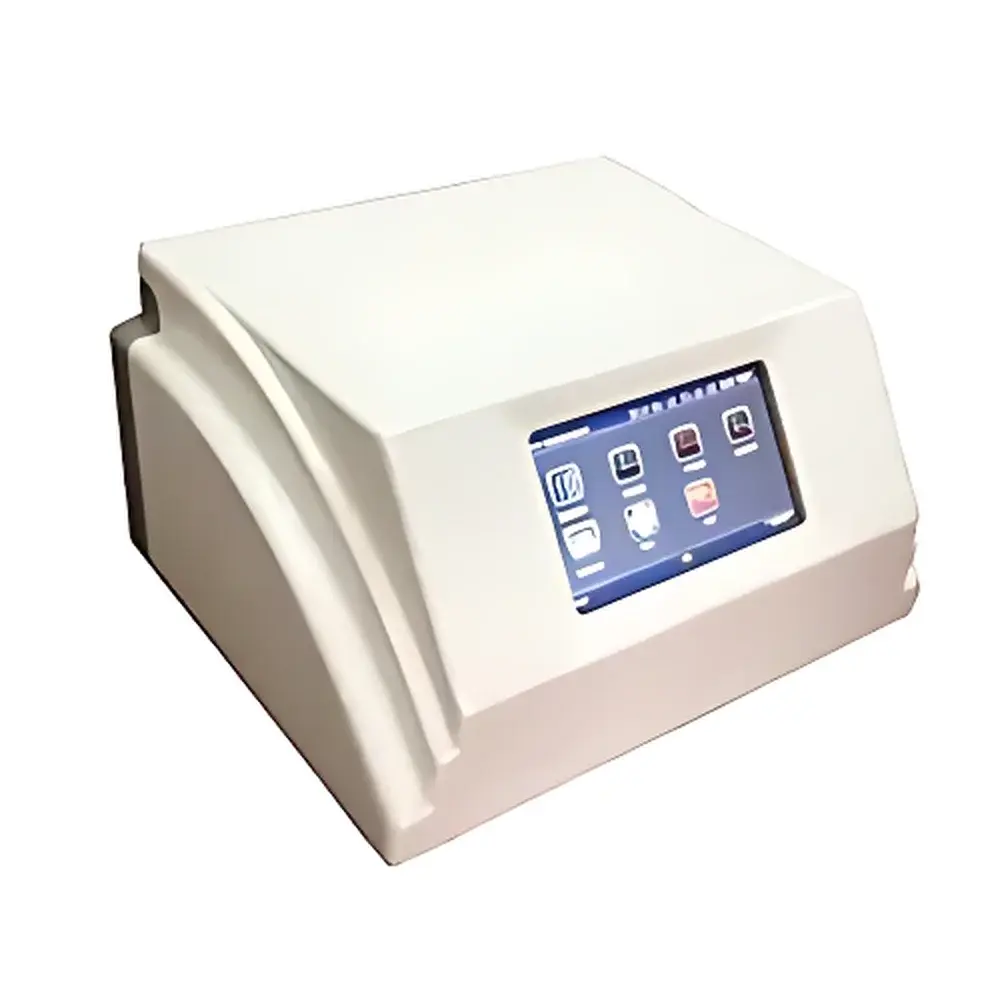
INNUO SYTP-1 Quartz Crystal Microbalance (QCM)
| Brand | INNUO |
|---|---|
| Origin | Shanghai, China |
| Model | SYTP-1 |
| Operating Frequency | 10 MHz |
| Mass Sensitivity | 2.26 × 10⁸ Hz/(g/cm²) |
| Mass Detection Range | 4.42 × 10⁻⁹ g/cm² to 4.42 × 10⁻⁴ g/cm² |
| Temperature Control Range | −196 °C to +70 °C |
| Vacuum Compatibility | Down to 1 × 10⁻⁵ Pa |
| Temperature Stability | ±0.1 °C |
| Frequency Resolution | ±1 Hz |
| Power Input | 100–240 VAC, 50/60 Hz |
| Interface Options | USB 2.0, Ethernet (RJ45), USB Flash Drive Data Export |
Overview
The INNUO SYTP-1 Quartz Crystal Microbalance is a high-stability, frequency-domain gravimetric sensor system engineered for real-time, label-free mass monitoring at the nanogram-per-square-centimeter level. Based on the piezoelectric resonance principle of AT-cut quartz crystals, the SYTP-1 measures minute mass changes via shifts in the fundamental resonant frequency (Δf) of a 10 MHz quartz crystal oscillator—governed by the Sauerbrey equation under rigid, thin-film approximation. This enables quantitative analysis of adsorption, desorption, film growth, interfacial reactions, and viscoelastic behavior in gas-phase, liquid-phase, or ultra-high vacuum environments. Designed for integration into controlled atmospheres—including cryogenic (down to liquid nitrogen temperatures) and high-vacuum (≤10⁻⁵ Pa) chambers—the SYTP-1 supports in situ and operando studies across electrochemistry, thin-film deposition, corrosion science, biosensor development, and surface functionalization workflows.
Key Features
- 7-inch capacitive touchscreen interface with integrated real-time visualization of temperature, setpoint, crystal frequency, temperature correction coefficients, and time-resolved frequency/temperature curves
- Dual-mode operation: fully autonomous standalone mode with embedded firmware control, or PC-synchronized mode via USB/Ethernet for advanced scripting and synchronization with auxiliary instrumentation
- Multi-interface data acquisition: native support for USB 2.0, 10/100 Mbps Ethernet (TCP/IP), and direct USB flash drive logging—enabling seamless integration into automated lab networks and GLP-compliant data archives
- Cryogenic and UHV-rated transducer assembly: quartz sensor head and coaxial cable rated for continuous operation from −196 °C to +70 °C under pressures as low as 1 × 10⁻⁵ Pa
- High-resolution frequency measurement engine with ±1 Hz absolute accuracy and sub-Hz short-term stability (Allan deviation < 0.3 Hz at 1 s gate time)
- Onboard temperature compensation algorithm that dynamically corrects for thermal drift using calibrated crystal temperature coefficients, ensuring mass stability ≤ ±0.5 ng/cm² over 8-hour runs at constant setpoint
Sample Compatibility & Compliance
The SYTP-1 accommodates standard 5–14 mm diameter quartz crystal sensors (e.g., QCM-D compatible formats) with gold, platinum, or custom electrode coatings. It supports measurements in ambient air, inert gas gloveboxes, electrochemical cells (with optional liquid cell kits), and vacuum deposition chambers. The system complies with IEC 61000-6-3 (EMC emission standards) and meets mechanical safety requirements per IEC 61010-1 for laboratory electrical equipment. While not pre-certified for FDA 21 CFR Part 11, its audit-trail-capable software architecture—including user access logs, electronic signatures, and immutable raw-data export—supports validation under GxP frameworks when deployed with qualified IT infrastructure and SOPs.
Software & Data Management
The SYTP-1 ships with QCMControl Suite—a Windows-based application supporting real-time frequency/temperature plotting, multi-curve overlay, batch calibration import (Sauerbrey, Kanazawa, Lu–Lewis models), and CSV/TXT export with timestamped metadata (including instrument ID, operator, session ID, and environmental conditions). All acquired data are stored in hierarchical directories with automatic versioning; USB drive exports include checksum-verified binary backups alongside human-readable summaries. For enterprise deployment, the Ethernet interface enables RESTful API access (via HTTP POST/GET) for integration with LIMS, ELN, or custom process-control systems. Raw frequency time-series data retain full 32-bit resolution and are archived without interpolation or lossy compression.
Applications
- Real-time monitoring of atomic layer deposition (ALD) and physical vapor deposition (PVD) kinetics
- In situ electrochemical QCM (EQCM) studies of ion insertion, polymer swelling, and redox-driven mass changes in battery and supercapacitor materials
- Gas-phase adsorption isotherms and selectivity screening for MOFs, zeolites, and chemiresistive sensor layers
- Protein–ligand binding affinity quantification in flow-through or static microfluidic QCM configurations
- Corrosion initiation detection via sub-monolayer oxide formation on metal surfaces under humid or saline exposure
- Viscoelastic characterization of soft films (e.g., hydrogels, polyelectrolyte multilayers) using dissipation monitoring (when paired with optional dual-harmonic or impedance modules)
FAQ
Is the SYTP-1 compatible with third-party quartz crystals?
Yes—standard 5–14 mm diameter, 10 MHz AT-cut crystals with BNC or SMB connectors can be used, provided electrode geometry and mounting torque align with the sensor holder specifications.
Can the system operate inside a glovebox or vacuum chamber?
Yes—the probe assembly and cabling are rated for inert gas and vacuum environments down to 1 × 10⁻⁵ Pa; feedthrough compatibility requires standard KF16 or CF35 flange adapters (not included).
Does the instrument support harmonic analysis beyond the fundamental frequency?
The base SYTP-1 model operates at the 10 MHz fundamental mode; higher-harmonic capability (e.g., 3rd, 5th, 7th overtones) requires optional impedance analyzer integration and is not natively supported in firmware.
What is the typical warm-up time to achieve ±0.1 °C thermal stability?
Under ambient conditions, thermal equilibrium at ±0.1 °C is achieved within 15 minutes after power-on; stabilization time increases proportionally with setpoint deviation from ambient (e.g., ~45 min at −40 °C).
How is traceability maintained for calibration and maintenance records?
The QCMControl Suite generates ISO/IEC 17025-aligned calibration reports with uncertainty budgets; all maintenance events are logged with timestamps, technician IDs, and action descriptions—exportable as PDF or XML for internal QA review.





