
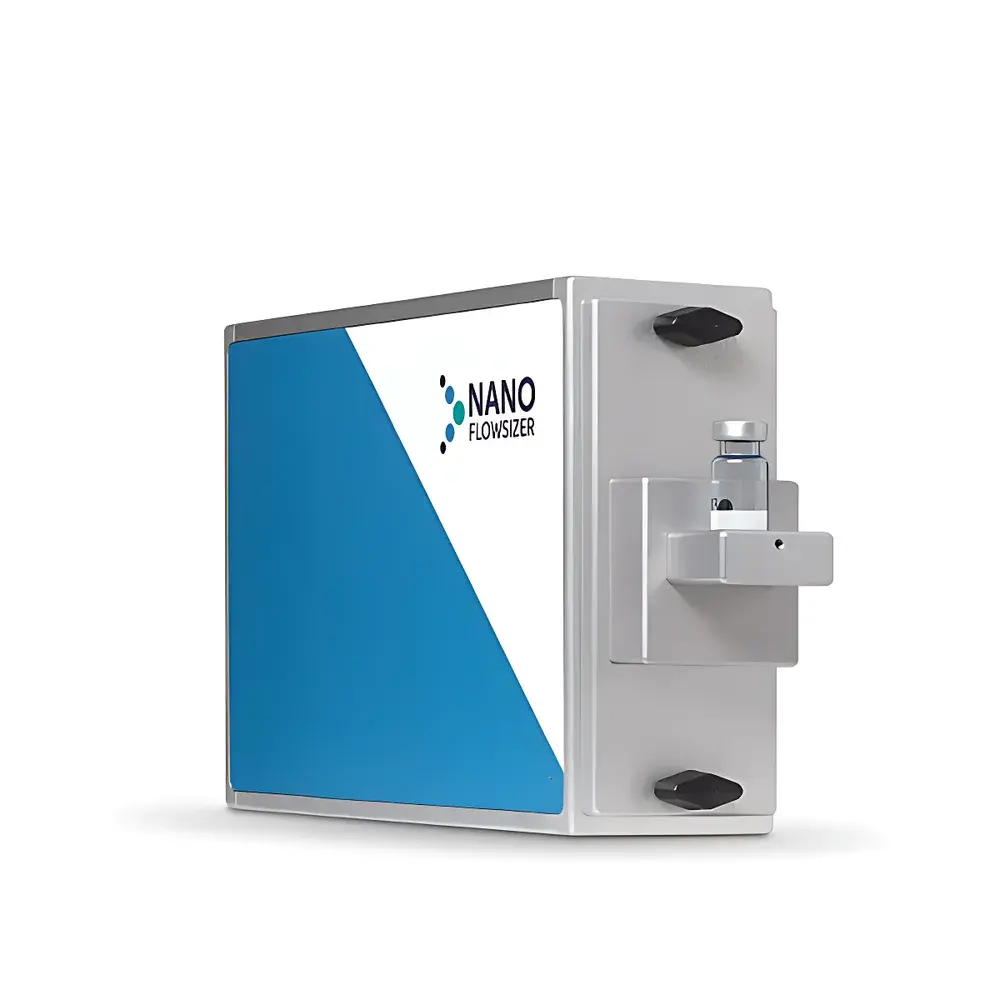
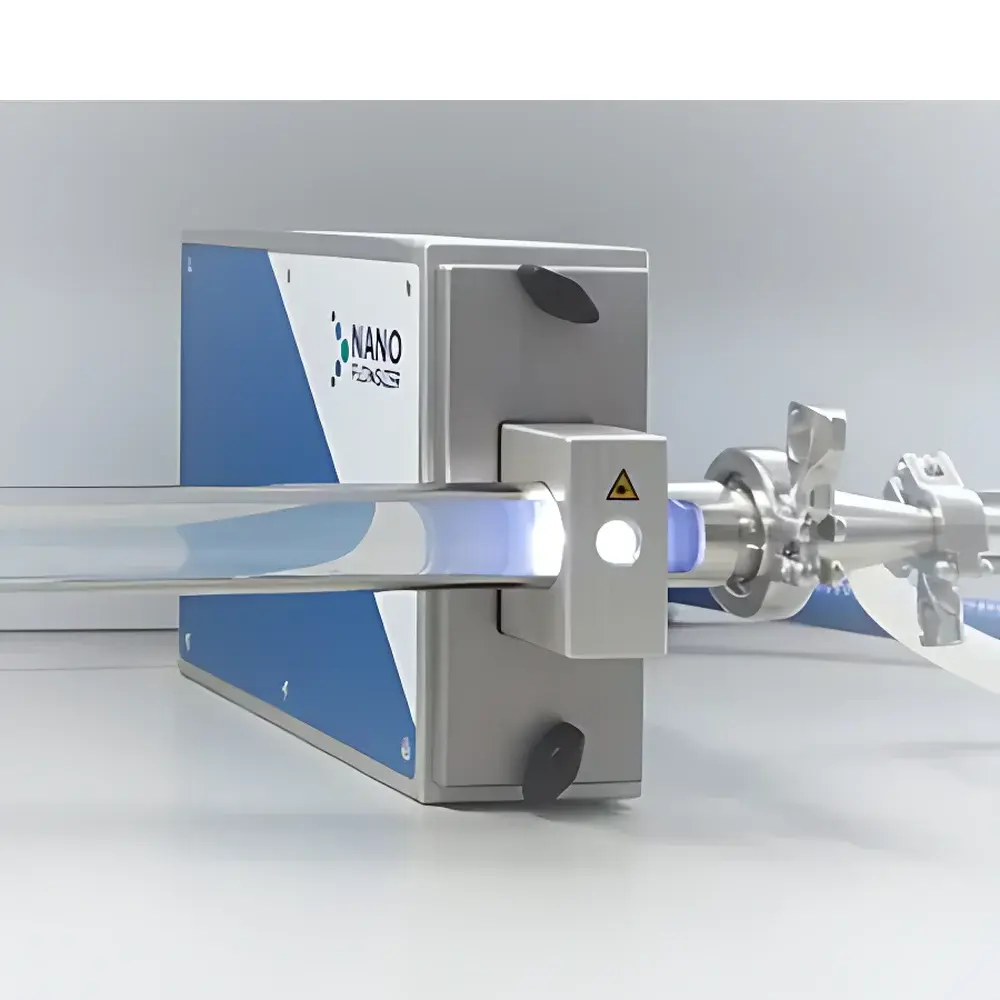
INPROCESS-LSP NanoFlowsizer Online Nanoparticle Size Analyzer
| Brand | INPROCESS-LSP |
|---|---|
| Origin | Netherlands |
| Model | NanoFlowsizer |
| Particle Size Range | 10–1000 nm |
| Size Reproducibility | ±2 nm |
| Temperature Range | −10 to 125 °C |
| Temperature Control Accuracy | ±0.5 °C (−10 to 85 °C), ±2.0 °C (85 to 125 °C) |
| Optical Signal Frequency | 76 Hz |
| Measurement Principle | Spatially Resolved Dynamic Light Scattering (SR-DLS) |
| Sample Concentration Range | Unrestricted |
| Minimum Sample Volume | ≥100 µL |
| Zeta Potential Range | Not applicable (dedicated particle sizing only) |
| Measurement Time | <10 s per acquisition |
Overview
The INPROCESS-LSP NanoFlowsizer is a purpose-engineered online nanoparticle size analyzer designed for continuous, real-time characterization of colloidal dispersions in process environments. Unlike conventional benchtop DLS instruments limited to static, offline measurements, the NanoFlowsizer implements Spatially Resolved Dynamic Light Scattering (SR-DLS)—a patented optical configuration that enables robust size analysis under high-turbidity conditions without dilution or flow-cell fouling. SR-DLS decouples scattering signal acquisition from bulk optical path interference by spatially segmenting the detection volume along the laser beam axis, allowing statistically meaningful autocorrelation functions to be extracted even from highly concentrated nanosuspensions (>100 mg/mL). This architecture supports direct integration into stainless-steel process lines via sanitary tri-clamp fittings (e.g., ISO-KF or DIN 11851), with IP65-rated housing and explosion-proof optional configurations compliant with ATEX/IECEx Zone 2 requirements.
Key Features
- True online capability: First-in-class system validated for uninterrupted in-line monitoring of nanoparticle size distribution during manufacturing campaigns—no sampling loops, no bypass lines required.
- SR-DLS optical engine: Eliminates multiple scattering artifacts through axial spatial resolution, enabling accurate hydrodynamic diameter measurement across the full 10–1000 nm range without sample dilution.
- Wide operational temperature envelope: Integrated Peltier-based thermostatic control maintains setpoint stability within ±0.5 °C from −10 to 85 °C, and ±2.0 °C up to 125 °C—critical for thermal stability assessment of lipid nanoparticles (LNPs) and polymeric micelles.
- Rapid acquisition cycle: Full-size distribution output generated in under 10 seconds, synchronized with industrial PLCs via EtherNet/IP or Modbus TCP for closed-loop process feedback.
- Dual-mode operation: Switch seamlessly between online dynamic mode (continuous streaming analysis) and offline static mode (batch vial analysis) using the same optical core and calibration database.
Sample Compatibility & Compliance
The NanoFlowsizer accommodates diverse nanomaterial classes—including mRNA-LNPs, polymeric nanoparticles, nanoemulsions, quantum dots, and catalytic metal colloids—without modification to fluidic path geometry. Its open-flow cuvette design accepts samples ranging from aqueous buffers to viscous organic phases (e.g., ethanol/water mixtures, propylene glycol formulations), with no moving parts in contact with the stream. All wetted materials comply with USP Class VI and FDA 21 CFR Part 211 requirements for pharmaceutical manufacturing equipment. The system meets ISO 22412:2017 for DLS methodology validation and supports audit-ready data integrity features aligned with ALCOA+ principles, including electronic signatures, immutable raw data archiving, and configurable user access levels per GMP Annex 11.
Software & Data Management
XsperGo software serves as the unified interface for instrument control, real-time visualization, and statistical trend analysis. It provides automated baseline correction, multi-angle intensity weighting, and cumulant + non-negative least squares (NNLS) distribution deconvolution. All measurement metadata—including timestamp, temperature, pressure, and optical alignment diagnostics—are embedded in each .nfs binary file. Data export supports ASTM E2927-compliant CSV formats and native integration with LIMS platforms via RESTful API. For regulated environments, XsperGo includes 21 CFR Part 11-compliant electronic record functionality: role-based permissions, audit trail logging (with WHO-issued timestamps), and cryptographic hash verification of raw correlation data.
Applications
- mRNA vaccine development: Real-time monitoring of LNP size drift during microfluidic mixing and post-dilution hold steps.
- Nanopharmaceutical QC: In-process verification of batch-to-batch consistency for paclitaxel-albumin nanoparticles (Abraxane®-like systems).
- Cosmetic emulsion stability: Detection of Ostwald ripening onset in oil-in-water nanoemulsions during thermal cycling.
- Heterogeneous catalysis: Tracking metal nanoparticle agglomeration kinetics inside fixed-bed reactors under reaction conditions.
- Food-grade nanocellulose: Quantifying fibrillation efficiency in real time during high-pressure homogenization.
FAQ
Does the NanoFlowsizer require calibration standards for routine operation?
No. The system employs factory-calibrated optical path geometry and laser wavelength reference; only periodic verification using NIST-traceable polystyrene nanolatex standards (e.g., 60 nm and 200 nm) is recommended every 6 months per ISO 22412.
Can it measure zeta potential in-line?
No. The NanoFlowsizer is optimized exclusively for hydrodynamic size determination via SR-DLS. Zeta potential requires electrophoretic mobility measurement, which is incompatible with continuous-flow geometry; offline zeta analysis remains necessary.
What is the minimum detectable concentration?
There is no defined lower limit—detection sensitivity depends on particle refractive index contrast and instrument alignment. Typical detection thresholds are ~1 × 10⁹ particles/mL for 50 nm polystyrene in water, verified per ISO 22412 Annex B.
Is cleaning-in-place (CIP) supported?
Yes. The flow cell and optical window assembly are compatible with standard CIP protocols using 0.5–2.0 M NaOH or 1.0% phosphoric acid at ≤80 °C; full CIP validation reports are available upon request.



