
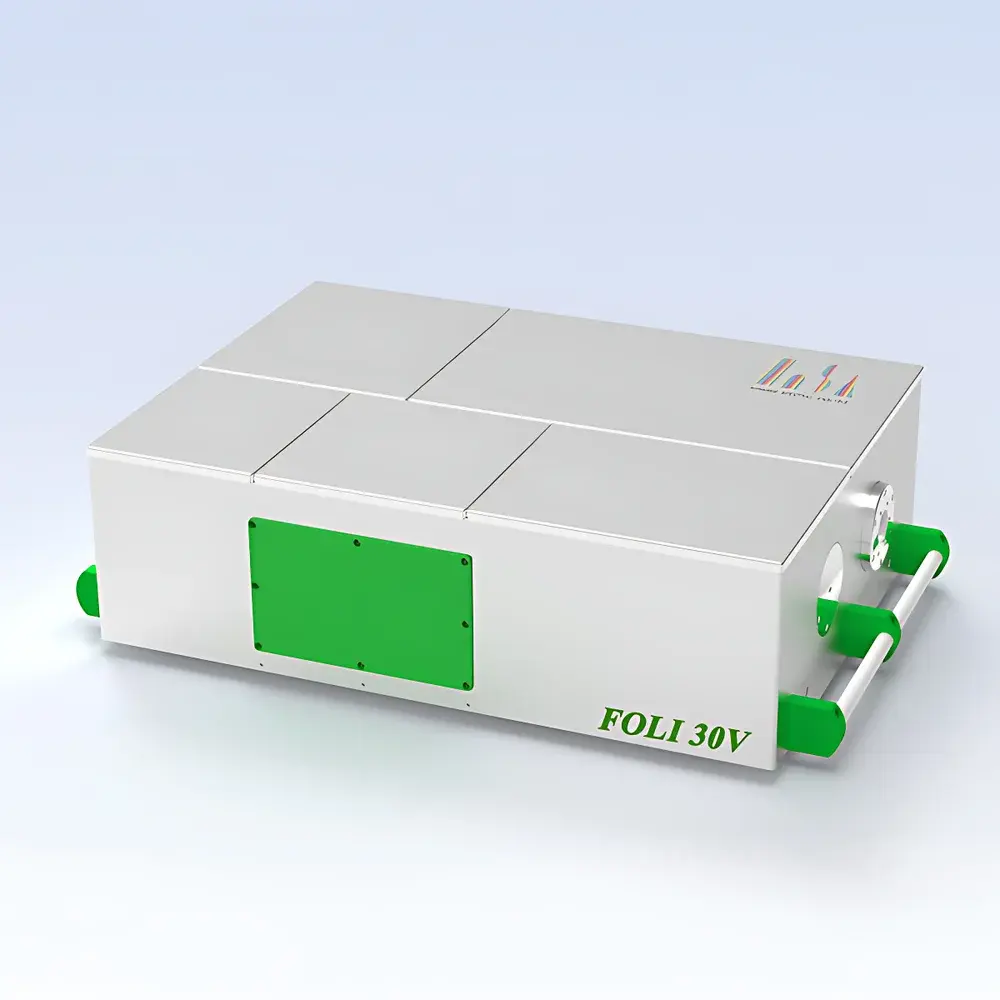
INSA Optics FOLI30V Vacuum Fourier Transform Infrared (FTIR) Spectrometer
| Brand | INSA Optics |
|---|---|
| Origin | Shanghai, China |
| Manufacturer Type | Original Equipment Manufacturer (OEM) |
| Instrument Type | Laboratory FTIR Spectrometer |
| Spectral Range | 8000–350 cm⁻¹ (extendable to 12800–4000 cm⁻¹ in NIR |
| Spectral Resolution | 0.2 cm⁻¹ |
| Scan Speed | 2.5–60 kHz |
| Signal-to-Noise Ratio (SNR) | 40,000:1 (at 4 cm⁻¹, 1 min scan, MCT detector) |
| Wavenumber Accuracy | < ±0.1 cm⁻¹ |
| Vacuum Level | ≤ 0.2 mbar |
| Optical Design | All-metal vacuum-sealed cast-aluminum interferometer housing with independent optical chamber |
Overview
The INSA Optics FOLI30V is a research-grade vacuum Fourier Transform Infrared (FTIR) spectrometer engineered for ultra-high sensitivity and spectral fidelity in demanding analytical environments. Unlike conventional benchtop FTIR systems operating under ambient atmosphere, the FOLI30V employs a fully evacuated optical path — encompassing the interferometer, beam splitter, detectors, and sample compartment — eliminating absorption interference from atmospheric CO₂ (2349 cm⁻¹) and H₂O vapor (broad bands centered at ~1370, ~1870, and ~3700 cm⁻¹). This vacuum architecture increases photon throughput by up to 3× compared to air-path instruments and enables detection of weak vibrational signals from monolayer-thick films, surface-adsorbed species, and low-concentration gaseous analytes. The system is built around a high-stability, self-compensating立体角镜 (corner-cube) interferometer with permanent alignment, rated for >10 years of continuous operation without recalibration. Its rigid cast-aluminum monolithic optical base minimizes thermal drift and mechanical vibration, ensuring long-term wavenumber stability (<0.01 cm⁻¹ over 8 hours) and measurement reproducibility (RSD < 0.3% for peak intensity across 50 consecutive scans).
Key Features
- Full-vacuum optical design (≤0.2 mbar) with dual-stage vacuum control: independent evacuation of main optical chamber and sample compartment via oil-free diaphragm pump
- Automated spectral region switching: software-controlled selection of NIR/MIR/FIR sources (water-cooled Hg lamp, ceramic, tungsten), detectors (InGaAs, DLaTGS, liquid-helium-cooled bolometer), and beam splitters (KBr, CaF₂, ZnSe, quartz)
- Single-acquisition broadband capability: simultaneous MIR–FIR acquisition from 6000–50 cm⁻¹; extendable to 12500–10 cm⁻¹ (THz range) with modular optics
- High-resolution performance: 0.2 cm⁻¹ unapodized resolution with He–Ne laser referencing (633 nm) and real-time laser fringe tracking
- Modular external port architecture: six standardized vacuum-compatible optical ports (CF-35 or CF-63 flanges) for integration with UHV chambers, cryogenic dewars (4 K–300 K), high-temperature emission cells (up to 1000 °C), gas cells (path lengths up to 20 m), and external detector modules
- Vacuum-compatible diamond ATR accessory: single-crystal diamond (type Ib, 1 mm × 1 mm contact area) with chemical inertness, wear resistance, and compatibility with corrosive liquids and solids under vacuum
- Thermal management: active temperature stabilization of critical optical components; operational stability maintained across ambient lab temperatures of 15–35 °C
Sample Compatibility & Compliance
The FOLI30V supports solid, liquid, gas, and thin-film samples under controlled vacuum conditions. It accommodates standard transmission cells (CaF₂, BaF₂, KBr windows), gas cells with variable pathlengths (0.1–20 m), and reflection accessories including DRIFTS, specular reflectance, and grazing-angle ATR. For regulated environments, the instrument complies with ISO 17025:2017 requirements for calibration traceability and measurement uncertainty reporting. Data acquisition and processing adhere to ALCOA+ principles (Attributable, Legible, Contemporaneous, Original, Accurate, Complete, Consistent, Enduring, Available) and support 21 CFR Part 11-compliant audit trails when deployed with validated software configurations. Optional GLP/GMP mode enables electronic signatures, role-based access control, and instrument-use logging suitable for pharmaceutical QC laboratories.
Software & Data Management
Controlled via Windows 10–based INSA SpectraSuite™ v5.x, the software provides full instrument automation, spectral preprocessing (zero-filling, phase correction, apodization), quantitative analysis (classical least-squares, PLS regression), and library searching against an embedded database of >10,000 IR reference spectra — all labeled with IUPAC names and CAS numbers. Users may build custom searchable libraries with metadata tagging (sample prep method, vacuum pressure, temperature, detector type). The software includes automated CO₂/H₂O subtraction algorithms optimized for vacuum-mode baselines, intelligent peak identification using second-derivative matching, and report generation compliant with ASTM E1421 and ISO 18381 standards. Raw interferogram and spectrum files are stored in vendor-neutral HDF5 format with embedded metadata (wavenumber calibration, vacuum pressure timestamp, detector gain, laser wavelength).
Applications
- In situ catalysis studies: time-resolved DRIFTS of adsorbed intermediates on metal oxide surfaces under UHV or controlled gas atmospheres
- Surface science: vibrational characterization of self-assembled monolayers (SAMs), 2D materials (graphene, MXenes), and molecular crystals under cryogenic vacuum
- Semiconductor metrology: quantitative analysis of dopants (B, P, As, Sb) in silicon wafers via lattice-mode absorption in the far-IR (20–100 cm⁻¹)
- Pharmaceutical solid-state analysis: polymorph identification, hydrate/solvate screening, and API-excipient interaction mapping using vacuum-enhanced sensitivity
- Gas-phase spectroscopy: high-resolution rotational–vibrational analysis of transient species (e.g., radicals, carbocations) in matrix-isolation experiments at 4–20 K
- Materials science: phonon dispersion mapping in perovskites, topological insulators, and superconductors via THz-range (10–300 cm⁻¹) transmission measurements
FAQ
What vacuum level does the FOLI30V achieve, and how is it monitored?
The system achieves ≤0.2 mbar in the main optical chamber and ≤1 mbar in the sample compartment, measured in real time via integrated capacitance manometers with digital readout in the control software.
Can the FOLI30V perform time-resolved measurements under vacuum?
Yes — with optional rapid-scan mode (up to 60 kHz mirror velocity) and external trigger input, it supports kinetic measurements with temporal resolution down to 10 ms per spectrum.
Is the diamond ATR accessory compatible with corrosive samples under vacuum?
Yes — the monocrystalline diamond crystal is chemically inert to strong acids, bases, and organic solvents, and its vacuum-rated housing maintains seal integrity below 10⁻³ mbar.
Does the system support external synchronization with other equipment (e.g., mass spectrometers or XRD)?
Yes — TTL-compatible trigger I/O ports enable hardware-level synchronization with UHV chambers, gas dosing systems, and in situ reaction cells.
How is spectral calibration maintained during extended vacuum operation?
Calibration is continuously referenced to the He–Ne laser fringe signal; long-term wavenumber stability is verified daily using NIST-traceable polystyrene film (peak at 1601.5 cm⁻¹) or air-water vapor lines.




