
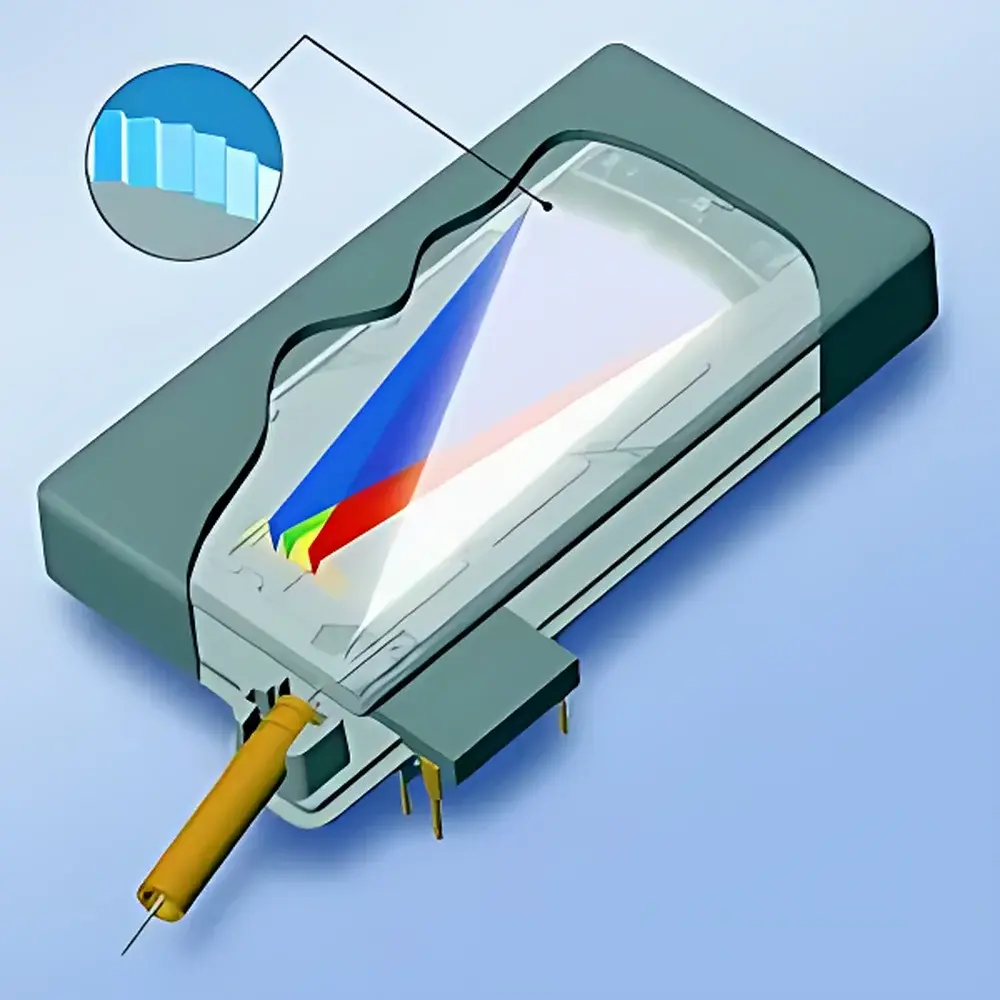
INSION UV/VIS Fiber Optic Spectrometer – Miniature MEMS-Based Spectral Sensor Module
| Brand | INSION |
|---|---|
| Origin | Germany |
| Model | UV-VIS Miniature Spectrometer |
| Spectral Range | 330 nm – 1050 nm |
| Optical Resolution (FWHM) | 8–10 nm |
| Signal-to-Noise Ratio | >5000:1 |
| Integration Time | 1 ms – 40,000 ms |
| Detector | Hamamatsu 256-pixel linear CMOS array |
| Slit Width | 50 µm |
| Wavelength Repeatability | <0.1 nm |
| Interface | Micro-USB + SMA905 fiber connector |
| Dimensions | 69 mm × 40 mm × 13.6 mm |
| Compliance | CE, RoHS |
Overview
The INSION UV-VIS Miniature Spectrometer is a high-performance, chip-scale fiber optic spectrometer engineered for integration into portable, handheld, and OEM analytical systems. Leveraging monolithic MEMS-based waveguide optics fabricated on a single silicon substrate, this device replaces traditional free-space optical benches with a robust, alignment-free planar architecture. Its core measurement principle relies on dispersive waveguide spectroscopy: incident light coupled via SMA905 fiber enters a micro-fabricated grating-integrated waveguide, where spectral separation occurs through diffraction and guided-mode propagation, followed by detection on a Hamamatsu 256-pixel linear CMOS sensor. This one-chip design ensures exceptional thermal stability, mechanical shock resistance, and long-term wavelength fidelity—critical for field-deployable and embedded applications requiring consistent spectral response across operating temperatures (−10 °C to +50 °C) and vibration environments. With a spectral coverage spanning the ultraviolet through near-infrared (330–1050 nm), it supports quantitative absorbance, reflectance, fluorescence excitation profiling, and colorimetric analysis in resource-constrained platforms.
Key Features
- Monolithic MEMS optical engine: No moving parts, no alignment drift, minimal sensitivity to thermal expansion or mechanical stress
- High inter-unit consistency: Typical wavelength repeatability <0.1 nm and inter-instrument spectral deviation <±0.3 nm enable reliable model transfer in multi-unit deployments
- Wide dynamic range: Adjustable integration time from 1 ms to 40 s supports both low-light fluorescence and high-intensity reflectance measurements
- Compact form factor: 69 × 40 × 13.6 mm footprint facilitates integration into handheld analyzers, point-of-care devices, and inline process sensors
- Dual-interface architecture: Micro-USB for power, control, and data streaming; SMA905 for standardized fiber-optic coupling (e.g., 200 µm core, 0.22 NA)
- Low power consumption: Operates at <350 mW (5 V DC), compatible with battery-powered systems and USB-powered DAQ setups
Sample Compatibility & Compliance
This spectrometer is optimized for liquid, solid, and gaseous samples interrogated via reflective probes, transmission cuvettes, or contactless diffuse reflectance heads. It supports standard 1–2 m fiber lengths with minimal modal noise when paired with solarization-resistant UV-grade silica fibers. The optical path is sealed against dust and humidity per IP52 specifications. Regulatory compliance includes CE marking under the EU Electromagnetic Compatibility Directive 2014/30/EU and RoHS 2011/65/EU. While not certified for medical device use out-of-the-box, its stable spectral calibration traceability (NIST-traceable reference lamps available upon request) and deterministic hardware behavior support validation under ISO/IEC 17025 laboratory accreditation frameworks and FDA-aligned instrument qualification protocols (IQ/OQ/PQ).
Software & Data Management
The spectrometer ships with cross-platform SDKs (C/C++, Python, LabVIEW, MATLAB) supporting real-time spectrum acquisition, dark/baseline correction, and user-defined calibration polynomials. Raw 16-bit intensity data is streamed at up to 100 spectra/s (full 256-point resolution) over USB 2.0. Firmware supports onboard averaging, ROI extraction, and trigger-synchronized acquisition. For regulated environments, optional audit-trail-enabled software modules comply with ALCOA+ principles: all parameter changes, calibration events, and data exports are timestamped, user-attributed, and non-erasable. Data output formats include CSV, HDF5, and vendor-neutral JCAMP-DX—ensuring interoperability with LIMS, ELN, and chemometric modeling tools (e.g., PLS regression in Unscrambler or Python scikit-learn).
Applications
- Portable water quality monitoring: Nitrate, nitrite, and organic matter quantification via UV-Vis absorption peaks (e.g., 220 nm, 275 nm, 400 nm)
- OEM integration in handheld colorimeters for paint, textile, and food surface analysis
- In-line pharmaceutical tablet coating thickness verification using NIR reflectance (900–1050 nm)
- LED and OLED emission profiling for display manufacturing QA
- Lab-on-chip absorbance detection in microfluidic diagnostic cartridges
- Educational spectroscopy kits requiring rugged, reproducible hardware for undergraduate physics and chemistry labs
FAQ
Is this spectrometer suitable for GLP-compliant laboratories?
Yes—when used with documented calibration procedures, version-controlled firmware, and audit-trail software, it meets foundational requirements for instrument qualification under GLP (OECD Principles) and internal QA/QC workflows.
Can I perform absolute irradiance measurements with this device?
Not natively—calibration is relative unless paired with an NIST-traceable radiometric standard lamp and configured with appropriate throughput correction factors.
What is the typical warm-up time required for spectral stability?
Less than 60 seconds to achieve <0.05 nm wavelength drift after power-on, verified across ambient temperature gradients of ±5 °C/h.
Does the SDK support real-time peak identification and concentration calculation?
Yes—the Python SDK includes open-source spectral processing functions for baseline correction, peak detection (using second-derivative methods), and multivariate calibration deployment.
Are custom slit widths or grating options available for OEM orders?
Yes—INSION offers tailored optical configurations (e.g., 25 µm slit, extended NIR range to 1100 nm) under NRE-supported volume agreements (MOQ ≥ 500 units).




