
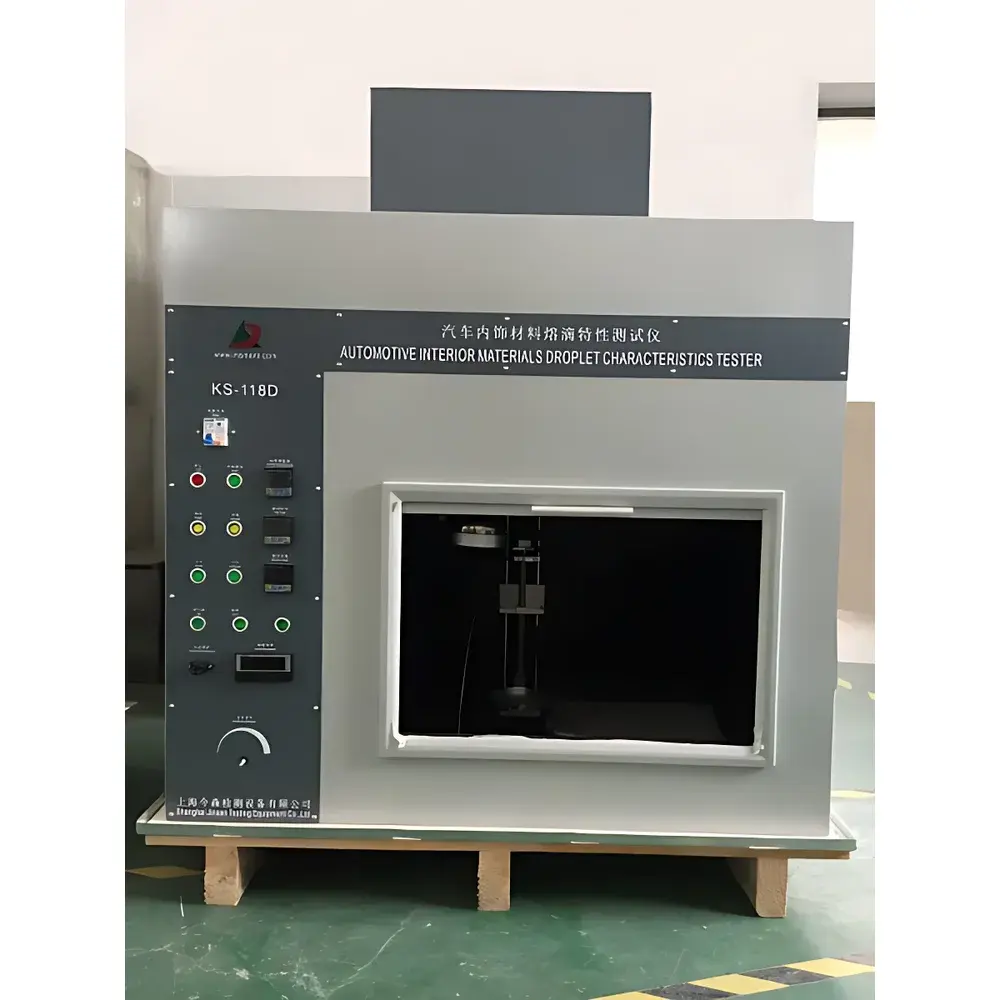
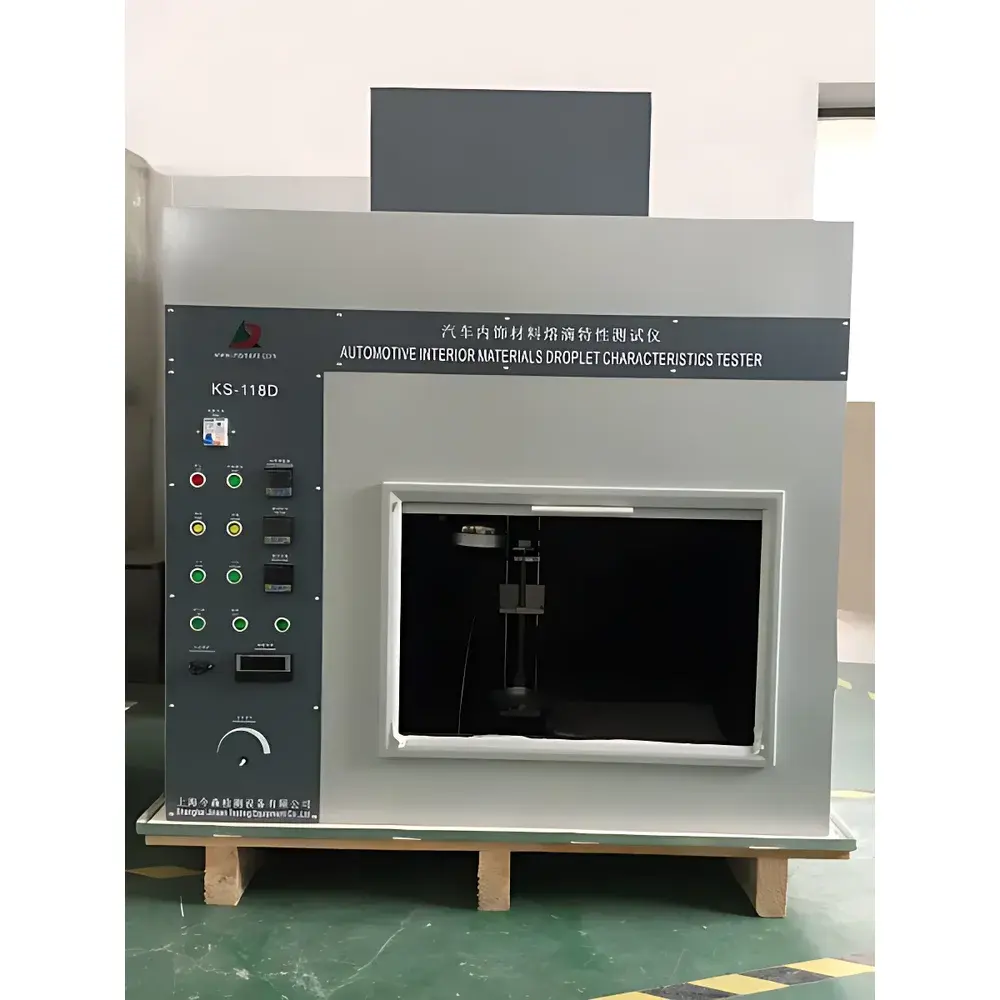
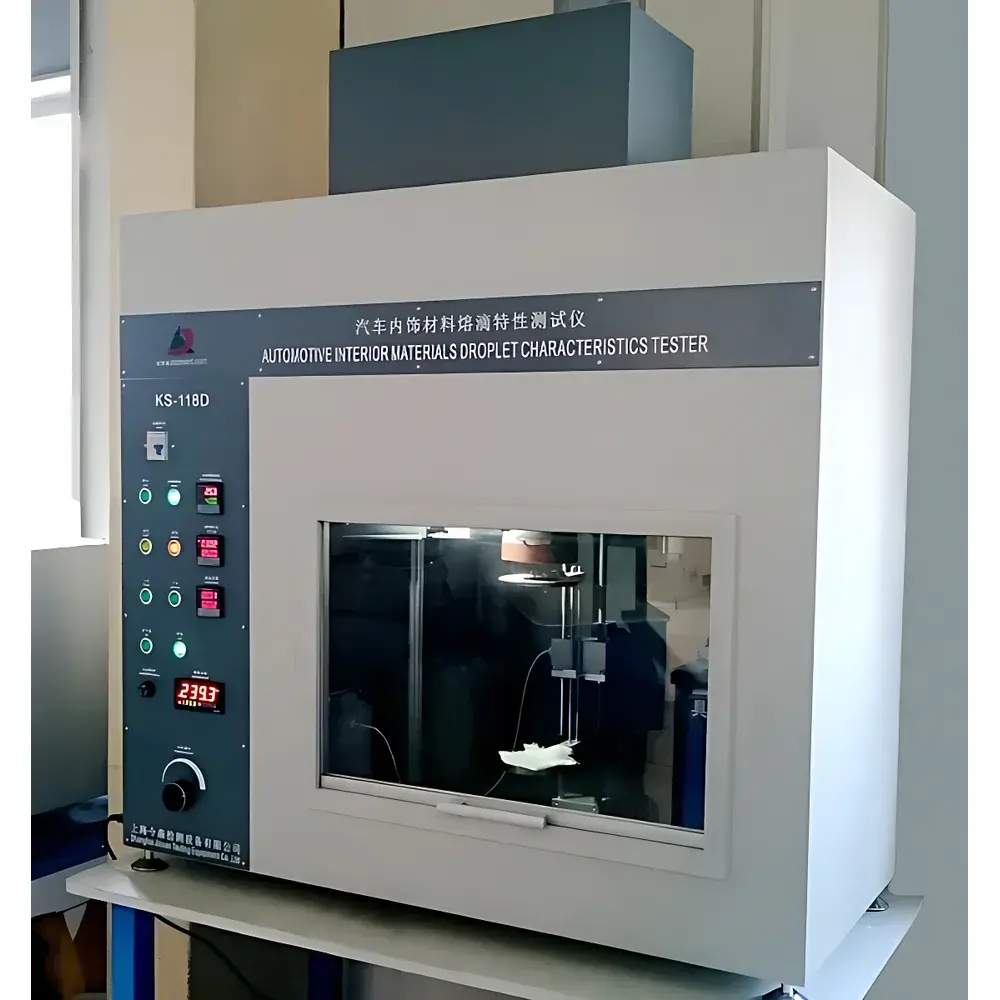
Insment KS-118D Automotive Interior Material Dripping Behavior Tester for UN ECE R118 Annex 7
| Brand | Insment |
|---|---|
| Model | KS-118D |
| Origin | Shanghai, China |
| Radiation Source Power | 500 W |
| Radiation Surface Diameter | Φ100 mm ± 5 mm |
| Sample Holder Inner Diameter | 118 mm (stainless steel ring) |
| Stainless Steel Mesh | Wire diameter 0.70 mm, aperture 2.10 mm |
| Sample Dimensions | 70 mm × 70 mm, max thickness 13 mm |
| Drip Catcher Diameter | Φ118 mm, depth 12 mm |
| Distance from Sample Upper Surface to Radiant Source | 30 mm |
| Distance from Sample Holder to Drip Catcher (cotton pad) | 300 mm |
| Heat Flux Meter Range | 10 W/cm² |
| Overall Dimensions | 1120 mm (W) × 580 mm (D) × 1350 mm (H) |
| Exhaust Port Diameter | Φ100 mm |
| Power Supply | AC 220 V, 50 Hz, ≤1000 W |
| Compliance | UN ECE Regulation No. 118, Annex 7 |
Overview
The Insment KS-118D Automotive Interior Material Dripping Behavior Tester is a precision-engineered apparatus designed exclusively for evaluating the molten drip behavior of automotive interior materials in accordance with UN ECE Regulation No. 118, Annex 7. This standardized test method assesses whether thermoplastic or thermosetting components—such as headliners, pillar trims, seat fabrics, and insulation foams—undergo dripping during thermal exposure, and whether such drips ignite or propagate flame when contacting an underlying cotton wool ignition substrate. The device operates on a controlled radiant heating principle: a 500 W electric radiant source emits uniform thermal flux onto a horizontally mounted specimen positioned 30 mm beneath the emitter. The specimen rests on a stainless steel support ring (ID 118 mm) fitted with a calibrated mesh (0.70 mm wire diameter, 2.10 mm aperture), ensuring consistent sample geometry and airflow. A standardized cotton wool pad is placed 300 mm below the mesh in a dedicated Φ118 mm × 12 mm drip catcher. The system enables real-time observation of melt formation, droplet detachment, trajectory, and ignition response—critical parameters for regulatory conformance and fire safety engineering in vehicle cabin design.
Key Features
- Compliance-focused mechanical architecture engineered to replicate the exact dimensional and thermal boundary conditions specified in UN ECE R118 Annex 7, including fixed 30 mm source-to-sample and 300 mm sample-to-cotton distances.
- Robust cold-rolled steel enclosure with orange-peel textured epoxy coating, providing enhanced resistance to acid, alkali, and thermal degradation over extended service life.
- Integrated radiant heater assembly with precise lateral displacement mechanism—enabling operator-initiated retraction (for flame suppression during initial 5-minute observation window) and repeatable return to nominal 30 mm standoff position.
- Calibrated heat flux meter (range: 0–10 W/cm²) for verification of incident thermal irradiance prior to each test cycle, supporting traceable test documentation.
- Dedicated exhaust duct (Φ100 mm) and ventilation path to maintain ambient oxygen concentration and prevent localized smoke accumulation that could interfere with visual assessment of drip ignition.
- Modular stainless steel sample holder and replaceable mesh inserts ensure long-term dimensional stability and cleaning repeatability across high-throughput laboratory environments.
Sample Compatibility & Compliance
The KS-118D accommodates flat, rigid or semi-rigid specimens measuring 70 mm × 70 mm with a maximum thickness of 13 mm—covering common OEM material forms including laminated composites, coated textiles, expanded polypropylene (EPP), polyurethane (PU) foams, and PVC-based trim sheets. All test procedures strictly adhere to the procedural sequence defined in Annex 7: pre-conditioning at 23 °C ± 2 °C and 50 % ± 5 % RH for ≥24 h; mounting without compression; initiating radiant exposure; monitoring for ignition, dripping, and cotton pad ignition within the prescribed 60-second post-drip observation window. Results are classified per Annex 7 Table 1 criteria: “Pass” if no flaming drips occur or if drips extinguish before contacting cotton; “Fail” if cotton ignites or sustained flaming drips persist beyond 10 seconds. The instrument supports audit-ready documentation required under ISO/IEC 17025-accredited testing laboratories and aligns with broader automotive fire safety frameworks including FMVSS 302 and GB 8410.
Software & Data Management
The KS-118D is a manually operated, non-automated test platform requiring direct operator intervention per Annex 7 protocol steps—including timed heater retraction, visual flame assessment, and pass/fail determination based on cotton ignition. As such, it does not incorporate embedded firmware or proprietary software. However, its mechanical repeatability and clearly defined physical tolerances enable full integration into LIMS or ELN systems via structured manual entry templates. Test records—including ambient temperature/humidity logs, specimen identification, heater stabilization time, observed drip onset time, number and morphology of drips, cotton ignition status, and final classification—can be documented in compliance with GLP principles and FDA 21 CFR Part 11–aligned electronic record practices when paired with validated laboratory documentation workflows.
Applications
This tester serves Tier 1 suppliers, OEM engineering labs, and independent certification bodies engaged in component-level fire safety validation for passenger vehicles, light commercial vehicles, and buses. Typical use cases include pre-compliance screening of new polymer formulations, root-cause analysis of drip-related field incidents, comparative evaluation of flame-retardant additives (e.g., brominated vs. phosphorus-based systems), and technical support for UN ECE type-approval submissions. Its deterministic physical configuration ensures inter-laboratory reproducibility—a prerequisite for dispute resolution in supply chain quality audits and homologation dossier reviews.
FAQ
Does the KS-118D comply with any international standards beyond UN ECE R118 Annex 7?
Yes—it is dimensionally and operationally aligned with ISO 3795 (Road vehicles — Determination of burning behaviour of interior materials) Clause 7.3 for dripping assessment, and supports test execution under SAE J369 (Flammability of Interior Trim Materials) where dripping evaluation is referenced.
Is calibration certification included with the instrument?
A factory-verified heat flux meter calibration certificate is supplied; users must perform periodic verification using NIST-traceable radiometers per ISO/IEC 17025 requirements.
Can the device be used for non-automotive materials?
While optimized for ECE R118, its radiant geometry and specimen constraints permit adaptation for other regulated sectors—e.g., railway (EN 45545-2) or aerospace (FAR 25.853)—subject to method validation per relevant clauses.
What maintenance is required to ensure long-term measurement fidelity?
Monthly inspection of mesh integrity, quarterly cleaning of radiant source reflector surface with non-abrasive solvent, and annual verification of heater output stability using calibrated power meter.
Is exhaust gas analysis capability integrated?
No—the KS-118D is a pass/fail visual assessment system only; coupling with FTIR or GC-MS requires external fume hood integration and separate sampling infrastructure.



