
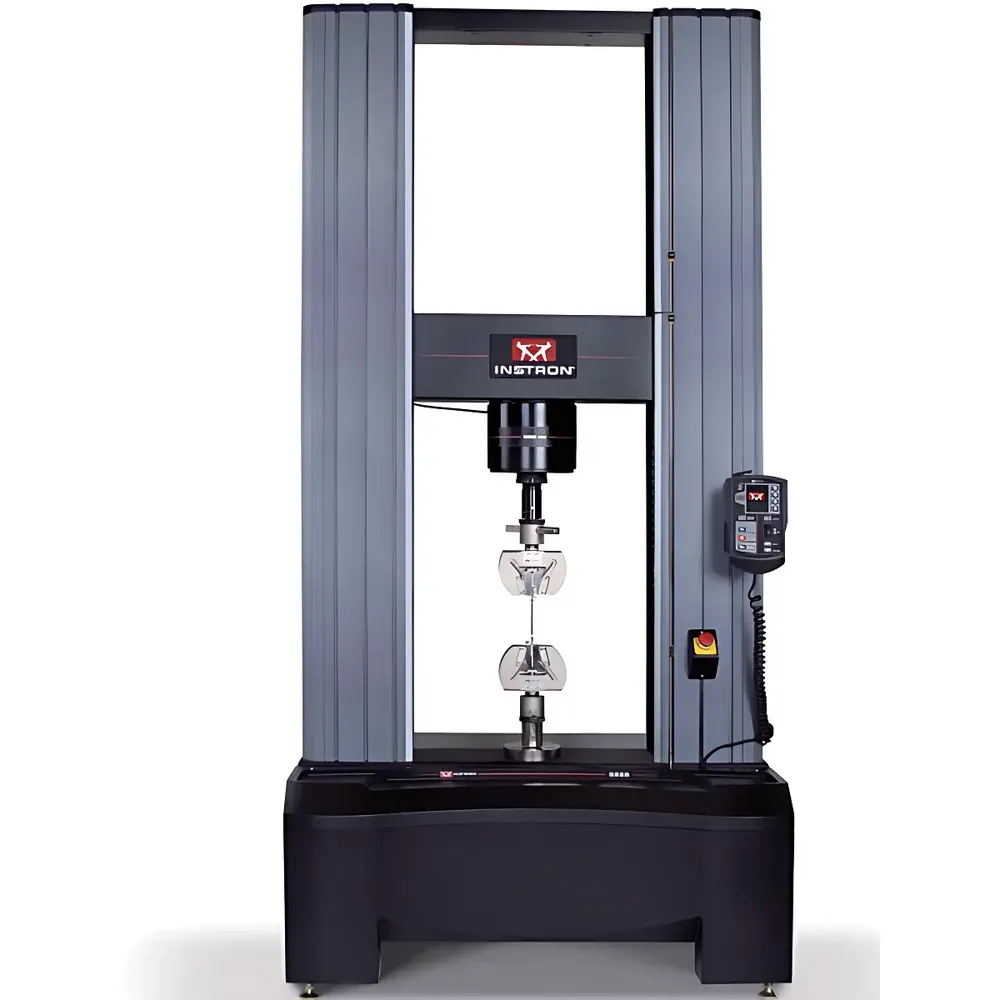
Instron 5980 Series Dual-Column Floor-Mounted Universal Testing Machine
| Brand | Instron |
|---|---|
| Origin | USA |
| Model | 5980 Series |
| Load Capacity | Up to 600 kN (135,000 lbf) |
| Vertical Test Space | Up to 2050 mm (80.7 in) |
| Control System | Bluehill Universal Software |
| Sensor Channels | Up to 4 built-in |
| Interface | Integrated Ethernet |
| Compliance | ASTM E4, E8, E9, E21, ISO 6892-1, ISO 527, ISO 178, USP <1041>, FDA 21 CFR Part 11 (with audit trail enabled) |
Overview
The Instron 5980 Series dual-column floor-mounted universal testing machine is a high-capacity electromechanical materials testing system engineered for precision mechanical characterization under static and quasi-static loading conditions. Based on servo-controlled electromechanical actuation and compliant with fundamental principles of uniaxial force–displacement metrology, the 5980 platform delivers traceable, repeatable, and standards-compliant measurements across tensile, compressive, flexural, shear, and cyclic test modes. Designed for structural validation and quality assurance in demanding industrial environments—including aerospace component certification, automotive crash simulation support, and heavy-gauge metal fabrication—this system integrates rigid dual-column architecture, high-stiffness crosshead guidance, and real-time closed-loop control to minimize parasitic bending moments and ensure axial alignment within ±0.01° over full travel. Its load frame complies with ISO 7500-1 Class 0.5 accuracy requirements and supports calibration traceability to NIST or UKAS-accredited laboratories.
Key Features
- High-rigidity dual-column steel frame with precision-ground linear bearings and preloaded ball screws for minimal deflection and consistent load train alignment
- Integrated Ethernet interface enabling deterministic communication with host PCs; compatible with standard TCP/IP networks without proprietary drivers
- Up to four simultaneously active sensor input channels—including load, displacement, strain, and environmental inputs—for multi-parameter correlation during complex protocols
- Real-time control panel with tactile soft-keys, dynamic parameter visualization, and programmable specimen protection logic (e.g., automatic stop on overload or excessive extension)
- Expanded speed range from 0.00005 to 1000 mm/min with improved speed accuracy (±0.1% of setpoint) and enhanced data sampling up to 10 kHz
- T-slot reinforced base table (M12 threaded inserts, 100 mm pitch) for secure fixture mounting and modular test setup reconfiguration
- Built-in LED task lighting focused on the gauge section to facilitate optical extensometer placement and visual inspection of specimen deformation
- Optional pneumatic or hydraulic wedge-action grips with auto-clamp triggering via Bluehill software—reducing operator intervention and improving throughput consistency
Sample Compatibility & Compliance
The 5980 Series accommodates specimens ranging from thin foils (<0.1 mm thick) to structural assemblies exceeding 1 m in length and 600 kN in ultimate load capacity. Standard configurations support ASTM E8/E8M (tensile testing of metallic materials), ASTM D638/D638M (plastics), ISO 6892-1 (metallic tensile), ISO 527 (plastics tensile), ISO 178 (flexural properties), and ASTM C39 (concrete compression). Optional accessories—including video extensometers, digital image correlation (DIC) systems, environmental chambers (−70 °C to +350 °C), and high-temperature furnaces—extend compliance into GLP/GMP-regulated workflows. When configured with Bluehill Universal’s 21 CFR Part 11 module, the system provides electronic signatures, audit trails, role-based access control, and data integrity safeguards required for FDA-submitted reports.
Software & Data Management
Control, acquisition, and reporting are unified through Bluehill Universal—a validated, scalable software platform supporting method-driven test execution and automated pass/fail evaluation. The software features intuitive workflow templates aligned with ISO/IEC 17025 documentation requirements, customizable report generation (PDF, Excel, XML), and native integration with LIMS and MES systems via ODBC or RESTful API. All raw data—including time-stamped load, position, strain, and auxiliary channel values—are stored in an encrypted, tamper-evident binary format (.bup) with embedded metadata (operator ID, calibration dates, environmental logs). Version-controlled method libraries allow centralized deployment across multiple instruments while maintaining full revision history and change tracking.
Applications
The 5980 Series serves as a primary test asset in R&D labs and production QA departments evaluating mechanical performance of advanced engineering materials. Typical use cases include: monotonic tensile testing of aluminum alloys (AA7075-T6, AA6061-T6) per AMS 4027; compression testing of carbon-fiber-reinforced polymer (CFRP) laminates per ASTM D6641; shear testing of riveted joints per NASM 1312-8; fatigue pre-screening of fasteners per SAE J429; and creep rupture analysis of high-strength steels per ASTM E139. Its scalability—from 100 kN entry-level (5982) to 600 kN heavy-duty (5989)—enables seamless transition from material screening to full-scale structural validation without methodology recalibration.
FAQ
What standards does the 5980 Series comply with for load cell calibration?
The system meets ISO 7500-1 Class 0.5 requirements and supports calibration traceability to national metrology institutes (e.g., NIST, PTB, NPL) via certified reference standards.
Can Bluehill Universal be validated for regulated environments?
Yes—when deployed with the 21 CFR Part 11 compliance package, it satisfies FDA, EMA, and PMDA regulatory expectations for electronic records and signatures.
Is remote operation supported?
Full remote monitoring and test initiation are possible via secure VPN or corporate intranet using Bluehill Remote Connect, with session logging and user authentication enforced.
How is crosshead alignment verified and maintained?
Alignment is verified using ASTM E1012 procedures; the dual-column design incorporates adjustable leveling feet and precision-machined column-to-base interfaces to sustain alignment over extended service life.
What is the maximum vertical test space for the 5989 model?
The 5989 configuration offers 2000 mm (78.8 in) of usable vertical test space, expandable to 2050 mm (80.7 in) with optional height extension kits.



