
OK Instrument OK-TS-15 LED Thermal Shock Test Chamber
| Brand | OK Instrument |
|---|---|
| Origin | Guangdong, China |
| Manufacturer Type | Direct Manufacturer |
| Model | OK-TS-15 |
| Price | USD 12,500 (FOB Guangdong) |
| High-Temperature Range | +150 °C |
| Low-Temperature Range | −50 °C |
| Thermal Shock Range | −50 °C to +150 °C |
| Temperature Stability | ±2 °C |
| Heating Rate | 10 °C/min |
| Cooling Rate | 10 °C/min |
Overview
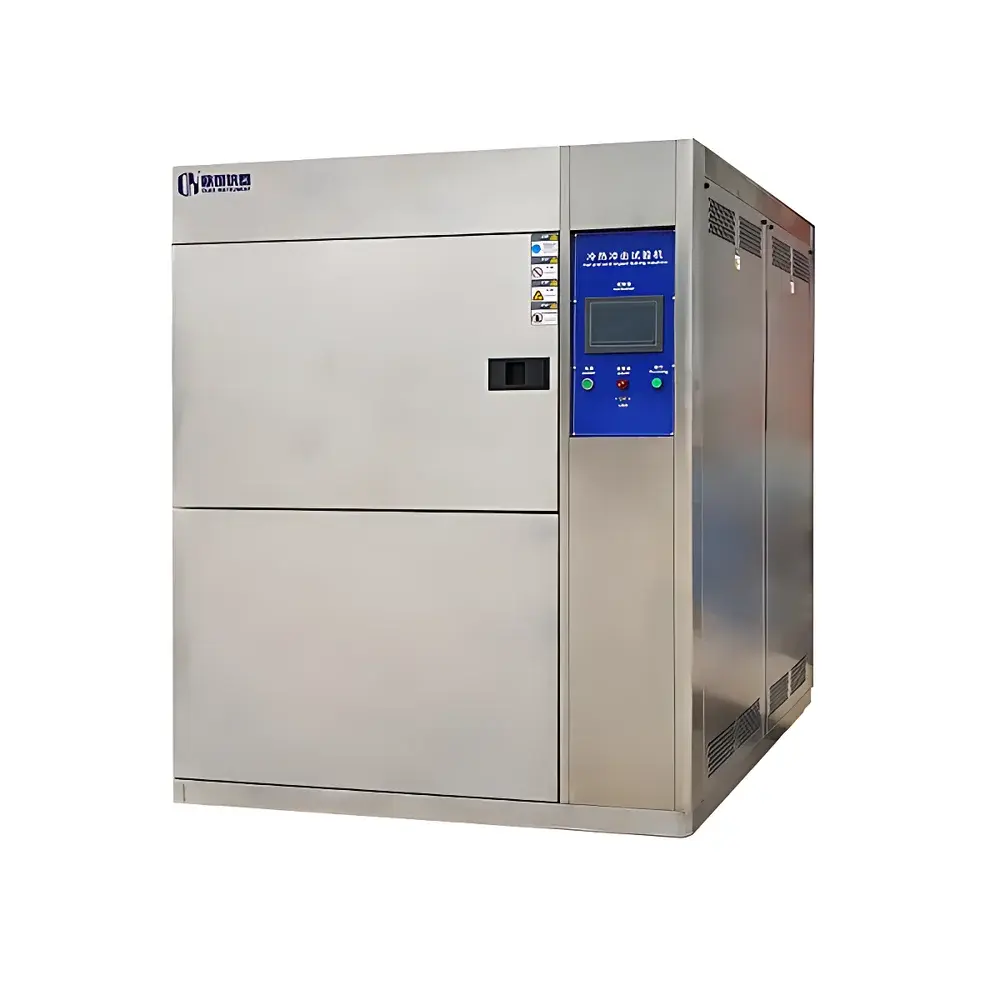
The OK Instrument OK-TS-15 LED Thermal Shock Test Chamber is a precision-engineered environmental test system designed for accelerated evaluation of material integrity under rapid, extreme temperature transitions. It operates on the principle of mechanical thermal shock—subjecting specimens to abrupt, repetitive shifts between high- and low-temperature zones without intermediate dwell at ambient conditions. Unlike conventional temperature cycling chambers, this unit delivers true thermal shock by minimizing transition time (<5 min recovery per cycle) and maintaining tight control over chamber boundary temperatures (±2 °C stability). The system employs a two-zone air-impingement architecture with pneumatically actuated damper doors, enabling rapid thermal transfer while preserving sample positional stability during testing. Its design conforms to the fundamental thermomechanical requirements of shock-induced failure analysis—including interfacial delamination, solder joint fatigue, polymer embrittlement, and coefficient-of-thermal-expansion (CTE) mismatch assessment.
Key Features
- Two-zone configuration with independent high-temperature (+150 °C) and low-temperature (−50 °C) chambers, eliminating thermal mass interference during transition
- High-fidelity temperature ramping: 10 °C/min heating and cooling rates, verified per IEC 60068-2-14 Annex A
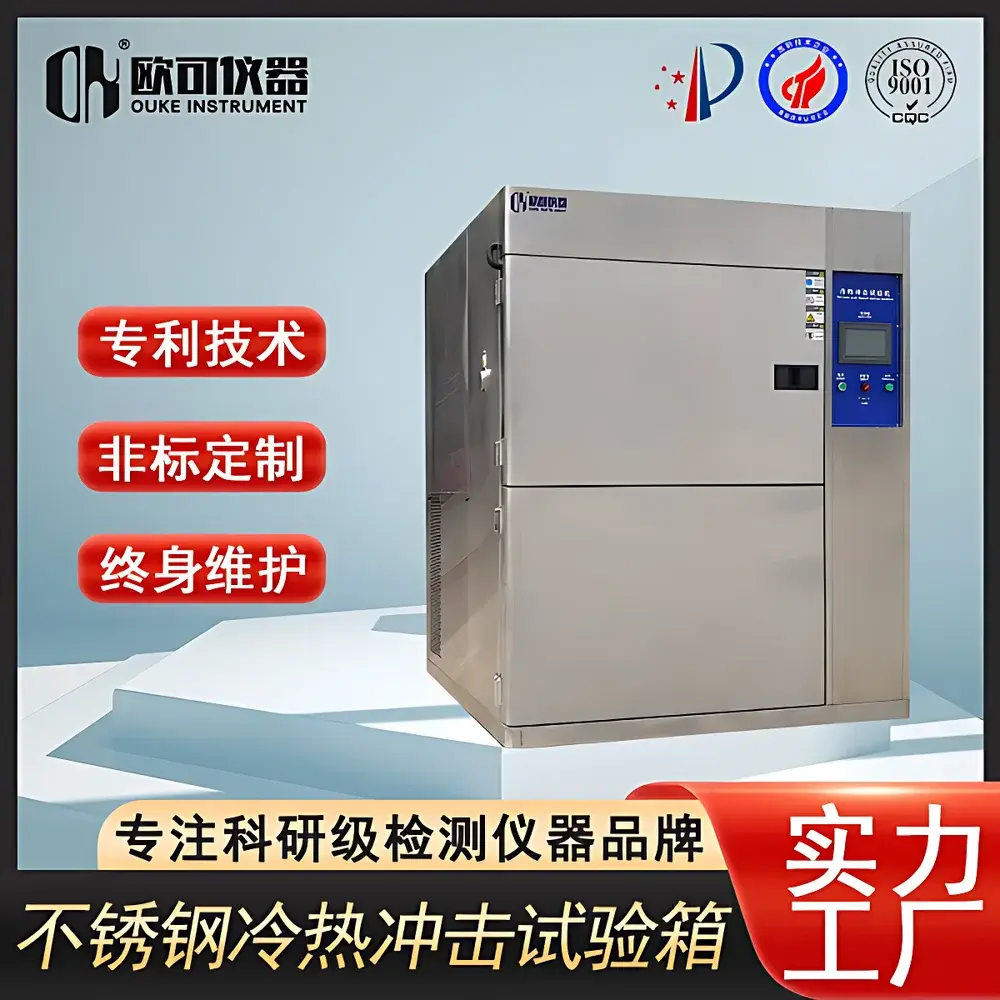
- Stainless steel 304 interior (mirror-finish) and exterior construction, compliant with ISO 9001 manufacturing protocols
- Dual-stage cascade refrigeration system using environmentally compliant R404A/R23 refrigerant blend, coupled with water-cooled condensation (external cooling tower required)
- Pneumatic door actuation with <1.2 s full-cycle switching time, minimizing thermal lag and ensuring repeatable shock profiles
- Integrated energy regulation logic that dynamically modulates compressor load and expansion valve duty cycle to maintain setpoint accuracy while optimizing power consumption
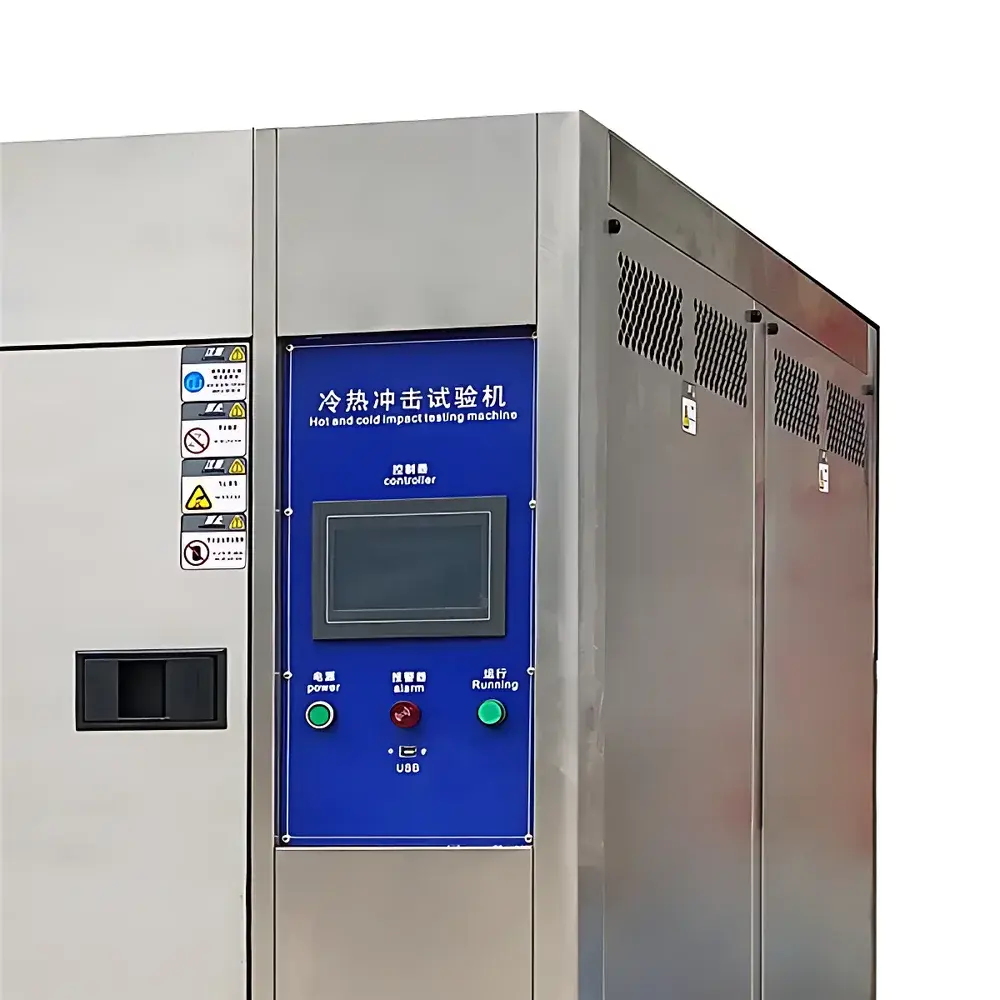
- Standard 50 mm diameter cable port (stainless steel), dual-tier 304 stainless steel sample trays, and IP54-rated electrical cabinet
Sample Compatibility & Compliance
The OK-TS-15 accommodates samples up to 60 × 50 × 50 cm (W×H×D) in internal volume, supporting rigid PCB assemblies, automotive ECUs, LED modules, aerospace fasteners, and molded elastomeric seals. It meets the physical and procedural requirements of multiple international standards, including: IEC 60068-2-14 (Test N: Change of Temperature), MIL-STD-810H Method 503.5, GJB 150.5A–2009 (Temperature Shock), GB/T 2423.22–2012 (Environmental Testing – Part 2: Tests – Test N: Change of Temperature), and QC/T 17–1992 (Automotive Component Environmental Endurance). All temperature sensors are calibrated traceable to NIM (National Institute of Metrology, China) standards; data logging supports GLP-compliant audit trails when paired with optional software packages.
Software & Data Management
The chamber integrates a programmable 7-inch TFT touchscreen controller with real-time PID tuning, multi-segment profile programming (up to 99 cycles, 99 steps), and automatic fault logging. Optional OK-DataLink™ software enables remote monitoring via Ethernet or RS485, exporting CSV-formatted time-stamped records (temperature, cycle count, alarm status) compatible with LIMS environments. Full 21 CFR Part 11 compliance is achievable through optional user role management, electronic signatures, and immutable audit trail generation—validated for use in regulated QA/QC laboratories operating under ISO/IEC 17025 or IATF 16949 frameworks.
Applications
This thermal shock chamber is routinely deployed in reliability engineering workflows across electronics manufacturing (e.g., assessing solder joint reliability per JEDEC JESD22-A106), LED packaging qualification (die-attach adhesion under thermal cycling), automotive component validation (connector housing warpage, sensor housing seal integrity), and advanced materials R&D (polymer composite microcrack propagation kinetics). Its reproducible shock profiles support root-cause analysis of field failures linked to thermal fatigue mechanisms, providing statistically significant acceleration factors (AF) when correlated with Arrhenius-based lifetime models.
FAQ
What is the difference between thermal shock and temperature cycling?
Thermal shock involves instantaneous transfer between extreme temperature zones with minimal dwell time, inducing high transient stress gradients. Temperature cycling includes extended dwell periods at extremes, emphasizing cumulative degradation rather than peak stress response.
Is external cooling infrastructure mandatory?
Yes—a dedicated water-cooled condenser system (10 m³/h flow capacity, 30–35 °C inlet temperature) must be provided onsite to sustain rated cooling performance and compressor longevity.
Can the OK-TS-15 perform single-zone temperature cycling?
No—it is engineered exclusively for two-zone thermal shock. For single-chamber cycling applications, OK Instrument recommends the OK-TC series temperature chambers.
What calibration documentation is supplied?
Each unit ships with factory calibration certificates for all PT100 sensors (±0.15 °C accuracy at 0 °C and 100 °C), validated against reference standards accredited to ISO/IEC 17025.
Is custom internal dimensioning available?
Yes—OK Instrument offers OEM engineering services for non-standard chamber volumes, including modified door configurations, reinforced load-bearing shelves, and specialized thermal shielding options.



