
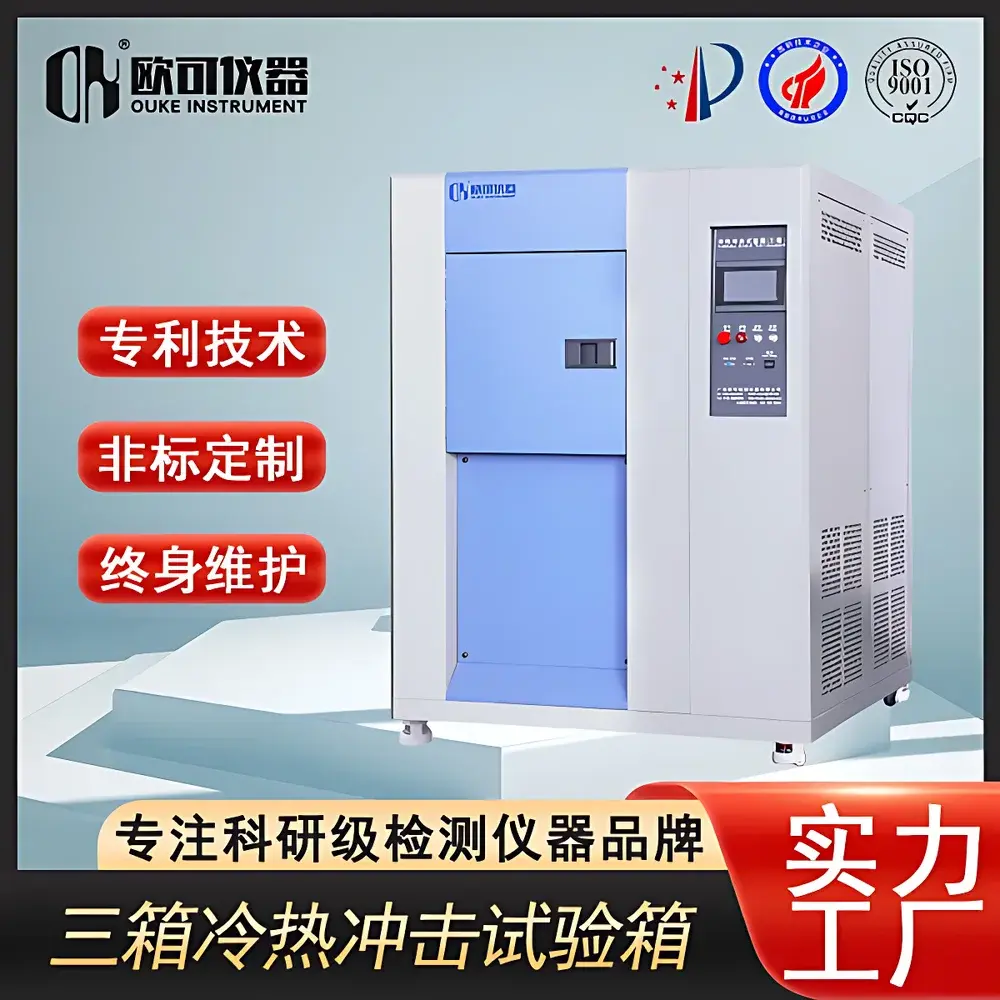
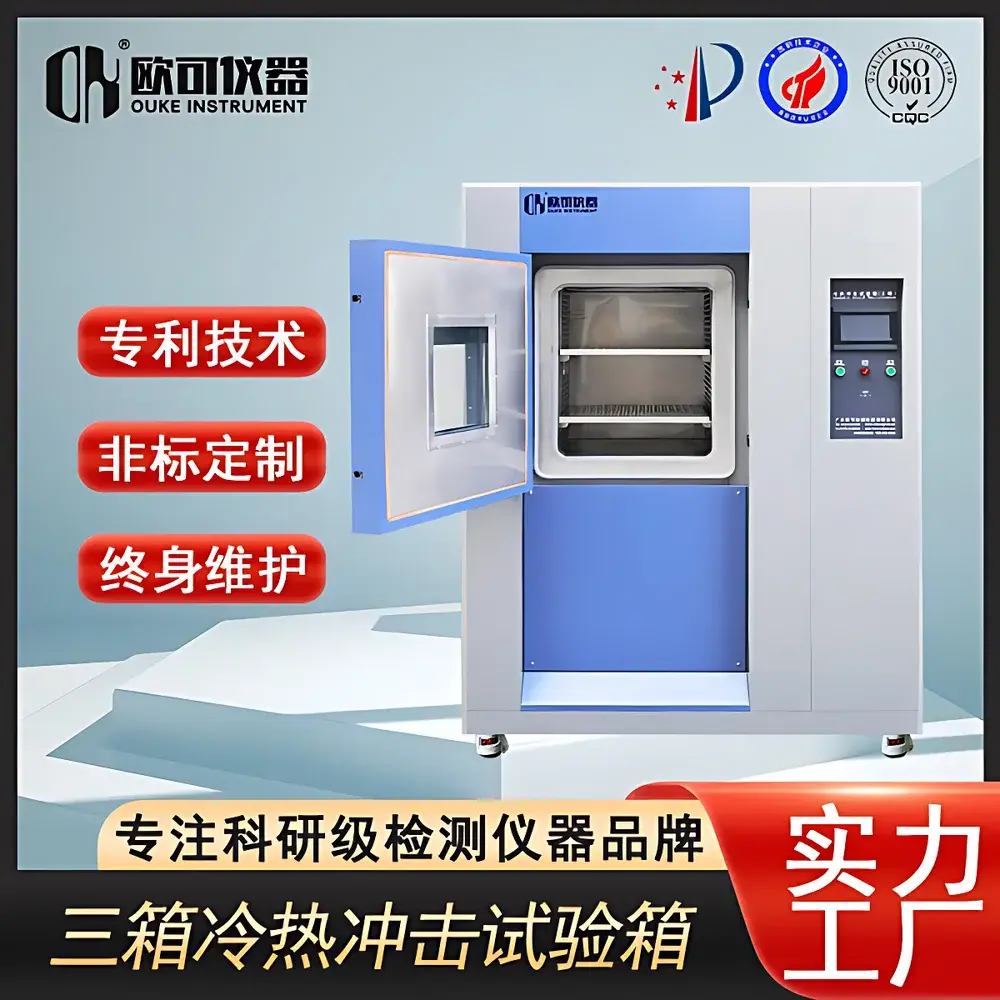
OK Instrument OK-TS-49 Thermal Shock Test Chamber
| Brand | OK Instrument |
|---|---|
| Origin | Guangdong, China |
| Manufacturer Type | Direct Manufacturer |
| Model | OK-TS-49 |
| Price | USD 12,500 (FOB Guangdong) |
| High-Temperature Range | +150 °C |
| Low-Temperature Range | −50 °C |
| Thermal Shock Range | −50 °C to +150 °C |
| Temperature Stability | ±2.0 °C |
| Heating Rate | 10 °C/min |
| Cooling Rate | 10 °C/min |
| Temperature Control Accuracy | ±0.5 °C |
| Temperature Uniformity | ±2.0 °C |
| Hot Zone Storage Range | RT to +200 °C |
| Cold Zone Storage Range | RT to −70 °C |
| Transfer Time (Door Switch) | <5 min |
| Internal Dimensions (W×H×D) | 40×35×30 cm |
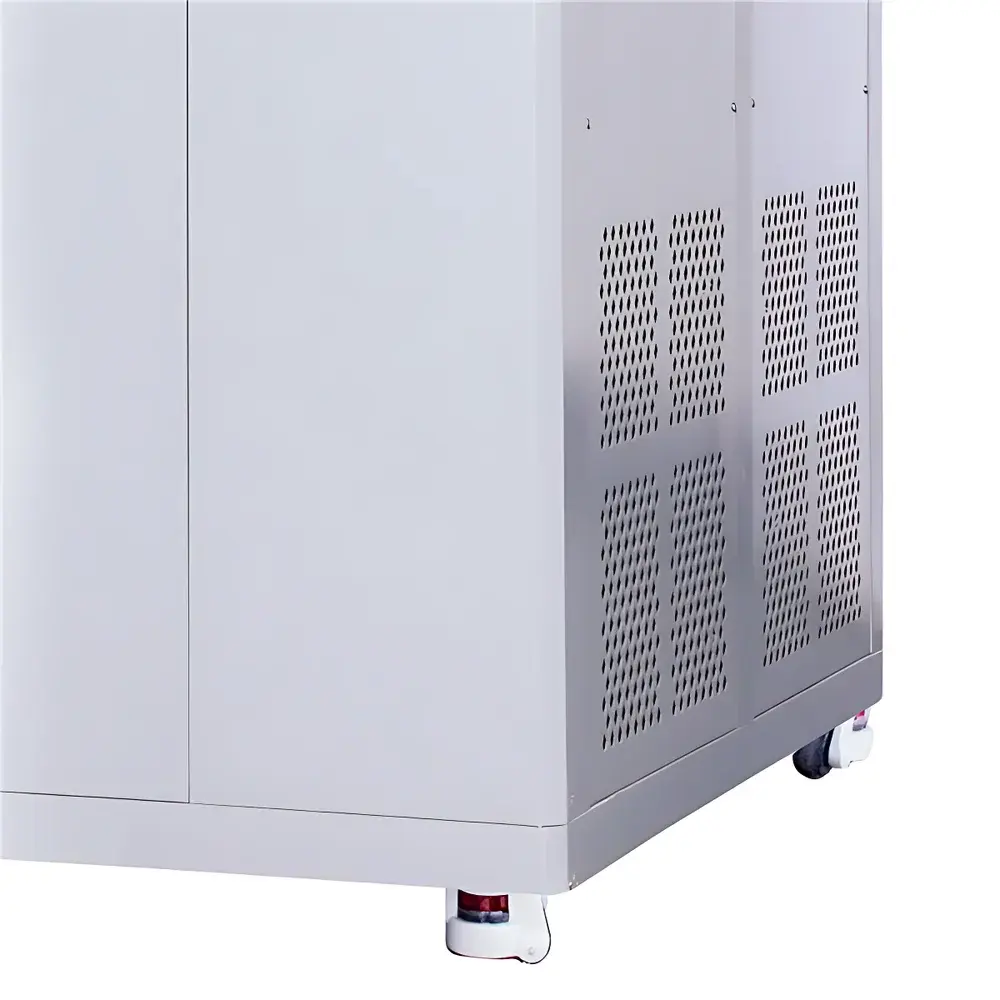
| External Dimensions (W×H×D) | 145×180×140 cm |
| Refrigeration System | Hermetic or Semi-Hermetic Compressor with R404A/R23 Eco-Friendly Refrigerant |
| Interior Material | SUS#304 Mirror-Finish Stainless Steel |
| Exterior Material | SUS#304 Stainless Steel or Powder-Coated Steel |
| Insulation | High-Density Fire-Retardant PU Foam |
| Power Supply | AC 380 V ±5%, 50 Hz ±0.5 Hz, 3-Phase 5-Wire |
Overview
The OK Instrument OK-TS-49 Thermal Shock Test Chamber is an engineered solution for accelerated reliability assessment of electronic components, automotive modules, aerospace hardware, and polymer-based assemblies subjected to rapid thermal transients. Based on the two-box (hot/cold reservoir) air-transfer principle, the system subjects test specimens to abrupt transitions between extreme temperature extremes—without mechanical movement of the sample. This architecture ensures high reproducibility, minimal thermal inertia interference, and strict compliance with standardized thermal shock protocols defined in IEC 60068-2-14 (Test N), MIL-STD-810H Method 503.5, and GJB 150.5A–2009. The chamber operates under a static specimen configuration: pneumatic actuation rapidly opens/closes insulated transfer doors, enabling airflow exchange between thermally isolated hot and cold zones. This design eliminates vibration-induced artifacts common in single-chamber ramp-and-soak systems and supports precise dwell-time control at both extremes.
Key Features
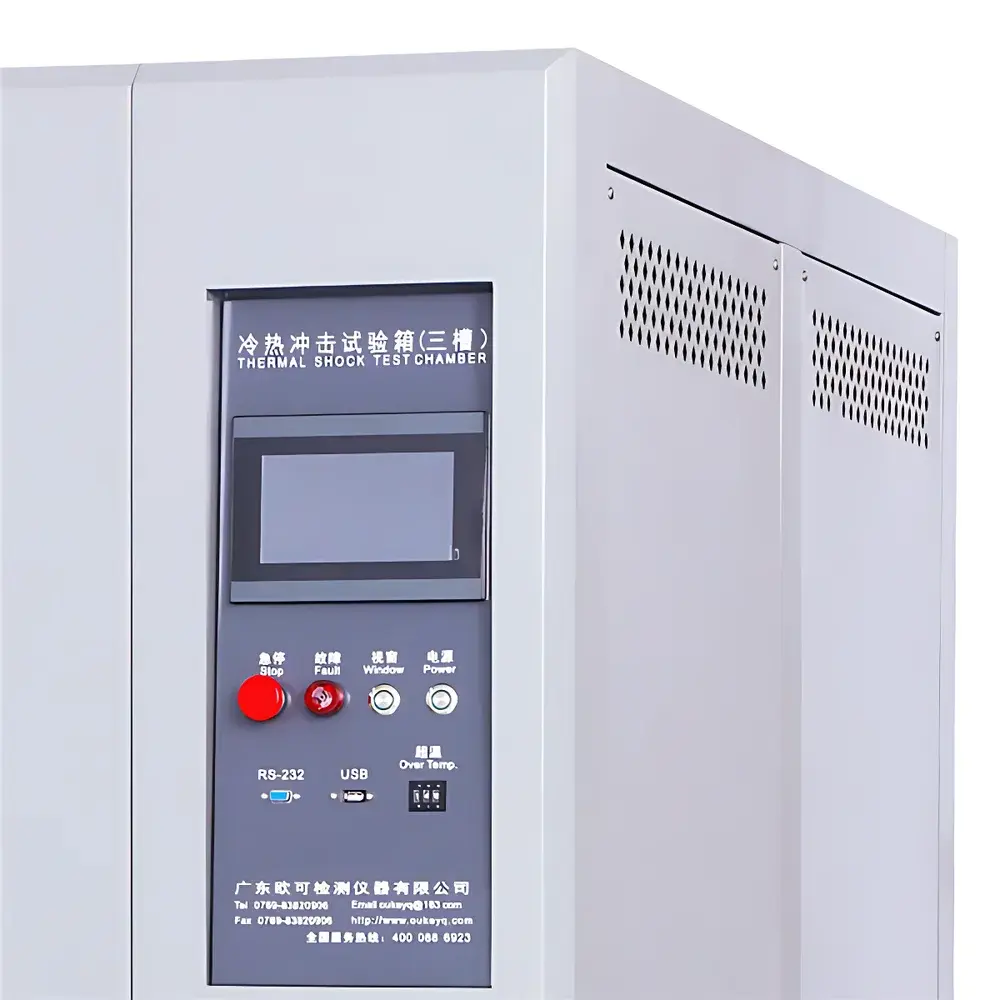
- Intuitive 7-inch color TFT touchscreen interface with multilingual support (English, Chinese, Spanish) and real-time graphical trend display of zone temperatures, transfer timing, and cycle progression.
- PID-based digital temperature control algorithm with auto-tuning capability, delivering ±0.5 °C setpoint accuracy and ±2.0 °C uniformity across the 40 L test volume.
- Programmable cycle sequencing: up to 999 cycles per test profile, with independent dwell time settings (1–9999 minutes) for hot and cold phases, plus optional automatic defrost scheduling between cycles.
- Configurable operation modes: dual-zone (two-box) thermal shock, or optional tri-zone configuration (OK-TS series expandable to three-reservoir architecture for extended low-temperature staging).
- Comprehensive safety interlock system including over-temperature cutoff, refrigerant pressure monitoring, door position verification, phase-loss protection, and real-time fault logging with diagnostic code display and step-by-step remediation guidance.
- Preconditioning scheduler: enables scheduled start-up with pre-cooling or pre-heating initiated automatically prior to user-defined test commencement—reducing total test turnaround time.
Sample Compatibility & Compliance
The OK-TS-49 accommodates samples up to 30 cm depth × 35 cm height × 40 cm width, with two adjustable SUS#304 stainless steel shelves and a standard 50 mm diameter cable/port access port. Its construction meets IP20 ingress protection requirements and incorporates fire-retardant polyurethane insulation (oxygen index ≥28%) compliant with UL 94 V-0. The chamber satisfies essential regulatory alignment for quality assurance workflows: it supports GLP-compliant test execution through audit-trail-capable data logging (optional USB/RS485 export), and its temperature performance adheres to calibration traceability standards per ISO/IEC 17025 when operated with accredited external sensors. It is routinely deployed in laboratories validating conformance to GB/T 2423.22–2012 (Temperature Change), SJ/T 10187–1991 (Single-Chamber Type), and IEC 60068-2-14 Ed. 3.0 (2016), with documented thermal transition times verified per Clause 6.3.
Software & Data Management
Embedded firmware provides local storage of up to 100 complete test logs (including timestamps, zone temperatures, door status, alarms, and cycle counters). Optional PC-based OK-DataLink software enables remote monitoring via Ethernet, CSV report generation with configurable metadata fields (operator ID, sample ID, revision level), and integration into LIMS environments via Modbus TCP. All logged parameters are timestamped with millisecond resolution and retain integrity during power interruption due to non-volatile memory backup. For regulated industries, optional 21 CFR Part 11-compliant firmware upgrade adds electronic signature enforcement, role-based access control, and immutable audit trail export—fully supporting FDA-submission-ready documentation packages.
Applications
- Qualification testing of printed circuit board assemblies (PCBAs) for solder joint fatigue resistance under repeated thermal cycling.
- Evaluation of encapsulant delamination, wire bond lift-off, and die attach integrity in semiconductor packages (QFN, BGA, CSP).
- Validation of thermal expansion coefficient (CTE) mismatch effects in multi-material optoelectronic housings and sensor modules.
- Reliability screening of lithium-ion battery cells and module-level thermal management interfaces under transient load conditions.
- Material compatibility assessment for adhesives, conformal coatings, and potting compounds used in avionics and defense electronics.
FAQ
What is the typical transfer time between hot and cold zones?
The pneumatic door switching mechanism achieves full thermal zone transition in less than 5 seconds, with total exposure-to-target-temperature recovery within 5 minutes—verified per IEC 60068-2-14 Annex A.
Can the chamber operate continuously for extended qualification runs?
Yes. Designed for Class II industrial duty cycle (IEC 60034-1), the dual-refrigeration circuit supports uninterrupted operation for >1,000 hours with scheduled maintenance intervals aligned to compressor runtime and oil life metrics.
Is third-party calibration certification available?
OK Instrument provides factory calibration certificates traceable to NIM (China National Institute of Metrology); optional UKAS-accredited field calibration services are available upon request.
Does the system support custom test profiles beyond standard thermal shock?
The controller supports user-defined ramp/soak sequences—including variable-rate heating/cooling segments and conditional branching based on real-time sensor feedback—enabling custom HALT/HASS-like stress profiles.
What electrical infrastructure is required for installation?
AC 380 V ±5%, 50 Hz ±0.5 Hz, 3-phase 5-wire supply with dedicated 63 A circuit breaker and grounding resistance <4 Ω; ambient operating temperature range: 5–35 °C with ≤80% RH non-condensing.



