
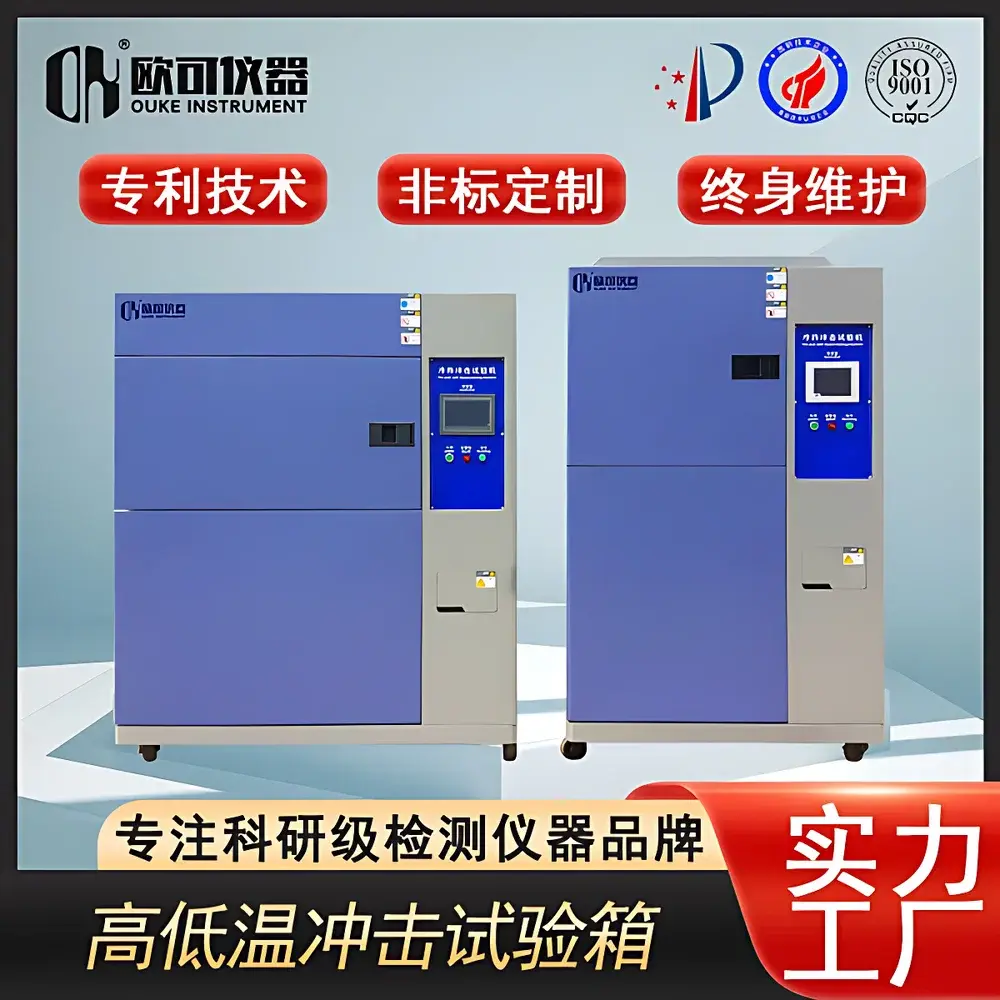
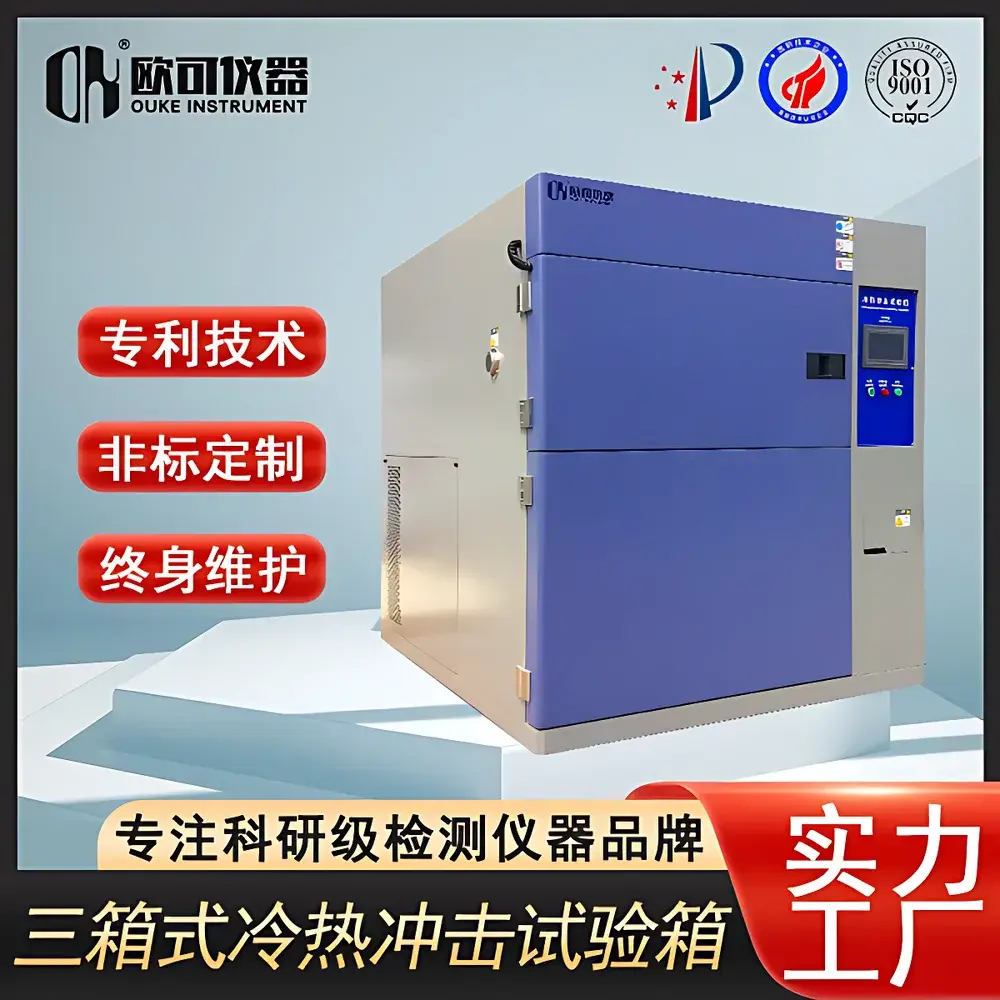
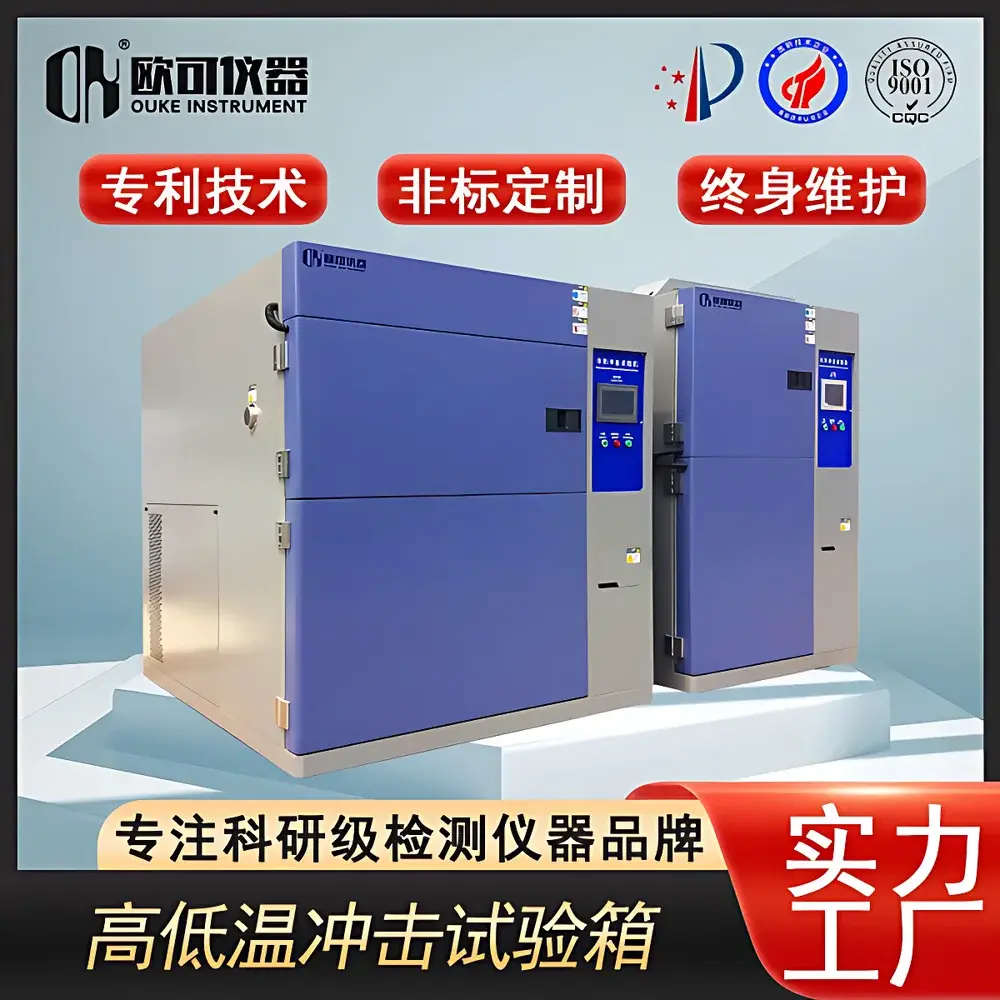
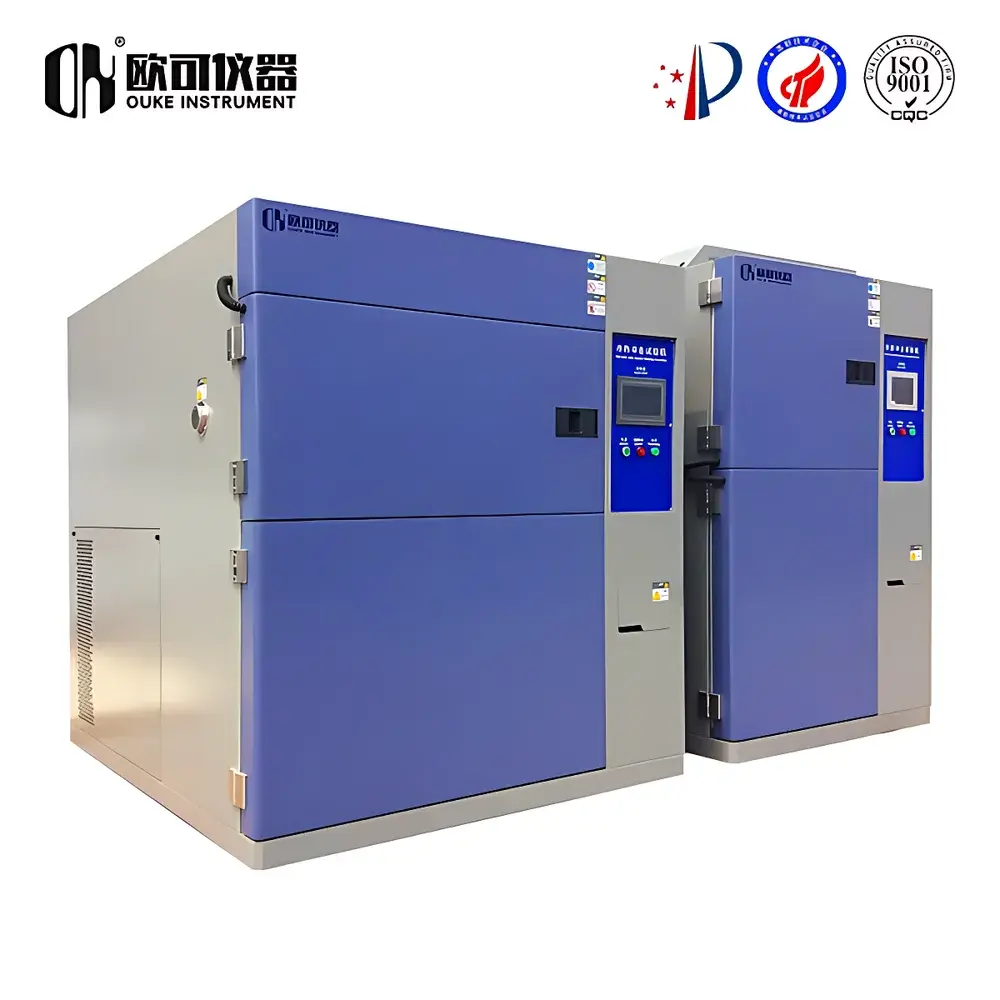
OK Instrument OK-TS-80.00 Thermal Shock Test Chamber
| Brand | OK Instrument |
|---|---|
| Origin | Guangdong, China |
| Manufacturer Type | Direct Manufacturer |
| Country of Origin | China |
| Model | OK-TS-80.00 |
| High Temperature Range | +150 °C |
| Low Temperature Range | −50 °C |
| Thermal Shock Range | −50 °C to +150 °C |
| Temperature Stability | ±2 °C |
| Heating Rate | 10 °C/min |
| Cooling Rate | 10 °C/min |
Overview
The OK Instrument OK-TS-80.00 Thermal Shock Test Chamber is an engineered environmental test system designed for rapid, repeatable, and high-fidelity thermal cycling validation of electronic components, automotive modules, aerospace hardware, and polymer-based assemblies. It operates on the principle of abrupt temperature transition—either via dual-chamber (hot/cold) air transfer using a motorized basket mechanism or triple-chamber (hot/ambient/cold) static-sample configuration—to subject test specimens to extreme thermal gradients without mechanical vibration or positional disturbance. This architecture enables precise simulation of real-world thermal shock conditions encountered during operational start-up, field deployment, or storage transitions—critical for identifying latent defects such as interfacial delamination, solder joint fatigue, sealant cracking, or coefficient-of-thermal-expansion (CTE) mismatch failures.
Key Features
- Dual-mode chamber architecture: configurable as two-zone (hot/cold) with pneumatic door switching and motorized specimen basket, or three-zone (hot/ambient/cold) with stationary test sample placement in central chamber
- High-speed thermal transition capability: achieves ≤10 °C/min heating and cooling rates across full operating range (−50 °C to +150 °C), validated per IEC 60068-2-14 (Test N)
- Binary cascade refrigeration system: utilizes imported semi-hermetic compressors with R404A/R23 refrigerant blend; includes evaporative condenser for efficient inter-stage heat exchange and energy regulation
- Precision temperature control: PID-controlled digital instrumentation with ±0.5 °C setpoint accuracy and ±2.0 °C uniformity across working volume
- Robust thermal insulation: high-density, flame-retardant polyurethane (PU) foam with ≥150 mm wall thickness ensures minimal thermal leakage and stable chamber dynamics
- Stainless steel construction: interior chamber fabricated from mirror-finish SUS#304 stainless steel; exterior options include SUS#304 or powder-coated carbon steel
- Standard interface provisions: one 50 mm diameter cable port (stainless steel), two adjustable SUS#304 shelf layers, rear-mounted 3-phase 380 V AC power inlet (2.5 m cable)
Sample Compatibility & Compliance
The OK-TS-80.00 accommodates test specimens up to 50 × 40 × 40 cm (W×H×D), with customizable internal dimensions available upon request. Its design supports both component-level qualification (e.g., PCBAs, connectors, sensors) and subassembly testing (e.g., battery packs, lighting modules, brake calipers). The system meets or exceeds requirements of multiple international and industry-specific standards including: IEC 60068-2-14 (Temperature Change), GB/T 2423.22-2002, GJB 150.5-2009 (MIL-STD-810G Method 503.5), QC/T 17-1992 (Automotive Component Environmental Testing), EIA-364-32 (Thermal Shock for Connectors), and SJ/T 10186–10187 (Y73 Series Temperature Cycling Chambers). All control logic and data logging functions are structured to support GLP/GMP-aligned audit trails when integrated with compliant software platforms.
Software & Data Management
The chamber integrates with OK Instrument’s proprietary OK-TCMS v3.2 control and monitoring suite, supporting real-time parameter visualization, programmable multi-step profiles (up to 99 segments), automatic cycle counting, and timestamped event logging. Data export is available in CSV and XML formats compatible with LIMS environments. Optional upgrade paths include FDA 21 CFR Part 11-compliant user authentication, electronic signatures, and audit trail generation—enabling traceability for regulated industries including medical device manufacturing and automotive Tier-1 supply chain validation. Remote monitoring via Ethernet/IP or optional RS-485 Modbus RTU interface allows integration into centralized facility SCADA systems.
Applications
- Qualification testing of printed circuit board assemblies (PCBAs) under JEDEC J-STD-020 moisture sensitivity level (MSL) protocols
- Reliability screening of automotive ECUs, ADAS sensors, and infotainment units per ISO 16750-4 and LV-124 specifications
- Material compatibility assessment of encapsulants, adhesives, and conformal coatings subjected to repeated thermal excursions
- Validation of hermetic seals in MEMS devices, optoelectronic packages, and RF modules
- Accelerated life testing of lithium-ion battery cells and modules under thermal stress conditions
- Pre-shipment stress screening for avionics components per DO-160 Section 4.5 (Temperature Variation)
FAQ
What is the difference between two-zone and three-zone thermal shock configurations?
Two-zone systems use a moving basket to shuttle samples between hot and cold chambers, enabling faster transitions but introducing mechanical motion. Three-zone designs maintain sample position while routing conditioned air—ideal for vibration-sensitive or large-format assemblies.
Does the system require external cooling water infrastructure?
Yes. The binary cascade refrigeration system requires a dedicated closed-loop cooling tower delivering 10 m³/h of water at ≤32 °C ambient intake temperature. This must be supplied by the end user.
Can the OK-TS-80.00 be configured for extended low-temperature operation below −50 °C?
Standard configuration supports −50 °C minimum. Custom variants with enhanced cryogenic circuits (e.g., −65 °C capability) are available under OK-HH series engineering specifications.
Is calibration certification included with shipment?
Each unit ships with factory-as-built temperature mapping report (per ISO/IEC 17025 guidelines) and NIST-traceable sensor calibration certificate for primary chamber sensors.
How is thermal uniformity verified across the working volume?
Uniformity is validated using 9-point thermocouple mapping per IEC 60068-3-5, performed at three load conditions: empty, 50% volume loaded, and fully loaded with inert thermal mass equivalent to typical DUT weight distribution.



