


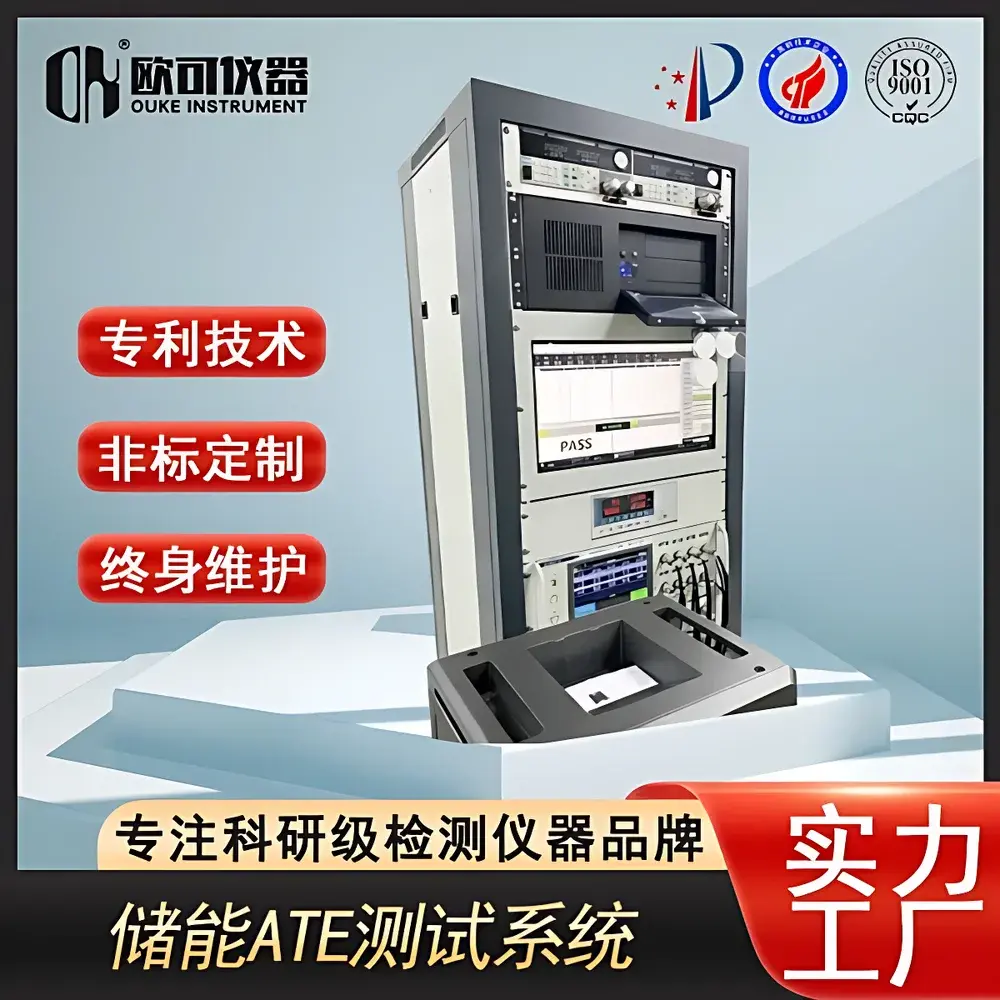
OK Instruments OK-ATE-2 Photovoltaic & Energy Storage Automated Test Equipment System
| Brand | OK Instruments |
|---|---|
| Origin | Guangdong, China |
| Manufacturer Type | OEM/ODM Manufacturer |
| Country of Origin | China |
| Model | OK-ATE-2 |
| Price | USD 2,700 (FOB Guangdong) |
Overview
The OK Instruments OK-ATE-2 Photovoltaic & Energy Storage Automated Test Equipment System is an integrated, production-grade ATE platform engineered for end-of-line (EOL) functional and performance validation of electrochemical energy storage systems. It implements a hardware-in-the-loop (HIL) architecture to concurrently test battery packs (up to 1000 V DC), battery modules, battery management systems (BMS), power conversion systems (PCS), and photovoltaic (PV)-storage hybrid configurations. The system operates on the foundational principle of automated, synchronized stimulus-response measurement across electrical, thermal, communication, and safety domains—enabling deterministic verification of compliance with IEC 62116 (anti-islanding), IEC 61000 (EMC), GB/T 37408-2019 (grid-connected energy storage), and GB/T 20438-2017 (functional safety). Designed for high-mix, high-volume manufacturing environments, the OK-ATE-2 replaces fragmented manual test benches with a unified, traceable, and audit-ready workflow—serving as both a quality gatekeeper and a data acquisition backbone for statistical process control (SPC) and digital twin enablement.
Key Features
- Modular, scalable architecture supporting single- or multi-channel parallel testing of battery packs, BMS units, and PCS inverters—reducing EOL test cycle time by up to 65% versus sequential manual methods.
- Dual-domain simulation capability: programmable grid emulator (AC 220/380 V ±20%, 45–65 Hz, harmonic injection, voltage sag/swell) and PV array simulator (0–1000 V / 0–200 A, MPPT efficiency evaluation).
- High-fidelity BMS HIL interface with real-time voltage, temperature, and current signal emulation—validating SOC estimation accuracy, protection logic (overvoltage, undervoltage, overtemperature, short-circuit), relay switching integrity, and insulation detection response.
- Comprehensive safety compliance suite: integrated insulation resistance tester (1–5000 MΩ, 50–1000 V DC), AC/DC dielectric withstand tester (up to 5 kV), and grounding continuity analyzer—all calibrated per GB/T 3048.1-2018.
- Wide-range bidirectional power capability: 0–200 kW regenerative load with ±0.1% FS power measurement accuracy; DC charge/discharge (0–200 A, ±0.05% FS) and AC output (0–100 A) with synchronized 10–2000 Hz sampling (≤0.5 ms inter-channel skew).
- Industrial-grade automation stack: PLC-controlled sequencing, barcode-scanned DUT identification, HV/LV/signal/communication interface manifold, and fail-safe interlock circuitry compliant with ISO 13849-1 Category 3.
Sample Compatibility & Compliance
The OK-ATE-2 supports full-spectrum validation of residential and commercial energy storage systems—including LiFePO₄, NMC, sodium-ion, and flow battery-based configurations—as well as integrated photovoltaic-storage-charging (PV-ESS-CHG) systems. It accommodates form factors ranging from 48 V modular battery racks to 1500 V utility-scale battery containers (with optional high-voltage extension modules). All test procedures adhere to mandatory regulatory frameworks including IEC 62619 (secondary lithium cells), UL 1973 (energy storage systems), and China’s mandatory CCC certification requirements for grid-tied equipment. The system’s firmware and software logs maintain full 21 CFR Part 11-compliant audit trails, supporting GLP/GMP-aligned manufacturing environments where electronic records must be attributable, legible, contemporaneous, original, and accurate (ALCOA+ principles).
Software & Data Management
The OK-ATE-2 runs on a dual-software architecture: OK-TestStudio (graphical test sequence editor supporting drag-and-drop HPPC, dynamic load cycling, and fault injection scripting) and OK-DataHub (real-time monitoring, SPC analytics, and MES-integrated reporting). Test data—including ≥2 million timestamped samples per run—is stored in IEEE 1516-2020-compliant HDF5 format and exportable to CSV, Excel, and PDF with configurable Pass/Fail thresholds. Built-in statistical analysis tools perform Cp/Cpk calculation, parameter binning (e.g., capacity, DCIR, self-discharge rate), and trend forecasting using moving-window regression. Native APIs support MQTT, Modbus TCP, and Profinet integration for direct synchronization with factory MES, ERP, and SCADA systems—enabling closed-loop process optimization and full-lifecycle traceability from raw cell to field-deployed asset.
Applications
- End-of-line functional verification of BMS firmware logic under simulated fault conditions (e.g., cell imbalance, thermistor open-circuit, CAN bus timeout).
- Grid-code compliance testing: anti-islanding (IEC 62116), reactive power response (IEC 61850-7-420), and harmonics distortion (IEC 61000-3-12) validation for PCS units.
- Photovoltaic-storage coordination testing: MPPT tracking efficiency under partial shading, seamless islanding-to-grid reconnection, and solar forecast-driven charge scheduling.
- Accelerated aging correlation: correlating EOL test metrics (OCV hysteresis, pulse resistance drift, SOC estimation error) with accelerated calendar/cycle life test results.
- Process capability analysis: statistical benchmarking of production batches against design specifications for capacity retention, voltage consistency, and thermal management response latency.
FAQ
Does the OK-ATE-2 support third-party BMS protocols such as CANopen or J1939?
Yes—it includes protocol-agnostic CAN FD, RS485, and Ethernet interfaces with configurable baud rates and message filtering; custom DBC files and protocol stacks can be imported via OK-TestStudio.
Can the system perform simultaneous AC and DC testing on the same DUT?
Yes—the integrated grid emulator and bidirectional DC source allow concurrent AC grid interaction testing (e.g., reactive power injection) while applying dynamic DC load profiles to the battery pack.
Is remote diagnostics and firmware update capability available?
Yes—secure TLS 1.2-enabled remote access allows OEM engineers to monitor live test execution, retrieve diagnostic logs, and deploy validated firmware updates without on-site intervention.
How does the system ensure measurement traceability to national standards?
All analog input/output channels are factory-calibrated against NIM (National Institute of Metrology, China) reference standards; calibration certificates include uncertainty budgets compliant with ISO/IEC 17025.
What industrial certifications does the hardware platform hold?
The enclosure meets IP30 (standard) or optional IP54 rating; EMC performance conforms to GB/T 17626 series (equivalent to IEC 61000-4-x); safety design complies with GB 4208 and IEC 61000-6-2/6-4.
Related Products





