
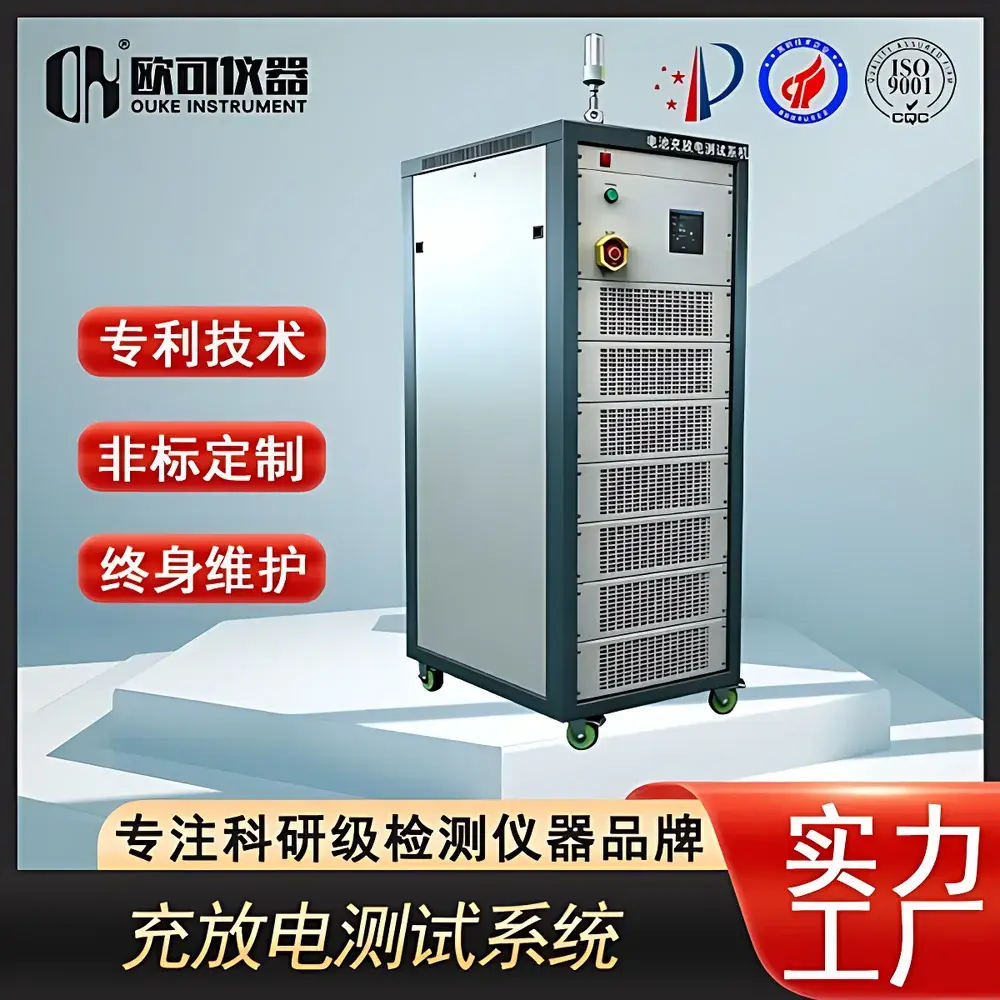
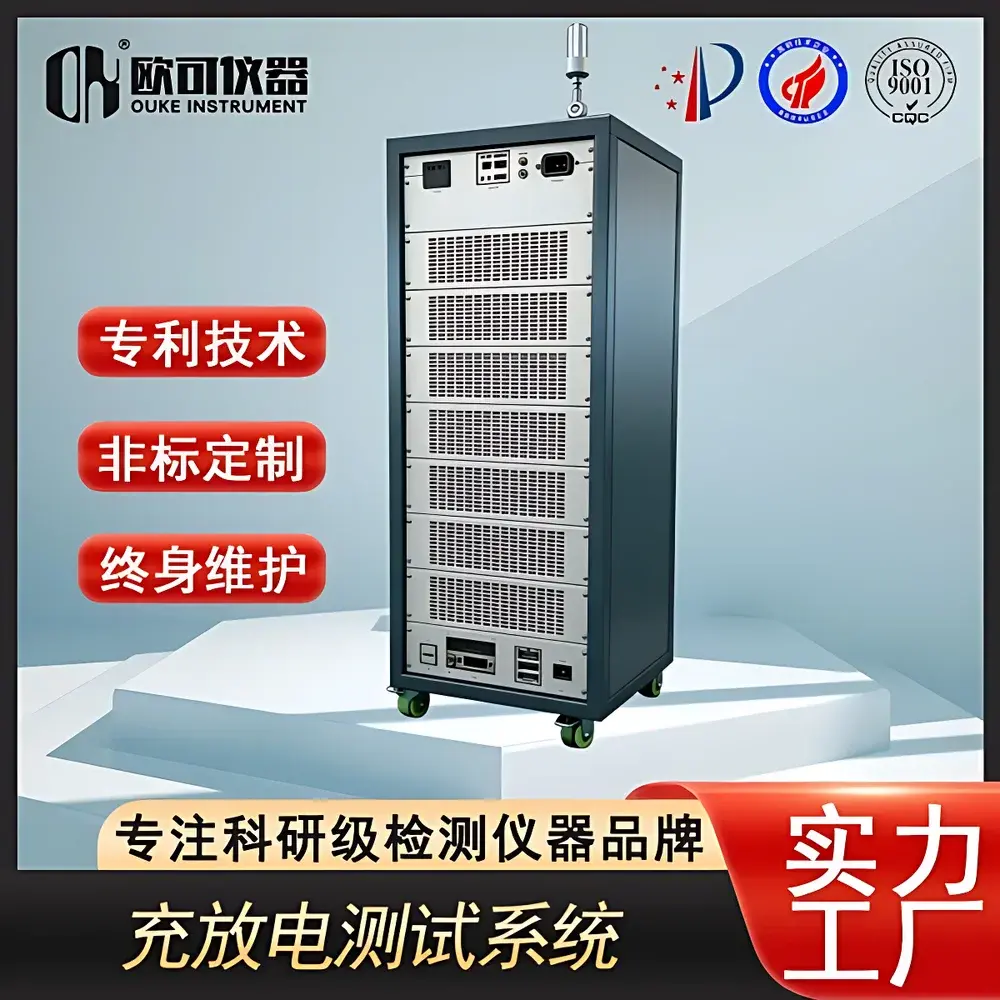
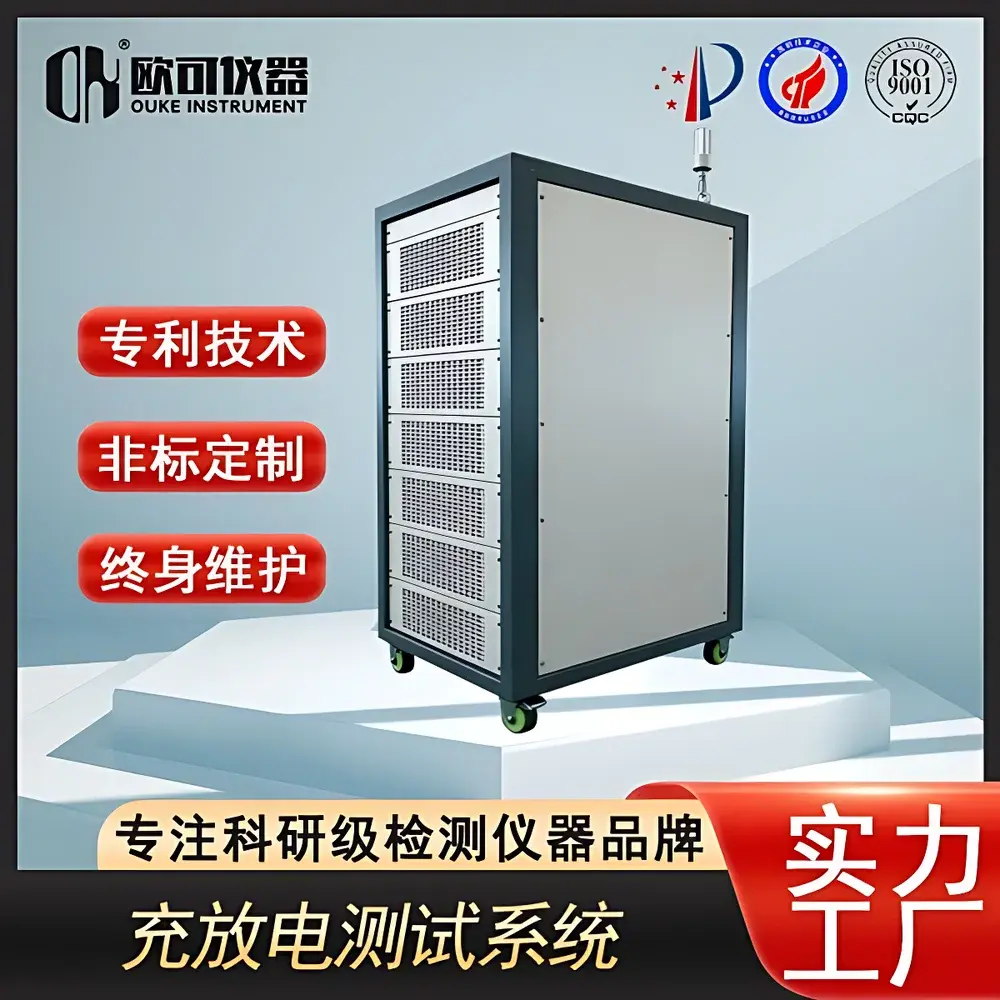
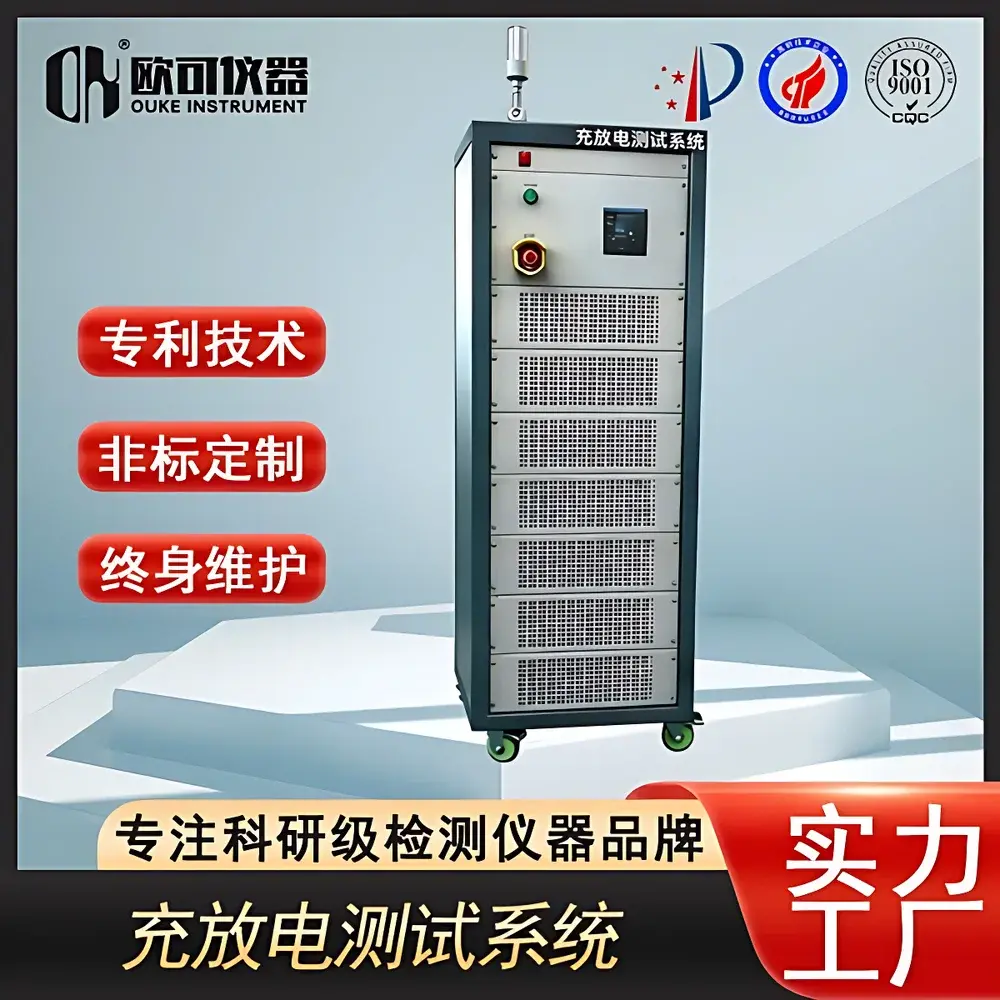
OK Instruments OK-CFDX-2 Lithium Battery Charge-Discharge Test System
| Brand | OK Instruments |
|---|---|
| Origin | Guangdong, China |
| Manufacturer Type | Direct Manufacturer |
| Country of Origin | China |
| Model | OK-CFDX-2 |
| Voltage Range | 0–1000 V (expandable) |
| Current Range | Charge 0–200 A / Discharge 0–300 A (both expandable) |
| Voltage Accuracy | ±0.05% FS |
| Current Accuracy | ±0.05% FS |
| Voltage Resolution | 1 mV |
| Current Resolution | 10 mA |
| Internal Resistance Range | 0–200 mΩ |
| IR Accuracy | ±1% FS |
| IR Method | AC Impedance at 1 kHz |
| Capacity Range | 0–1000 Ah |
| Capacity Accuracy | ±0.1% FS |
| Test Modes | CC/CV/CP |
| Sampling Rate | 10–1000 Hz (adjustable) |
| Data Storage | ≥1,000,000 records |
| Output Formats | Excel, CSV, PDF |
| Communication Interfaces | RS485, Ethernet, USB (CAN/Modbus/Profinet optional) |
| Enclosure Options | Benchtop or Cabinet |
| Channel Configurations | 1–64 independent channels |
| Power Supply | AC 380 V ±10% / 220 V ±10%, 50 Hz |
| IP Rating | IP30 (IP54 optional) |
| Temperature Range | −20 °C to +60 °C (−40 °C to +85 °C optional) |
Overview
The OK Instruments OK-CFDX-2 Lithium Battery Charge-Discharge Test System is a precision electrochemical testing platform engineered for rigorous characterization and validation of lithium-based energy storage devices—including pouch, prismatic, and cylindrical cells, modules, and battery packs. Built upon a bidirectional DC power architecture, the system implements programmable current, voltage, and power control with high-fidelity real-time data acquisition. Its operational foundation lies in galvanostatic, potentiostatic, and power-controlled test protocols, enabling accurate measurement of capacity, coulombic efficiency, internal resistance (via 1 kHz AC impedance), open-circuit voltage (OCV) vs. state-of-charge (SOC) relationships, and dynamic response under simulated load profiles. Designed for R&D labs, quality assurance departments, and cell manufacturing facilities, the OK-CFDX-2 supports full compliance with international battery testing standards including GB/T 31485–2015, GB/T 31486–2015, and IEC 62619, ensuring traceable, reproducible, and audit-ready test execution.
Key Features
- Bidirectional channel architecture integrating high-precision regenerative DC power supplies—each channel operates independently with full galvanostatic, potentiostatic, and constant-power capability.
- High-resolution measurement subsystem: voltage accuracy ±0.05% FS (1 mV resolution), current accuracy ±0.05% FS (10 mA resolution), and AC internal resistance measurement with ±1% FS accuracy at 1 kHz.
- Flexible channel scalability: configurable from single-channel benchtop units to multi-channel cabinet systems supporting up to 64 fully isolated test channels.
- Programmable sampling frequency from 10 Hz to 1000 Hz, synchronized across all active channels for transient event capture and pulse-response analysis.
- Integrated hardware-level safety: hardwired overvoltage, undervoltage, overcurrent, overtemperature, and short-circuit protection, complemented by user-definable software thresholds and emergency stop logic.
- Modular environmental integration: native support for thermal chamber synchronization (−40 °C to +85 °C), enabling temperature-dependent performance mapping and accelerated aging studies.
Sample Compatibility & Compliance
The OK-CFDX-2 accommodates a broad spectrum of lithium-ion and lithium-metal chemistries across form factors—soft-pack, prismatic, and cylindrical configurations—at cell, module, and pack levels. Custom fixture interfaces ensure low-impedance, repeatable electrical contact while minimizing parasitic losses. All test procedures adhere to standardized methodologies defined in GB/T 31485–2015 (safety requirements), GB/T 31486–2015 (performance specifications), and IEC 62619 (industrial secondary lithium cells). The system’s firmware and software architecture support GLP-compliant operation, including electronic signatures, audit trails, and 21 CFR Part 11–ready data integrity controls when configured with appropriate security policies.
Software & Data Management
The embedded OK-BatTest software provides a deterministic, scriptable test environment with graphical step editor, built-in templates for standard protocols (e.g., cycle life, rate capability, OCV-SOC mapping), and Python-based API for custom waveform generation and closed-loop control logic. Real-time visualization includes synchronized voltage/current/time plots, differential voltage (dV/dQ) analysis, and heat-map overlays for capacity fade tracking. Raw data is stored in binary-optimized format and exportable to CSV, Excel, and PDF with configurable metadata headers. Historical datasets are indexed by batch ID, operator, test condition, and timestamp—enabling cross-experiment correlation and statistical process control (SPC) reporting. Remote monitoring and control via secure Ethernet interface allow centralized fleet management in multi-system deployments.
Applications
- Cell-level qualification: capacity calibration, DCIR pulse testing, hybrid pulse power characterization (HPPC), and OCV-SOC curve derivation for BMS algorithm development.
- Module and pack validation: balancing performance assessment, inter-cell variance analysis, and thermal runaway propagation studies under controlled ambient conditions.
- Lifetime modeling: calendar and cycle aging tests under variable SOC windows, temperature gradients, and charge/discharge C-rates per ISO 12405-3 guidelines.
- Dynamic load simulation: replay of WLTC, UDDS, or grid-frequency regulation profiles to evaluate real-world energy throughput and degradation kinetics.
- Safety certification support: overcharge, overdischarge, external short-circuit, and high-temperature soak tests aligned with UN 38.3 and UL 1642 requirements.
FAQ
What safety certifications does the OK-CFDX-2 comply with?
The system meets industrial safety requirements per IEC 61000-6-2/6-4 and carries CE marking for EMC and LVD. While the instrument itself is not UL-listed, its architecture supports integration into UL-certified test enclosures and conforms to functional safety principles outlined in ISO 13849-1 for Category 3 PLd-rated control systems.
Can the OK-CFDX-2 perform electrochemical impedance spectroscopy (EIS)?
The base configuration does not include EIS functionality; however, an optional EIS add-on module is available, providing frequency sweep capability from 10 mHz to 100 kHz with four-terminal sensing and phase-resolved impedance analysis.
Is remote firmware update supported?
Yes—secure OTA updates are enabled via authenticated HTTPS connections through the Ethernet interface, with version rollback capability and SHA-256 integrity verification.
How is channel synchronization achieved across multi-unit installations?
Synchronization is implemented via IEEE 1588 Precision Time Protocol (PTP) over Ethernet, ensuring sub-millisecond timing alignment between channels distributed across multiple cabinets or racks.
Does the system support third-party data ingestion (e.g., from BMS or thermal sensors)?
Yes—the software SDK includes drivers for Modbus TCP, CAN FD, and MQTT protocols, allowing concurrent ingestion of auxiliary signals such as thermocouple readings, pressure transducer outputs, or BMS-reported SOC/SOH telemetry.






