
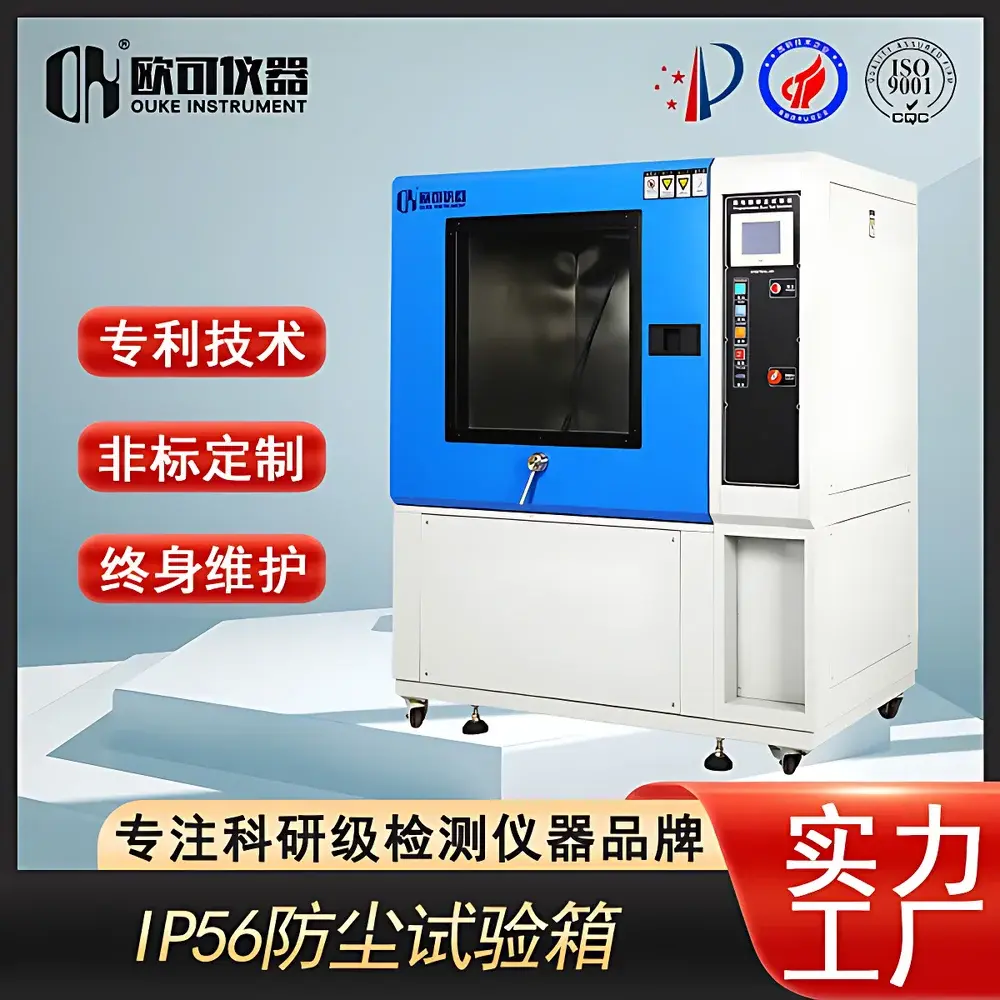
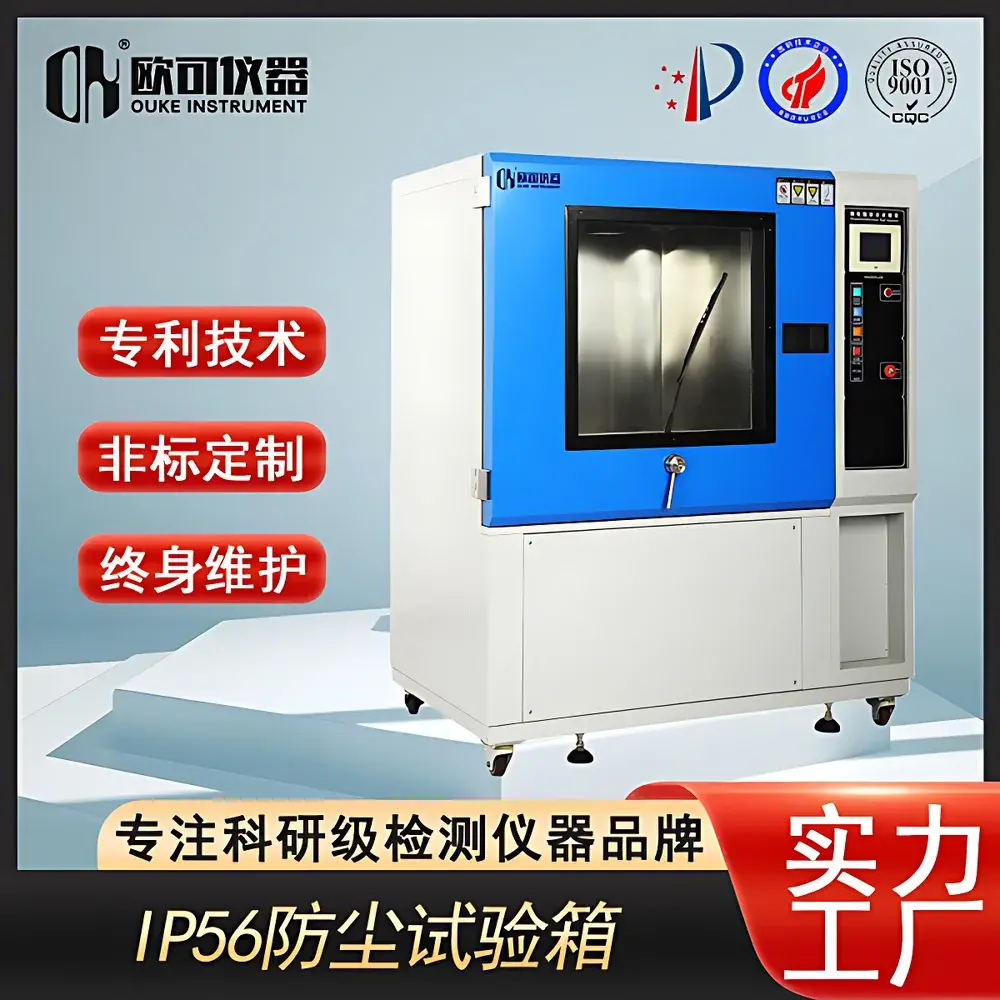
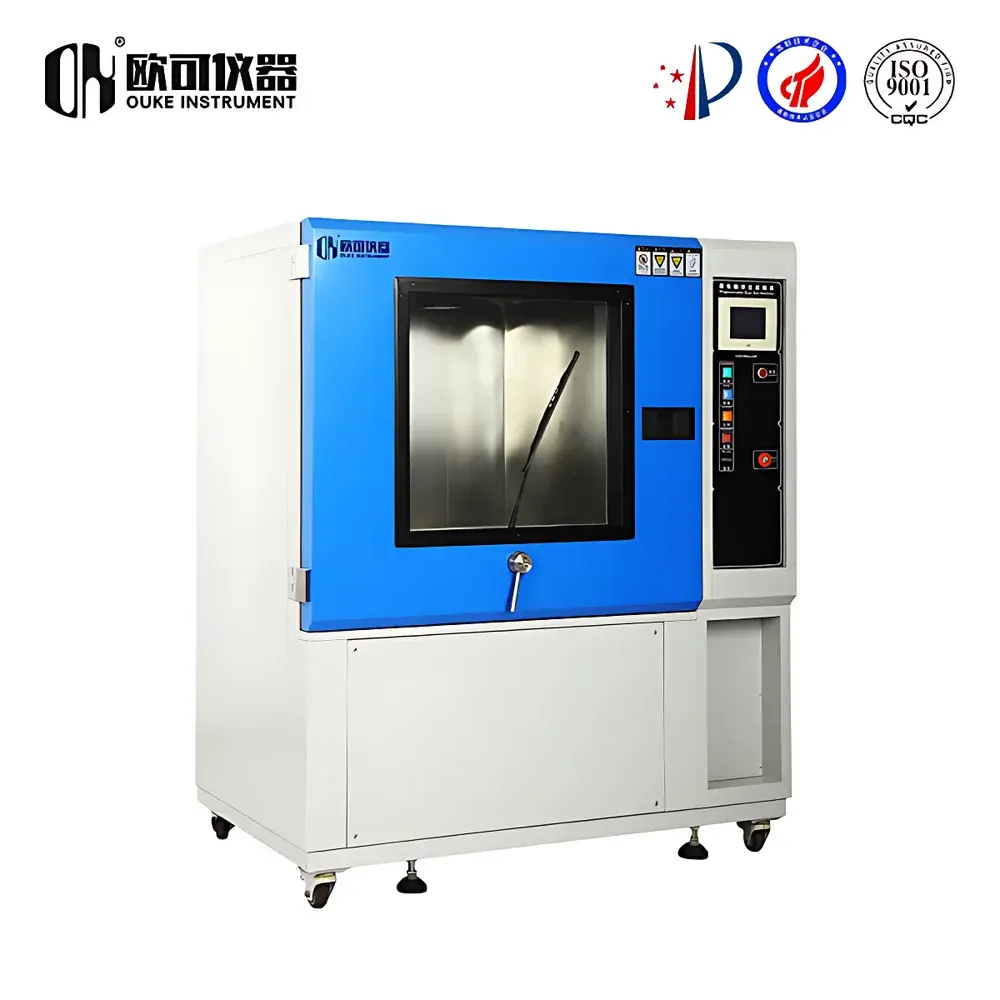
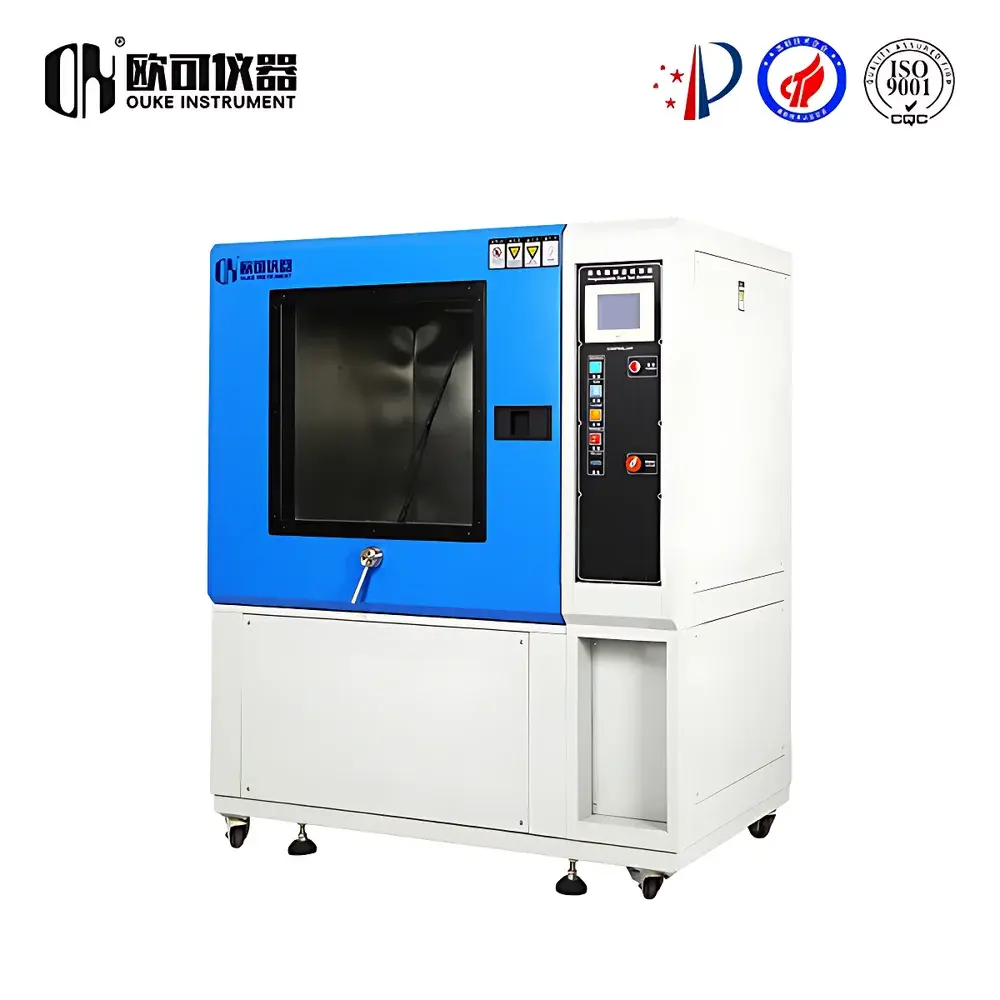
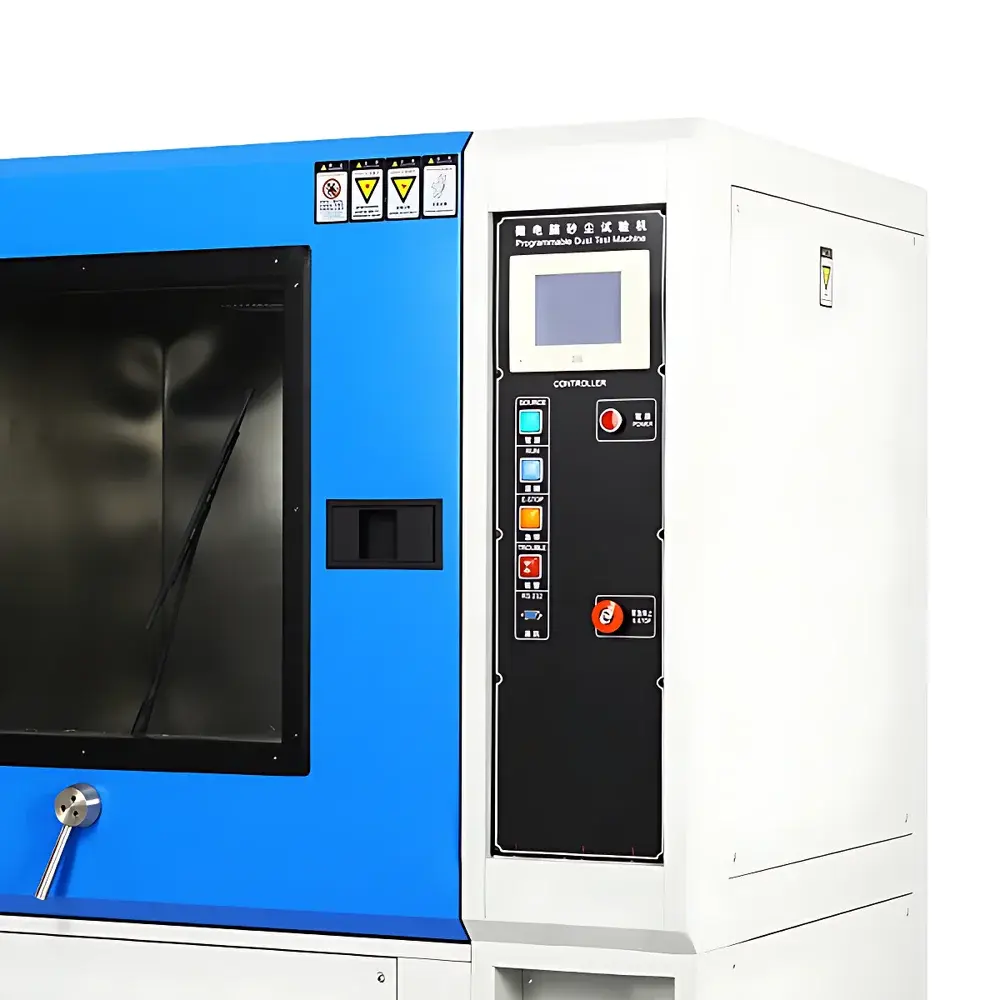
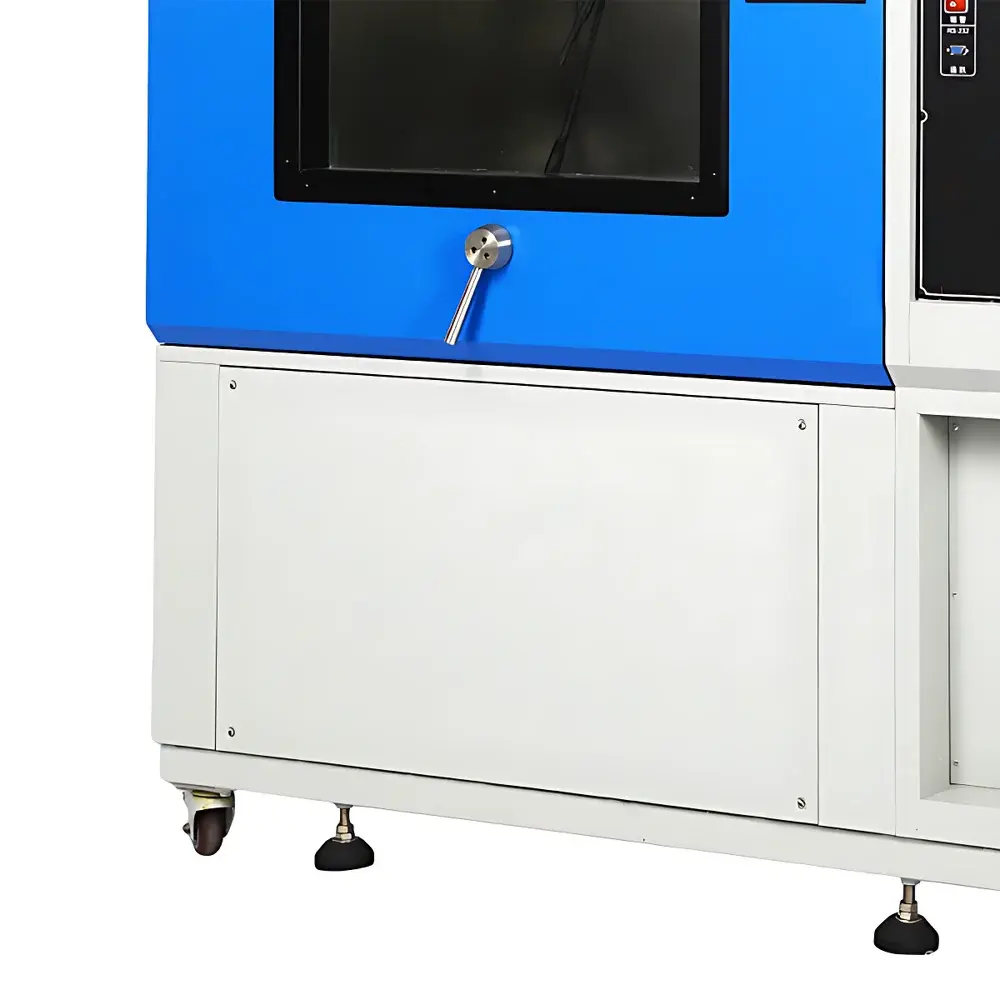
OK Instruments OK-HC-900 Sand and Dust Test Chamber
| Brand | OK Instruments |
|---|---|
| Origin | Guangdong, China |
| Manufacturer Type | Direct Manufacturer |
| Product Category | Domestic |
| Model | OK-HC-900 |
| Sand Composition | 97–99% SiO₂ (silicon dioxide) |
| Sand Blowing Concentration | 1.1 g/m³ ± 0.25 g/m³ to 2.2 g/m³ ± 0.5 g/m³ |
| Sand Blowing Velocity | 0–29 m/s |
| Dust Blowing Concentration | 0.1–10.6 g/m³ ± 7 g/m³ |
| Dust Blowing Velocity | 8.9 m/s ± 1.2 m/s |
| Internal Chamber Dimensions | 90 × 90 × 90 cm |
| Temperature Range | 20 °C ± 15 °C (ambient) |
| Relative Humidity | 45–90 % RH |
| Test Duration | 0–99 h |
| Dust Type | Talcum powder or standardized test dust (particle size ≤ 75 µm |
| nominal wire diameter of sieve mesh | 50 µm) |
| Air Pressure Control | Bottom-mounted pneumatic dust dispersion with adjustable pressure and free-fall sedimentation |
| Power Supply | AC 220 V ± 5 % / 50 Hz ± 0.5 Hz |
Overview
The OK Instruments OK-HC-900 Sand and Dust Test Chamber is an engineered environmental simulation system designed to evaluate the ingress protection (IP) performance of enclosures under controlled airborne particulate exposure conditions. It operates on the principle of forced-air suspension and gravitational settling of standardized test dust and sand particles, replicating real-world desert, industrial, or off-road environments where equipment may be subjected to abrasive particulate ingress. The chamber supports full compliance with international IP rating verification protocols—specifically IP5X (dust-protected) and IP6X (dust-tight)—as defined in IEC 60529, ISO 20653, and GB 4208-2008. Its dual-mode operation enables both floating dust (F-type) and circulating dust (C-type) test profiles, accommodating diverse validation requirements across automotive, aerospace, defense, and industrial electronics sectors.
Key Features
- Triple independent dust control channels (F1/F2/F3) for precise selection and execution of floating dust test conditions per GB/T 2423.37-2008 and GJB 150.12A-2009;
- Integrated vibratory dust dispersion mechanism ensuring consistent particle suspension density across repeated test cycles;
- Calibrated dust concentration collector with traceable gravimetric measurement capability to minimize operator-induced variability;
- Modular airflow design supporting both low-velocity floating dust (≤5 m/s) and high-velocity circulating dust (up to 29 m/s), enabling simulation of static deposition and dynamic abrasion scenarios;
- Adjustable bottom-air-pressure injection system with fine-tuned pneumatic regulation for reproducible dust cloud initiation and uniform sedimentation;
- Stainless-steel internal chamber construction with sealed access ports, corrosion-resistant viewing window, and EMI-shielded electrical feedthroughs for long-term reliability and safety;
- Compliance-ready configuration including temperature and humidity monitoring sensors (±0.5 °C, ±3 % RH accuracy) with optional data logging interface.
Sample Compatibility & Compliance
The OK-HC-900 accommodates a wide range of test specimens—including automotive lighting assemblies, instrument clusters, seat adjustment mechanisms, seatbelt retractors, steering column switches, door latch modules, and protective covers for electronic control units. All test configurations adhere strictly to the dimensional and procedural constraints outlined in applicable standards: IEC 60529 (IP code definitions), DIN 40050-9 (automotive dust resistance), ISO 20653 (road vehicles—protection against foreign objects), GB/T 2423.37-2008 (sand and dust testing methods), GJB 150.12A-2009 (military environmental engineering), and GB 7000.1 (luminaire dust resistance). The chamber’s internal volume (90 L) allows full enclosure testing up to 60 cm diagonal, with custom cavity options available for larger DUTs upon request.
Software & Data Management
The chamber integrates a programmable logic controller (PLC)-based interface with local touchscreen HMI for real-time parameter adjustment, cycle sequencing, and alarm management. While no proprietary PC software is bundled, all operational parameters—including duration, airflow velocity, dust concentration setpoint, and ambient condition logs—are exportable via RS-485 or USB as CSV files for integration into enterprise quality management systems (QMS). Audit trail functionality supports GLP/GMP-aligned documentation requirements, and timestamped event logs comply with FDA 21 CFR Part 11 principles when paired with validated third-party data acquisition platforms. Calibration certificates for integrated sensors are provided with each unit and traceable to NIM (National Institute of Metrology, China).
Applications
- Verification of IP5X/IP6X sealing integrity for automotive ECUs, connectors, and sensor housings;
- Dust ingress resistance validation of LED headlamps, tail lamps, and interior lighting per GB 7000.1 and ECE R112;
- Functional endurance testing of mechanical actuators—e.g., seat track adjusters, HVAC blend doors, and gear selector linkages—under prolonged particulate exposure;
- Qualification of military-grade avionics enclosures per MIL-STD-810H Method 510.6 (sand and dust);
- Accelerated wear assessment of O-rings, gaskets, and elastomeric seals used in outdoor-rated power distribution cabinets;
- Research-grade evaluation of filter media efficiency and particle capture thresholds in HVAC filtration prototypes.
FAQ
What dust types are compatible with the OK-HC-900?
Standardized talcum powder (≤75 µm particle size, 50 µm nominal sieve wire diameter) or ISO 12103-1 A2 Fine Test Dust (or equivalent) may be used. SiO₂-based sand (97–99% purity) is supplied for high-abrasion sand-blowing tests.
Can the chamber perform both IP5X and IP6X tests in a single cycle?
No—IP5X and IP6X require distinct airflow velocities, dust concentrations, and exposure durations. Each test mode must be selected and executed separately using the F/C channel controls.
Is temperature and humidity control built-in?
The chamber maintains ambient laboratory conditions (20 °C ± 15 °C, 45–90 % RH) but does not include active heating, cooling, or humidification subsystems. Optional climate-controlled enclosures can be integrated externally.
Does the OK-HC-900 meet FDA or ISO 13485 requirements?
While not a medical device itself, the chamber supports validation activities compliant with ISO 13485:2016 Annex C (environmental testing of medical device enclosures) and can be qualified per IQ/OQ protocols for regulated environments.
What maintenance intervals are recommended?
Dust collection filters should be inspected after every 10 test hours; vibration actuators and pneumatic valves require biannual lubrication and functional verification per the manufacturer’s maintenance logbook.



