
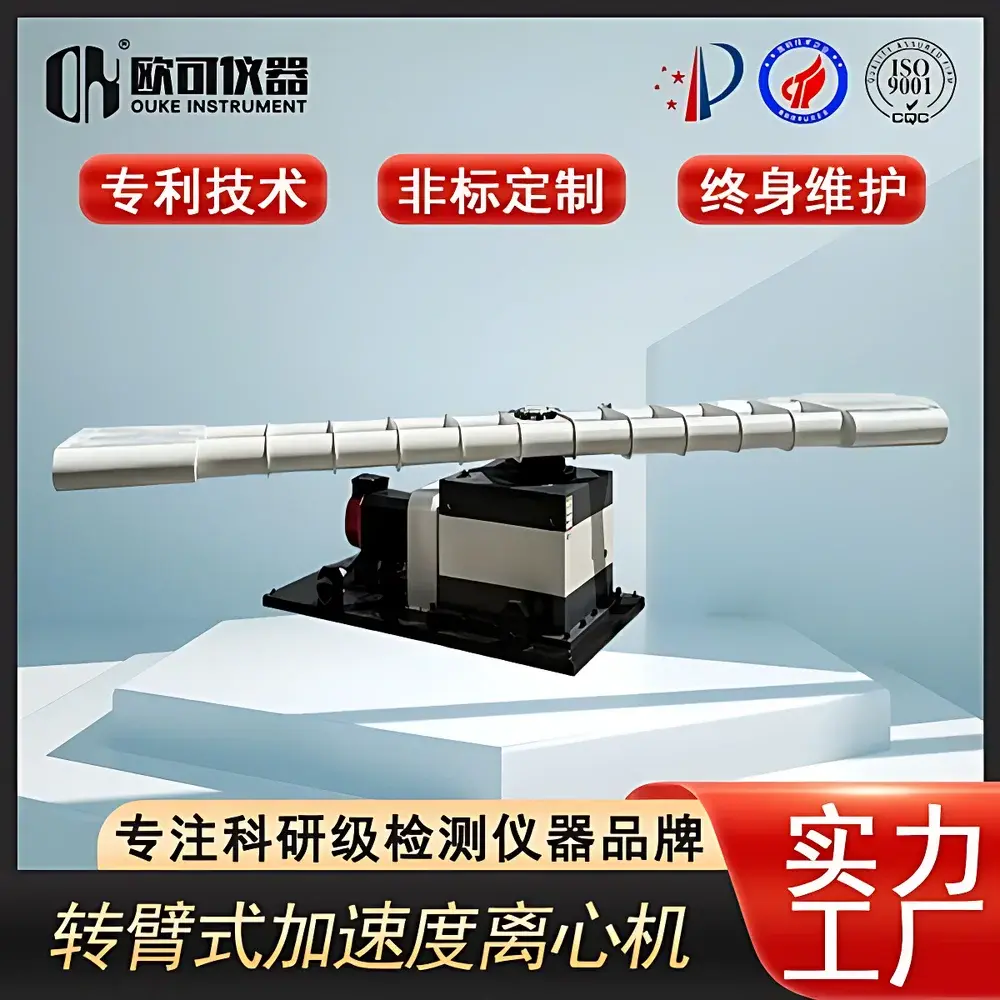
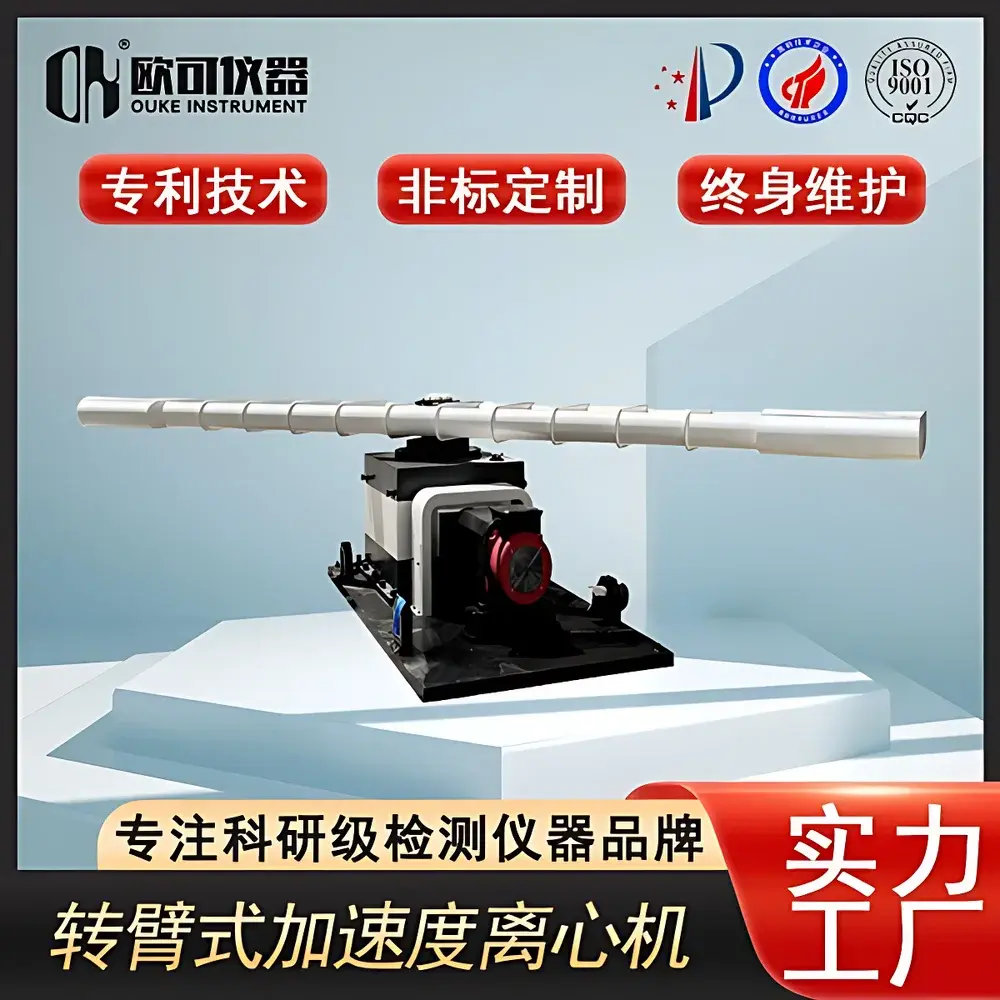
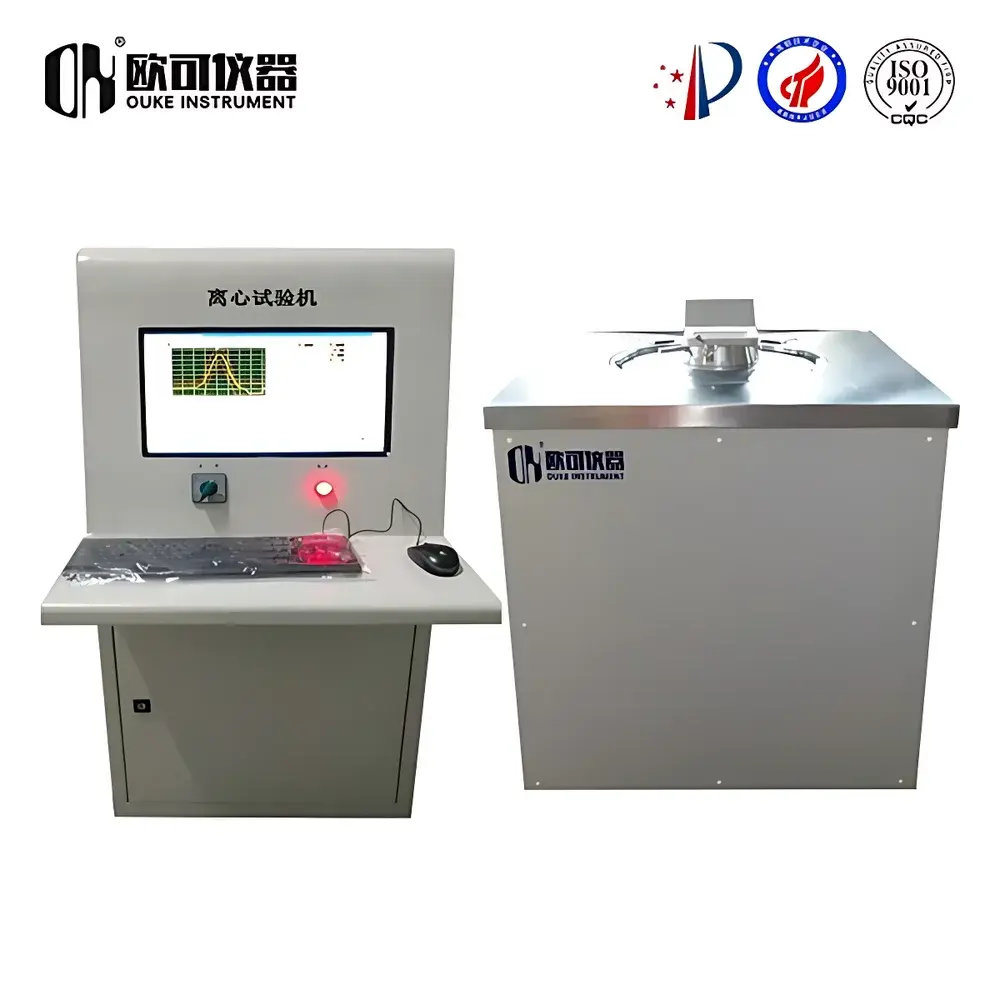
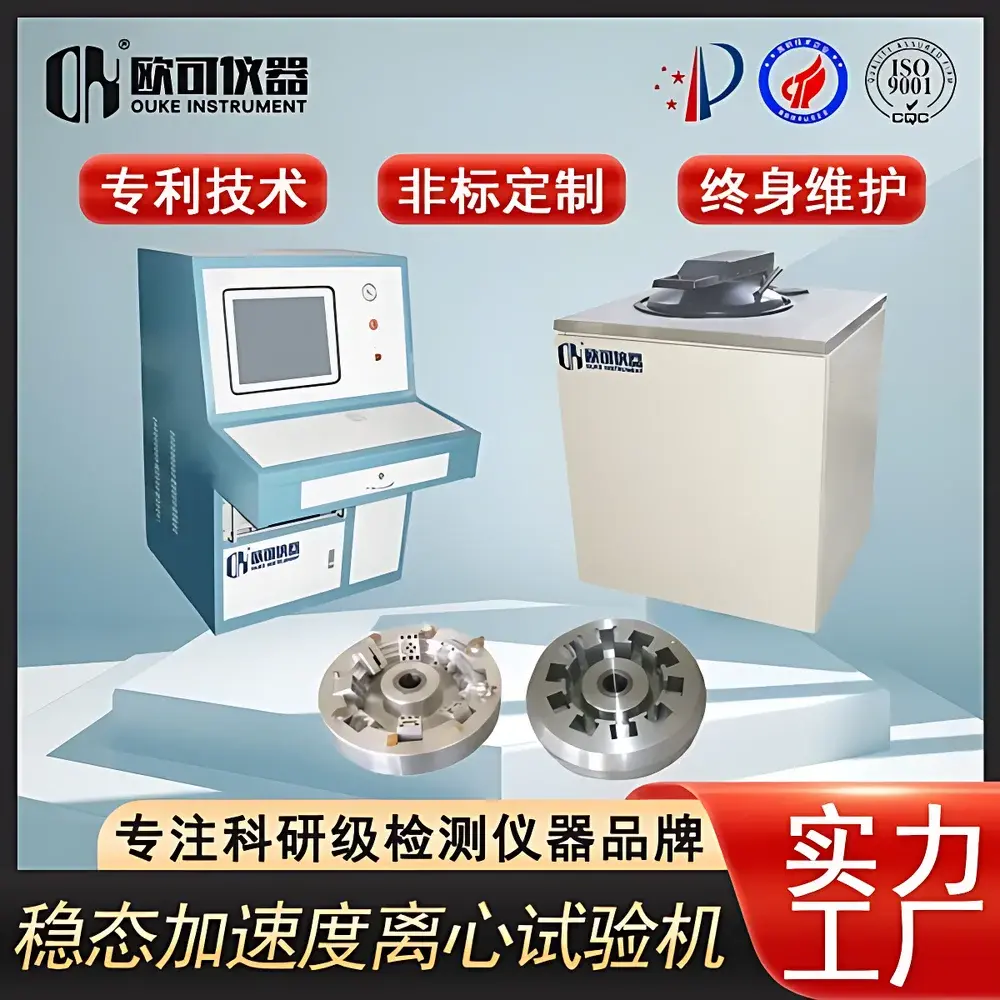
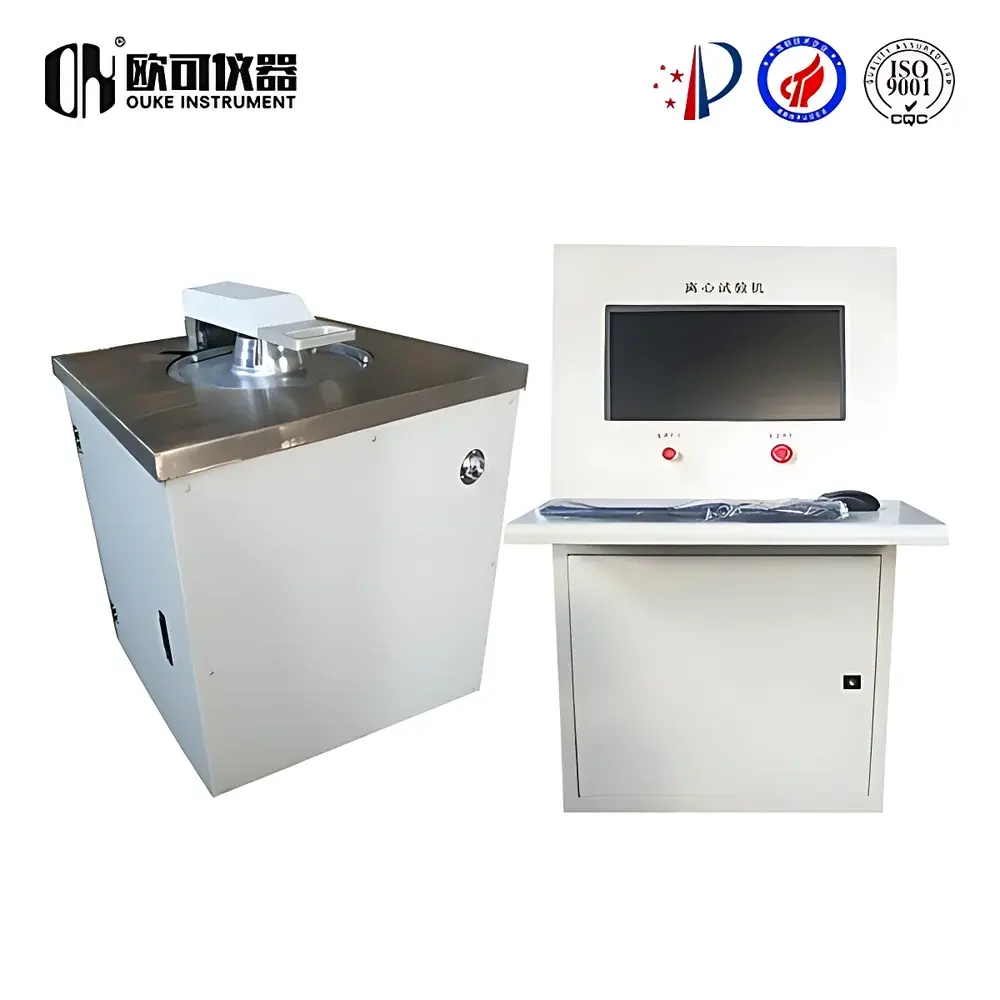
OK Instruments OK-LXJ50B Steady-State Acceleration Centrifuge
| Brand | OK Instruments |
|---|---|
| Origin | Guangdong, China |
| Manufacturer Type | Direct Manufacturer |
| Product Category | Domestic |
| Model | OK-LXJ50B |
| Price | USD 28,000 (FOB Guangdong) |
Overview
The OK Instruments OK-LXJ50B Steady-State Acceleration Centrifuge is an electromechanical test system engineered to generate and maintain precisely controlled, unidirectional, constant-magnitude acceleration fields—expressed in multiples of Earth’s gravitational acceleration (g, where 1 g = 9.80665 m/s²). Unlike shock or vibration testers, this centrifuge operates on the principle of uniform circular motion, applying sustained radial acceleration via centripetal force according to the fundamental relation: a = ω²r = (2πN/60)² × r, where a is acceleration (g), N is rotational speed (rpm), and r is effective radius (m). It is purpose-built for environmental stress screening and qualification testing of high-reliability components under prolonged over-acceleration conditions—such as those encountered during missile maneuvering, aircraft high-g turns, stage separation in launch vehicles, or atmospheric re-entry. Its architecture integrates high-inertia rotor dynamics, real-time closed-loop speed regulation, and synchronized signal integrity management across rotating interfaces—making it a core asset in aerospace, defense, and advanced electronics reliability laboratories.
Key Features
- High-stability rotary platform with dynamically balanced arm assembly, incorporating counterweight compensation for extended operational duty cycles at elevated g-levels
- Brushless AC servo motor drive with vector-controlled inverter, enabling smooth ramp-up/down profiles and ±0.5% speed stability under load
- Modular specimen mounting basket with adjustable angular orientation (±90° pitch/yaw) to align acceleration vector precisely with device-under-test (DUT) sensitive axes
- Integrated safety-rated containment chamber compliant with ISO 13857 (minimum safety distances) and EN 60204-1 (electrical safety), featuring interlocked access doors and burst-resistant polycarbonate viewport
- Multi-channel slip-ring assembly supporting up to 16 independent analog/digital signal paths (e.g., voltage, current, thermocouple, TTL) with ≤ 2 mΩ contact resistance and < −80 dB crosstalk suppression
- Real-time acceleration monitoring via calibrated optical encoder and redundant piezoresistive g-sensor feedback, feeding into PID-regulated control loop
Sample Compatibility & Compliance
The OK-LXJ50B accommodates specimens up to 5 kg mass and 300 mm maximum dimension (diameter/length), with customizable fixture interfaces for PCB-mounted ICs, MEMS inertial sensors, avionics modules, and automotive ECUs. It supports standardized test configurations per MIL-STD-883 Method 2001.7 (“Constant Acceleration”), GJB 548B-2005 Test Method 2001, and IEC 60068-2-7 (“Test Ga: Constant Acceleration”). These standards mandate specific acceleration magnitudes (e.g., 20,000 g for 1 min; 50,000 g for 30 s), dwell durations, axis alignment protocols (X/Y/Z orthogonal or 12-directional sequential), and pre-/post-test electrical functional verification. The system’s mechanical design and control firmware are architected to meet GLP audit requirements—including full traceability of setpoints, actual g-values, timestamps, and operator IDs—ensuring data integrity for regulatory submissions.
Software & Data Management
The centrifuge is operated via OK-CentriControl™ v3.2—a Windows-based application with dual-mode interface: manual parameter entry and script-driven automated test sequences. All acceleration profiles, run logs, and sensor data streams are timestamped and stored in IEEE-compliant .tdms format. The software enforces user role-based access control (admin/operator), supports 21 CFR Part 11–compliant electronic signatures, and generates PDF reports containing raw acceleration traces, pass/fail status per IEC/MIL criteria, and metadata for QA archival. Data export supports CSV, MATLAB (.mat), and LabVIEW-compatible formats. Optional integration with enterprise LIMS platforms is available via OPC UA protocol.
Applications
- Aerospace & Defense: Qualification of gyroscopes, accelerometers, and flight control actuators under sustained high-g loads; validation of satellite payload survivability during launch phase
- Automotive Electronics: Functional testing of airbag crash sensors, ADAS radar modules, and battery management systems under lateral acceleration equivalent to >1.5 g cornering
- Semiconductor Reliability: Structural integrity assessment of wire-bonded dies, die-attach adhesion, and package delamination per MIL-STD-750 and JESD22-A108
- MEMS Device Characterization: Bias stability evaluation of resonant gyros and capacitive accelerometers under static g-field exposure
- Materials Science: Creep behavior analysis of polymer composites and aluminum alloys under constant tensile stress induced by radial acceleration
- Inertial Sensor Calibration: Reference-grade g-level generation for null-point and scale-factor calibration of tactical-grade IMUs
FAQ
What is the maximum achievable acceleration for the OK-LXJ50B?
The system achieves up to 150,000 g at its maximum rated radius of 0.35 m and top speed of 5,000 rpm. Actual g-level depends on specimen radius and operational constraints.
Does the system support multi-axis acceleration testing?
No—it produces uniaxial radial acceleration only. Multi-axis simulation requires sequential reorientation of the specimen mount per standard-defined directions.
Is remote operation and monitoring supported?
Yes—via Ethernet-connected PC with OK-CentriControl™; optional VNC-based supervisory access for off-site oversight (firewall-configurable).
How is data synchronization maintained between rotating and stationary systems?
Through low-noise slip-ring channels with hardware-triggered sampling clocks, synchronized to the main encoder signal with jitter < 1 µs.
Can the OK-LXJ50B be integrated into an existing HALT/HASS chamber environment?
Not directly—the unit is a standalone mechanical test system. However, post-centrifuge functional testing can be performed inside thermal/vacuum chambers using extracted specimens.



