
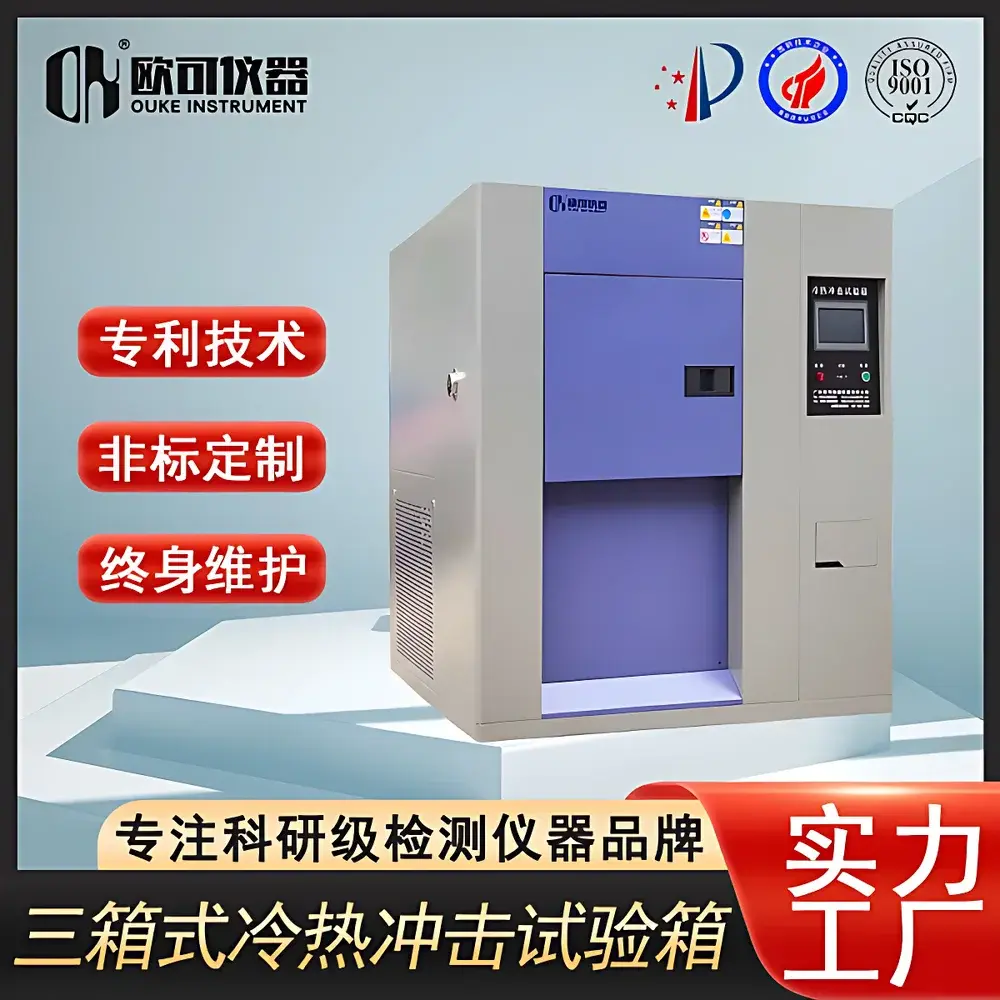
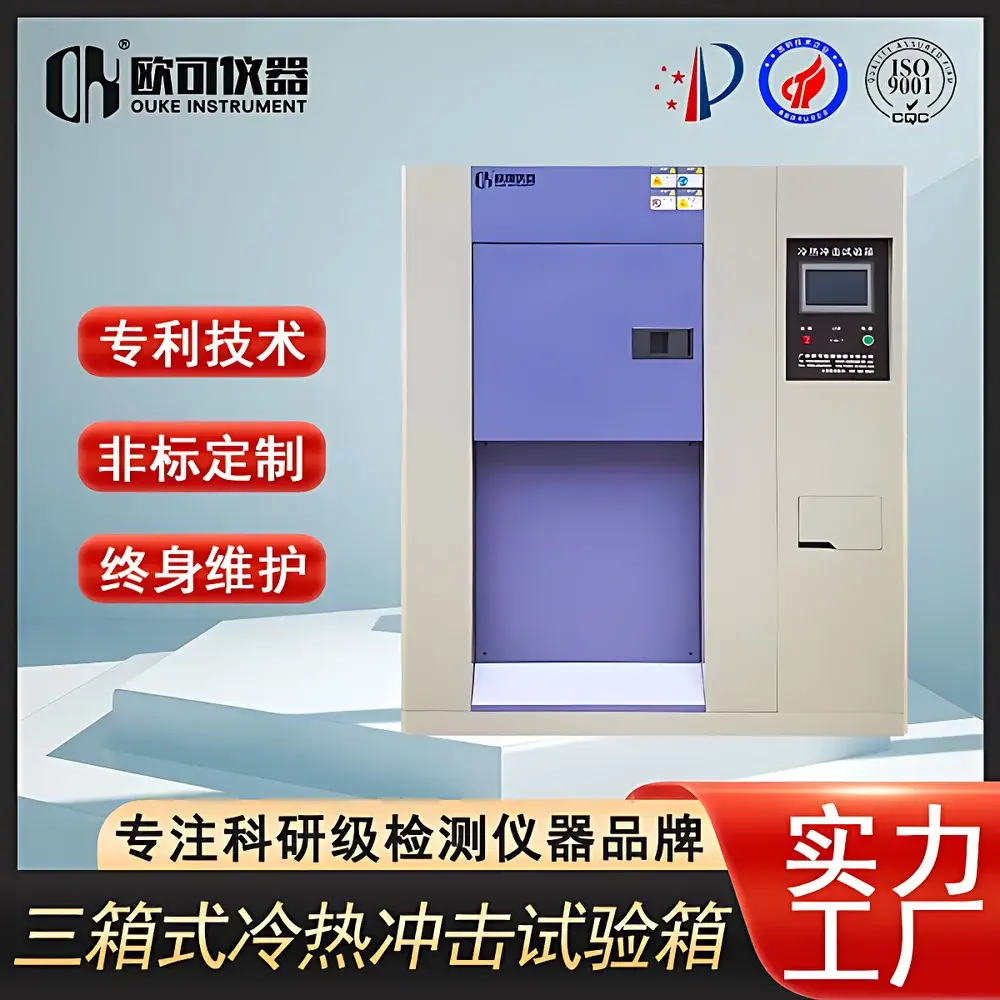
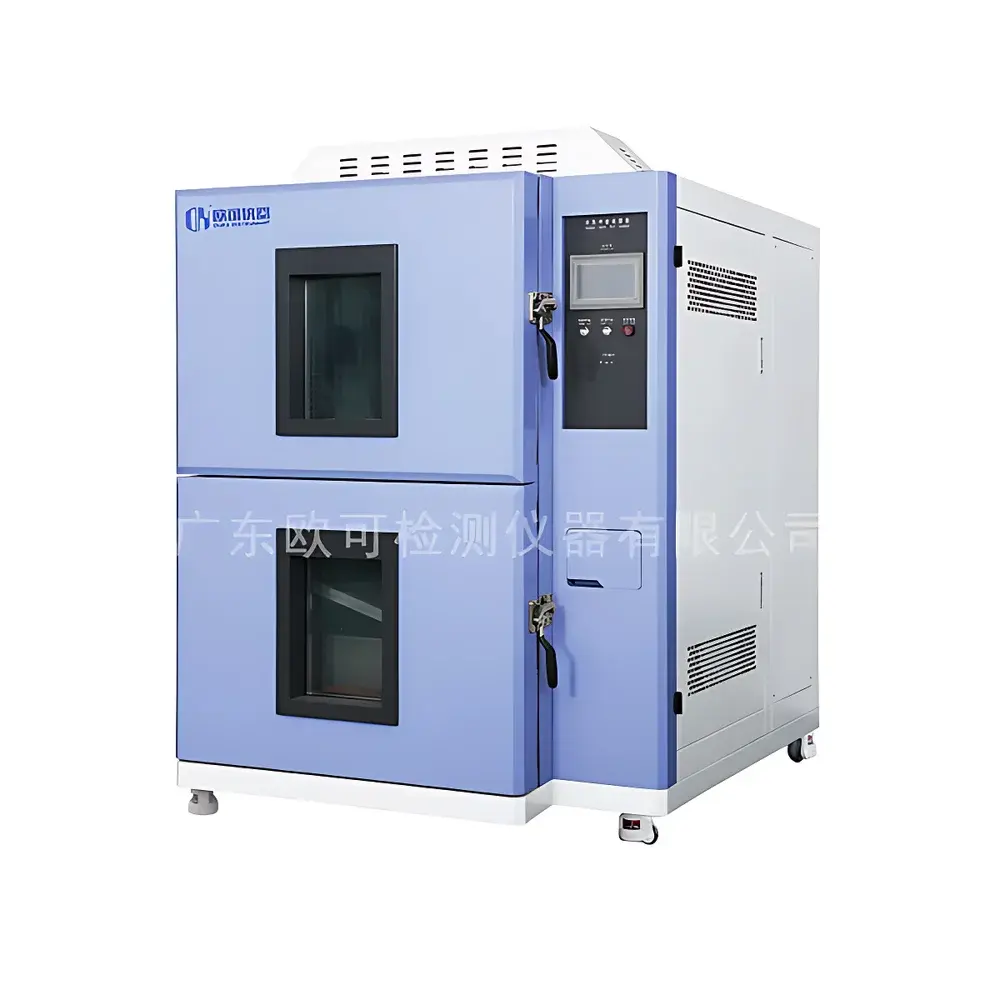
OK Instruments OK-TS-150 LED-Controlled Thermal Shock Test Chamber
| Brand | OK Instruments |
|---|---|
| Model | OK-TS-150 |
| Origin | Guangdong, China |
| Manufacturer Type | Direct Manufacturer |
| Temperature Range | -50 °C to +150 °C |
| Temperature Stability | ±2 °C |
| Ramp Rate (Heating/Cooling) | 10 °C/min |
| Compliance | GB/T 2423.1, GB/T 2423.2, GB/T 2423.22, GJB 150.3–150.5, GJB 360.7, GJB 367.2, IEC 60068-2-14, SJ/T 10186–10187, QC/T 17, EIA-364-32 |
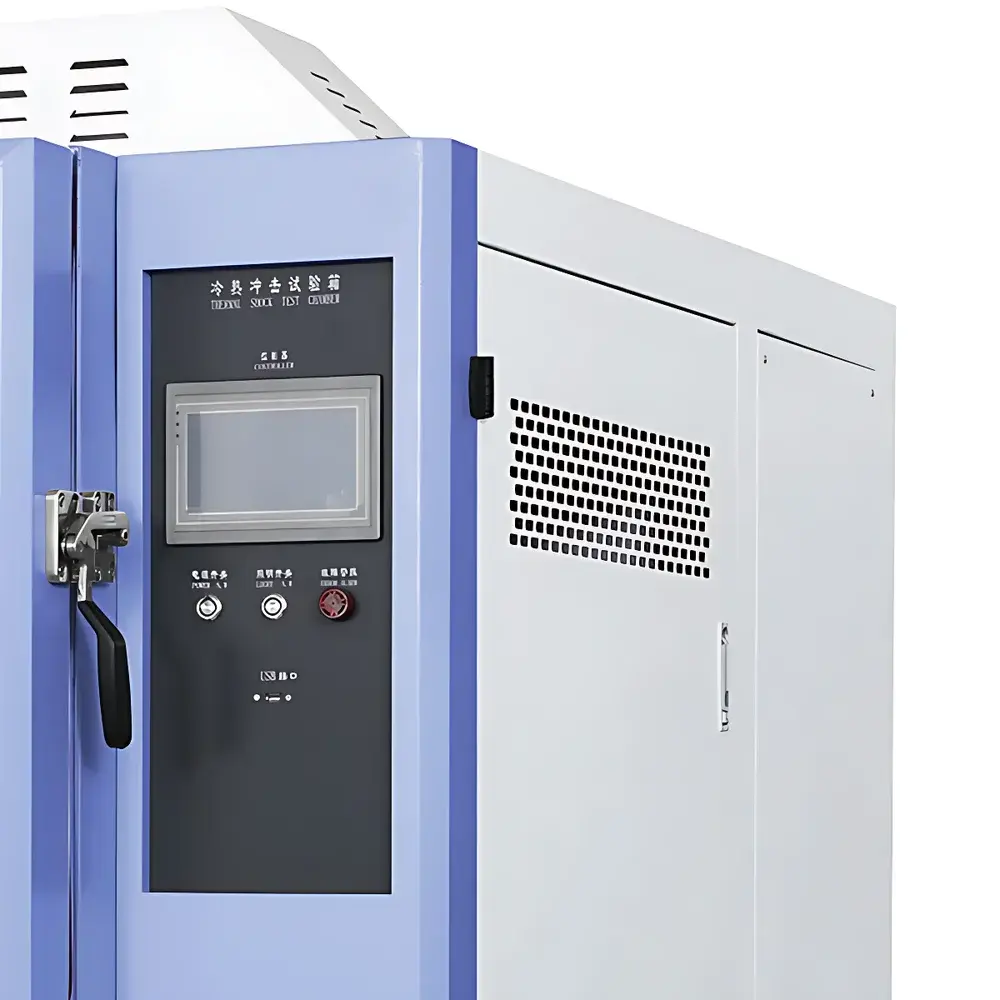
| Controller | Touchscreen Color LCD with PID Algorithm |
| Configuration | Two-Zone Static Specimen Design (Hot/Cold Chambers with Pneumatic Door Switching) |
| Internal Dimensions (W×H×D) | 60×50×50 cm |
| Insulation | High-Density Fire-Retardant PU Foam |
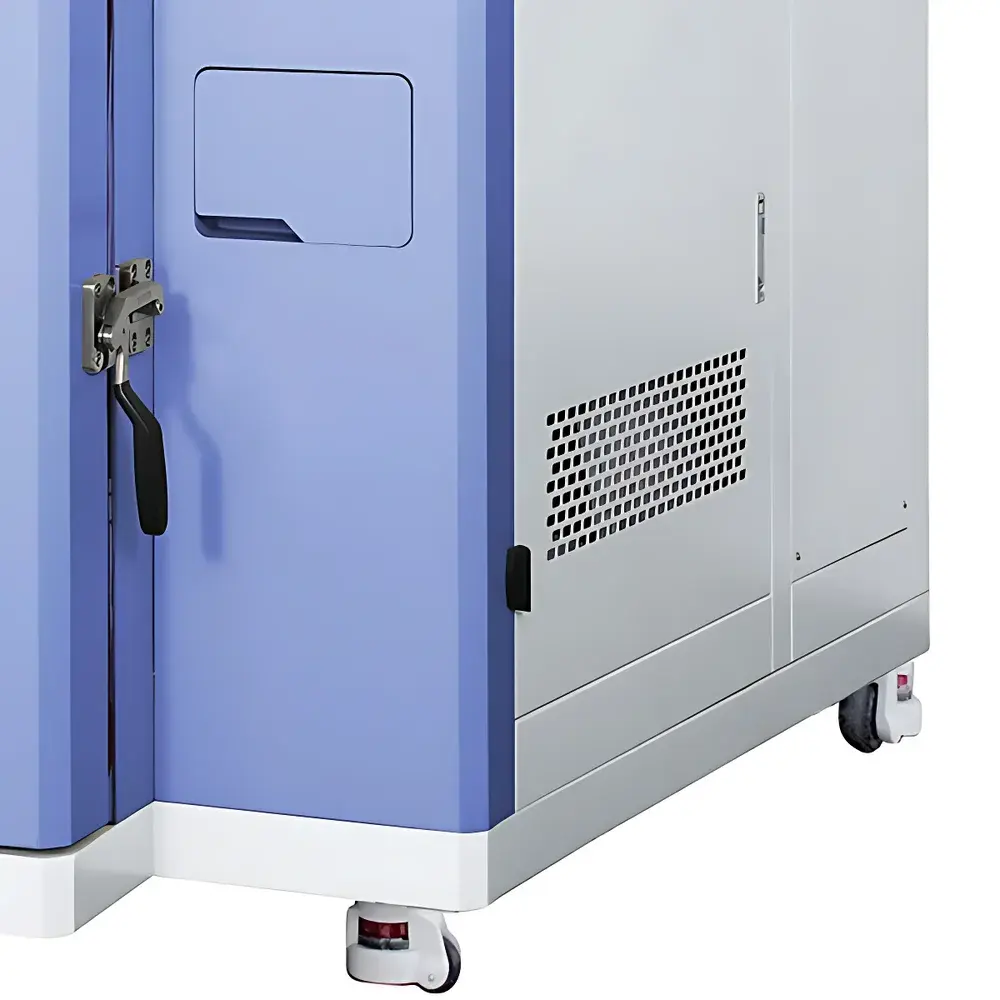
| Refrigeration System | Semi-Hermetic Compressor with R404A/R23 Refrigerant Blend |
| Chamber Material | Interior – SUS#304 Mirror-Finish Stainless Steel |
| Power Supply | AC 380 V ±5%, 50 Hz ±0.5 Hz, 3-Phase 5-Wire |
Overview
The OK Instruments OK-TS-150 LED-Controlled Thermal Shock Test Chamber is an engineered environmental stress screening system designed for rapid, repeatable thermal cycling of electronic components, automotive modules, aerospace hardware, and polymer-based assemblies. It operates on the two-zone static specimen principle—comprising independent high-temperature (up to +150 °C) and low-temperature (down to −50 °C) storage chambers—with pneumatic actuation enabling sub-5-second transfer of test specimens between zones. This architecture eliminates mechanical movement of samples, minimizing vibration-induced artifacts and ensuring high reproducibility in thermal shock evaluation per IEC 60068-2-14 Method N and MIL-STD-810G / GJB 150.5 protocols. The chamber’s core function is to accelerate latent defects—such as interfacial delamination, solder joint fatigue, or coefficient-of-thermal-expansion (CTE) mismatch failures—by subjecting devices to abrupt temperature transitions at controlled ramp rates of 10 °C/min.
Key Features
- Full-color touchscreen HMI controller with intuitive navigation, real-time graphical trend display, and multilingual UI support (English default)
- PID-based closed-loop temperature regulation delivering ±0.5 °C control accuracy and ±2.0 °C uniformity across the 60×50×50 cm test volume
- Programmable cycle sequencing: up to 999 cycles with user-defined dwell times, transition intervals, and automatic defrost scheduling
- Pre-conditioning mode with scheduled start-up—enables pre-cooling or pre-heating during standby to minimize test initiation delay
- Integrated safety architecture including over-temperature cutoff, refrigerant pressure monitoring, door interlock, phase failure protection, and real-time fault diagnostics with plain-text root-cause guidance
- Dual-zone thermal reservoirs: hot zone (RT to +200 °C), cold zone (RT to −70 °C); enables extended testing beyond nominal −50 °C to +150 °C operational envelope
- Standardized 50 mm diameter cable/port access with silicone gasket, plus two adjustable SUS#304 stainless steel shelves
Sample Compatibility & Compliance
The OK-TS-150 accommodates rigid and semi-rigid specimens up to 45 kg (static load), including PCBAs, sensors, connectors, battery packs, optical housings, and molded plastic enclosures. Its internal chamber—lined with electropolished SUS#304 stainless steel—resists corrosion from condensate and thermal oxidation byproducts. The system meets full regulatory alignment with international qualification standards: GB/T 2423.1–2 (cold/heat testing), GB/T 2423.22–2002 (temperature change), GJB 150.3–150.5 (military environmental testing), GJB 360.7 and GJB 367.2 (avionics thermal shock), IEC 60068-2-14 (environmental testing—Part 2: Tests—Test N: Change of temperature), and EIA-364-32 (thermal shock evaluation of electrical connectors). All thermal profiles are traceable and auditable under GLP-compliant data logging frameworks.
Software & Data Management
The embedded controller supports USB export of time-stamped CSV datasets containing chamber setpoints, actual temperatures (hot/cold/test zones), ramp rates, cycle counters, and alarm logs. Optional Ethernet connectivity enables integration into centralized lab management systems via Modbus TCP or OPC UA. Raw data includes timestamped thermocouple readings (Type K, Class 1 accuracy) sampled at 1 Hz resolution. Audit trails comply with FDA 21 CFR Part 11 requirements when paired with OK Instruments’ optional validation package (IQ/OQ documentation, calibration certificates, and electronic signature module).
Applications
- Qualification of automotive ECUs and ADAS modules per QC/T 17–92 and ISO 16750-4
- Reliability screening of semiconductor packaging (QFN, BGA, CSP) prior to burn-in
- Validation of conformal coating integrity on printed circuit boards
- Thermal fatigue assessment of MEMS devices and optoelectronic assemblies
- Material compatibility testing for adhesives, potting compounds, and encapsulants used in harsh-environment electronics
- Process validation for reflow soldering and underfill curing steps in SMT lines
FAQ
What is the difference between a thermal shock chamber and a standard temperature cycling chamber?
Thermal shock chambers employ separate hot/cold reservoirs and rapid pneumatic transfer—enabling transitions in seconds—whereas temperature cycling chambers modulate a single chamber volume, resulting in slower ramp rates and longer dwell stabilization periods.
Can the OK-TS-150 perform tests below −50 °C?
Yes—the cold reservoir is rated to −70 °C, allowing configurable cold冲击 conditions down to −65 °C per GJB 367.2 Clause 405, though operational test range remains −50 °C to +150 °C unless customized.
Is the system compliant with FDA 21 CFR Part 11 for regulated pharmaceutical or medical device testing?
Out-of-the-box compliance requires the optional validation suite; standalone operation provides audit-ready logs but lacks electronic signature and role-based access controls without add-on firmware.
What maintenance intervals are recommended for the refrigeration system?
Compressor oil and filter dryer replacement every 24 months; refrigerant leak check and pressure calibration annually; door seal inspection quarterly.
Does the chamber support remote monitoring via SCADA or LabView?
Yes—via standard Modbus TCP over Ethernet or RS-485; LabVIEW drivers and SCADA tag mapping templates are available upon request from OK Instruments Technical Support.



