
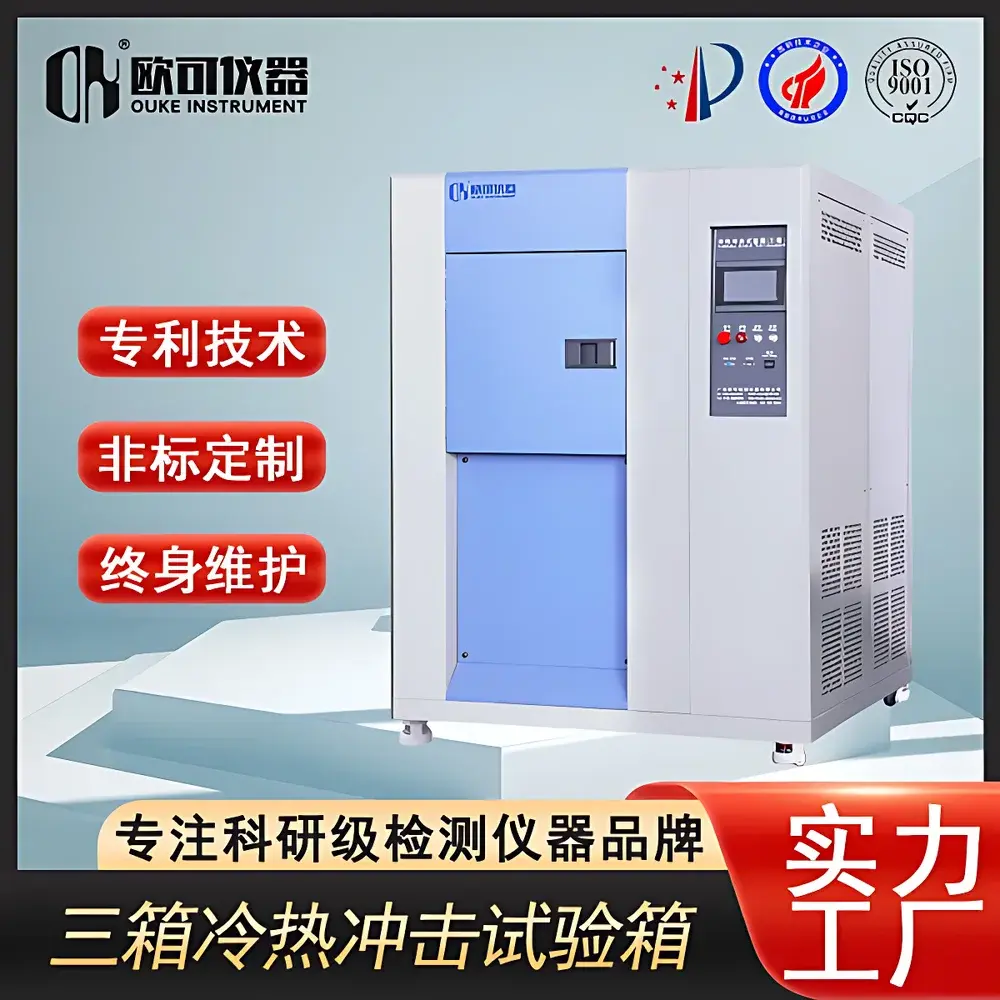
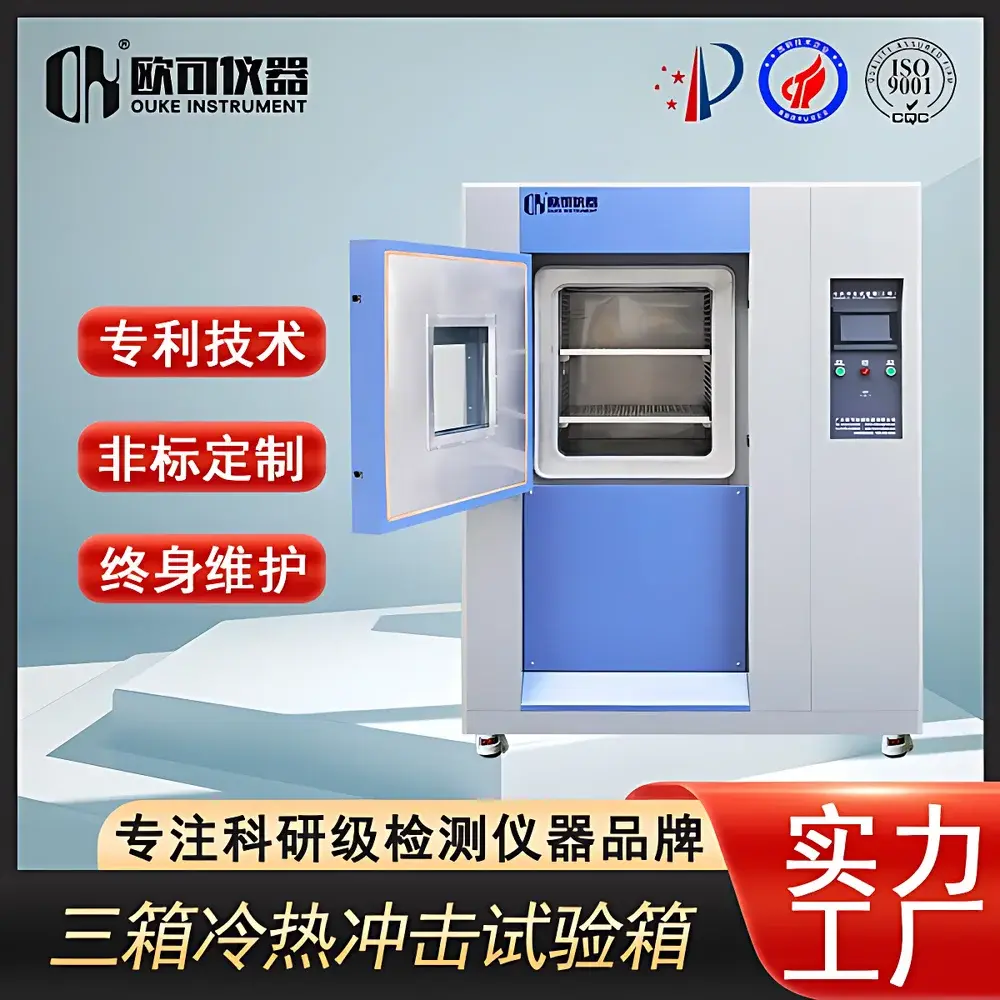
OK Instruments OK-TS-49.0.0 Thermal Shock Test Chamber
| Brand | OK Instruments |
|---|---|
| Origin | Guangdong, China |
| Manufacturer Type | Direct Manufacturer |
| Model | OK-TS-49.0.0 |
| High Temperature Range | +150 °C |
| Low Temperature Range | −50 °C |
| Thermal Shock Range | −50 °C to +150 °C |
| Temperature Stability | ±2 °C |
| Heating Rate | 10 °C/min |
| Cooling Rate | 10 °C/min |
Overview
The OK Instruments OK-TS-49.0.0 Thermal Shock Test Chamber is an engineered environmental test system designed to evaluate material and component reliability under rapid, repeated transitions between extreme high and low temperature extremes. It operates on the principle of thermal shock testing—subjecting specimens to abrupt temperature changes to accelerate failure mechanisms such as interfacial delamination, solder joint fatigue, coating cracking, and coefficient-of-thermal-expansion (CTE) mismatch-induced stress. This chamber supports both two-zone (hot/cold chamber with specimen transfer via motorized basket) and three-zone (hot soak / cold soak / test chamber) configurations—enabling precise control over dwell time, transition time, and thermal gradient exposure per IEC 60068-2-14 (Test N), MIL-STD-810H Method 503.7, and ASTM D6272. Its dual-loop cascade refrigeration architecture—comprising a high-temperature R404A circuit and low-temperature R23 circuit—ensures stable, repeatable performance across the full operational range without reliance on liquid nitrogen or external cryogenic sources.
Key Features
- Robust cascade refrigeration system using imported semi-hermetic German compressors, integrated with water-cooled condensers requiring external cooling tower (10 m³/h capacity)
- Programmable temperature transition rates up to 10 °C/min (heating and cooling), with ≤5-minute recovery time between thermal extremes
- High-precision PID-controlled temperature regulation with ±0.5 °C setpoint accuracy and ±2.0 °C uniformity across the test volume
- Three-zone configuration option: independent hot soak chamber (RT to +200 °C), cold soak chamber (RT to −70 °C), and insulated test chamber for static sample placement
- Two-zone configuration with pneumatic door actuation and motor-driven specimen basket for seamless hot-to-cold transfer
- Interior constructed from mirror-finish SUS#304 stainless steel; exterior in corrosion-resistant SUS#304 or powder-coated steel
- Energy-regulating refrigeration design that dynamically modulates compressor load and expansion valve operation to maintain efficiency across varying thermal loads
- Standard 50 mm diameter cable port (stainless steel), dual adjustable stainless steel shelves, and 3-phase 380 V / 50 Hz power interface
Sample Compatibility & Compliance
The OK-TS-49.0.0 accommodates samples up to 40 × 35 × 30 cm (W×H×D) internal volume, with custom configurations available for larger footprints (e.g., OK-TS-80/150/225 variants). It complies with international standards including IEC 60068-2-14 (Test N: Change of Temperature), ISO 16750-4 (Road vehicles – Environmental conditions and testing for electrical and electronic equipment), GJB 150.5A-2009 (Military standard for temperature shock), QC/T 17-92 (Automotive component weathering), and EIA-364-32 (Thermal shock testing of electrical connectors). The chamber’s validated thermal profiles support GLP-compliant qualification protocols and are suitable for pre-production validation, accelerated life testing, and failure analysis in aerospace, automotive electronics, semiconductor packaging, and medical device manufacturing.
Software & Data Management
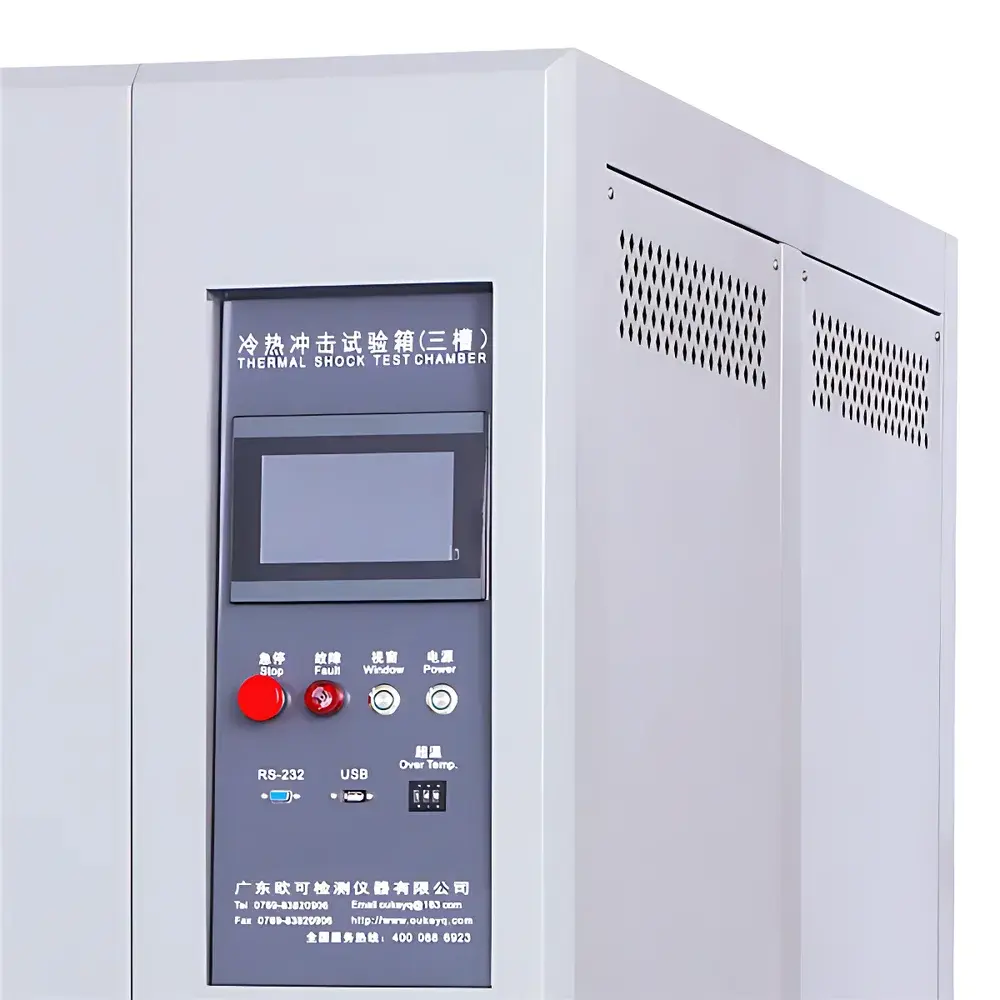
Equipped with a 7-inch color touchscreen HMI running embedded real-time OS, the chamber provides intuitive cycle programming—including multi-step ramp-soak-shock sequences, user-defined dwell times, and automatic fault logging. Optional PC-based software enables remote monitoring, data export in CSV/Excel format, audit trail generation (aligned with FDA 21 CFR Part 11 requirements), and integration into enterprise MES/QMS platforms via Modbus TCP or RS485. All temperature recordings are timestamped with millisecond resolution and stored internally for ≥30 days, supporting traceability for ISO 9001 and IATF 16949 audits.
Applications
- Qualification of PCB assemblies and BGA packages against intermetallic growth and solder joint fracture
- Evaluation of polymer encapsulants, conformal coatings, and adhesive bonds under cyclic thermal stress
- Testing of MEMS sensors, optoelectronic modules, and battery cells for dimensional stability and seal integrity
- Verification of automotive ECUs, lighting systems, and infotainment units per ISO 16750-4 Level 3/4 severity classes
- Reliability screening of space-grade components per ECSS-Q-ST-70-08C thermal cycling specifications
- Material science research on phase transformation kinetics and microcrack propagation in composites
FAQ
What is the difference between two-zone and three-zone thermal shock configurations?
In a two-zone system, the test specimen moves between hot and cold chambers via a motorized basket—minimizing thermal mass interference but requiring mechanical motion. In a three-zone design, the specimen remains stationary while air or gas is routed between isolated hot/cold reservoirs and the test chamber—reducing vibration and enabling tighter control over transition timing and thermal overshoot.
Does this chamber meet MIL-STD-810H or DO-160G requirements?
Yes—the OK-TS-49.0.0 achieves the required temperature transition rates and dwell stability specified in MIL-STD-810H Method 503.7 and DO-160G Section 4.2 (Temperature Shock), subject to proper calibration and procedural adherence during test execution.
Is external cooling infrastructure mandatory?
Yes—this model requires a dedicated water-cooled condenser loop serviced by an external cooling tower delivering 10 m³/h at ≤32 °C inlet temperature. Air-cooled alternatives are available upon request for select configurations.
Can the chamber be integrated into automated test lines?
Yes—standard digital I/O ports (24 V DC), Modbus RTU/TCP, and optional Ethernet/IP support enable seamless integration with PLC-controlled test cells and robotic handling systems.
What safety certifications does the unit carry?
The chamber conforms to CE marking requirements (EMC Directive 2014/30/EU, LVD Directive 2014/35/EU), and its electrical design follows IEC 61000-6-2/6-4 for industrial environments. UL/cUL listing is available as a factory-installed option.
Related Products



