
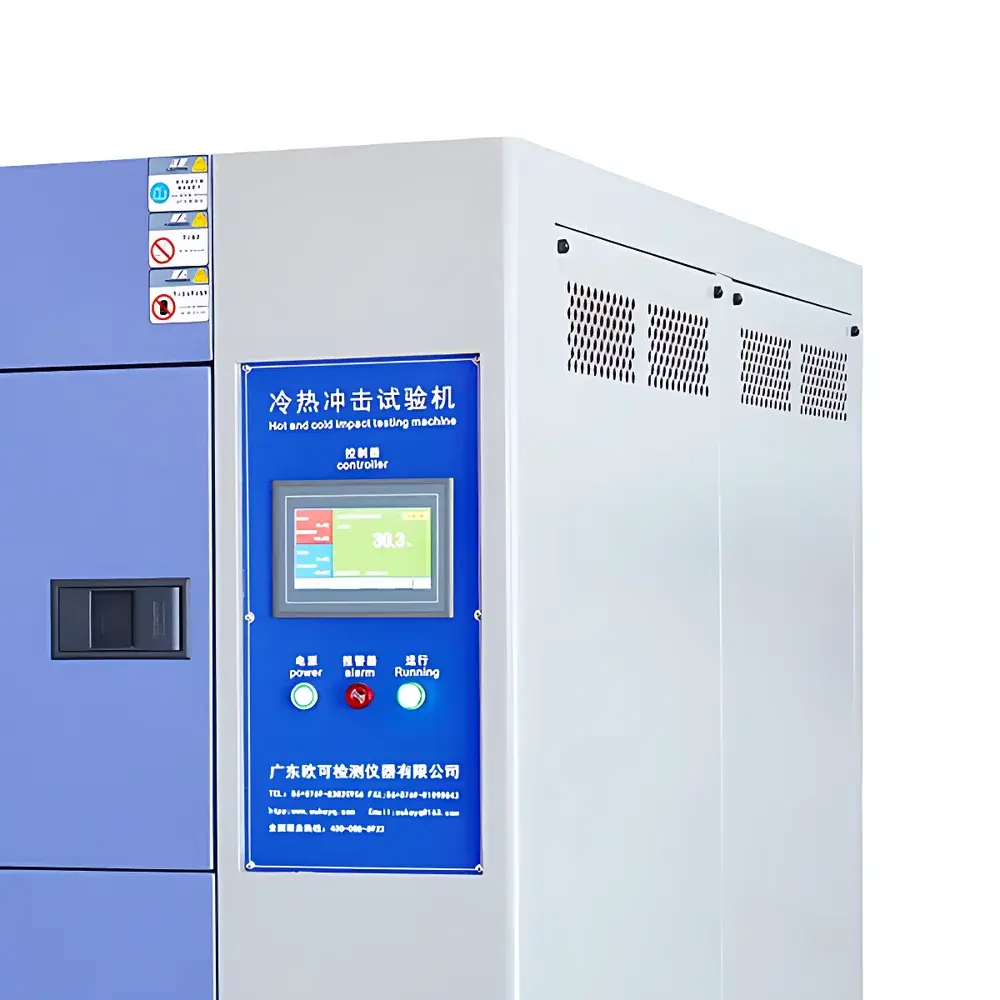
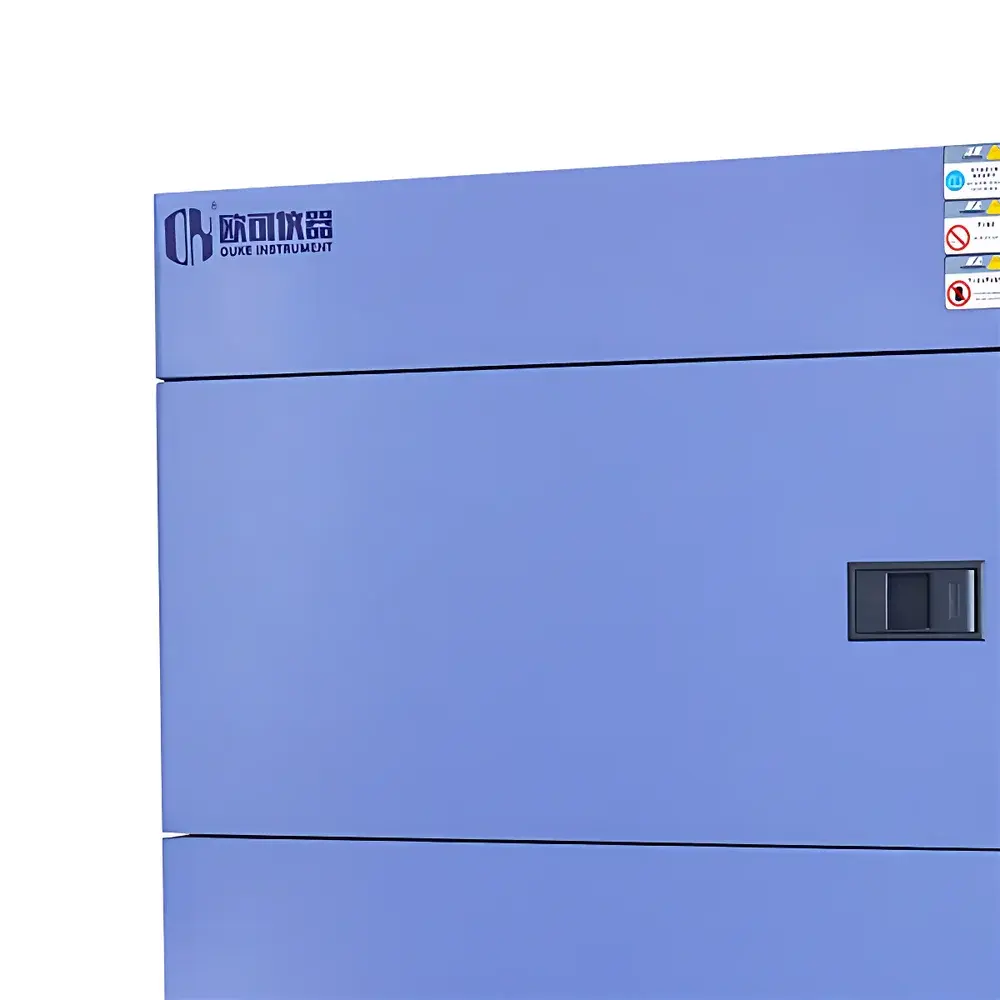
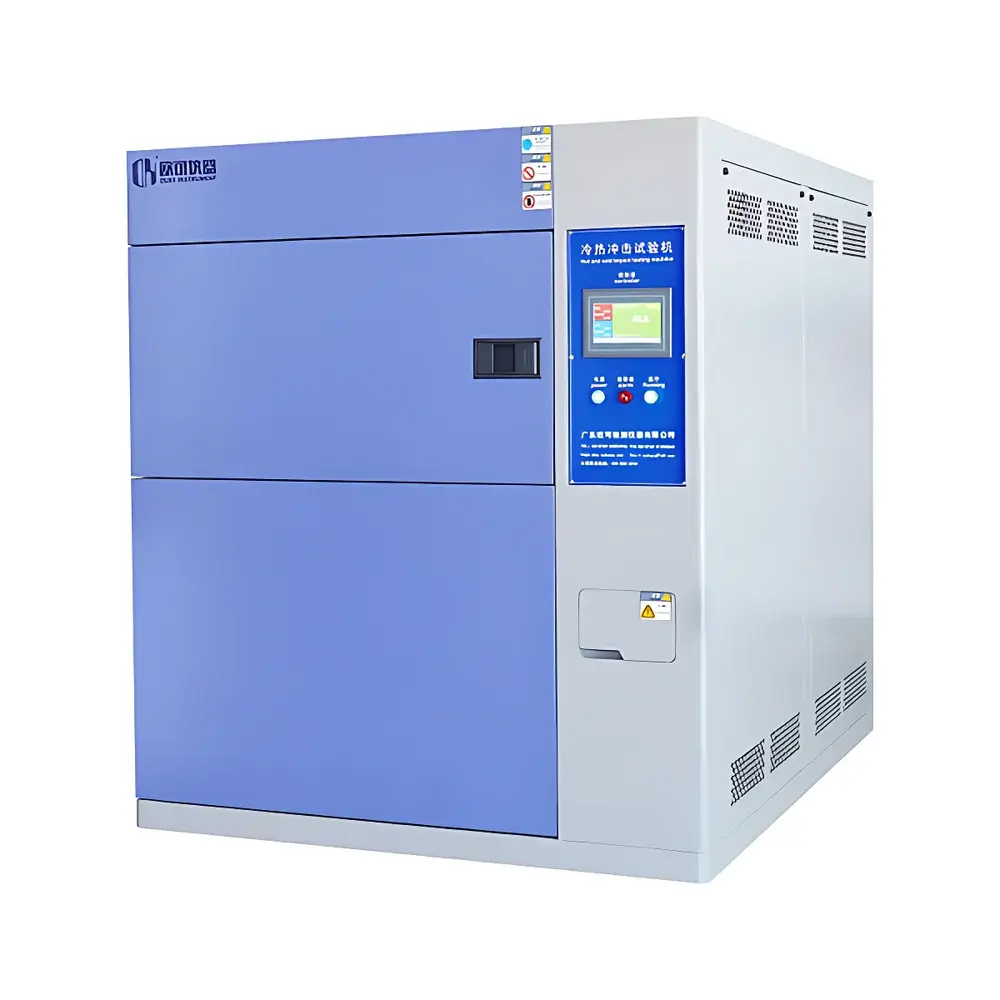
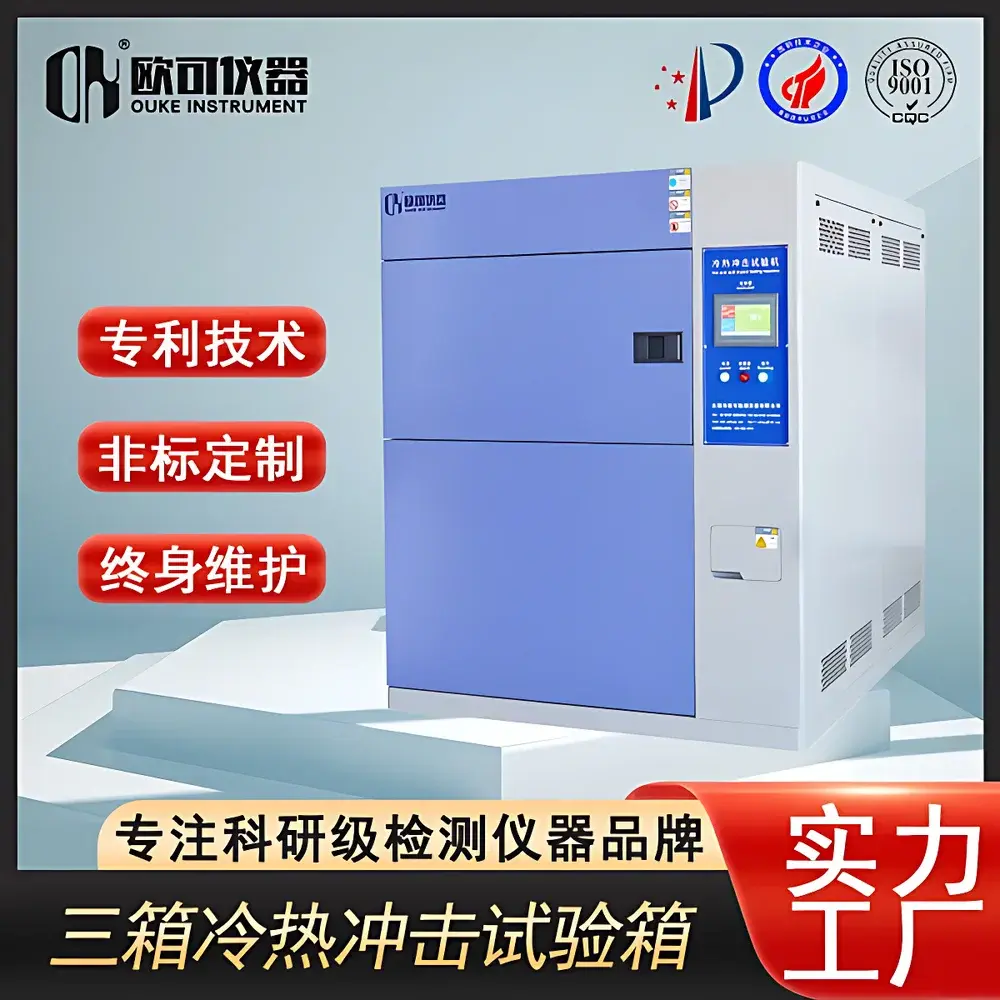
OK Instruments OK-TS-49.0.00 Programmable Thermal Shock Test Chamber
| Brand | OK Instruments |
|---|---|
| Origin | Guangdong, China |
| Manufacturer Type | Direct Manufacturer |
| Model | OK-TS-49.0.00 |
| High Temperature Range | +150 °C |
| Low Temperature Range | −50 °C |
| Thermal Shock Range | −50 °C to +150 °C |
| Temperature Stability | ±2 °C |
| Heating Rate | 10 °C/min |
| Cooling Rate | 10 °C/min |
Overview
The OK Instruments OK-TS-49.0.00 Programmable Thermal Shock Test Chamber is an engineered environmental simulation system designed for accelerated reliability assessment of electronic components, automotive modules, aerospace hardware, and precision mechanical assemblies under rapid, repetitive temperature transitions. It operates on the principle of controlled thermal shock—subjecting test specimens to abrupt, high-magnitude temperature shifts between extreme hot and cold zones—to accelerate failure mechanisms such as interfacial delamination, solder joint fatigue, coefficient-of-thermal-expansion (CTE) mismatch stress, and material embrittlement. Unlike standard temperature cycling chambers, this unit implements a dual-chamber (hot/cold) or optional tri-chamber (hot/cold/test) architecture with pneumatic air-door switching, ensuring specimen immobility during exposure and eliminating mechanical vibration artifacts associated with basket-transfer systems. The chamber complies with fundamental thermodynamic design standards for transient thermal response, including ISO 16750-4 (road vehicles), IEC 60068-2-14 (Test N: Change of Temperature), and MIL-STD-810H Method 503.5 (Temperature Shock), enabling reproducible qualification testing in accordance with industry-recognized reliability protocols.
Key Features
- Programmable multi-segment thermal shock profiles with up to 999 cycles, user-defined dwell times (1 min–999 h), and automatic transition sequencing
- Dual-zone configuration with independent high-temperature chamber (+150 °C max) and low-temperature chamber (−50 °C min), both equipped with PID-controlled heating/cooling loops
- Pneumatically actuated stainless-steel isolation doors ensure zero specimen movement during thermal transfer—critical for optical alignment-sensitive devices and MEMS packages
- Built-in energy-regulated cascade refrigeration system using R404A/R23 mixed refrigerants, featuring two-stage compression, evaporative condensers, and real-time load-adaptive capacity modulation
- High-efficiency insulation using imported fire-retardant polyurethane foam (≥150 mm thickness) with thermal conductivity ≤0.022 W/m·K, minimizing ambient heat leakage and improving temperature stability
- Internal chamber constructed from mirror-finish SUS#304 stainless steel; external housing in powder-coated SUS#304 or optional painted steel for corrosion resistance and cleanroom compatibility
- Integrated 50 mm diameter cable port with silicone gasket and two adjustable stainless-steel shelves for flexible DUT mounting and signal routing
Sample Compatibility & Compliance
The OK-TS-49.0.00 accommodates samples up to 40 × 35 × 30 cm (W × H × D) in internal volume, supporting standardized test fixtures for PCBs, connectors, sensors, battery packs, and encapsulated optoelectronic modules. Its thermal performance meets or exceeds requirements defined in multiple international and military specifications, including: IEC 60068-2-14 (Test N), GB/T 2423.22–2002 (Temperature Change), GJB 150.5–2009 (Military Standard for Temperature Shock), QC/T 17–1992 (Automotive Component Environmental Testing), and EIA-364-32 (Thermal Shock Testing of Electrical Connectors). All control algorithms and data logging functions are structured to support GLP-compliant audit trails, with optional validation documentation (IQ/OQ/PQ) available upon request. The chamber’s ±2 °C temperature uniformity across the working zone and ±0.5 °C control accuracy align with ASTM E2293–22 requirements for thermal chamber qualification.
Software & Data Management
The system integrates a 7-inch industrial-grade touchscreen HMI running embedded Linux-based firmware with intuitive graphical programming interface. Users define thermal shock sequences via time-temperature graphs or tabular input, with support for conditional branching (e.g., “if temperature deviation > ±1.5 °C, pause and alert”). Real-time monitoring includes dual-channel thermocouple inputs (T-type), chamber pressure status, compressor discharge temperature, and refrigerant saturation points. All operational parameters—including cycle count, elapsed time, maximum/minimum recorded temperatures per segment, and alarm logs—are timestamped and exportable in CSV format via USB or Ethernet. Optional software upgrade enables remote access via secure HTTPS, integration with LabView™ or Python-based test automation frameworks, and compliance with FDA 21 CFR Part 11 through electronic signature and audit trail modules.
Applications
This thermal shock chamber serves critical roles in product development and quality assurance workflows across regulated industries. In electronics manufacturing, it validates solder joint integrity of BGA and QFN packages under JEDEC J-STD-020 moisture sensitivity level (MSL) pre-conditioning protocols. Automotive Tier-1 suppliers use it for AEC-Q200 stress screening of passive components and power modules prior to PPAP submission. Aerospace subcontractors employ it for thermal vacuum pre-screening of avionics housings per DO-160 Section 4.2. In R&D laboratories, researchers apply it to study glass transition behavior of polymer composites, phase-change kinetics in shape-memory alloys, and degradation thresholds of lithium-ion battery electrolytes. Its programmability and repeatability make it suitable for HALT/HASS test plans where controlled thermal excursions form part of the stress profile matrix.
FAQ
What is the difference between two-chamber and three-chamber thermal shock configurations?
The two-chamber design uses separate hot and cold zones with pneumatic door switching, keeping the test sample stationary. The three-chamber variant adds a dedicated test chamber between hot and cold reservoirs, allowing continuous conditioning without thermal mass interference from the specimen—ideal for ultra-high-stability applications requiring <±1 °C uniformity.
Does the chamber support custom calibration certificates traceable to NIST or CNAS?
Yes—upon request, OK Instruments provides third-party calibration reports issued by CNAS-accredited laboratories, covering sensor linearity, chamber uniformity mapping, and rate-of-change verification per ISO/IEC 17025.
Is external cooling water required for operation?
Yes—the cascade refrigeration system requires a dedicated closed-loop cooling water supply at 10 m³/h flow rate and ≤32 °C inlet temperature. A compatible cooling tower must be installed externally; plumbing interfaces comply with ANSI B16.5 Class 150 flange standards.
Can the chamber be integrated into a larger environmental test suite with humidity or vibration modules?
While the OK-TS-49.0.00 is a standalone thermal shock platform, its RS485 Modbus RTU and Ethernet TCP/IP interfaces enable synchronized triggering and data exchange with complementary equipment such as humidity chambers or electrodynamic shakers via PLC-based master controllers.
What maintenance intervals are recommended for the refrigeration system?
Compressor oil analysis and refrigerant purity checks are advised every 12 months or 2,000 operating hours; filter-drier replacement every 24 months; and full system leak inspection per ASHRAE 15 guidelines prior to major recalibration events.



