
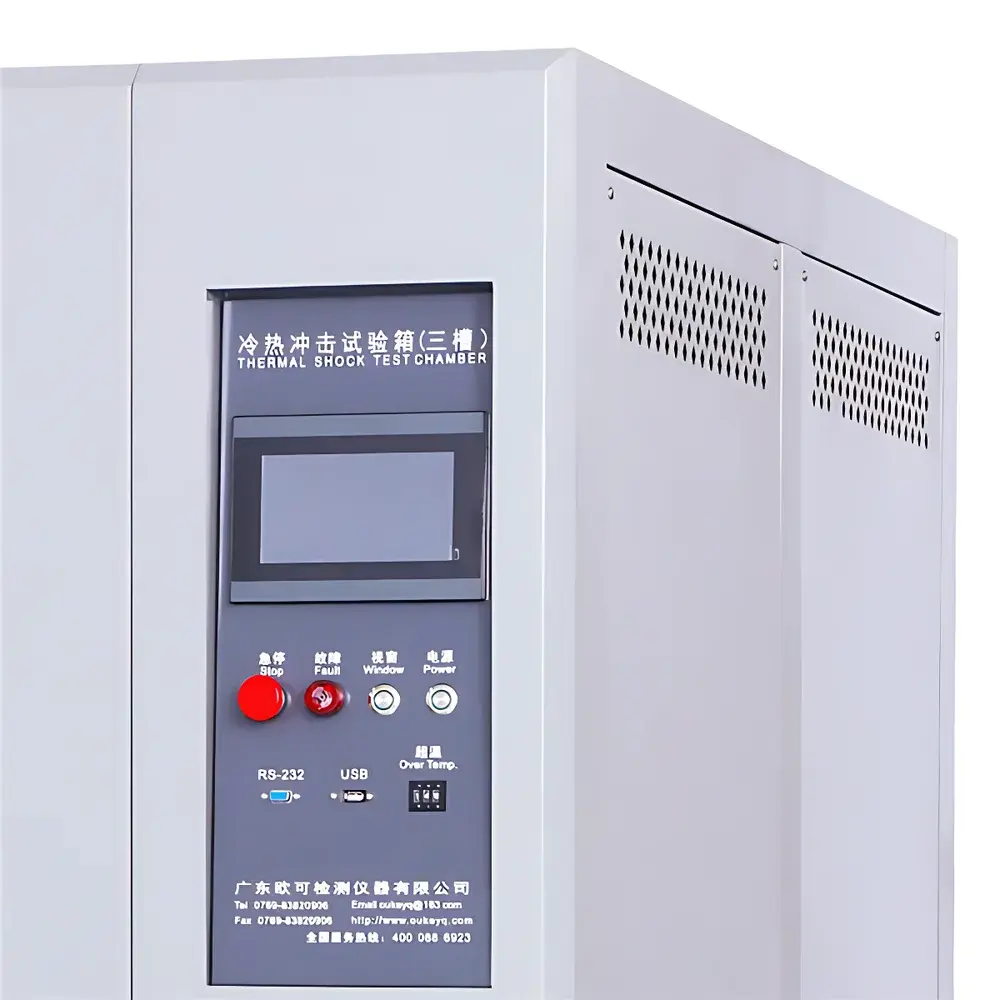
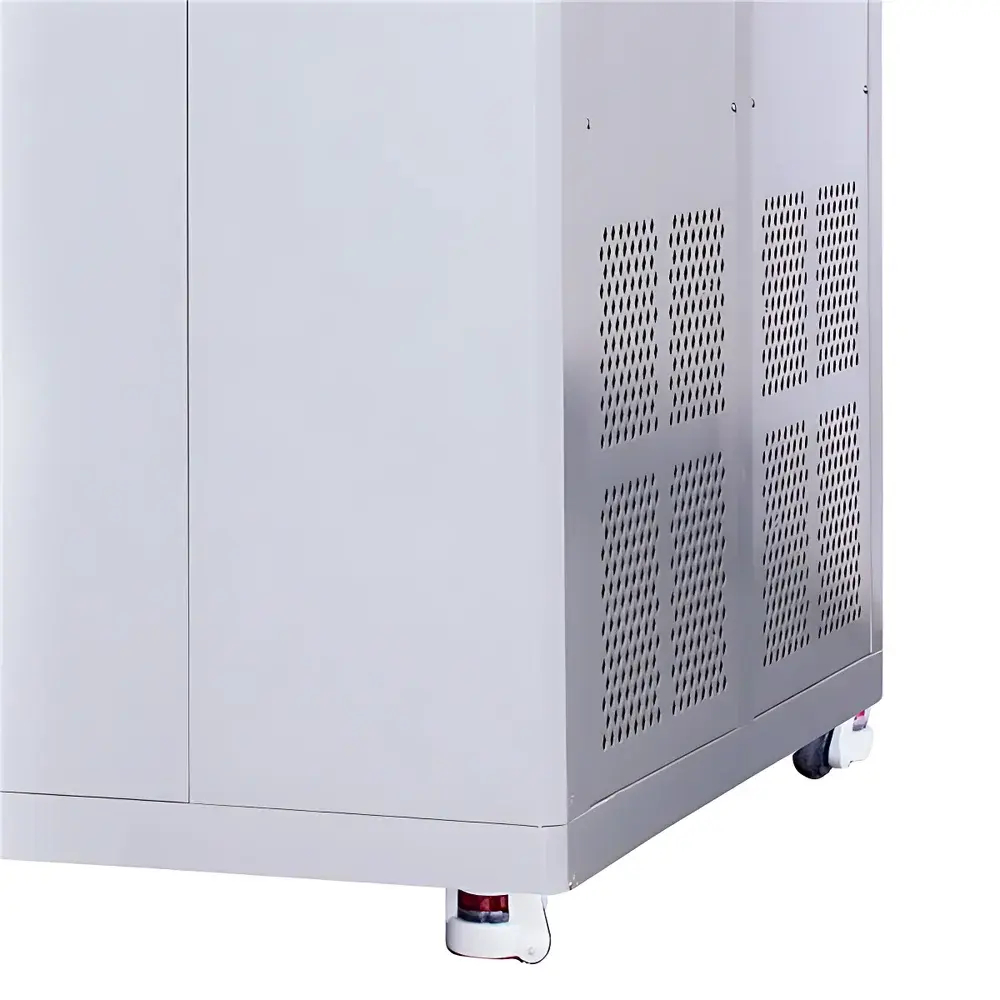
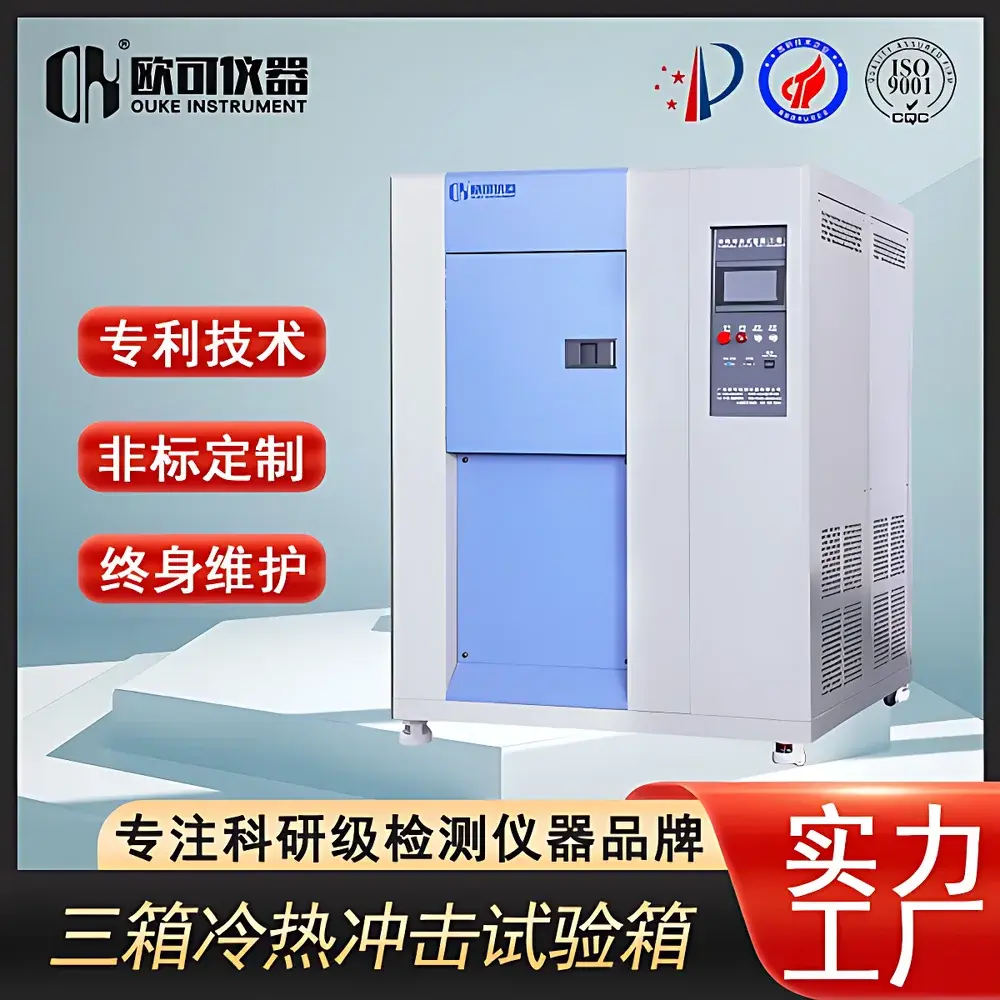
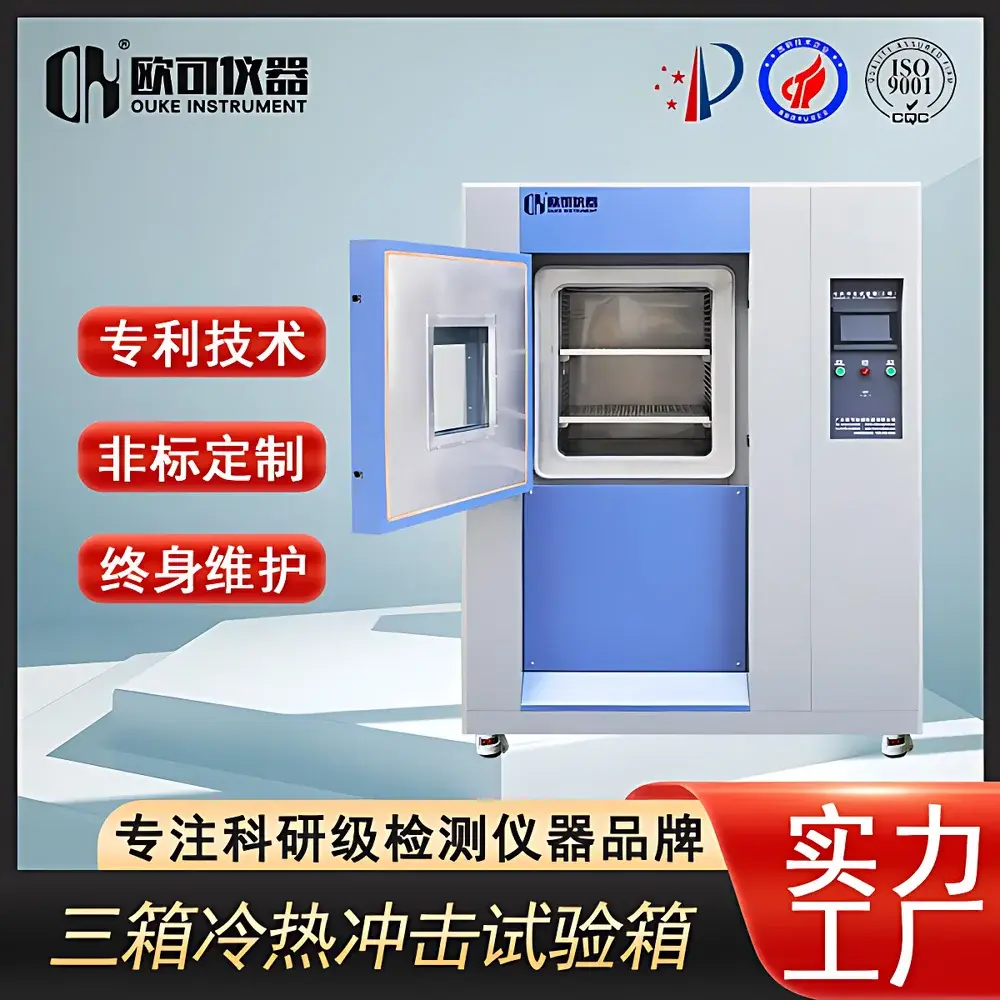
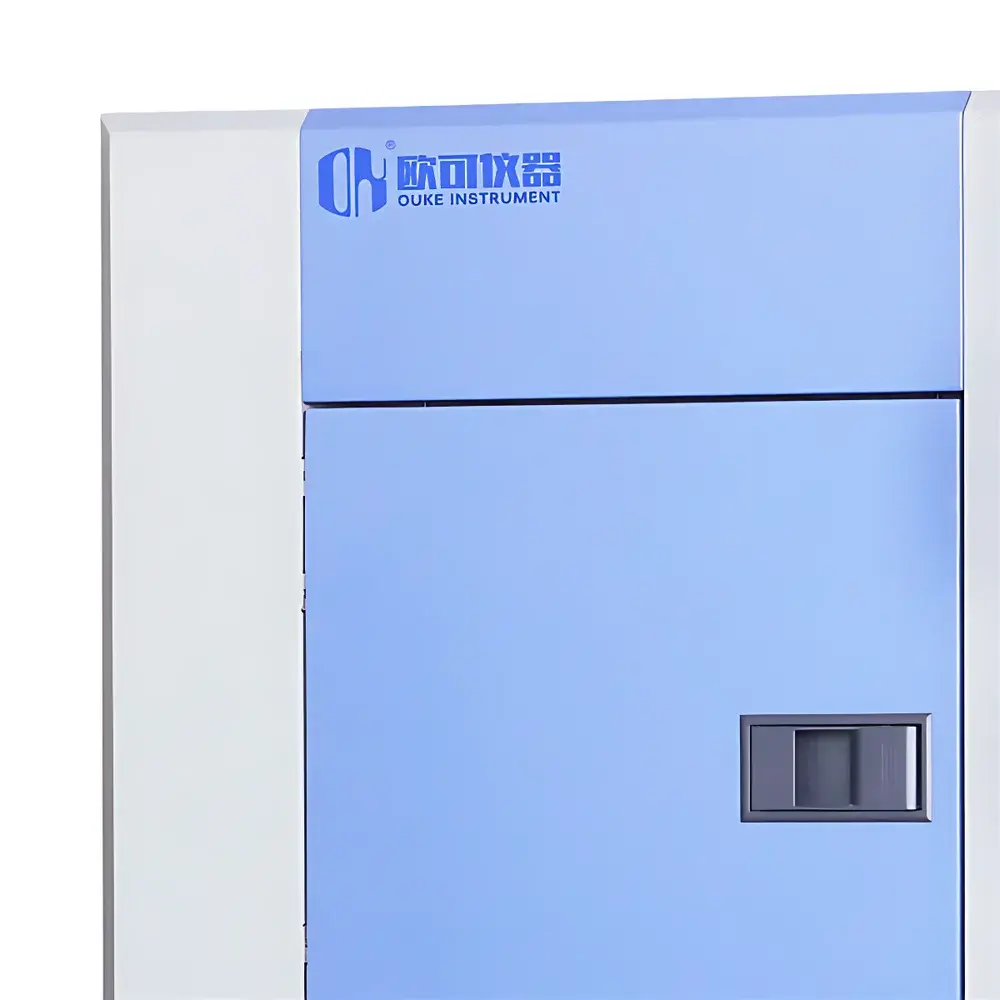
OK Instruments OK-TS-49.0 Thermal Shock Test Chamber
| Brand | OK Instruments |
|---|---|
| Origin | Guangdong, China |
| Manufacturer Type | Direct Manufacturer |
| Product Origin | Domestic (China) |
| Model | OK-TS-49.0 |
| High Temperature Range | +150 °C |
| Low Temperature Range | −40 °C |
| Thermal Shock Range | −40 °C to +150 °C |
| Temperature Stability | ±2 °C |
| Heating Rate | 20 °C/min |
| Cooling Rate | 20 °C/min |
Overview
The OK Instruments OK-TS-49.0 Thermal Shock Test Chamber is an engineered environmental test system designed to evaluate material and component reliability under rapid, repetitive transitions between extreme high and low temperature extremes. It operates on the two-zone (hot/cold chamber) principle with pneumatic air-door switching—ensuring test specimens remain stationary while thermal zones are alternately engaged. This architecture eliminates mechanical stress from specimen movement, enhancing repeatability and alignment with standardized thermal shock protocols. The chamber implements a dual-stage cascade refrigeration system, combining a high-temperature R404A circuit and a low-temperature R23 circuit, thermally coupled via an evaporative condenser. This configuration enables stable operation at −40 °C while maintaining precise control across the full −40 °C to +150 °C shock range. Designed for laboratory, QC, and aerospace qualification environments, the OK-TS-49.0 meets structural and performance requirements defined in key international standards for accelerated thermal stress evaluation.
Key Features
- Two-zone thermal shock architecture with independent hot and cold chambers and pneumatic air-door switching—ensuring zero specimen displacement during transition
- Dual-stage cascade refrigeration system using environmentally compliant refrigerants (R404A/R23), integrated with water-cooled condensation requiring external cooling tower (10 m³/h capacity)
- Temperature ramp rates of up to 20 °C/min in both heating and cooling directions, verified per IEC 60068-2-14 (Test N)
- Temperature stability maintained within ±2 °C across the working volume; control resolution of ±0.5 °C supported by PID-based digital controller with real-time feedback
- Interior constructed from mirror-finish SUS#304 stainless steel; exterior available in either brushed stainless steel or powder-coated steel
- High-density polyurethane (PU) insulation with fire-retardant formulation, providing thermal resistance >0.022 W/m·K
- Standard configuration includes one 50 mm diameter cable port, two adjustable SUS#304 shelf levels, and rear-mounted 3-phase 5-wire AC380 V ±5%, 50 Hz ±0.5 Hz power inlet (2.5 m cable)
Sample Compatibility & Compliance
The OK-TS-49.0 accommodates samples up to 40 × 35 × 30 cm (W×H×D) internal volume, with customizable variants (OK-TS-80/150/225) available for larger DUTs. Its static-test configuration ensures compatibility with fragile assemblies, PCBs, hermetic packages, optical modules, and automotive ECUs where vibration or motion-induced artifacts must be excluded. The system complies with multiple national and international thermal shock testing standards, including GB/T 2423.22–2002 (Temperature Change), IEC 60068-2-14 (Test N: Change of Temperature), GJB 150.5–86 (Military Standard Thermal Shock), EIA-364-32 (Thermal Shock for Connectors), and QC/T 17–92 (Automotive Component Environmental Testing). All operational parameters—including dwell time, transfer time, and recovery stabilization—are programmable and auditable to support GLP-compliant validation documentation.
Software & Data Management
Equipped with OK Instruments’ proprietary TSC-Manager™ control software, the OK-TS-49.0 supports full-cycle test programming, real-time graphing of chamber and DUT surface temperatures (via optional external thermocouple inputs), and automated report generation in PDF/CSV formats. Data logging occurs at user-defined intervals (1–60 s), with onboard storage retaining ≥30 days of continuous timestamped records. The software architecture adheres to FDA 21 CFR Part 11 principles: role-based access control, electronic signatures, and immutable audit trails for all parameter modifications and test executions. Exported datasets include metadata such as operator ID, calibration status, ambient conditions, and system error logs—enabling traceability in regulated manufacturing environments.
Applications
This thermal shock chamber serves critical roles in product development and quality assurance across electronics, aerospace, automotive, and medical device sectors. Typical use cases include solder joint fatigue analysis in SMT assemblies, validation of conformal coating integrity on printed circuit boards, screening of MEMS packaging adhesion under thermal cycling, qualification of battery module thermal interface materials, and accelerated life testing of LED encapsulants. Its rapid transition capability makes it especially suitable for identifying latent defects related to coefficient-of-thermal-expansion (CTE) mismatch, intermetallic growth, or microcrack propagation—phenomena often undetectable under steady-state thermal exposure.
FAQ
What is the difference between two-zone and three-zone thermal shock chambers?
Two-zone systems (like the OK-TS-49.0) alternate exposure using separate hot/cold chambers and air-door switching, keeping the test sample stationary. Three-zone designs add a dedicated test chamber and require specimen transfer via mechanical basket—introducing kinetic variables not present in two-zone configurations.
Does this chamber support automated test sequencing with dwell and transition control?
Yes. The TSC-Manager™ software allows definition of multi-step profiles, including variable dwell times, ramp rates, cycle counts, and pass/fail thresholds based on real-time sensor feedback.
Is external cooling infrastructure mandatory?
Yes. The cascade refrigeration system requires a dedicated water-cooled condenser loop supplied by an external cooling tower rated at ≥10 m³/h flow capacity.
Can the chamber be validated for ISO/IEC 17025-compliant calibration?
Yes. OK Instruments provides factory calibration certificates traceable to NIM (National Institute of Metrology, China) and supports on-site IQ/OQ/PQ protocol execution by third-party accredited laboratories.
What maintenance intervals are recommended for long-term reliability?
Compressor oil and filter replacement every 2,000 operating hours; annual inspection of refrigerant charge, door gasket integrity, and controller firmware updates per OK Instruments’ Maintenance Bulletin MB-TS-2023.



