
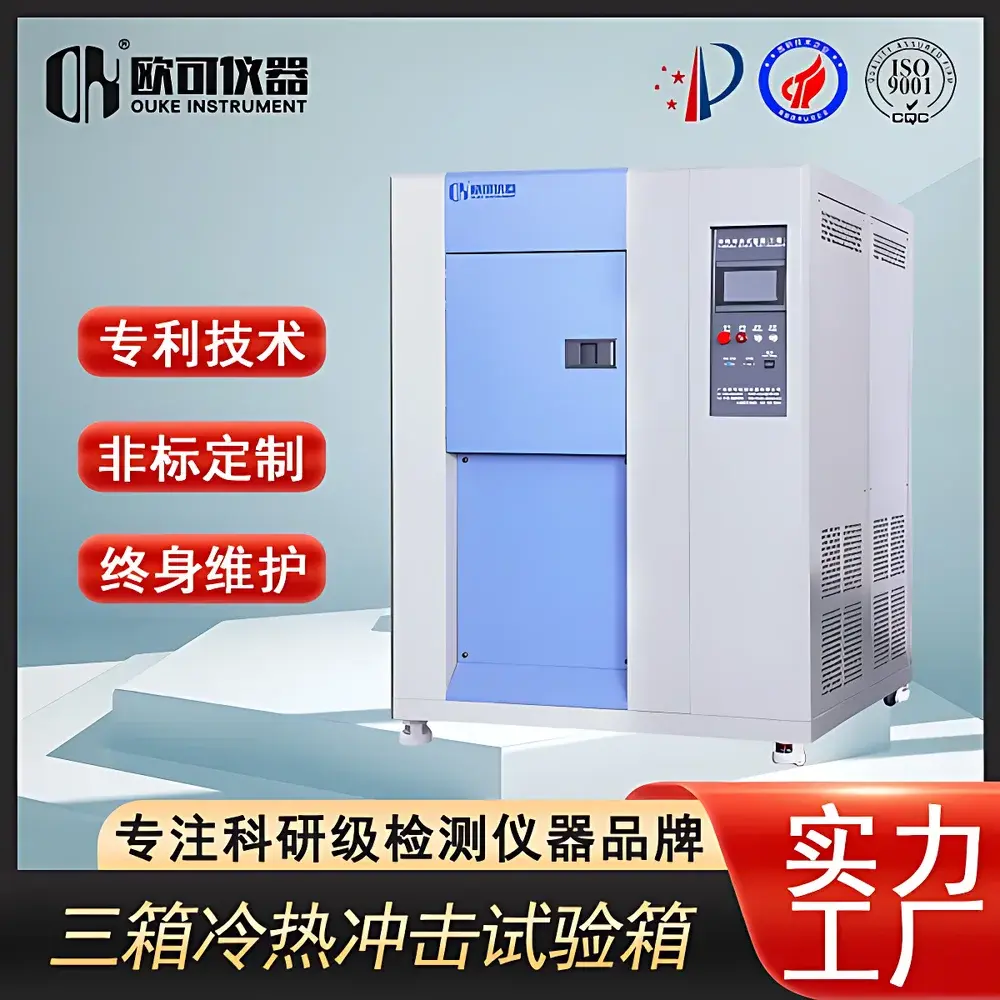
OK Instruments OK-TS-49.00 Thermal Shock Test Chamber
| Brand | OK Instruments |
|---|---|
| Origin | Guangdong, China |
| Manufacturer Type | Direct Manufacturer |
| Model | OK-TS-49.00 |
| High Temperature Range | +150 °C |
| Low Temperature Range | −50 °C |
| Thermal Shock Range | −50 °C to +150 °C |
| Temperature Stability | ±2 °C |
| Heating Rate | 10 °C/min |
| Cooling Rate | 10 °C/min |
Overview
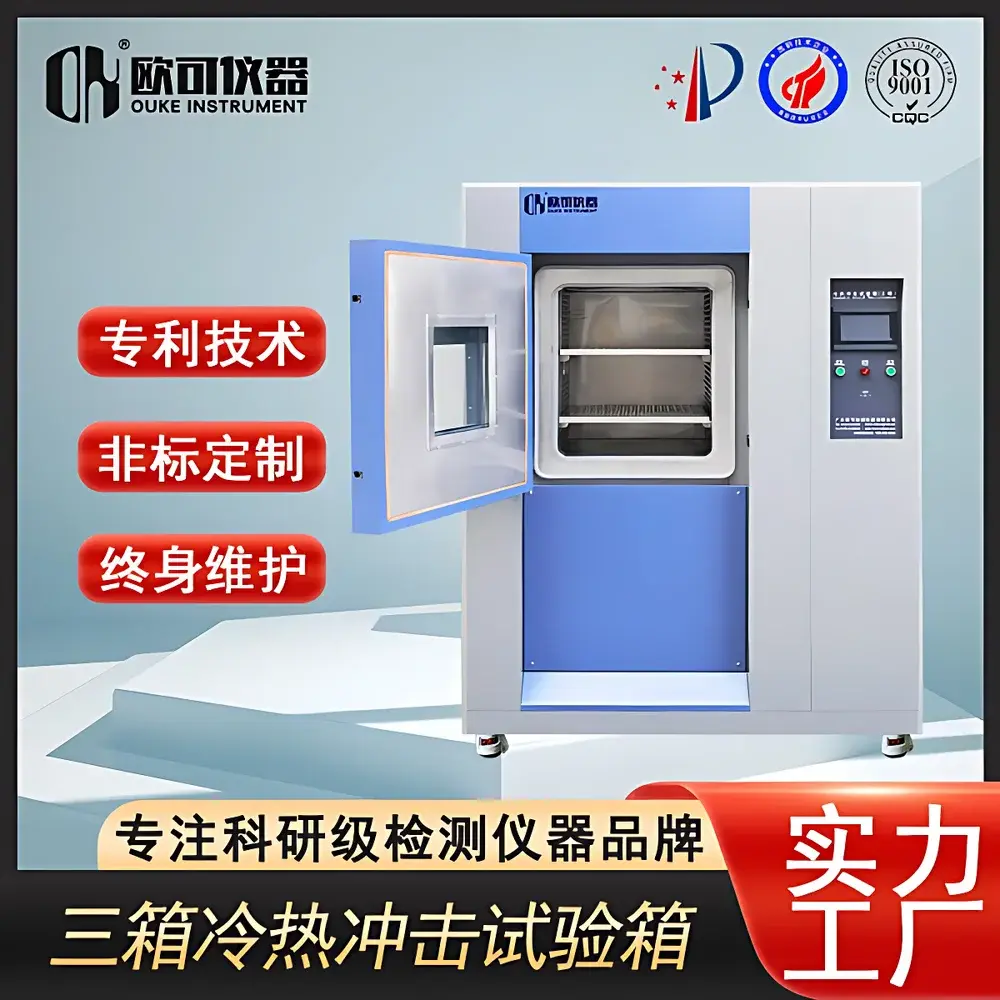
The OK Instruments OK-TS-49.00 Thermal Shock Test Chamber is an engineered environmental test system designed to evaluate material and component reliability under rapid, repetitive transitions between extreme high and low temperature extremes. It operates on the principle of mechanical thermal shock—inducing stress through controlled, high-rate temperature excursions that accelerate failure mechanisms such as interfacial delamination, solder joint fatigue, coating cracking, and coefficient-of-thermal-expansion (CTE) mismatch in electronic assemblies, automotive modules, aerospace composites, and polymer-based enclosures. Unlike steady-state thermal cycling chambers, this unit delivers discrete, high-fidelity shock events with precise dwell time control, enabling compliance-driven validation per MIL-STD-810H Method 503.5, IEC 60068-2-14 (Test N), and JESD22-A104D. The chamber supports both two-zone (hot/cold) and three-zone (hot/cold/test) configurations; the OK-TS-49.00 implements a two-zone design with pneumatic air-flap switching, ensuring specimen immobility during thermal transition—a critical requirement for optical alignment stability and vibration-sensitive DUTs.
Key Features
- Two-zone architecture with independent hot and cold reservoirs: hot zone up to +150 °C, cold zone down to −50 °C
- High-speed thermal transition: ≤10 °C/min heating and cooling rates across full operating range
- Thermal stability maintained at ±2 °C during dwell phases; temperature uniformity within test space: ±2.0 °C
- Dual-stage cascade refrigeration system using environmentally compliant R404A/R23 refrigerant blend, powered by imported semi-hermetic compressors
- Evaporative condenser energy-transfer interface enabling efficient heat rejection between high- and low-temperature loops
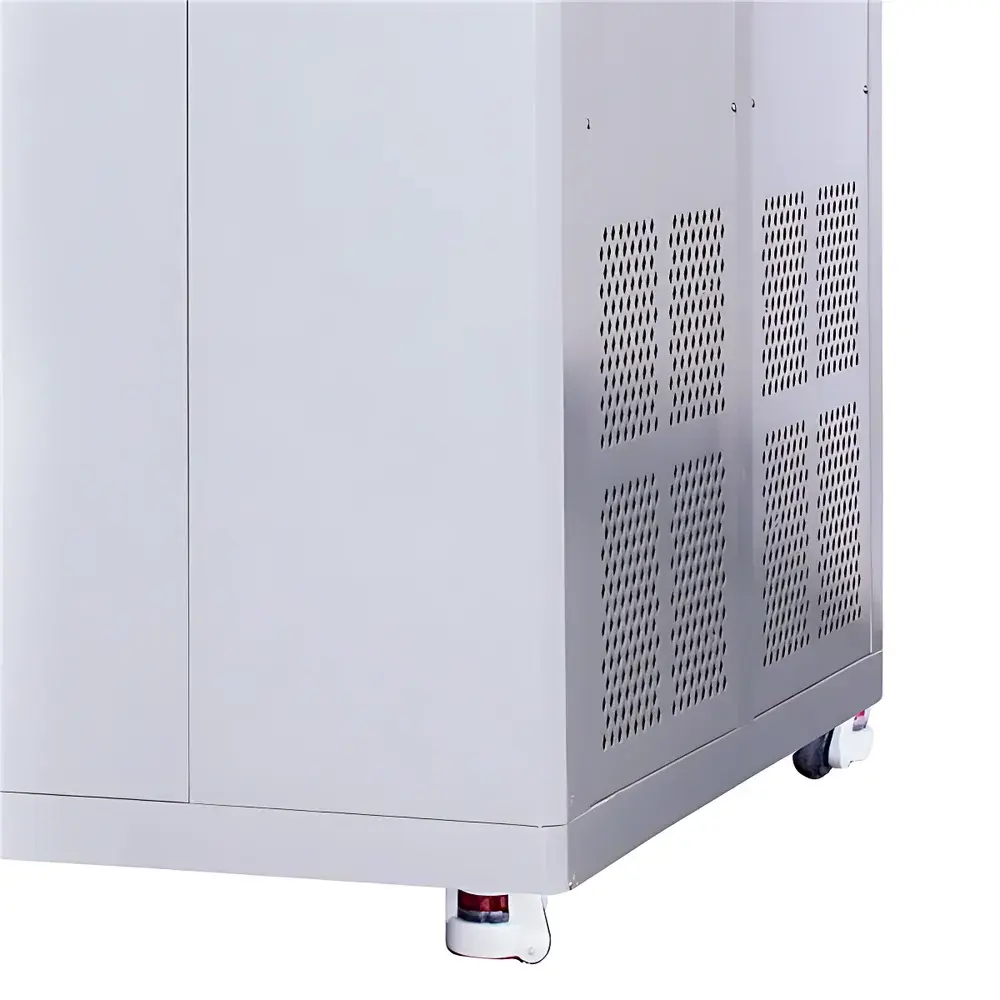
- Stainless steel 304 interior chamber (mirror finish) and exterior housing; high-density fire-retardant PU insulation (≥100 mm thickness)
- Pneumatically actuated stainless steel air flaps for zero-movement specimen exposure—eliminating mechanical stress from basket transfer
- Integrated 50 mm diameter cable port (stainless steel, sealed), dual adjustable 304 stainless steel shelves, and rear-mounted 3-phase 380 V / 50 Hz power inlet (2.5 m cable)
Sample Compatibility & Compliance
The OK-TS-49.00 accommodates specimens up to 40 × 35 × 30 cm (W × H × D) in internal volume, with customizable chamber dimensions available upon request. Its static-test configuration ensures compatibility with optoelectronic sensors, PCBAs with fine-pitch BGAs, MEMS devices, and hermetically sealed packages where positional integrity must be preserved during thermal transients. The system meets or exceeds requirements of GB/T 2423.22–2002 (Temperature Change), GJB 150.5–86 (Temperature Shock), SJ/T 10186–91 (Two-Zone Temperature Change Chambers), and EIA-364-32 (Thermal Shock Testing of Electrical Connectors). It supports GLP-compliant operation when paired with validated data logging and audit trail-enabled controllers—fully traceable per ISO/IEC 17025 documentation protocols.
Software & Data Management
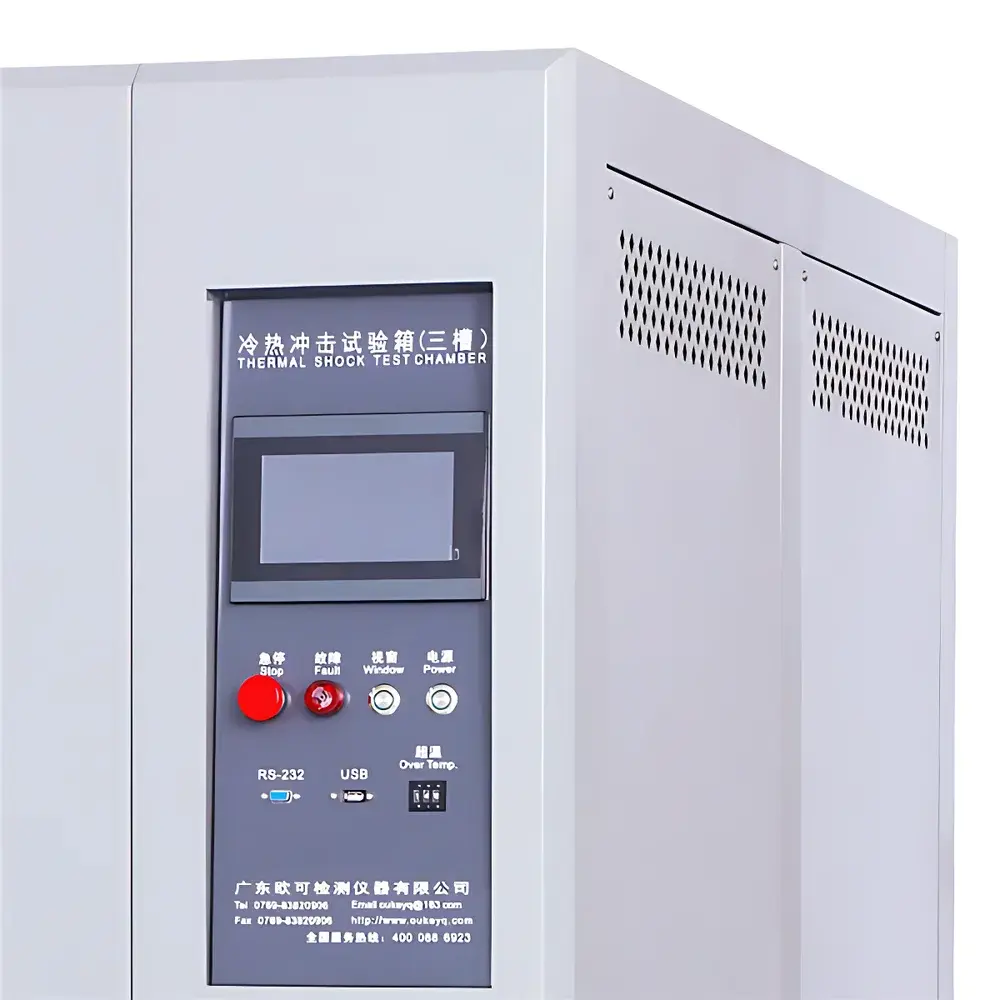
Equipped with a programmable touchscreen controller (Siemens LOGO! or equivalent industrial-grade HMI), the chamber enables user-defined shock profiles—including ramp rate, dwell duration, number of cycles, and sequence logic (e.g., hot→cold→hot, or asymmetric cycling). Real-time temperature monitoring is recorded at ≥1 Hz sampling frequency, with timestamped CSV export via USB or Ethernet. Optional integration with OK Instruments’ LabLink™ software suite provides remote supervision, alarm escalation (email/SMS), electronic signature support, and 21 CFR Part 11–compliant audit trails—including operator ID, parameter changes, and calibration event logs. All firmware adheres to IEC 61508 SIL2 functional safety principles for embedded control systems.
Applications
- Qualification testing of automotive ECUs, ADAS sensors, and battery management systems per QC/T 17–92
- Reliability screening of semiconductor packages (QFN, QFP, CSP) per JESD22-A104D and MIL-STD-750 Method 1071
- Accelerated life testing of conformal coatings, potting compounds, and adhesive bonds in aerospace structural components
- Validation of medical device housings and sterilizable electronics per ISO 13485 environmental stress protocols
- Failure analysis correlation studies linking thermal shock-induced microcracks to subsequent HALT/HASS outcomes
- Material science research on phase-transition behavior in shape-memory alloys and thermally responsive polymers
FAQ
What is the difference between two-zone and three-zone thermal shock chambers?
Two-zone chambers (like the OK-TS-49.00) use separate hot and cold reservoirs with pneumatic or mechanical isolation; the test specimen remains stationary. Three-zone designs add a dedicated test chamber—improving thermal recovery repeatability but increasing footprint and cost.
Does this chamber require external cooling water?
Yes. The cascade refrigeration system requires a dedicated closed-loop cooling tower delivering 10 m³/h of water at ≤32 °C inlet temperature, installed outdoors per manufacturer specifications.
Can the controller log data to a network server?
Yes—via optional Ethernet module supporting Modbus TCP and FTP upload; compatible with SCADA and LIMS platforms.
Is calibration certification included with shipment?
A factory-as-built temperature mapping report (per ASTM E74) is provided. UKAS or ISO/IEC 17025-accredited field calibration is available as an add-on service.
What maintenance intervals are recommended for the refrigeration system?
Compressor oil and filter replacement every 24 months; annual leak check and refrigerant charge verification; quarterly inspection of air flap seals and door gasket integrity.



