
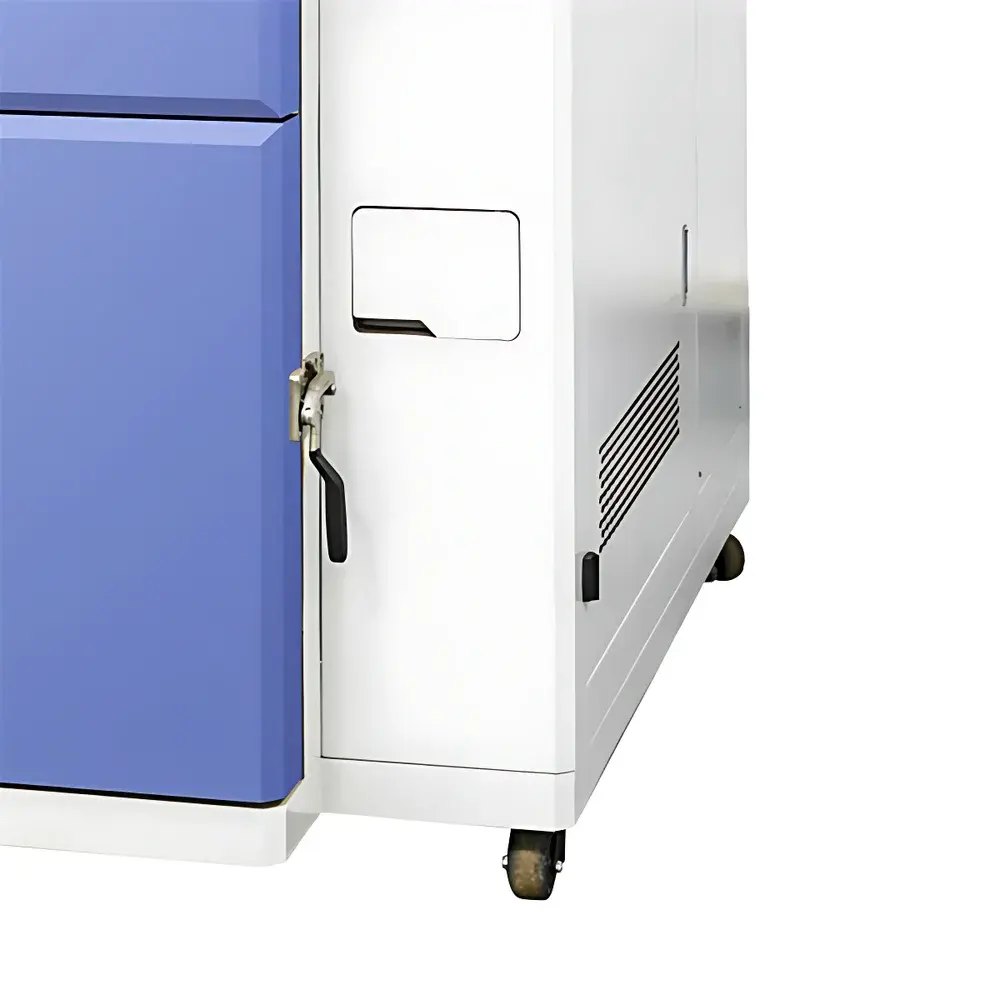
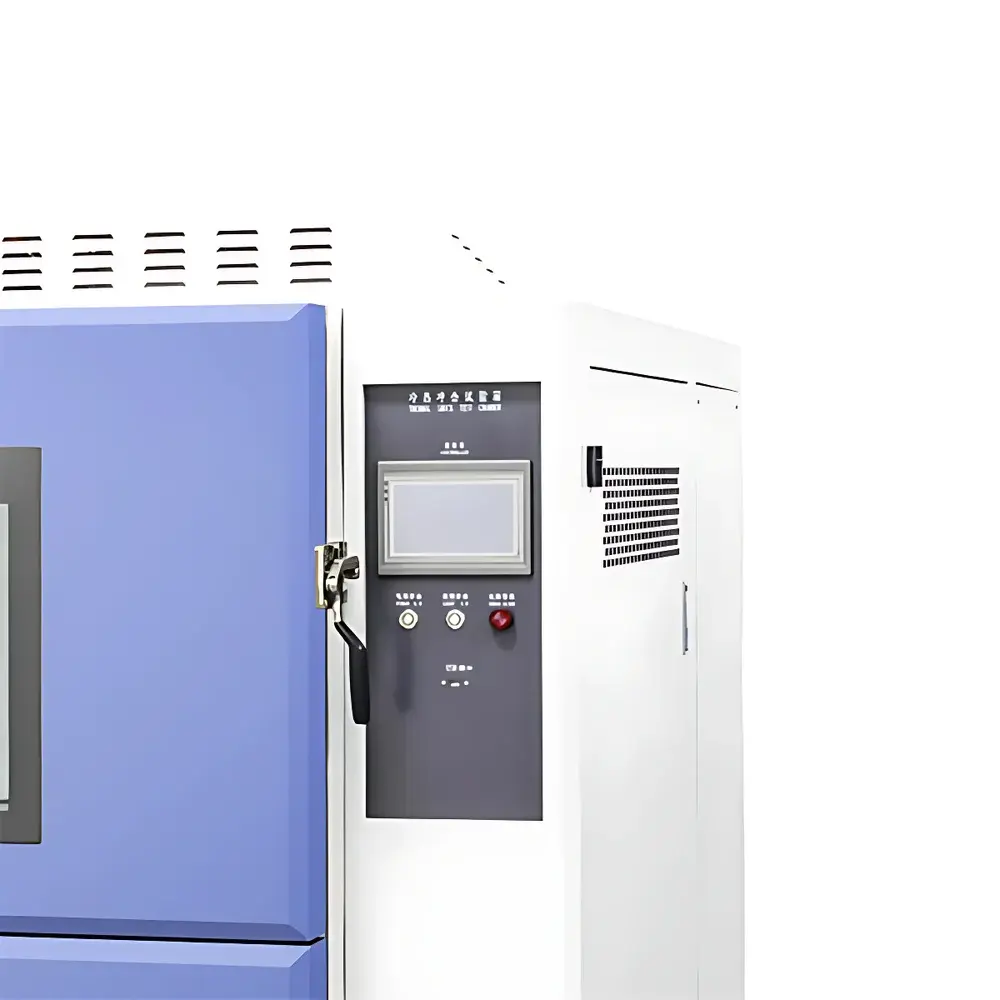
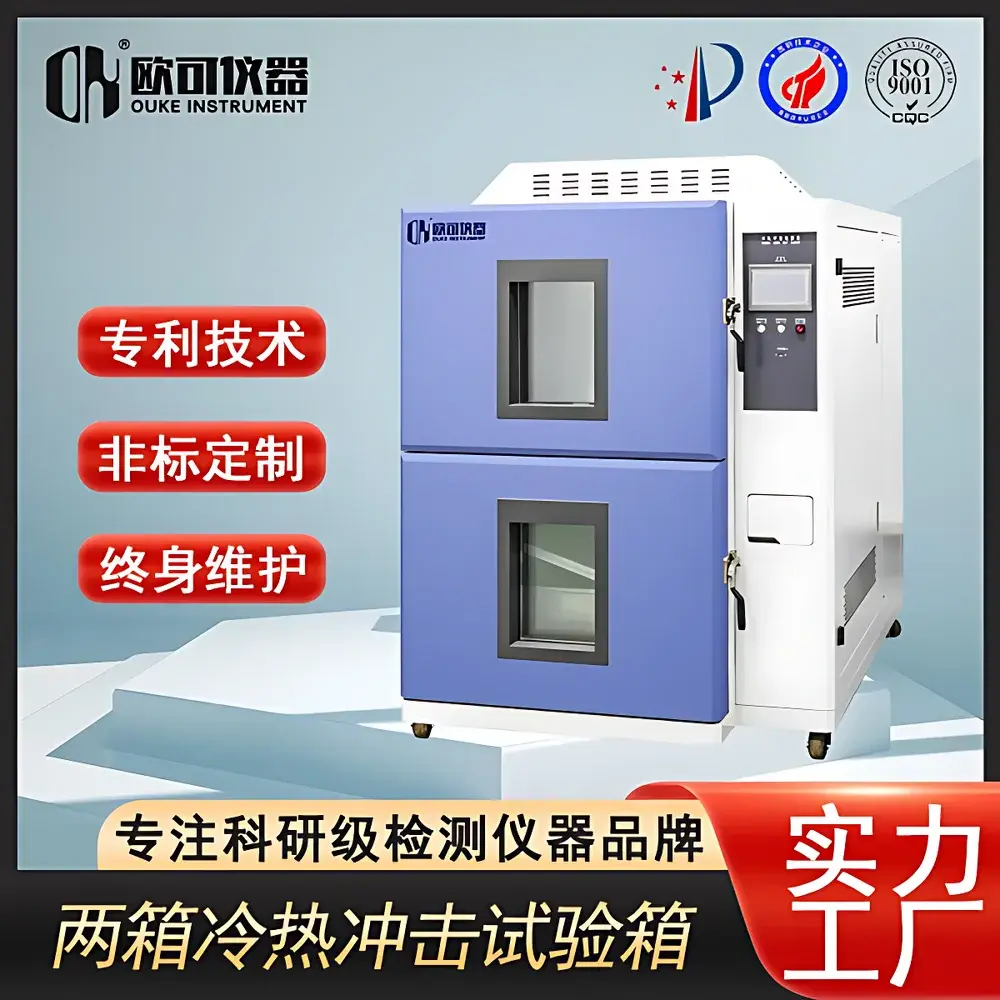
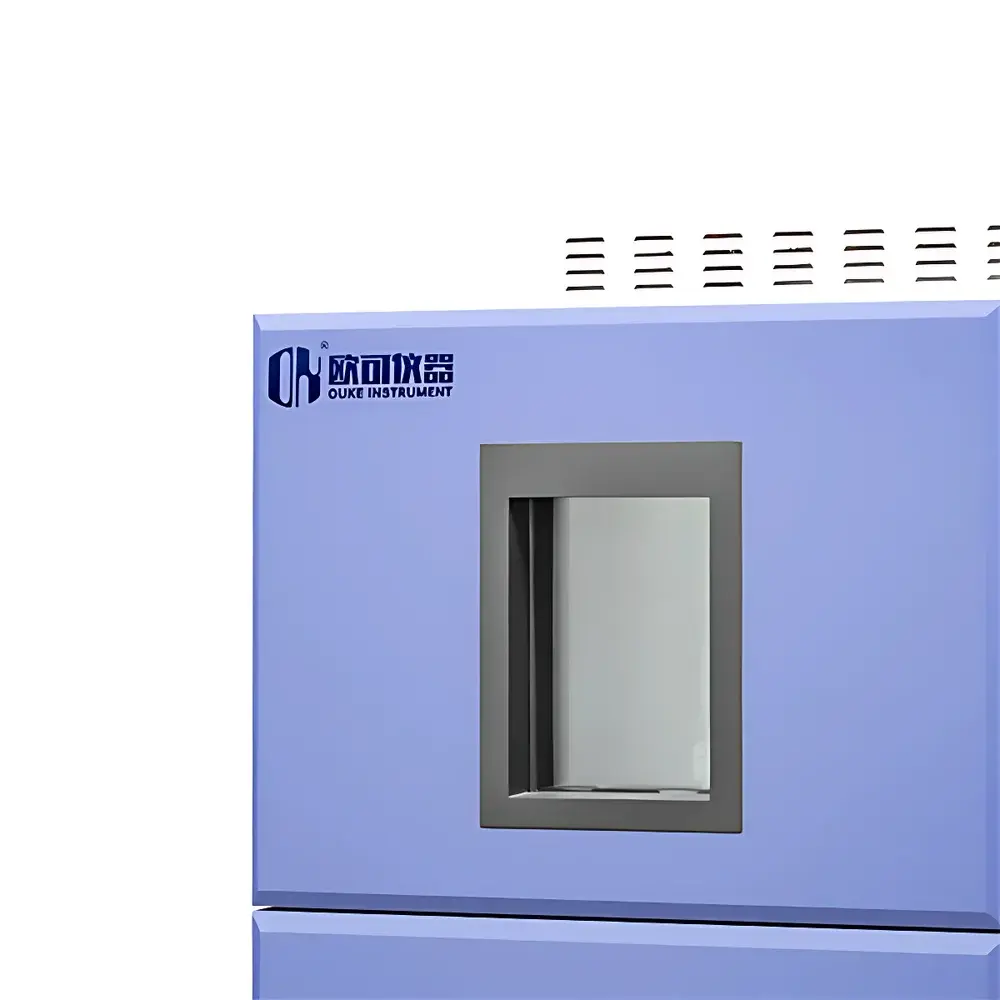
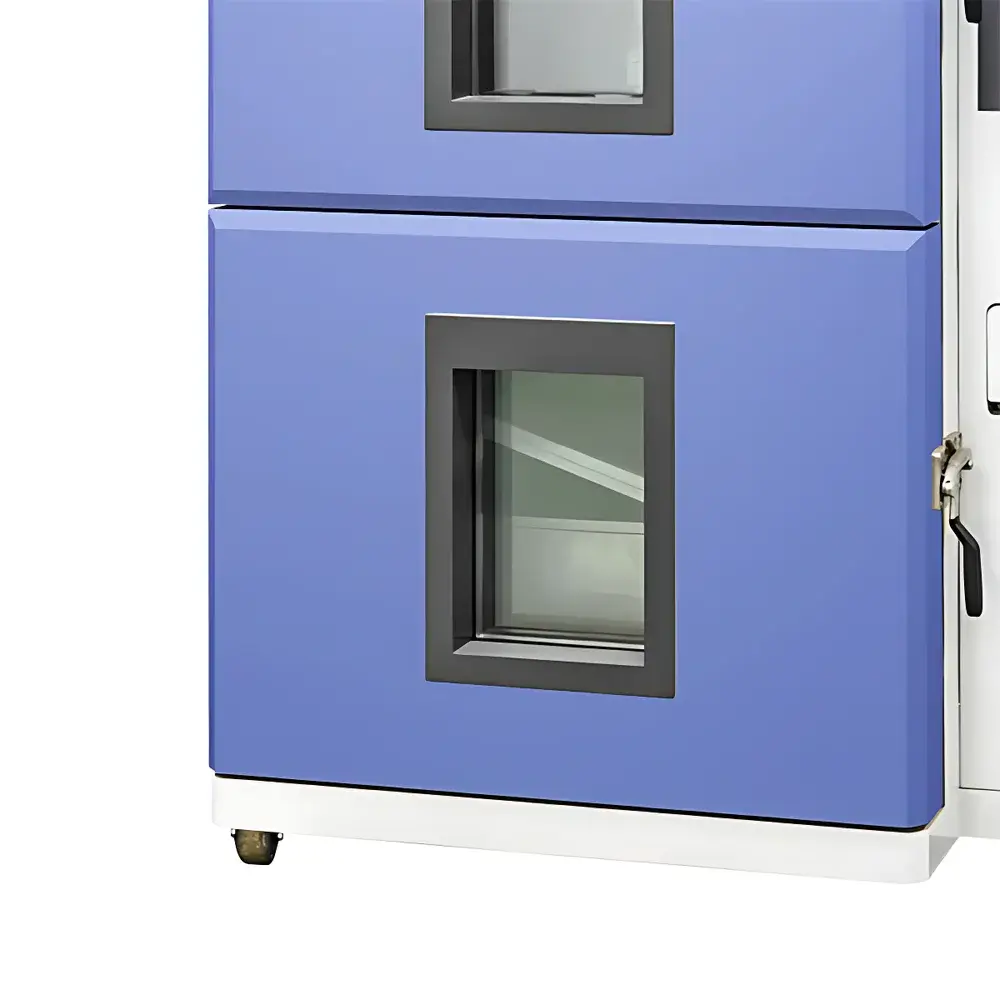
OK Instruments OK-TS-80 Thermal Shock Test Chamber
| Brand | OK Instruments |
|---|---|
| Origin | Guangdong, China |
| Manufacturer Type | Direct Manufacturer |
| Model | OK-TS-80 |
| High Temperature Range | +150 °C |
| Low Temperature Range | −50 °C |
| Thermal Shock Range | −50 °C to +150 °C |
| Temperature Stability | ±2 °C |
| Heating Rate | 10 °C/min |
| Cooling Rate | 10 °C/min |
| Internal Dimensions (W×H×D) | 50×40×40 cm |
| External Dimensions (W×H×D) | 150×185×145 cm |
| Hot Zone Storage Range | RT to +200 °C |
| Cold Zone Storage Range | RT to −70 °C |
| Test Zone Operating Range (Hot Shock) | +60 °C to +150 °C |
| Test Zone Operating Range (Cold Shock) | 0 °C to −55 °C |
| Switching Mechanism | Pneumatic Air Damper |
| Preheating Time (RT → +150 °C) | ~30 min |
| Precooling Time (RT → −70 °C) | ~85 min |
| Recovery Time | <5 min |
| Temperature Control Accuracy | ±0.5 °C |
| Temperature Uniformity | ±2.0 °C |
| Refrigeration System | Dual-stage cascade with semi-hermetic compressors (R404A/R23) |
| Inner Chamber Material | SUS#304 mirror-finish stainless steel |
| Outer Chamber Material | SUS#304 stainless steel or powder-coated steel |
| Insulation | High-density fire-retardant PU foam |
| Power Supply | AC 380 V ±5%, 50 Hz ±0.5 Hz, 3-phase 5-wire |
| Standard Accessories | One φ50 mm cable port, two-tier stainless steel shelves |
Overview
The OK Instruments OK-TS-80 Thermal Shock Test Chamber is an engineered solution for accelerated reliability evaluation of electronic components, automotive modules, aerospace assemblies, and polymer-based materials under rapid, extreme temperature transitions. Based on the two-box (hot/cold reservoir) pneumatic damper architecture, it subjects stationary test specimens to controlled, high-rate thermal cycling between independently stabilized temperature zones—enabling precise execution of standardized thermal shock protocols per IEC 60068-2-14 (Test N), MIL-STD-810H Method 503.6, and GJB 150.5A–2009. Unlike single-chamber systems relying on forced-air reversal, this dual-zone design eliminates thermal inertia limitations, delivering reproducible ramp rates of up to 10 °C/min across the full operational span of −50 °C to +150 °C. The chamber employs a two-stage cascade refrigeration system with semi-hermetic compressors and environmentally compliant refrigerants (R404A/R23), ensuring stable cold zone storage down to −70 °C and hot zone retention up to +200 °C—critical for achieving low recovery times (<5 min) and minimizing dwell-induced thermal gradients.
Key Features
- Dual independent thermal reservoirs: Hot zone (RT to +200 °C) and cold zone (RT to −70 °C), each equipped with dedicated heating/cooling circuits and PID-controlled immersion heaters or evaporator banks
- Pneumatically actuated stainless-steel air dampers for rapid, repeatable transfer of specimen exposure between zones—no mechanical movement of samples required
- High-efficiency insulation using imported fire-retardant polyurethane (PU) foam with ≥150 mm thickness in critical walls, minimizing heat leakage and energy consumption
- Temperature control accuracy of ±0.5 °C and uniformity of ±2.0 °C across the 50×40×40 cm test volume, verified per ASTM E741 and ISO 16750-4 Annex C
- Integrated energy modulation logic that dynamically adjusts compressor load and heater duty cycle to maintain setpoint stability without overcooling or overshoot
- Robust construction: Mirror-finish SUS#304 stainless steel interior and corrosion-resistant exterior (stainless or powder-coated steel)
- Standard configuration includes one φ50 mm cable port with silicone gasket and two adjustable stainless steel shelves—designed for compatibility with DUT fixtures and thermocouple routing
Sample Compatibility & Compliance
The OK-TS-80 accommodates a wide range of sample geometries and mounting configurations—including PCB assemblies, IC packages, battery cells, sensor housings, and molded plastic enclosures—within its 80 L test volume. Its static-test architecture eliminates vibration or positional artifacts associated with moving-basket designs, making it suitable for fragile or calibration-sensitive devices. The chamber complies with key international and defense standards including: IEC 60068-2-14 (Test N), ISO 16750-4:2018 (Road vehicles – Environmental conditions), MIL-STD-810H Method 503.6 (Temperature Shock), GJB 150.5A–2009 (Military standard for environmental engineering considerations), QC/T 17–1992 (Automotive component weathering), and EIA-364-32 (Thermal shock testing of electrical connectors). All temperature profiles are traceable to NIST-calibrated reference sensors, and system validation reports support GLP/GMP audit readiness.
Software & Data Management
Equipped with a programmable touchscreen controller (Siemens LOGO! or equivalent industrial-grade HMI), the OK-TS-80 supports user-defined thermal shock sequences—including step, ramp, soak, and multi-cycle profiles—with up to 99 segments per program. Real-time data logging records chamber temperatures (hot zone, cold zone, test zone), damper status, compressor run time, and alarm events at configurable intervals (1–60 s). Exportable CSV files enable post-test statistical analysis of thermal transition fidelity and recovery behavior. Optional Ethernet or RS485 interfaces allow integration into centralized lab management systems (LIMS) and support remote monitoring via Modbus TCP. For regulated environments, optional 21 CFR Part 11-compliant software add-ons provide electronic signatures, audit trails, and role-based access control—fully aligned with FDA and ISO 13485 quality system requirements.
Applications
- Qualification testing of avionics hardware per DO-160 Section 4 (Temperature Variation)
- Failure mode analysis of solder joints and underfill materials in high-density packaging
- Validation of thermal interface material (TIM) performance under cyclic stress
- Reliability screening of Li-ion battery modules prior to automotive qualification (UN 38.3, ISO 12405)
- Material compatibility assessment for optical coatings, adhesives, and elastomeric seals
- Pre-compliance screening for consumer electronics per JEDEC JESD22-A106B (Thermal Shock)
- Accelerated aging studies of encapsulated MEMS devices exposed to ambient extremes
FAQ
What cooling infrastructure is required for operation?
The OK-TS-80 requires an external water-cooled condenser system. A circulating cooling tower with ≥10 m³/h flow capacity must be provided by the user and installed outdoors. Water inlet temperature must remain ≤32 °C for rated performance.
Can the chamber operate continuously at −50 °C or +150 °C without cycling?
Yes—the hot and cold reservoirs are independently stabilized; the chamber supports static high-temperature soak (up to +200 °C) and static low-temperature soak (down to −70 °C) modes outside of shock sequences.
Is custom internal dimensioning available?
Yes. OK Instruments offers engineering consultation and bespoke chamber builds (OK-TS-49 through OK-TS-225 series) with tailored internal volumes, port layouts, and mounting provisions.
How is temperature uniformity validated?
Uniformity is verified using nine calibrated PT100 sensors placed per ISO 16750-4 Annex C grid layout; reports include min/max deviation, standard deviation, and spatial gradient mapping.
Does the system support automated pass/fail criteria based on thermal profile deviation?
Standard firmware logs deviations but does not execute real-time pass/fail logic. This functionality is available via optional PC-based control software with configurable tolerance bands and event-triggered notifications.



